Poecilia latipinna
Sailfin Molly
Formerly Mollienesia latipinna Lesueur, 1821
Last revised 2026Edit this page
On this page12 sections
Quick factsEdit
Difficulty4 of 8 measures
- Space
- medium tank
- Water
- flexible
- Temp
- flexible
- Diet
- unknown
- Temperament
- fights its own kind
- Social
- unknown
- Compatibility
- unknown
Other demands
Each of these can raise the rating on its own, whatever the measures above say.
- Hardiness
- unknown
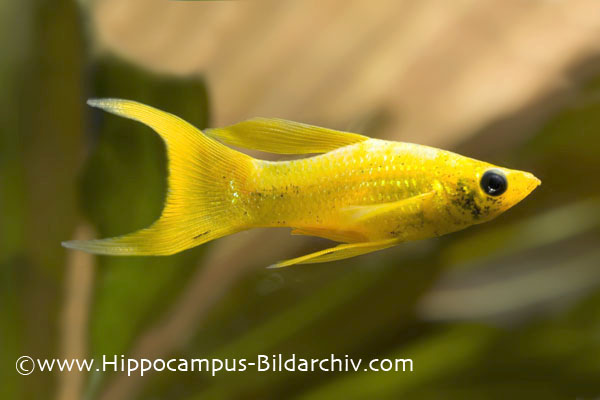
The sailfin molly, Poecilia latipinna, is a livebearer native to southern North America and Mexico, from Carolina to Veracruz. Bred into many colour morphs and crossed with P. sphenops, it can live perfectly well in fresh water provided it is not soft or acidic. Dark rectangular spots in the dorsal fin separate it from the similar P. velifera, and introduced populations in many countries often outcompete native species.
Etymology
EditPoecilia: from the Greek poikilo, meaning ‘variable, variegated’.
latipinna: from the Latin latus (wide, broad) and pinna (fin).
Distribution
EditNative to Southern North America and Mexico, from Carolina to Veracruz. Introduced populations have also become established in numerous countries as far ranging as Kenya and New Zealand. Wild fish are rare in the hobby these days, with the vast majority of the ones on sale being mass-produced in the Far East and Eastern Europe.
Habitat
Write a noteEditTypically found in heavily vegetated coastal streams, ponds, swamps, canals and ditches. It's particularly associated with brackish habitats where algae and other phytoplankton is present in large quantities.
Aquarium size
Write a noteEdit76 ∗ 38 ∗ 30 cm30 ∗ 15 ∗ 12 in
Maintenance
Write a noteEditA densely planted aquarium with some open space for swimming. It should be noted that these are highly vegetarian fish so any soft-leaved plants may be destroyed. Allowing some common green algae will provide additional food for the fish.
This species must be maintained in moderately hard or harder water, with a basic pH. When kept in soft or acidic water, the fish weakens fairly rapidly, frequently indicated by shimmying, fungus, and/or clamped fins. Salt is not necessary, as it is the "hard" minerals (calcium, magnesium) that are crucial to the long-term health of this species.
Water conditions
EditTemperature: 70ºF to 79ºF (21-26°C)
pH: 7.0-8.5
Hardness: 15-35 dH
These recommendations come from this profile’s own figures. They contain affiliate links, so we may earn a commission.
Diet
Write a noteEditWild fish are almost exclusively herbivorous, feeding on algae and other plant material. Today's tank-bred fish are far-removed from their ancestors and will accept most foods offered but some vegetable matter such as blanched spinach or vegetable flake should be included in the diet. If insufficient greenstuff is provided male dorsal fin development may be impaired.
Behaviour and compatibility
Write a noteEditGenerally suitable for a hard water community although may pick on smaller fish as it matures. Males can be aggressive to one another, particularly when spawning. Suggested tankmates include other livebearers, some catfish.
Sexual dimorphism
Write a noteEditMales possess a gonopodium and a large, long, sail-like dorsal fin.
Reproduction
Write a noteEditEasy. It is recommended to maintain this species in trios of 2 females to a single male as males can be quite vigorous in their pursuit of mates. Reproduces in the usual livebearer fashion. Gestation is a little longer than in some species taking around 2 months, after which up to 50 young may be produced. These are relatively large and will accept brine shrimp nauplii, micoworm or powdered flake from birth. The breeding tank should be heavily planted if the fry are to survive predation by the parents and other fish. The best method is to remove gravid females to a separate tank until they give birth. Interestingly wild-type fish are much less likely to eat their offspring than the domestic forms.
Notes
EditThe wild fish can exhibit several different types of patterning. P. latipinna has been selectively bred into many different colour morphs for the aquarium trade, and has also been crossbred with other molly species, particularly P. sphenops. They will also interbreed readily in the aquarium and in order to avoid this we suggest keeping only one species of molly per tank. There also exists a (in our opinion) grotesque 'balloon' variety of this fish in which the body is malformed and rounded, giving a balloon-like appearance. This condition can cause swimbladder and digestive problems and may bring about premature death. The wild fish can also exhibit several different types of patterning although it is rarely seen for sale.
This species is often referred to as a brackish species but can live perfectly well in freshwater provided it is not soft and/or acidic.
P. latipinna may be distinguished from the similar P. velifera by the presence of dark rectangular spots in the dorsal fin. In P. velifera these are lighter-coloured and round.
This is another of the livebearer species to have been introduced in many countries where it often outcompetes native species and upsets the ecological balance.
Species images · 6


These photographs are used with each photographer's permission.
Send a photograph