Genus
Acrossocheilus
- Species
- 5
- Photographed
- 5 of 5
- Difficulty rated
- 5 of 5
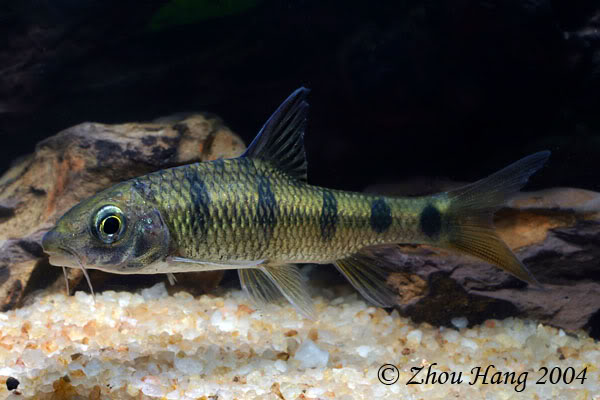
Acrossocheilus beijiangensis
Wu & Lin, 1977
Recorded from Fujian, Guangdong, and Guangxi provinces in southwestern China, plus the islands of Hainan and Hong Kong. Type locality is 'Lian-Xian and Yang-Shan, Guangdong, China', corresponding to the Bei River drainage.
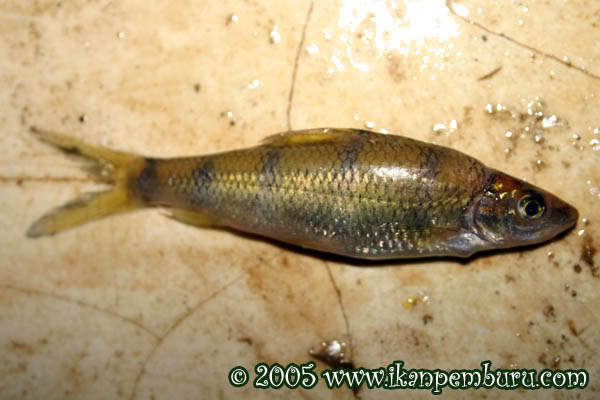
Acrossocheilus iridescens
Nichols & Pope, 1927
A. iridescens and its closest relative A. longipinnis can be distinguished from all other barred species of Acrossocheilus by the following characters: wider (vs. narrower) black vertical bars on the flank in adults, each five to eight (vs. no more than four) scales in width; a horse-shoe shaped (vs. arched) mouth gape; rostral barbel located posteriorly (vs. anteriorly) to a horizontal line through the anteriormost margin of the lower jaw; two postlabial grooves extending anteromedially beyond (vs. away from) a horizontal line through the roots of the rostral barbels.
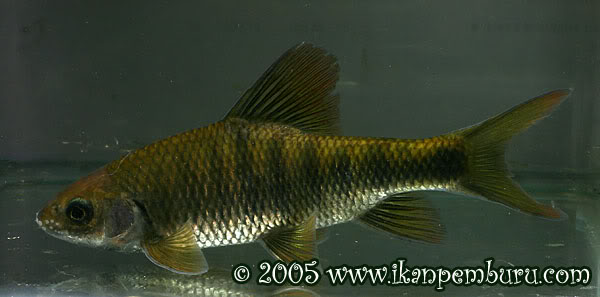
Acrossocheilus monticola
Günther, 1888
Apparently endemic to the upper Yangtze River basin, China. Type locality is 'mountain-stream fiowing into the Ichang gorge of the Yangtsze River'.
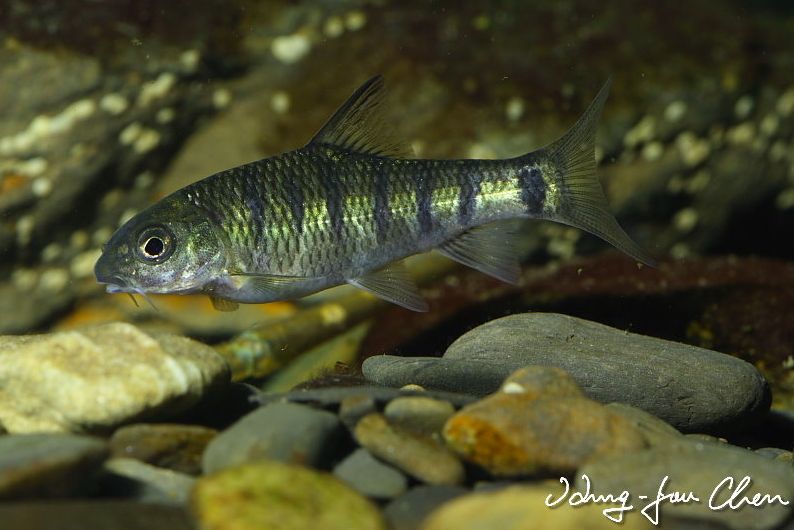
Acrossocheilus paradoxusTaiwan Banded Barb
Günther, 1868
The genus Acrossocheilus is restricted to southern China, northern Vietnam and northern Laos. It can be distinguished from related genera by the following combination of characters: rostral fold present; lips fleshy and continuous around corners of mouth; lower lip with a median interruption; mouth inferior; horny sheath on lower jaw; two pairs of barbels; last simple ray of dorsal fin osseous with a serrated or smooth posterior margin.
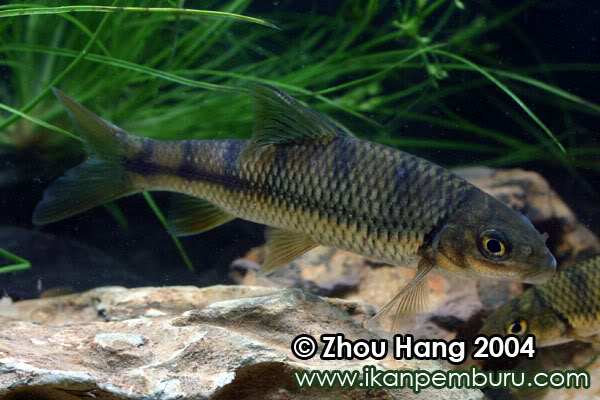
Acrossocheilus parallens
Nichols, 1931
Members of the genus are characterised by possessing a particular number of dark vertical bar on each flank, and A. parallens belongs to a group of species with five or six such bars, each of which is two scales in width. Congeners sharing this pattern include A. fasciatus, A. hemispinus (in juveniles only), A. jishouensis, A. kreyenbergii, A. paradoxus, A. spinifer, A. wenchowensis, and A. wuyiensis.