Genus
Dawkinsia
- Species
- 7
- Photographed
- 7 of 7
- Difficulty rated
- 7 of 7
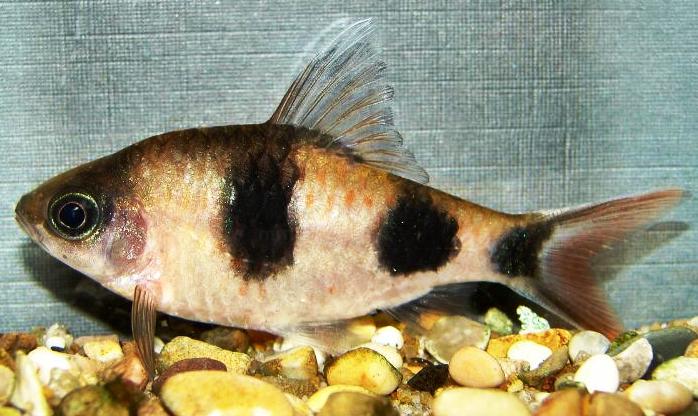
Dawkinsia arulius
Jerdon, 1849
The fish appearing in the majority of earlier literature as P. arulius or 'arulius barb', and often still traded as such, is the related D. tambraparniei. Though similar the latter can be told apart from D. arulius by possession of filamentous extensions to the dorsal-fin rays in males, longer maxillary barbels measuring > ½ eye diameter, i.e., 2.4 - 4.7 % SL, and some aspects of colour pattern.
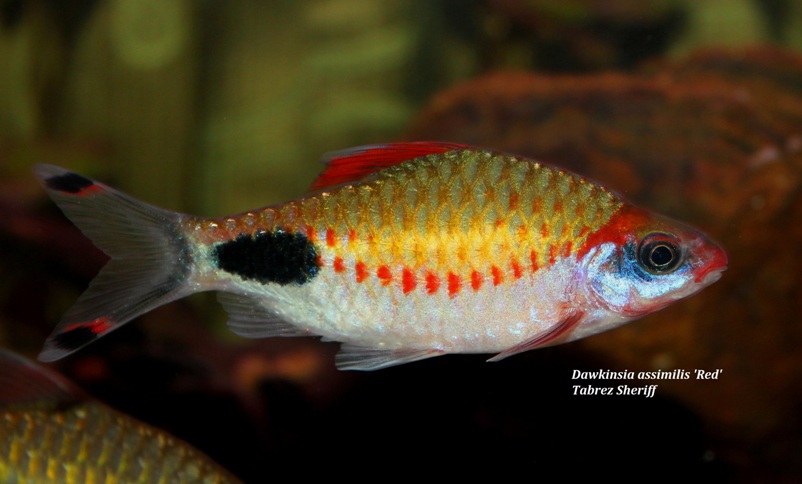
Dawkinsia assimilisMascara Barb
Jerdon, 1849
D. assimilis has been misidentified as Puntius mahecola (Valenciennes 1844) in the past but the identity of both species was resolved by Pethioyagoda and Kottelat (2005 a, 2005b). They inspected the syntypes of P. mahecola and concluded that though valid it isn't closely related to any Dawkinsia (then the Puntius filamentosus group) but is rather a smaller, silvery fish with a single dark blotch on the caudal peduncle, located entirely posterior to the anal-fin. It's wi....
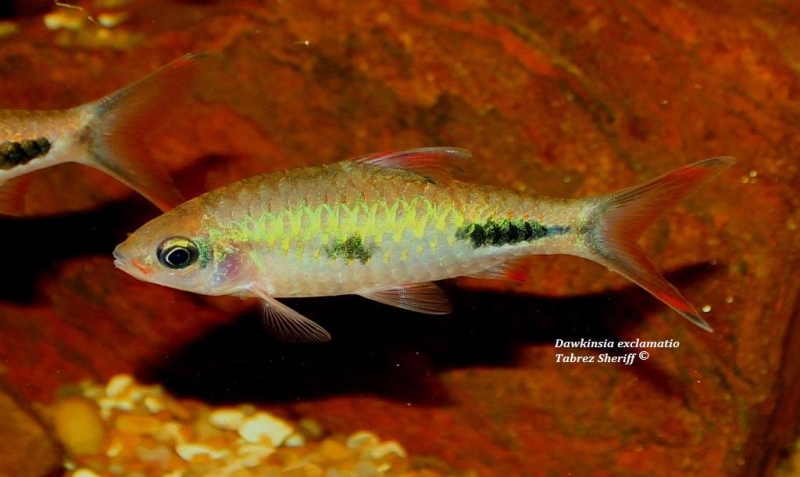
Dawkinsia exclamatio
Pethiyagoda & Kottelat, 2005
There is a case, however, to suggest that D. exclamatio is not actually a distinct taxon but rather a natural hybrid between D. assimilis and a D. arulius-like fish (possibly D. rubrotinctus) which occur together at its type locality in the Kallada River at Thenmalai. The potential of hybridisation is evidenced by the somewhat intermediate colour pattern in that it possesses a (roughly) W-shaped mid-lateral blot...
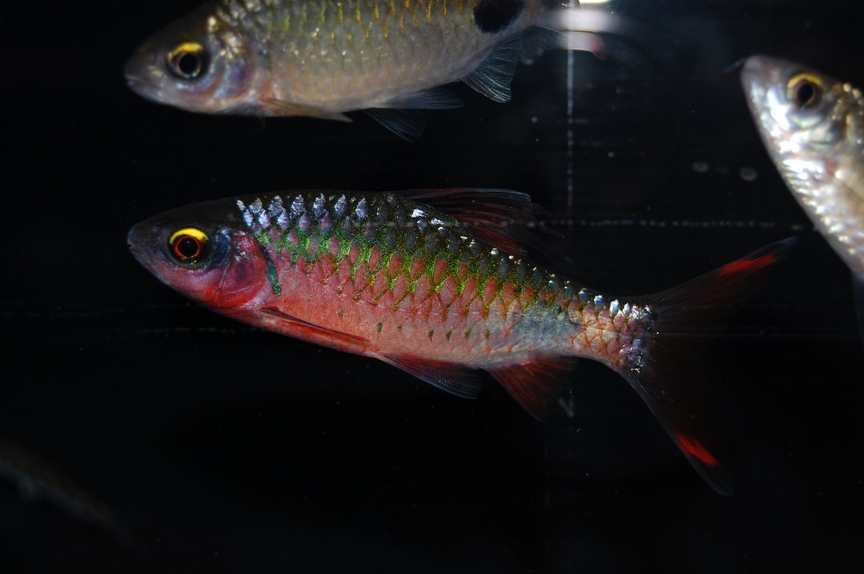
Dawkinsia filamentosaFilament Barb
Valenciennes, 1844
Not difficult to keep in a well-maintained set-up, though we recommend aquascaping the tank to resemble a flowing stream/river with a substrate of variably-sized, water-worn rocks, sand, fine gravel and perhaps some small boulders. This can be further furnished with driftwood roots or branches, and while the majority of aquatic plants will fail to thrive in such surroundings hardy types such as Microsorum, Bolbitis or Anubias spp. can be grown attached to the décor.
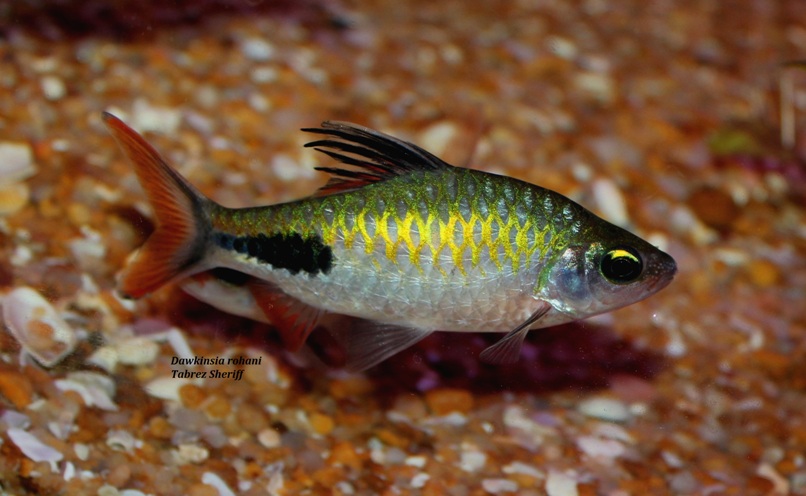
Dawkinsia rohani
Rema Devi, Indra & Knight, 2010
Known only from Kanyakumari District, Tamil Nadu state, at the southern tip of the Indian peninsula. Type locality is the Kodayar River drainage and it's also been collected in the Paralayar and Pamburivaikal river systems. No precise data is available but it's certainly a pelagic, riverine species with habitats likely to vary depending on locality and time o...
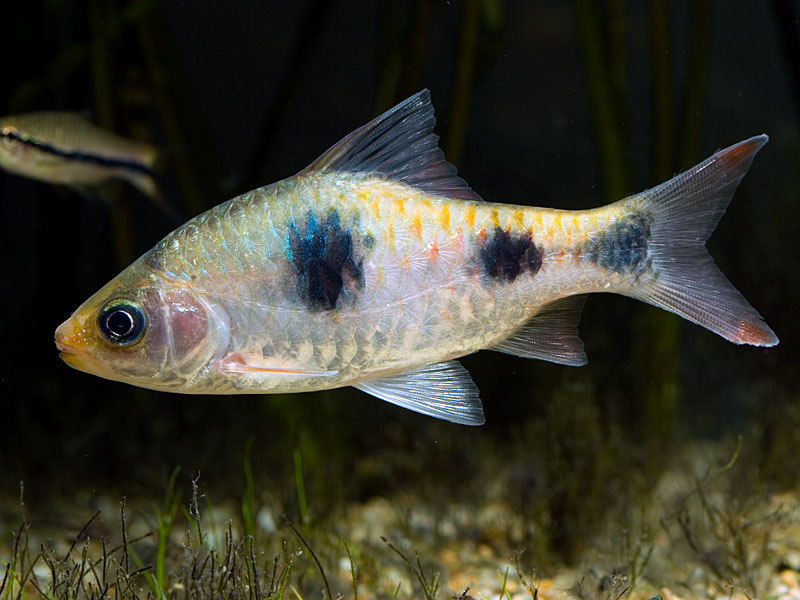
Dawkinsia rubrotinctus
Jerdon, 1849
This species may have appeared in the aquarium trade under the misapplied names Puntius arulius or P. tambraparniei in the past, both of which are also now classified within Dawkinsia. See the relevant profiles for D. arulius and D. tambraparniei for additional information regarding that confusion, since here we concentrate on D. rubrotinctus. It was initially described by Jerdon in 1849 but placed in synonymy with P. arulius by Day (1878), where it remained for ov...
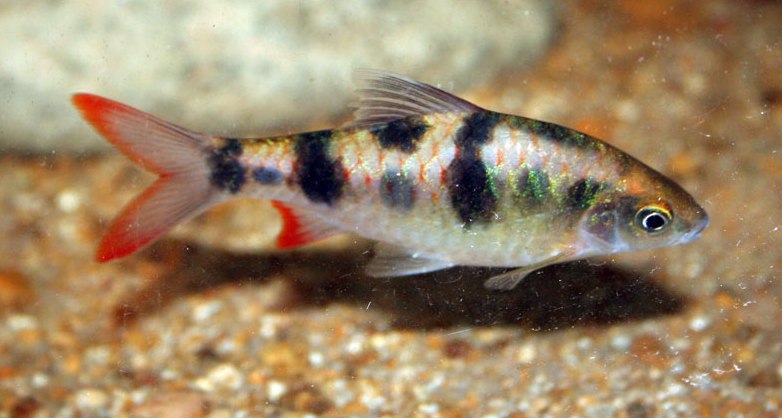
Dawkinsia tambraparniei'Arulius' Barb
Silas, 1954
D. exclamatio should also have a sub-terminal mouth and lack dorsal-fin filaments but some specimens possess a terminal mouth and/or possess dorsal filaments, and one specimen also had black caudal-fin tips as typically seen in D. filamentosa, whereas the description states that the fin tips are only dusky and lack distinctive markings.