Genus
Hypancistrus
- Species
- 6
- Photographed
- 6 of 6
- Difficulty rated
- 6 of 6
Where the name comes fromEdit
from the Greek ὑπό (hypó), meaning 'below, beneath, under', and the generic name Ancistrus, in reference to the reduced dentition compared with the latter.
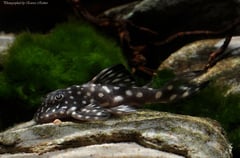
Hypancistrus inspectorL102
Armbruster, 2002
The snowball pleco (L102), Hypancistrus inspector, is a suckermouth catfish from the upper rio Negro in Brazil and the Casiquiare in Venezuela. Brown to black with large whitish to yellow spots, it is most similar to H. contradens. It is normally collected from rocky rapids, is a cave-spawner with male brood care, and should not be kept with other Hypancistrus in order to prevent hybridisation.
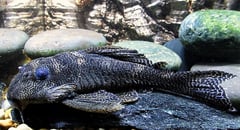
Hypancistrus seideliL066
Sousa, Sousa, Oliveira, Sabaj, Zuanon & Rapp Py-Daniel, 2025
The king tiger plec, Hypancistrus seideli, is a suckermouth catfish from the lower rio Xingu in Pará state, northern Brazil. Described by Sousa et al. in 2025, it is traded as L066 and L333 and also as 'network pleco' and 'scribbled pleco'. Its colour pattern is highly variable and it is regularly confused with L400. It inhabits turbulent whitewater rapids, much of which is likely to be severely degraded by the Belo Monte dam.
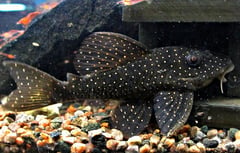
Hypancistrus sp.L004
authority not recorded
L004, the angelicus pleco, is an undescribed Hypancistrus from tributaries of the lower Amazon near its mouth in Pará state, northern Brazil. It is sometimes traded under the false name 'Peckoltia angelicus', and the codes L004, L005, L028 and L073 represent distinct populations from the Tocantins, Guamá and Pará rivers. Peaceful but territorial towards its own kind, it has been bred in aquaria many times.
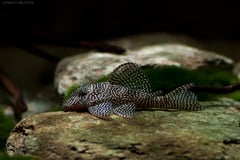
Hypancistrus sp.L260
authority not recorded
L260, the queen arabesque pleco, is an undescribed Hypancistrus known only from the lower rio Tapajós in Pará state, northern Brazil. Among the most popular loricariids in the hobby, it is available on a regular basis. The larger L411 from the rio Jarí looks similar, but in L260 the white vermiculations are significantly finer. The area where it is collected would be largely destroyed should a planned hydroelectric project go ahead.

Hypancistrus sp.L136
authority not recorded
L136 is an undescribed Hypancistrus from the rio Negro basin in Amazonas state, Brazil, collected in particular from the rio Demini. Highly variable in colour pattern, it has been assigned a series of L-numbers as a result. A peaceful cave-spawner with male brood care, it has been bred regularly in aquaria, but should not be kept with other Hypancistrus in order to prevent hybridisation.
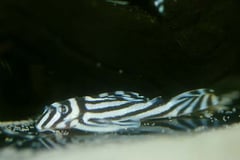
Hypancistrus zebraZebra Plec
Isbrücker and Nijssen, 1991
The zebra plec, Hypancistrus zebra (L046), is a small loricariid catfish from the Rio Xingú basin in Brazil, named for its zebra pattern. Brazil banned its export in 2004 and captive-bred fish are expensive. Shy and easily outcompeted for food, it needs warm water of 26 to 30 °C, high oxygen levels and pristine conditions, and does not suit the general community tank.