Genus
Pseudotropheus
- Species
- 9
- Photographed
- 1 of 9
- Difficulty rated
- 9 of 9
Pseudotropheus demasoni
authority not recorded
This dwarf mbuna is one of the more recent introductions into the hobby, being described only in 1994. It is not recommended for the beginner due to its pugnacious nature, but does make a good aquarium subject for the advanced aquarist. It exhibits some very entertaining behavioural traits, preferring to hug the rock surfaces much more than most mbuna. It will often be seen swimming on its side or upside down as it explores caves and crevices. As with other members of the genus, it possesses fla...
Pseudotropheus elongatusElongate Mbuna
authority not recorded
Over 30 different forms of this species occur in Lake Malawi. These should not be mixed in the aquarium as they will hybridise freely. P. elongatus differs morphologically from other mbuna, being relatively slender and elongate. In nature females protect territories which contain 'gardens' of algae which they leave to breed before returning once they are holding eggs. Juvenile fish from previous spawns also inhabit the territory, protecting it when the female is away. This species i...
Pseudotropheus estheraeRed Zebra
authority not recorded
A deservedly popular mbuna, there is ongoing debate as to the true genus of this species, it having been variously grouped in both Maylandia and Metriaclima, as well as the currently valid Pseudotropheus. It is unlikely it will remain in Pseudotropheus. To add to the confusion, it was only described as a distinct species in 1995, having previously been regarded as a morph of Maylandia zebra. Several colour forms are available and these should not be kept together under any circumstances as they ...
Pseudotropheus fainzilberiGoldbreast Zebra
authority not recorded
There is ongoing debate as to the true genus of this species, it having been variously grouped in both Maylandia and Metriaclima as well as the currently valid Pseudotropheus. It is unlikely it will remain in Pseudotropheus, however. One interesting feature is the presence of additional rows of teeth when compared to others in the genus. Also, the rows of bicuspid teeth, used for rasping algae from rock surfaces, extend further back into the mouth than in other Pseudotropheus. P. fainzilberi...
Pseudotropheus flavus
authority not recorded
Although it is a good choice for the general mbuna community, as mentioned above P. flavus should not be kept together with any member of the P. elongatus complex. Not only will these species interbreed, producing undesirable hybrid offspring, but males of these species will clash very heavily. As with other members of the genus it possesses flat, bicuspid teeth which are designed for scraping algae and other organisms from the surface of rocks....
Pseudotropheus lombardoiKennyi
authority not recorded
A popular mbuna that has been in the hobby for many years. There is ongoing debate as to the true genus of this species, it having been variously grouped in both Maylandia and Metriaclima, as well as the currently valid Pseudotropheus. It is unlikely it will remain in Pseudotropheus, however, and many sources already consider it a member of Metriaclima. As with other members of the genus, it possesses flat, bicuspid teeth which are designed for scraping algae and other organisms from the surface...
Pseudotropheus socolofiPowder Blue Cichlid
authority not recorded
This common mbuna also goes by the names "Eduard's mbuna" and "Pindani". It is one of the most popular Rift Lake cichlids in the hobby due to its striking colouration and somewhat peaceful nature (for a mbuna). Wild fish can now be quite difficult to find, as the vast majority of specimens offered for sale are tank-bred. An albino form exists in aquaria and has achieved a fair degree of popularity. A highly recommended beginner's mbuna....
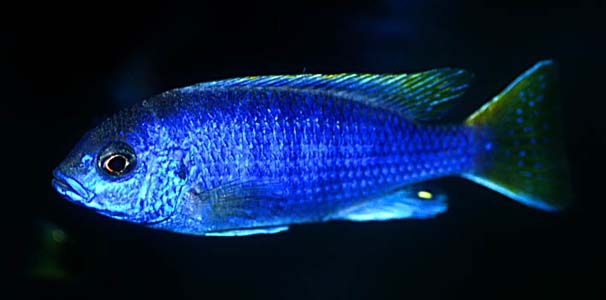
Pseudotropheus sp. 'acei'
authority not recorded
This is an excellent beginner's species as it is relatively peaceful and easily bred. Despite being undescribed to science it is widely available in the hobby. It is sometimes sold as Gephyrochromis acei. Several colour forms are available, including "yellow tail acei" and "white tail acei". None of these should be kept together in aquaria to prevent hybridisation. In nature it feeds specifically on algae and other organisms growing on submerged wood, and is the only ...
Pseudotropheus tropheops tropheops
authority not recorded
This species has a confusing taxonomic past. There are currently 3 subspecies, Pseudotropheus tropheops tropheops, P. t. romandi and P. t. gracilior. P. macrophthalmus and P. microstoma were also once considered as subspecies of tropheops, but are now classed as distinct species. Furthermore, it is likely that the current subspecies and their various colour forms (of which there are many) will be themselves reclassifed into the currently invalid genus Tropheops! Incidentally, none of the subspec...