Genus
Rasbora
- Species
- 19
- Photographed
- 3 of 19
- Difficulty rated
- 19 of 19
Rasbora borapetensisRed-tailed Rasbora
authority not recorded
R. borapetensis is one of the more commonly-encountered rasboras in stores and is particularly recommended for newcomers to the hobby. While it can appear a little plain or 'washed' of colour when seen on sale once settled and in good condition it is an eye-catching little fish that often schools quite closely. It's sometimes sold with the alternative trade names of black-line or magnificent rasbora. R. rubrodorsalis is a very similar-looking congener that occurs sympatrically...
Rasbora caudimaculataGreater Scissortail Rasbora
authority not recorded
This striking species may also be seen on sale with the trade name of 'red scissortail'. It can be distinguished from the similar-looking R. trilineata by the presence of orange/red colouration in the with other diagnostic features including black tips to the caudal lobes, 11-12 predorsal scale rows and a dark reticulated pattern to the edges of the scales. The 'scissortail' moniker is derived from the characteristic twitching motion of the when the fish is at rest. Rainb...
Rasbora cephalotaeniaPorthole Rasbora
authority not recorded
This species is not often exported which is a shame as it makes an elegant, peaceful resident of the larger community tank. It can be easily distinguished from similar-looking congeners such as R. einthovenii and R. jacobsoni by examining the dark lateral stripe that extends lengthways along the body of the fish as in R. cephalotaenia it is composed of a series of dark spots whereas in the other species it forms a continous solid line. Rainboth's 'Fishes of the Cambodian Mekong'...
Rasbora cf. dandia
authority not recorded
This fish may well be a form of R. dandia itself but in the absence of scientific confirmation we list it with a 'cf' abbreviation for the time being. It appears to be widely available in the trade but is often (mis)identified as R. wilpita, a species now confirmed as endemic to a small number of streams in Sri Lanka and which is probably much rarer in the hobby than previously thought. Valenciennes initially described Leuciscus dandia as a new species from Sri Lanka in 1844 but the...
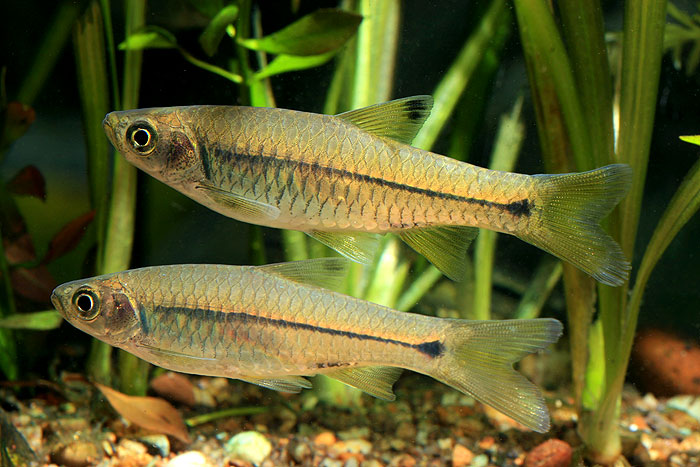
Rasbora dorsinotata
Kottelat, 1987
Type locality is 'Mae Nam Huey Bon, kilometer 45 on road from Amphoe ThaWang Pha to Amphoe Chiang Kham, Chiang Rai Province, Thailand', and this species appears restricted to the Mekong and upper Chao Phraya river basins in northern Thailand and northern Laos. The specimens pictured here were collected from th...
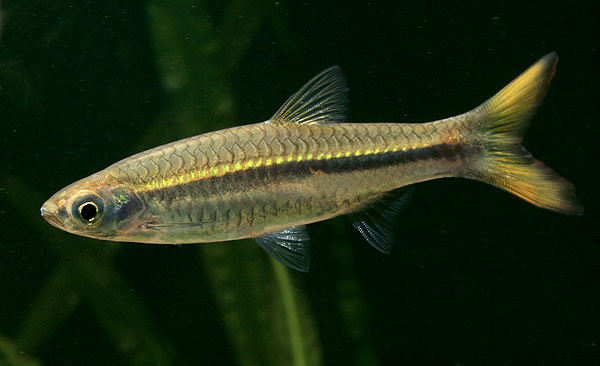
Rasbora dusonensis
Bleeker, 1850
The identity of this species was unclear for a number of decades prior to its redescription by Ng and Kottelat (2013). The confusion originated with Brittan (1954) who misidentified specimens of R. tornieri as R. dusonensis and was exacerbated by Alfred (1963) who concluded that the holotype of R. dusonensis was conspecific with R. myersi.
Rasbora einthoveniiBrilliant Rasbora
authority not recorded
This is one of the more commonly-seen rasboras in the hobby and is ideal for the medium-sized community set-up. It shares some close similarities with R. jacobsoni but can be most easily identified by the fact it lacks dark reticulated scales above the lateral stripe. This stripe also has noticeably more uneven or "crinkly" edges in R. einthovenii than in R. jacobsoni or indeed any other species of laterally-striped Rasbora. A further distinguishing combination of characters for both t...
Rasbora elegansElegant Rasbora
authority not recorded
This species is not especially popular in the hobby and is only infrequently seen on sale. It is clearly distinguishable from similar-looking members of the genus by lacking a dark stripe along the lateral line. Instead it possesses two spot-like markings on each flank, one below theorigin and lateral line and another at the caudal peduncle. The intensity of these can vary depending on the collection locality of the fish and they can be quite faint in some forms. There is also a third, smaller m...
Rasbora kalochromaClown Rasbora
authority not recorded
R. kalochroma exhibits variable patterning across its range according to locality with some forms possessing a line of spot-like markings connecting the two dark blotches on the flanks and others more intense body colouration. Juveniles are sometimes confused with Boraras maculatus and adults with the similarly-patterened R. elegans although the latter is easy to identify by its overall silver, as opposed to pinkish/reddish, colouration. The only congener for which it may be genuinely mistake...
Rasbora kottelati
authority not recorded
It is unclear if this species has been available in the aquatic trade as collections from its native waters only occur sporadically, therefore we have based much of the information here on experience with its closest relative R. kalochroma. These two are almost identical in appearance and share some meristic features but R. kottelati possesses an additional, oval-shaped dark blotch on the caudal peduncle, lacks the stripe in the middle of the seen in R. kalochroma and is consequently easy to dis...
Rasbora lacrimulaRed Cherry Rasbora
authority not recorded
This species is also traded as 'Bornean redfin rasbora', 'sunshine rasbora' and 'dwarf volcano rasbora' and first appeared in the hobby during the latter part of 2010. It can be told apart from all other members of the genus by a combination of the following characters: possession of small tubercules on the dorsal surface, posterior to theand continuing onto the upper part of caudal fin, visible as an irregular 'crest' when a specimen is viewed laterally; ...
Rasbora paucisqualis
authority not recorded
Rainboth's 'Fishes of the Cambodian Mekong' characterised members of Rasbora by possession of an unbranched, non-spiny firstray and seven soft dorsal rays, origin of thein the middle of the body, five branchedrays, a small mouth not extending below the eye and a lack of barbels. It's long been recognised as a polyphyletic lineage as noted by Kottelat (1999) amongst others, and in 2010 the results of a phylogenetic analysis by T. Y. Liao et al. suggested a number of changes in...
Rasbora paviana
authority not recorded
In much of the literature this species is pictured with the invalid name R. paviei, due to an issue with spelling which was corrected by Kottelat (2005), and the common name 'sidestripe rasbora' although the latter has yet to find popularity in the aquarium hobby. There are a number of similar-looking species including R. sumatrana, R. hobelmani and R. laticlavia and it can be problematic to separate members of this 'group'. If the collection locality of the fish is known ide...
Rasbora rasboraGangetic Scissortail Rasbora
authority not recorded
This species is rarely seen in the trade and little has been written regarding its captive care. It's possible that several colour forms may exist depending on collection locality. Rainboth's 'Fishes of the Cambodian Mekong' characterised members of Rasbora by possession of an unbranched, non-spiny firstray and seven soft dorsal rays, origin of thein the middle of the body, five branchedrays, a small mouth not extending below the eye and a lack of barbels. It's long b...
Rasbora rubrodorsalis
authority not recorded
R. rubrodorsalis occurs sympatrically with the very similar-looking R. borapetensis over some of its natural range but is much the rarer of the two in the aquarium hobby. They are easily distinguishable from one another because R. rubrodorsalis has a bright red blotch in thewhilst in R. borapetensis the dorsal is colourless and only the base of the is coloured red. This species is sometimes sold under the erroneous name(s) R. beauforti or R. sp. cf. beauforti, probably because it was picture...
Rasbora sarawakensis
authority not recorded
R. sarawakensis is poorly-documented in the aquarium literature and we're not even sure if it has been exported for the hobby although it may be worth looking out for among shipments of wild fish from southern/western Borneo. We find this a little odd as it is an attractive, very peaceful little fish that would suit many home aquaria and is apparently quite common across its natural range. Rainboth's 'Fishes of the Cambodian Mekong' characterised members of Rasbora by poss...
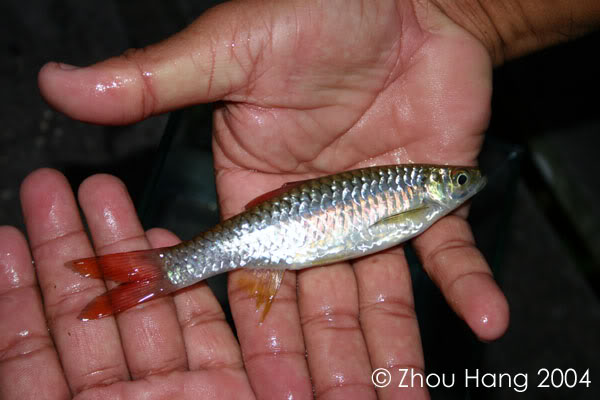
Rasbora tornieri
Ahl, 1922
Type locality is 'Central Sumatra, Indonesia', with additional records existing from Cambodia (Mekong drainage), Peninsular Malaysia (Perak River), Sumatra (from the Siak River, Riau province to the Musi River, South Sumatra (Sumatera Selatan) province) and Borneo (south and westwards from the Belait river basin in Brunei Darussalam to the Sambas drainage in West Kalimantan (Kalimantan Barat) province, Indonesia and probably in Sarawak, Malaysia).
Rasbora trilineataScissortail Rasbora
authority not recorded
This popular species is also known as the 'three-lined' rasbora and provided a large enough tank is available it is an excellent choice for those new to the hobby. The 'scissortail' moniker is derived from the characteristic twitching motion of the when the fish is at rest. It can be distinguished from the similar R. caudimaculata by lacking red colouration in the and from R. spilocerca by its much larger size. Several geographical forms appear to exist as some wild populatio...
Rasbora vulcanus
authority not recorded
This species was described in 1999 and may still occasionally be seen on sale under the incorrect names R. reticulata or R. cf. reticulata as well as the trade name 'volcano rasbora'. The real reticulata is endemic to the small island of Nias which lies off Sumatra's northwestern coast and is virtually inaccessible to fish collectors so is unlikely to be in the hobby although it may have been exported on a couple of occasions. It's a deeper-bodied fish and does not exhibit th...