Region · Indonesia
Riau Islands
- Species
- 14
- Countries
- 1
- Photographed
- 14 of 14
- Difficulty rated
- 14 of 14
Split acrossfrom the record that named both
Countries hereone fauna, more than one flag
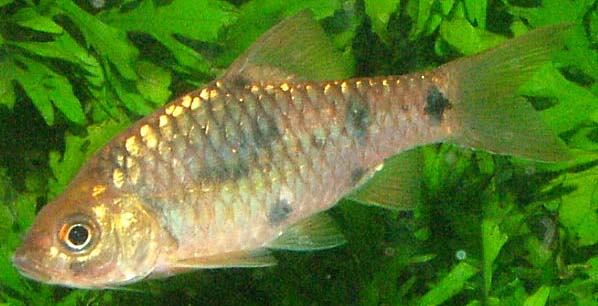
Barbodes banksi
Cyprinidae · Herre, 1940
This species is not often seen in the aquarium hobby but occasionally exported as bycatch among shipments of other fishes. It was described as a subspecies of the closely-related 'P.' binotatus but is currently considered distinct on a tentative basis as per Ng and Tan (1999) who stated it is 'likely' that the two represent extreme colour forms of a single, variably-patterned species.
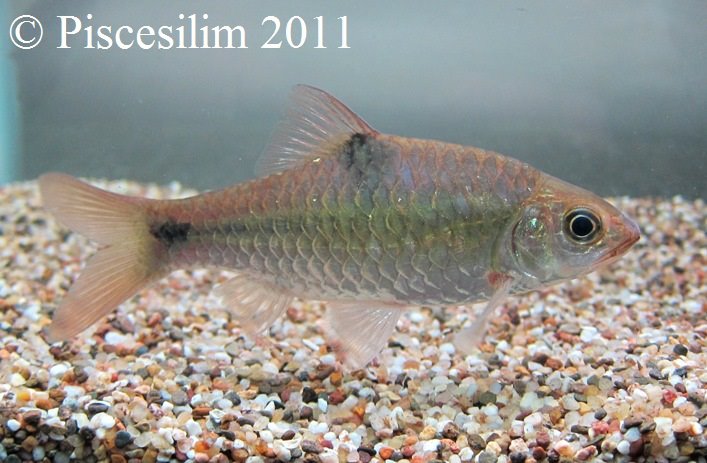
Barbodes binotatusSpotted Barb
Cyprinidae · Valenciennes, 1842
This species is so ubiquitous across its natural range that it's often referred to simply as 'common barb'. Basic adult colour pattern consists of a small, dark spot at the base of the dorsal-fin origin and another on the caudal peduncle but overall appearance varies somewhat depending on origin, with the anterior dark spot enlarged ventrally forming a bar or posterior spot extending into the caudal-fin, for example. The spots may also appear darker or lighter in some individuals.
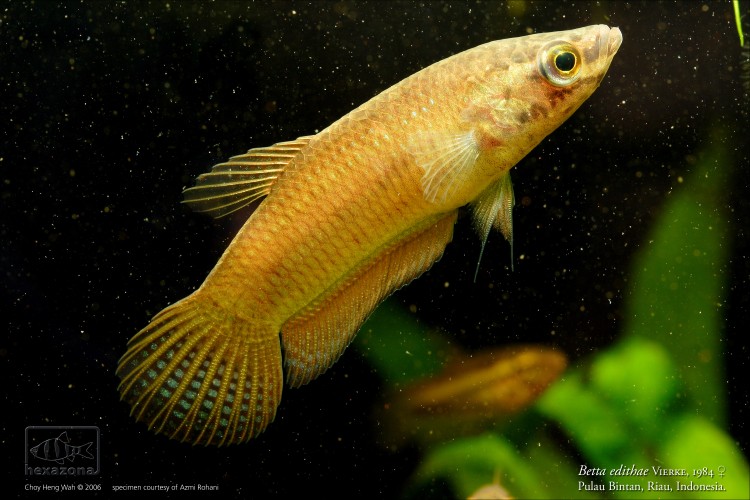
Betta edithae
Osphronemidae · Vierke, 1984
This species is the only member of the B. edithae group within the genus, and separated from all other Betta spp. by the fact that the branchiostegal membrane and posterior portion of the opercle are opaque or translucent. The original diagnosis by Vierke also states that it has relatively small eyes and short fins with a typical pattern of partial barring.
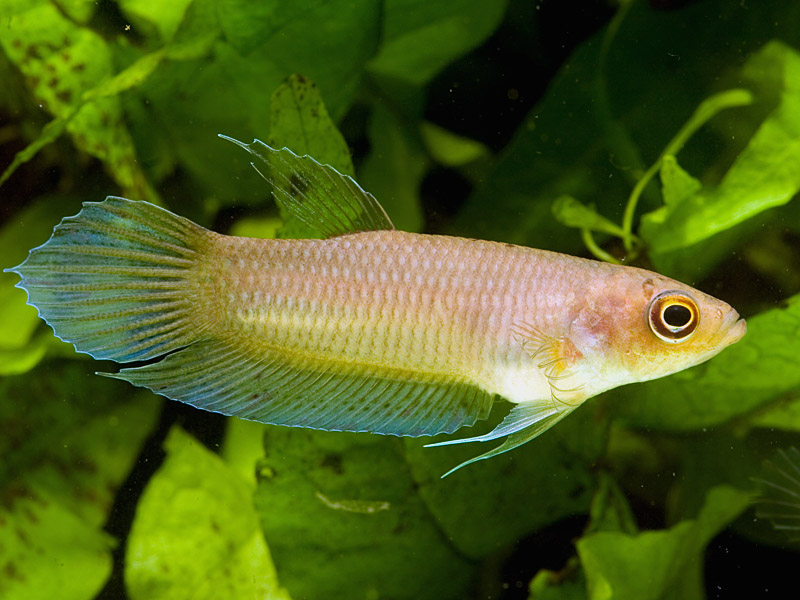
Betta hipposideros
Osphronemidae · Ng & Kottelat, 1994
The easiest way to distinguish these is by examining the throat markings, which vary according to species, and in the case of B. hipposideros form a black horse-shoe shape. It can also be separated from other group members by the following suite of characters: dark blotch on throat joined to black lower lip; presence of transverse bars in dorsal and caudal fins; absence of dark margin in anal-fin; opercle usually with gold scales, without iridescrent green scales; ventral margin of opercle brown; 6.5-7 subdorsal scales (mode 6.5); 9-10 postdorsal scales (mode 9.5); 31-32 lateral scales (mode 32).
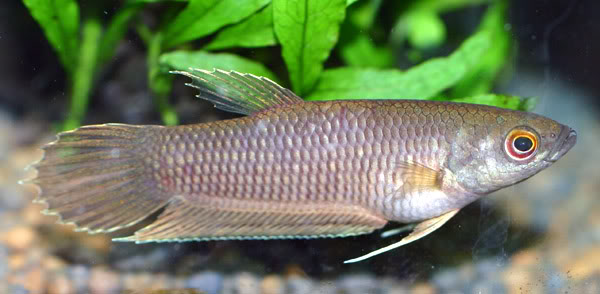
Betta spilotogena
Osphronemidae · Ng & Kottelat, 1994
Inhabits freshwater swamps and associated streams, typically shaded from the sun by dense riparian vegetation. The water is normally clear or lightly stained with tannins, and the fish found in water less than a metre deep alongside related species including Betta edithae, B. miniopinna, and B. fusca. PH has been measured to range between 4.9-5.5.
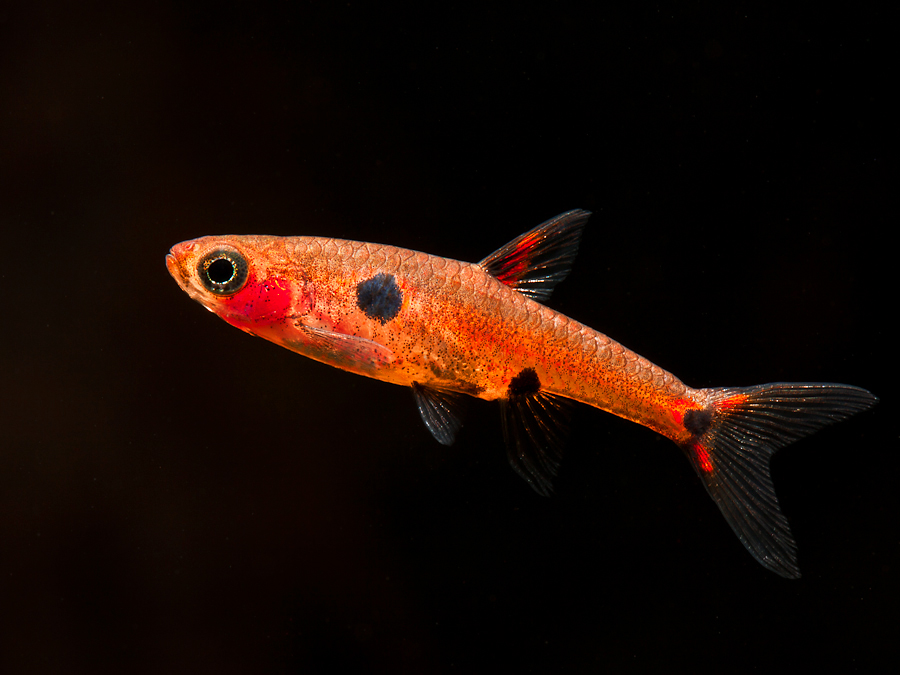
Boraras maculatusDwarf Rasbora
Cyprinidae · Duncker, 1904
Within the genus Boraras this species is most similar to B. naevus, though in the latter the red body colouration does not extend into the head. The two also differ in the following characters: anteriormost lateral blotch of comparable size in both sexes in B. maculatus vs. significantly larger in male than female B. naevus; 9-10 + 9 principal caudal-fin rays vs. 9 + 8; 26-29 lateral scales vs. 24-26; i.6.i. pelvic-fin rays vs. i.5.i.
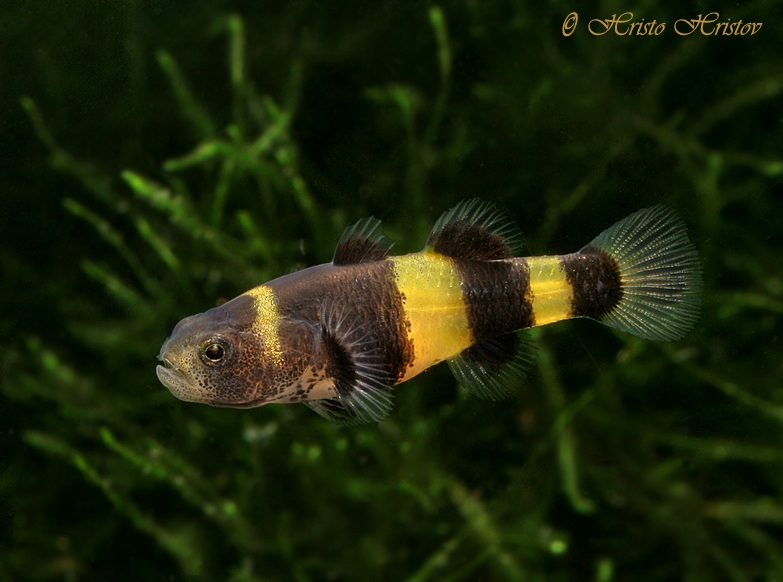
Brachygobius doriaeBumblebee Goby
Gobiidae · Günther, 1868
This species is among the more frequently-traded members of the genus, although confusion regarding its identification and natural distribution is commonplace and it's often misidentified as B. nunus or B. xanthozonus. It can be diagnosed as follows: <30 lateral scales; one black band on head, three on body; first black band on body overlapping first dorsal fin to the extent that almost all fin, except a narrow margin, is black, and beginning opposite centre of opercle...
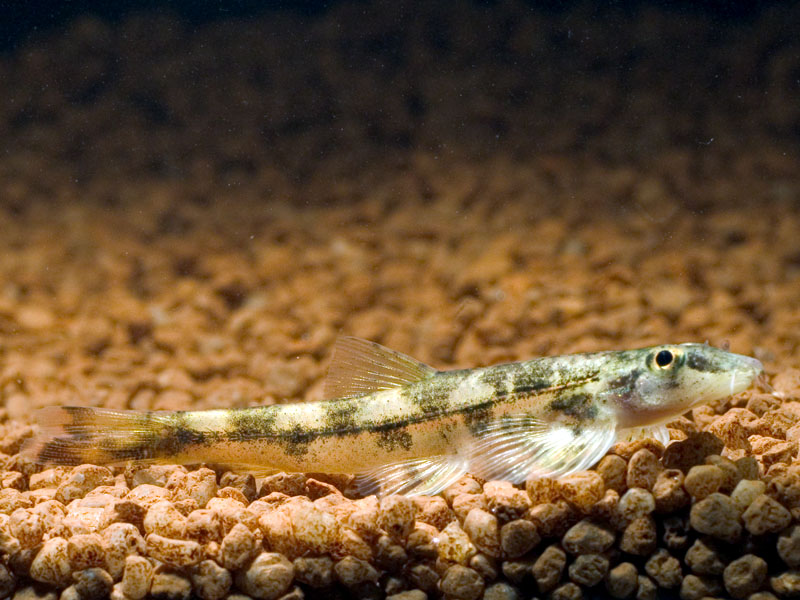
Homalopteroides nebulosus
Balitoridae · Alfred, 1969
The genus Homalopteroides was revalidated by Randall and Page (2012) and is told apart from the related Homaloptera by the following character combination: dorsal-fin origin above pelvic-fin; ≤ 60 lateral-line scales; ≤ 30 predorsal scales; oral morphology consisting of two thin and widely separated rostral barbels on each side of the mouth, thin crescent-shaped lips, the absence of any structure such as a mental pad or lobes between the lateral portions of the lower lip, and a chin that extends anterior to the lateral portions of the lower lip.
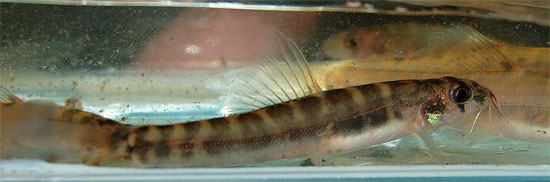
Nemacheilus spiniferus
Nemacheilidae · Kottelat, 1984
It's a member of the N. selangoricus group of species within the genus, an assemblage first recognised by Hadiaty and Kottelat (2009) and characterised by possession of two rows of horizontally-arran...
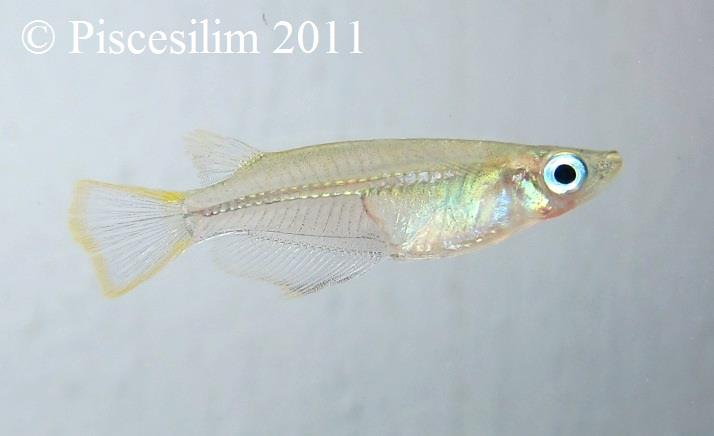
Oryzias javanicusJavanese Ricefish
Adrianichthyidae · Bleeker, 1854
This species is widely-distributed throughout Peninsular Thailand, Malaysia (Malay Peninsula plus the states of Sabah and Sarawak, Borneo), Singapore and Indonesia, with records from the Riau Archipelago, Sumatra, Java, Borneo, Bali, Lombok, and Sulawesi existing in the latter. Type locality is 'Panimbang River, Perdana, Indonesia'. It's typically found in coastal, normally brac...
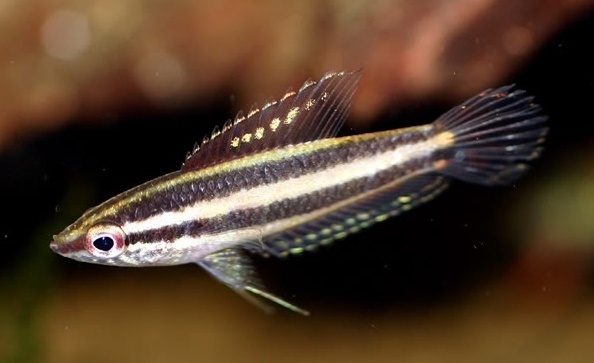
Parosphromenus bintan
Osphronemidae · Kottelat & Ng, 1998
This species is not generally available in the aquarium hobby on a commercial basis but is occasionally collected and distributed by private aquarists. It's name is sometimes misapplied to commercial shipments of other species, and there also exist a number of other fish with rounded caudal-fins that may or may not be conspecific, including P. sp. 'blue line' and P. sp. 'Selatan' from Sumatra.
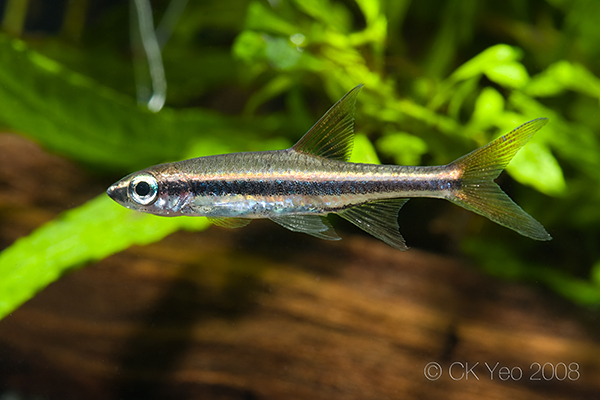
Trigonopoma gracile
Cyprinidae · Kottelat, 1991
This species occurs in several colour forms depending on collection locality with some exhibiting more intense pigmentation in the fins or an additional reddish lateral stripe, for example. It's sometimes said to closely resemble and occur sympatrically with Rasbora agilis, but that name is currently considered a junior synonym of the congener Trigonopoma pauciperforatum. R. agilis had previously been us...
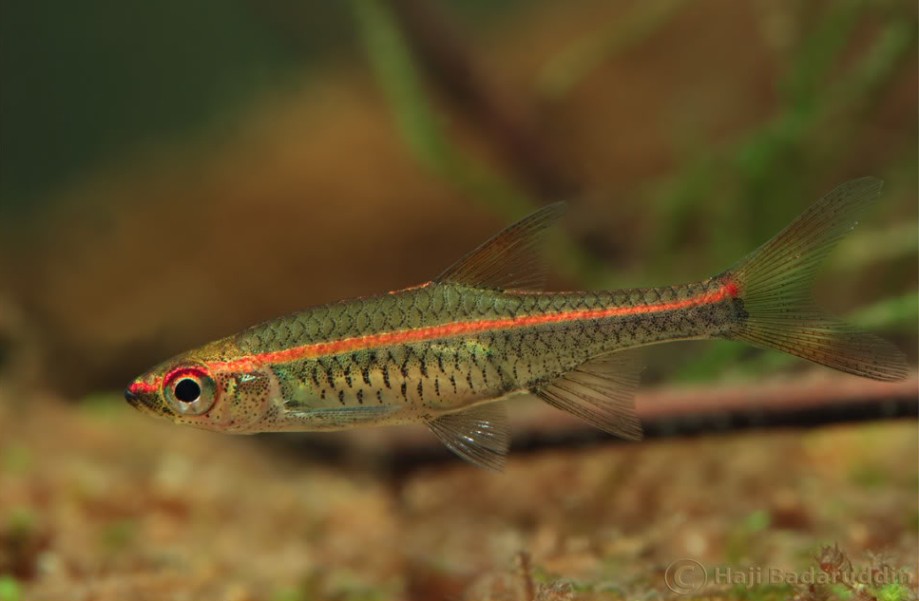
Trigonopoma pauciperforatumGlowlight Rasbora
Cyprinidae · Weber & de Beaufort, 1916
This species is also sold as the 'redline' rasbora which is something of a misnomer as in reality the colour of the lateral stripe that gives rise to the name can vary from deep orange to golden depending upon the collection locality of the fish as well as diet, condition, and even mood. Some specimens also have a second, darkish stripe beneath the other which seems to vary in length and intensity depending on a similar array of factors. Older fish tend to possess a greater degree of black edging to the scales, especially in the ventral portion of the body.
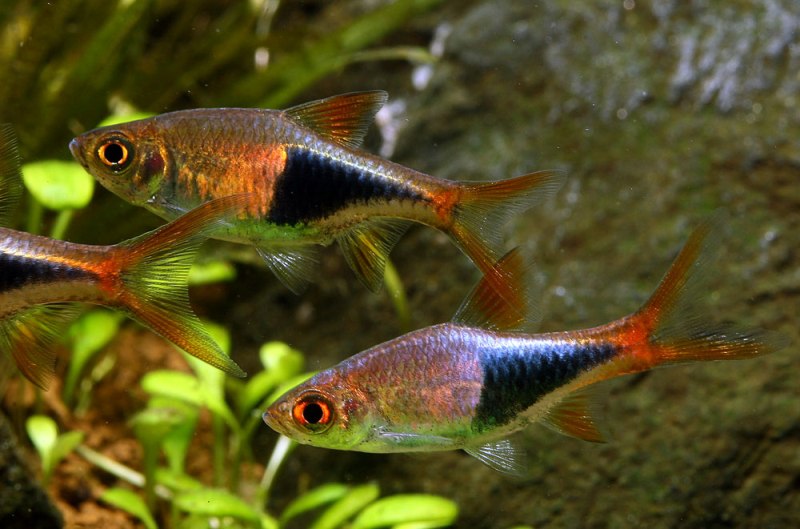
Trigonostigma heteromorphaHarlequin
Cyprinidae · Duncker, 1904
T. heteromorpha was first exported for aquaria in the early 1900s and has gone on to become one of the most familiar, enduring species in the hobby. It has suffered as a result of its popularity to a certain extent with the mass-produced fish we see today lacking much of the colour seen in wild specimens and even exhibiting morphological deformities in some cases. Several selectively-bred ornamental strains have also...