Results for “fin”
Type a name: scientific, common, or one a species used to go by. Or narrow the catalogue with the filters.
Filters
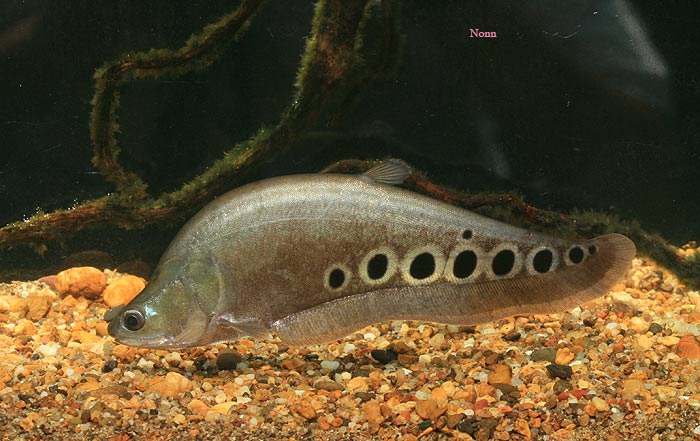
Chitala ornataClown Featherback
Gray, 1831
Max length1000mm SL39in SLTanknot recordedTemp20–28°C68–82°FpH6.0–8.0This species is also referred to as 'clown knifefish' in the aquarium trade. It arguably has no place in the ornamental hobby given its adult size and specialised requirements but remains inexplicably popular and an albino form has even been line-bred for the purpose. It can be distinguished from all congeners by presence of one or more rows of large ocellated spots above the base of the anal-fin, but...
Cichlasoma festaeRed Terror
authority not recorded
Max length508mm SL20in SLTank210 × 60cm84 × 24inTemp25–29°C77–84°FpH6.0–8.0The Red Terror can be troublesome to breed due to pairing problems - if a pair of fish are incompatible and are housed together for any length of time, it is likely that the weaker fish will be killed. The best way of getting a true pair is to grow 6 juveniles up until a noticeably strong pair has formed. Also, its size means finding an aquarium and suitable breeding surfaces can be difficult. As previously mentioned, rocks (siliconed if necessary) and bits of slate used to create man-made caves...
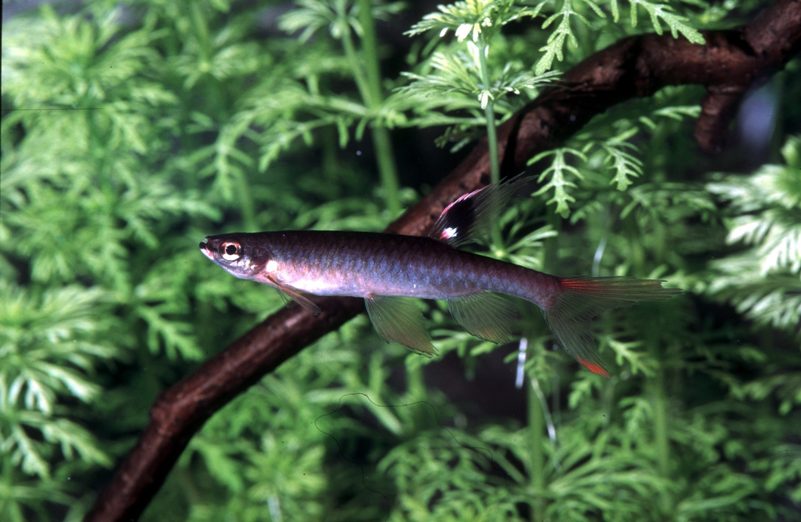
Copella carsevennensis
Regan, 1912
Max length40mm SL1.6in SLTank75 × 30cm30 × 12inTemp20–28°C68–82°FpH4.0–7.0C. carsevennensis has formerly been synonymised with C. arnoldi but was considered separate by Zarske (2011) using the following combination characters: absence (vs. presence) of a silvery-white to white patch in the centre of some of the flank scales in males, particularly in the lower half of the body; absence (vs. presence) of a horizontal dark body bar in nuptial males; absence (vs. presence) of thin black margins in the dorsal, ventral and anal fins; eggs deposited among submerged vegetation (vs. eg...
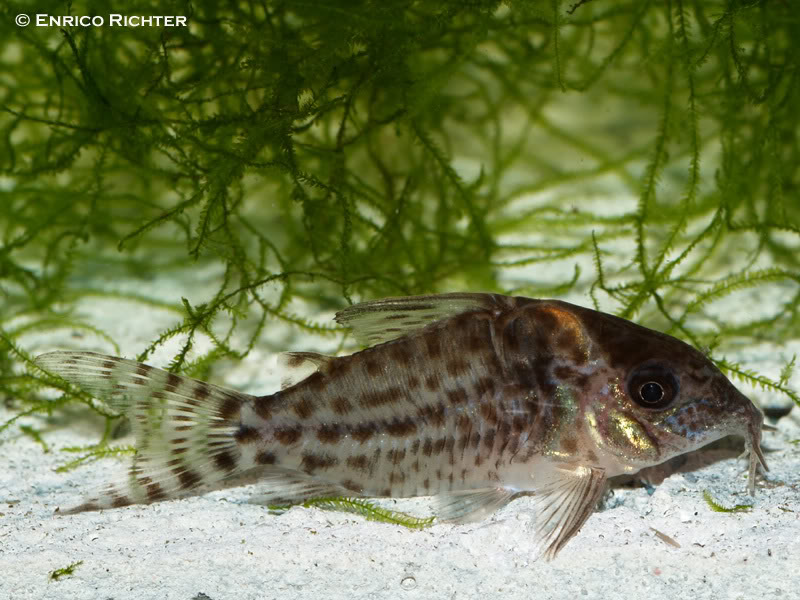
Corydoras agassiziiSpotted Cory
Steindachner, 1876
Max length70mm SL2.8in SLTanknot recordedTemp22–27°C72–81°FpH6.0–8.0This species' name is commonly misapplied to a number of similar-looking fishes and it can be difficult to identify if collection locality is unknown. In addition, colour pattern is variable and it's not clear whether this occurs between, within, or both between and within populations. In the original description, Steindachner did note that the first three dorsal-fin rays are completely black while the remainder is whi...
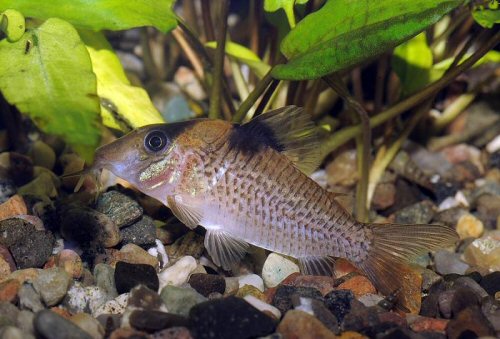
Corydoras ephippiferSaddle Cory
Nijssen, 1972
Max length60mm SL2.4in SLTanknot recordedTemp20–25°C68–77°FpH6.0–7.5This species appears superficially similar to a number of congeners including C. ambiacus, C. agassizii, C. brevirostris, C. delphax, and C. melanistius. Among these C. ephippifer seems to be unique in that all fins except the dorsal are transparent and lack markings.
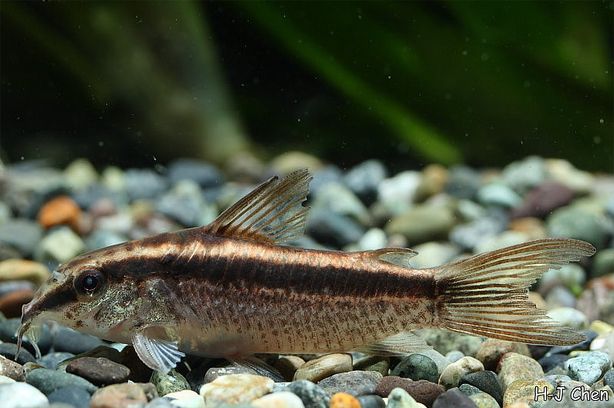
Corydoras gracilis
Nijssen & Isbrücker, 1976
Max length40mm SL1.6in SLTank60 × 30cm24 × 12inTemp20–26°C68–79°FpH5.0–7.5It can be distinguished from the majority of other Corydoras species by its distinctive colour pattern, comprising a uniform, lightish base pigmentation with a dark arched stripe extending over the upper portion of each flank, from the tip of the snout to the caudal-fin base. This is shared with a few congeners, however, including C. arcuatus, C. narcissus, and C. urucu.
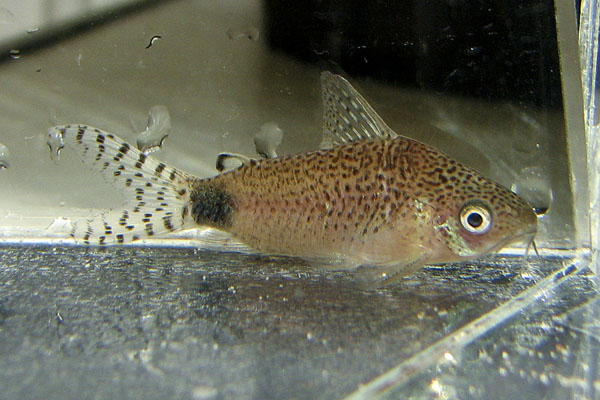
Corydoras guaporeGuaporé Cory
Knaack, 1961
Max length50mm SL2.0in SLTank90 × 30cm36 × 12inTemp22–28°C72–82°FpH5.0–7.0C. guapore is a sought after aquarium fish although it is not often traded. It exhibits slightly different behaviour to the majority of congeners in that it tends to form aggregations in midwater and spends a large proportion of its time away from the substrate. Its morphology exhibits corresponding adaptations towards a pelagic existence with a relatively large eye, a more terminal mouth position, more strongly-forked caudal-fin, and more symmetrical body shape than most other Corydoras species.
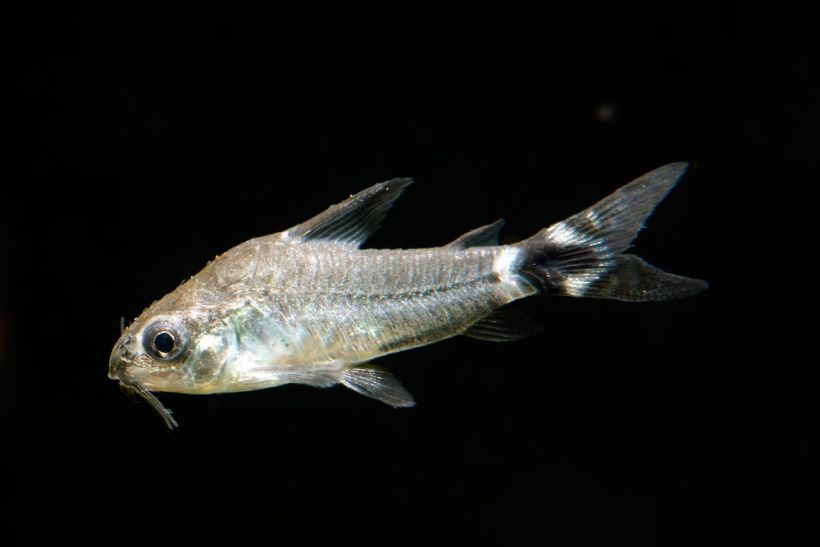
Corydoras hastatusTail-spot Pygmy Cory
Eigenmann & Eigenmann, 1888
Max length32mm SL1.3in SLTank60 × 30cm24 × 12inTemp20–26°C68–79°FpH6.0–7.5It exhibits slightly different behaviour to the majority of congeners in that it tends to swim in midwater and spends a large proportion of its time away from the substrate. Its morphology exhibits corresponding adaptations towards a pelagic existence with a relatively large eye, a more terminal mouth position, more strongly-forked caudal-fin, and more symmetrical body shape than most other Corydoras species.
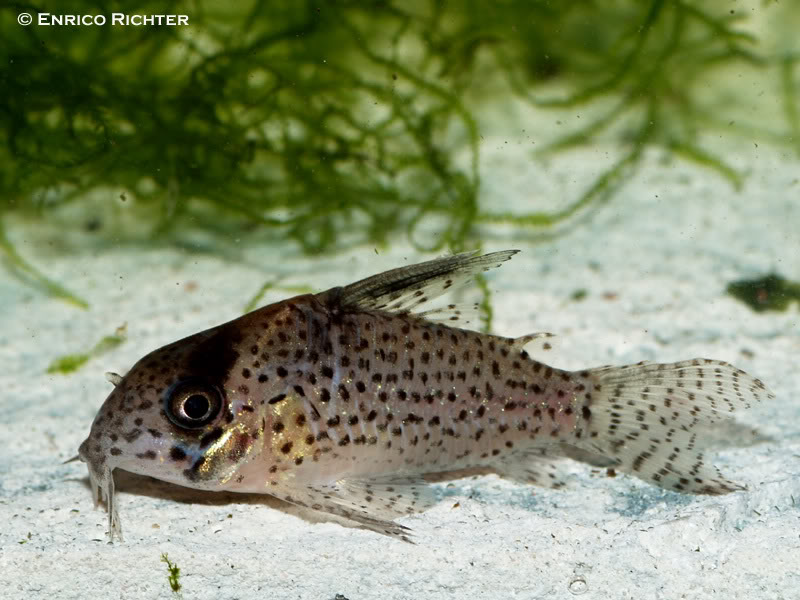
Corydoras kaneiC026
Grant, 1998
Max length50mm SL2.0in SLTank90 × 30cm36 × 12inTemp20–26°C68–79°FpH5.5–7.5Prior to description C. kanei was assigned the 'C' numbers C026 and C046. Among congeners it is most easily-confused with, and sometimes traded as, C. atropersonatus, but can be identified by presence (vs. absence in C. atropersonatus) of dark markings in the anal and caudal fins, presence of numerous, smaller (vs. fewer, larger) dark spots on the body, and an overall darker (vs. paler) base colouration.
Corydoras paleatusPepper Cory
authority not recorded
Max length70mm SL2.8in SLTank61 × 38cm24 × 15inTemp22–26°C72–79°FpH6.0–7.0Corydoras are members of the armoured catfish family. The genus name means "helmet skin" and the fish live up to this name as they are rather tough little fish. They also have spines in the leading rays of the pectoral fins to deter larger predators from eating them. Corydoras are sometimes observed taking a gulp of air at the water surface: this is because they can absorb oxygen through their gut. It is not known why cories do this even on oxygen rich waters. Along with the bronze ...
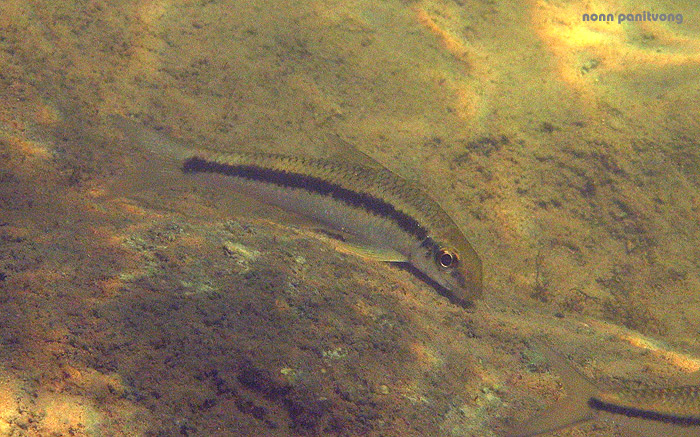
Crossocheilus burmanicus
Hora, 1936
Max length120mm SL5in SLTank150 × 45cm60 × 18inTemp20–26°C68–79°FpHnot recordedWe've been unable to obtain a diagnosis for this species to date but it can at least be distinguished from those congeners traded as 'Crossocheilus siamensis' (an invalid name synonymous with C. oblongus, which is itself of questionable identity), 'Siamese algae eater', or 'SAE' by the fact that the dark lateral stripe does not extend into the caudal-fin. Members of Crossocheilus are characterised by...
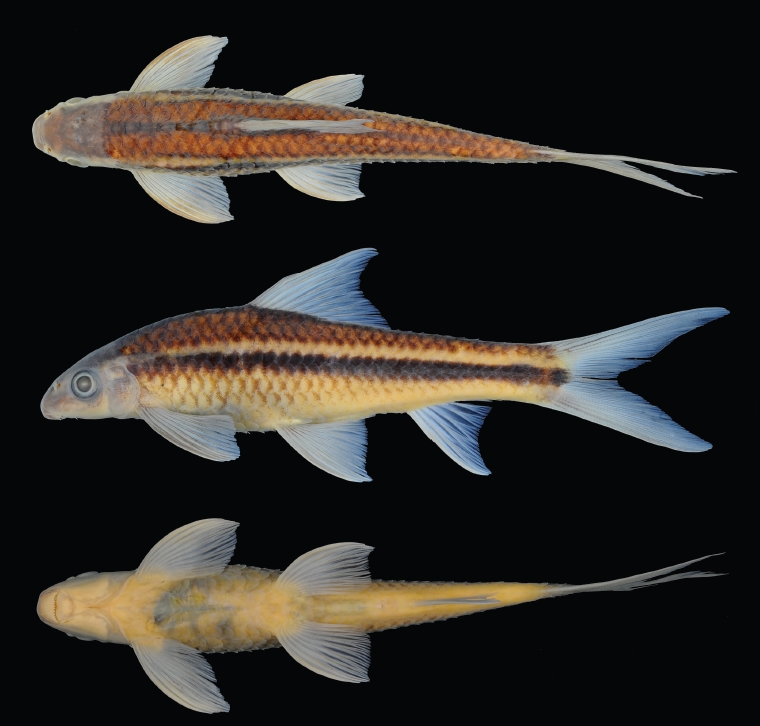
Crossocheilus elegans
Kottelat & Tan, 2011
Max length110mm SL4in SLTank150 × 45cm60 × 18inTemp20–25.5°C68–78°FpHnot recordedThis species can be most easily distinguished from other members of the genus by its colour pattern which consists of a blackish midlateral stripe extending from the tip of the gill opening to the middle of the caudal-fin base, which is separated from the dark brown dorsum by a pale yellowish brown stripe. This differs from the pattern seen in other Crossocheilus species with a black midlateral stripe in which the the dorsum is olive brown and much paler than the midlateral stripe, there is no yellow stripe between the dorsum and the black stripe, and the black stripe extends to the tip of the snout.
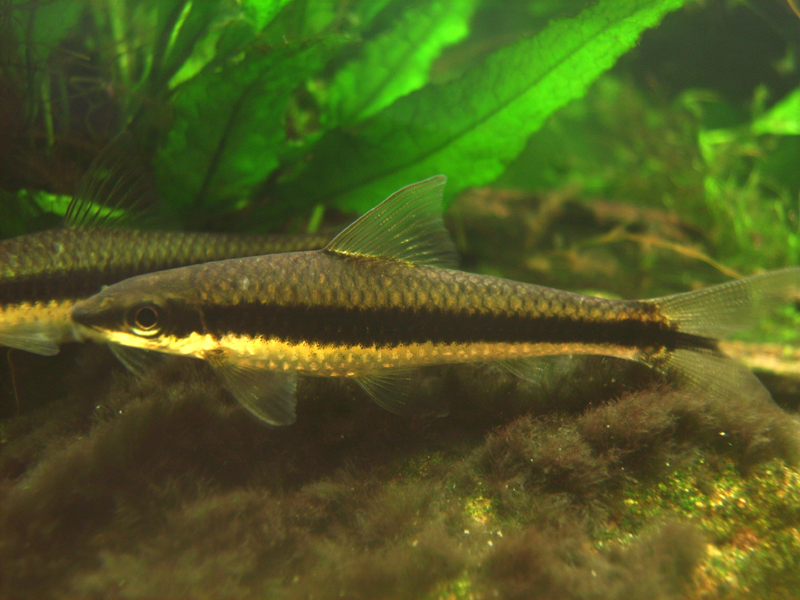
Crossocheilus langeiSiamese Algae Eater
Bleeker, 1860
Max length150mm SL6in SLTank150 × 45cm60 × 18inTemp20–26°C68–79°FpH6.0–7.5C. oblongus is another name widely misused in the trade but that species has seemingly never been exported and was described as a blueish fish with yellow fins. It's native to streams of Gunung Salak mountain in Bogor Regency, West Java, Indonesia where collecting of ornamental fishes is almost non-existent. Other species of laterally-striped Crossocheilus also exist and may be available from time-to-time but are more easily told apart from the group described above.
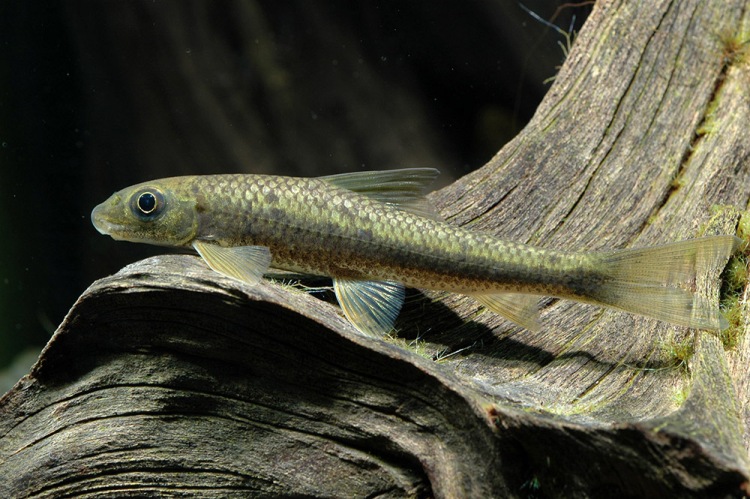
Crossocheilus latius
Hamilton, 1822
Max length150mm SL6in SLTank150 × 45cm60 × 18inTemp18–24°C64–75°FpH6.0–7.5C. latius isn't often available in the trade but makes an excellent alternative to more commonly-offered members of the genus should you be lucky enough to find some. Shipments of similar-looking Indian Garra species such as G. mullya or G. gotyla sometimes contain the odd specimen. It exhibits morphological differences when compared with other members of the genus and may be assigned to a separate taxon at some point in the future.
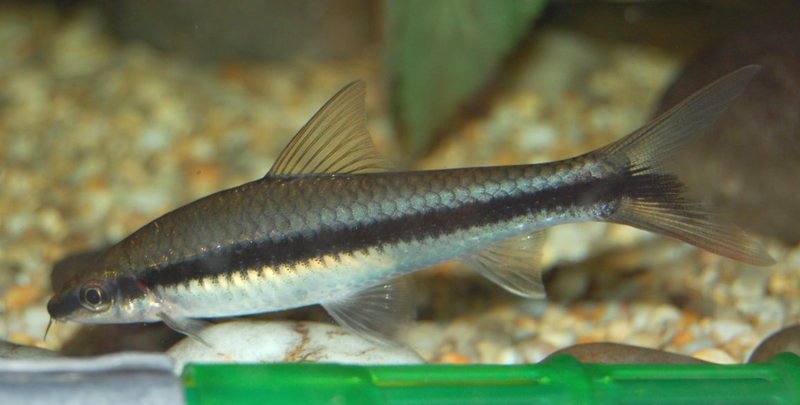
Crossocheilus nigriloba
Popta, 1904
Max length150mm SL6in SLTank150 × 45cm60 × 18inTemp20–26°C68–79°FpH6.0–7.5While separating some of the fish that may be found on sale as 'C. siamensis' is a tricky task, C. nigriloba is quite simple to identify. The dark lateral body stripe uniquely breaks up into a series of blotches when the fish are sparring, stressed or sleeping and the lower caudal fin lobe contains dark pigmentation suffused with red. The latter feature has given rise to the trade name of 'penguin flying fox'.
Cynotilapia afraDogtooth Cichlid
authority not recorded
Max length100mm SL3.9in SLTank100 × 30cm39 × 12inTemp25–29°C77–84°FpH7.5–8.5C. afra is easily confused with some species of Pseudotropheus, but can be distinguished by its smaller adult size and unicuspid (as opposed to bicuspid) teeth. Also in this species the black bars on the flanks continue into the dorsal fin, unlike in Pseudotropheus zebra, for example. It exists in many different colour forms in nature. These forms should not be mixed in aquaria as they may spawn with each other, producing unwanted hybrid fry. Despite this ability to interbreed, it's probabl...
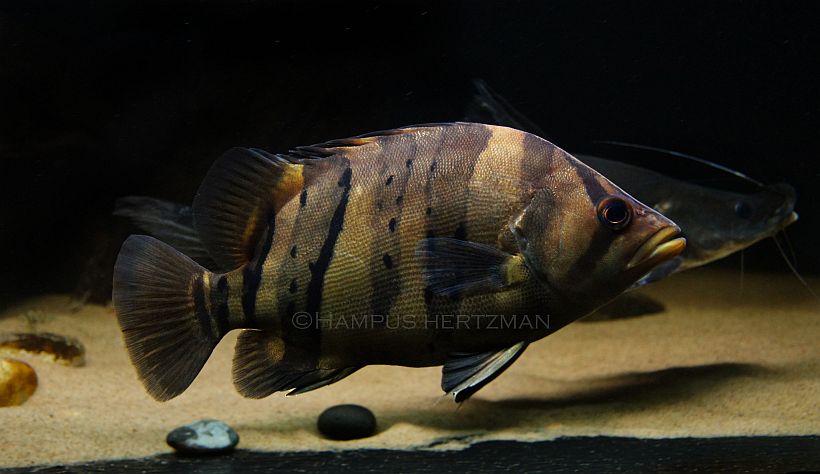
Datnioides microlepisIndonesian Tiger Perch
Bleeker, 1854
Max length500mm SL20in SLTanknot recordedTemp20–28°C68–82°FpH5.5–7.5In aquarium literature this species is also referred to as 'fine scaled tiger fish', 'Indonesian tiger fish', 'Sumatran tiger fish', 'Indo datnoid', and 'Indo dat'. The common name of 'tiger fish' is also used in reference to the African alestid genus Hydrocynus, and the more appropriate 'tiger perch' was suggested by Roberts and Kottelat (1994).
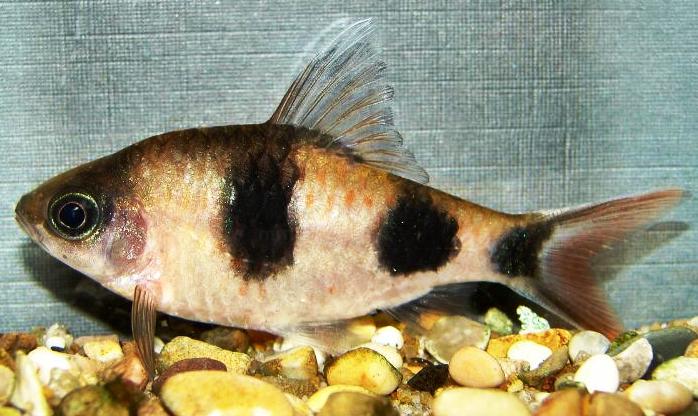
Dawkinsia arulius
Jerdon, 1849
Max length100mm SL3.9in SLTank120 × 45cm48 × 18inTemp19–25°C66–77°FpH6.0–7.5The fish appearing in the majority of earlier literature as P. arulius or 'arulius barb', and often still traded as such, is the related D. tambraparniei. Though similar the latter can be told apart from D. arulius by possession of filamentous extensions to the dorsal-fin rays in males, longer maxillary barbels measuring > ½ eye diameter, i.e., 2.4 - 4.7 % SL, and some aspects of colour pattern.
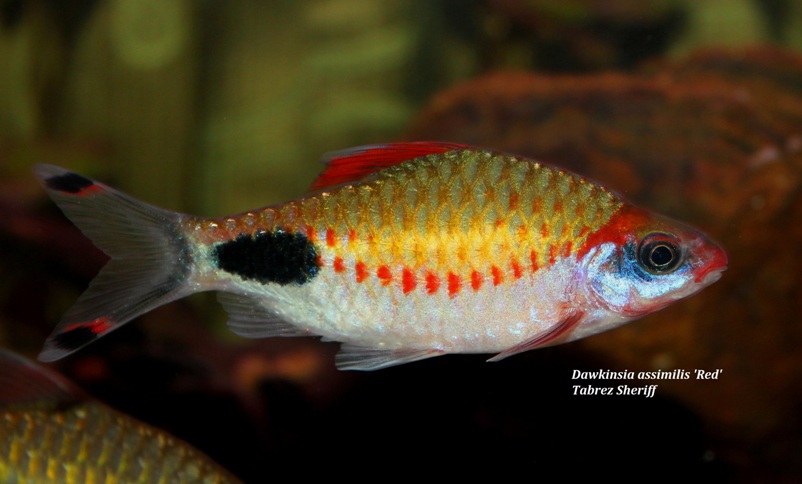
Dawkinsia assimilisMascara Barb
Jerdon, 1849
Max length120mm SL5in SLTank120 × 45cm48 × 18inTemp19–25°C66–77°FpH6.0–7.0D. assimilis has been misidentified as Puntius mahecola (Valenciennes 1844) in the past but the identity of both species was resolved by Pethioyagoda and Kottelat (2005 a, 2005b). They inspected the syntypes of P. mahecola and concluded that though valid it isn't closely related to any Dawkinsia (then the Puntius filamentosus group) but is rather a smaller, silvery fish with a single dark blotch on the caudal peduncle, located entirely posterior to the anal-fin. It's wi....
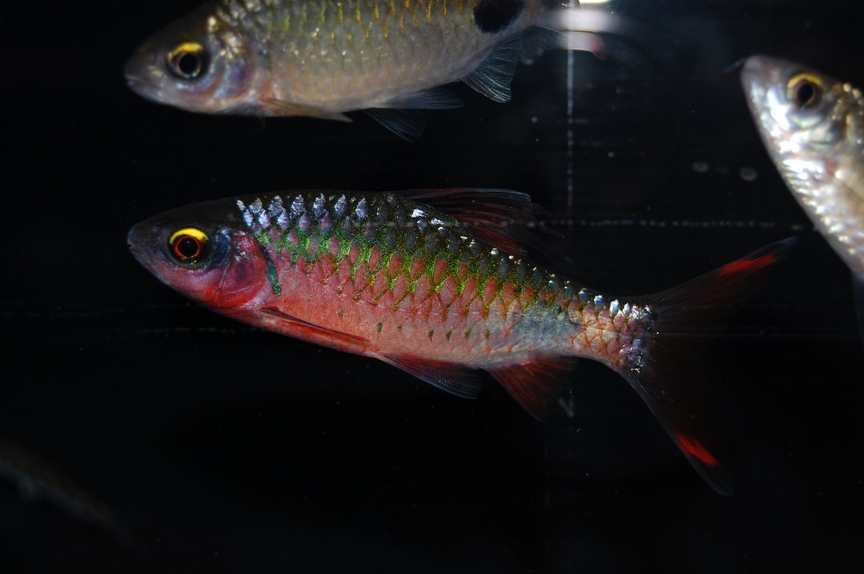
Dawkinsia filamentosaFilament Barb
Valenciennes, 1844
Max length120mm SL5in SLTank120 × 45cm48 × 18inTemp20–25°C68–77°FpH6.0–7.0Not difficult to keep in a well-maintained set-up, though we recommend aquascaping the tank to resemble a flowing stream/river with a substrate of variably-sized, water-worn rocks, sand, fine gravel and perhaps some small boulders. This can be further furnished with driftwood roots or branches, and while the majority of aquatic plants will fail to thrive in such surroundings hardy types such as Microsorum, Bolbitis or Anubias spp. can be grown attached to the décor.