Results for “genus”
Type a name: scientific, common, or one a species used to go by. Or narrow the catalogue with the filters.
Filters
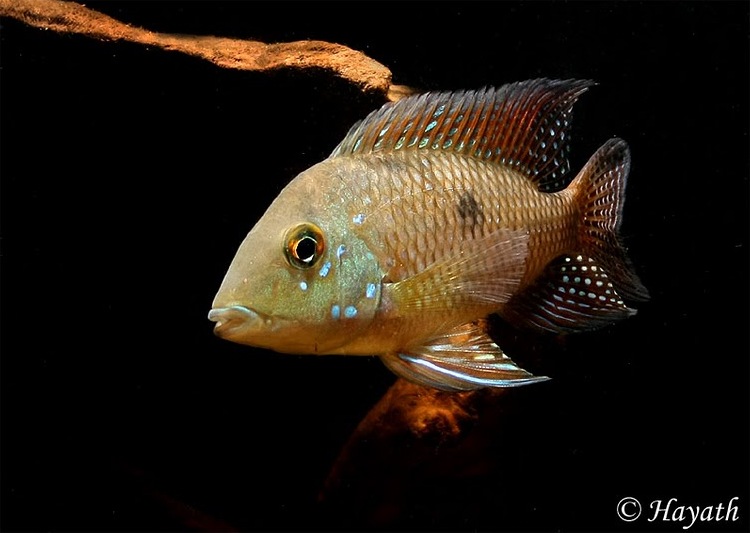
'Geophagus' iporangensis
Haseman, 1911
Max length100mm SL3.9in SLTank120 × 30cm48 × 12inTemp20–26°C68–79°FpH6.0–7.0Juvenile specimens of this species are readily confused with those of other members of the 'G.' brasiliensis species group, but adults are easily-distinguished by their relatively smaller adult size and comparative lack of reflective blue scales on the body and head. The genus Geophagus was rediagnosed by Kullander (1986) who restricted it to include only those species with paired caudal extensions to the swi...
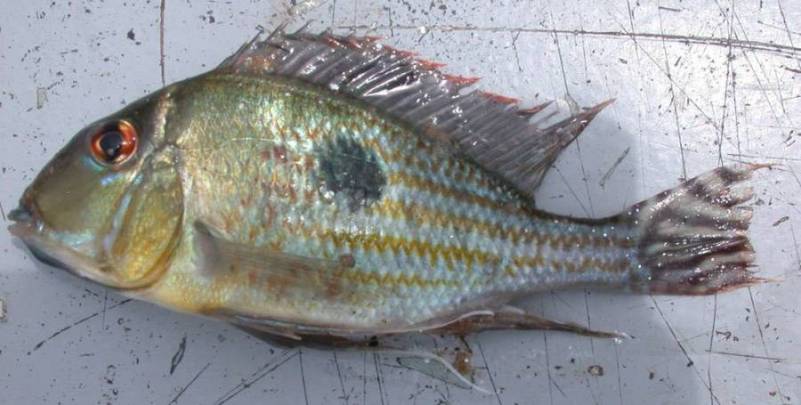
Geophagus megasema
Heckel, 1840
Max length175mm SL7in SLTank180 × 60cm72 × 24inTemp22–30°C72–86°FpH5.5–7.5This species is very rare in the aquarium hobby and may never have been available on a commercial basis although it has been collected, bred and distributed by some private collectors. It's a member of the putative G. surinamensis 'group' of closely-related species within the genus and ca...
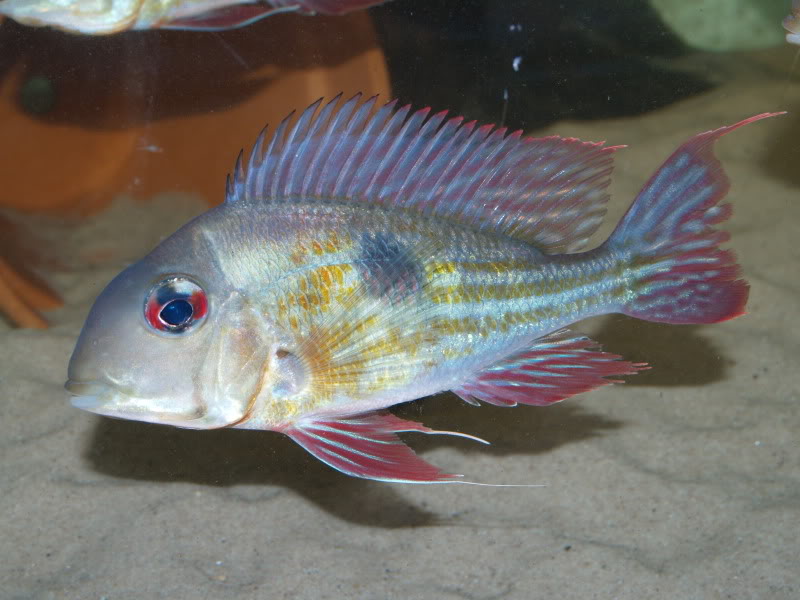
Geophagus proximus
Castelnau, 1855
Max length225mm SL9in SLTank180 × 60cm72 × 24inTemp24–32°C75–90°FpH4.0–7.0This species is rare in the hobby though it's name is often attached to shipments of other Geophagus species. It's a member of the nominal G. surinamensis 'group' of closely-related species within the genus and can be identified by a combination of characters including: possession of dark preopercular marking; no vertical bars on the flanks; relatively large, roughly oblong-shaped dark midlateral marking; caudal fin brownish with 3-5 light stripes on upper lobe and less well-defined stripes or mottled pattern of light spots with narrow dark interspaces on lower lobe.
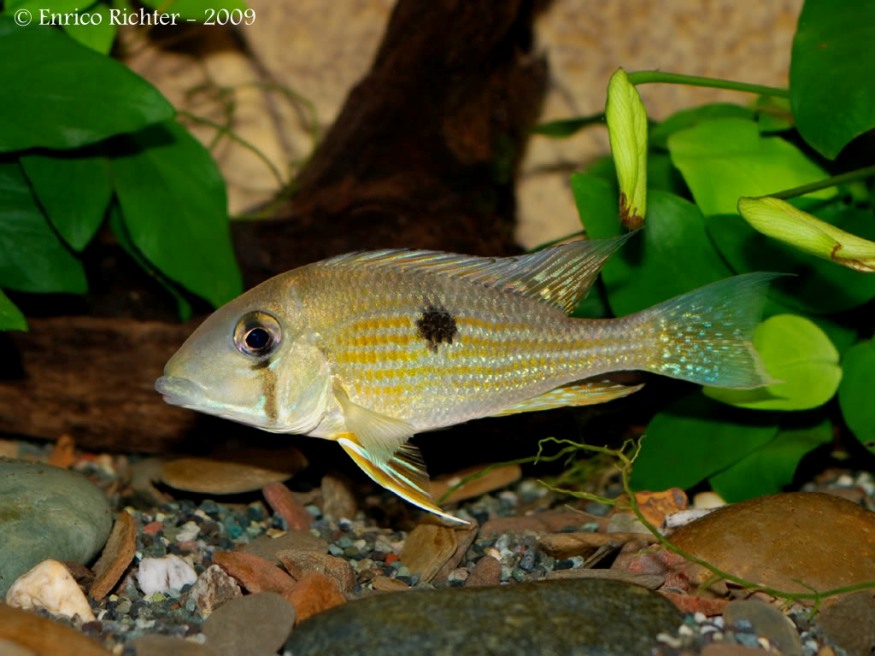
Geophagus taeniopareius
Kullander & Royero, 1992
Max length150mm SL6in SLTank150 × 45cm60 × 18inTemp24–30°C75–86°FpH5.5–6.8This species is relatively rare in the hobby but sometimes available from specialist retailers or private breeders. Though described in 1992 it was first collected much earlier and has been in the hobby since the late 1970s, being known as 'Wangenstrich-Erdfresser' (cheek-stripe eartheater) in Germany. It's one of just five Geophagus species not to be included in the nominal G. surinamensis 'group' of closely-related species within the genus along with G. argyrostictus, G. gottwaldi, G. grammepareius and G. harreri.
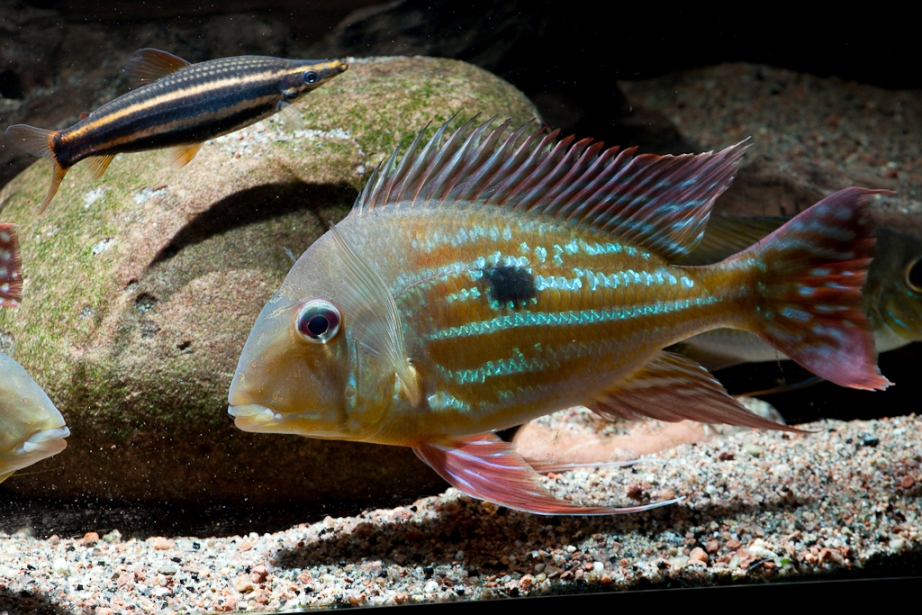
Geophagus winemilleri
López-Fernández & Taphorn, 2004
Max length200mm SL8in SLTank180 × 60cm72 × 24inTemp26–30°C79–86°FpH4.0–7.0This species is rare in the hobby although other species are sometimes sold under the name. It's a member of the nominal G. surinamensis 'group' of closely-related species within the genus and can be identified by a combination of characters including: possession of dark preopercular marking; four parallel, ventrally-inclined bars on each flank (normally visible only when the fish are stressed, spawning or preserved); dark lateral spot positioned within the second vertical bar; caudal fin red with variable pattern of large, iridescent blue to white spo...
Gnathochromis permaxillaris
authority not recorded
Max length150mm SL6in SLTank120 × 30cm48 × 12inTemp22–27°C72–81°FpH7.5–9.0This species was originally classified in the genus Limnochromis. There are a couple of colour morphs available and these should not be mixed in aquaria, as they may hybridise. In nature, this fish feeds in a similar way to Geophagus species, in that it will sift sand through its gills to extract invertebrates hidden in the substrate. It is a deep water fish and has been recorded foraging at depths of up to 200 metres. These movements seem to be related to the presence of the plankton on which...
Gobioides broussonnetiiViolet Goby
authority not recorded
Max length625mm SL25in SLTank120 × 60cm48 × 24inTemp22–26°C72–79°FpH7.5–9.0This fish is also commonly sold as the dragon or Peruvian goby, or dragon fish, and its bizarre appearance has made it popular in the trade. This is unfortunate, as not only does it grow very large, but it has specialised feeding requirements and does not survive for very long in freshwater. When provided with the correct conditions, however, it makes a unique and fascinating captive subject. There is a smaller species in the genus, G. peruanus, that does survive in freshwater, being a riverine ...
Gymnarchus niloticusAba Aba
authority not recorded
Max length1650mm SL65in SLTank360 × 120cm142 × 48inTemp23–28°C73–82°FpH6.5–8.0G. niloticus is the only species in its genus and is utterly unique. Unlike other knifefish it has an extended dorsal rather thangiving rise to the alternative common name of upside-down knifefish. Despite this common name, it is actually more closely related to the Mormyrid group of species. It is a truly beautiful sight in motion despite its lack of bright colours, as it can move in virtually any direction with ease using its undulatingto 'steer'. It also produces a weak electrical d...
Gymnotus pedanopterusZebra Knifefish
authority not recorded
Max length280mm SL11in SLTanknot recordedTemp22–28°C72–82°FpH6.0–7.0The genus Gymnotus has undergone considerable taxonomic revision in recent years, with over 20 new species being described since 1994, of which this stunning species is one. It's still very rare in the hobby and tends to command a high price when available. Like other Gymnotids, it produces a weak electric field using specially-adapted muscle tissue located towards the tail. It also possesses electroreceptors which allow the fish to receive electrical signals. With these the fish can sense ...
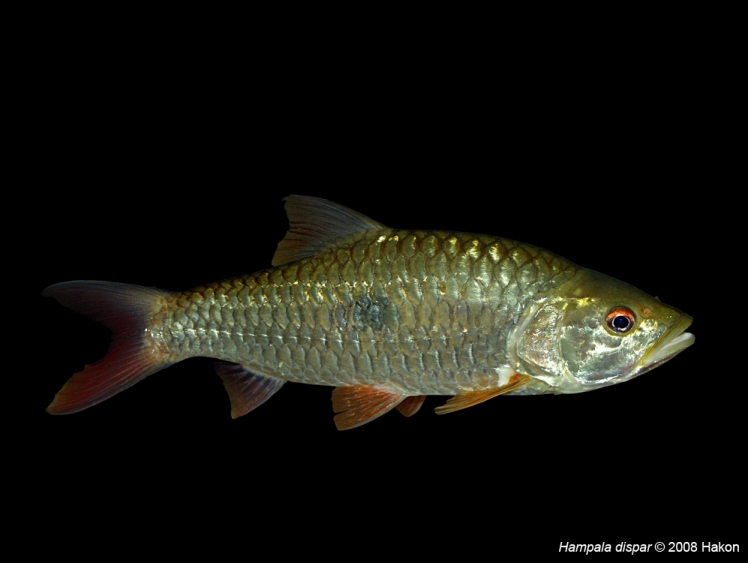
Hampala disparSpotted Hampala Barb
Smith, 1934
Max length350mm SL14in SLTank240 × 60cm96 × 24inTemp20–25°C68–77°FpH6.0–8.0The genus currently contains seven species of which H. macrolepidota and, to a lesser extent, H. dispar are the only ones seen with any regularity in the aquarium trade. As well as having the widest distribution H. macrolepidota is also the largest member of the group. All representatives can appear superficially similar at first glance, the exception being H. lopezi which is endemic to a single island in The Philippines and displays a unique lateral band-like marking on the flanks.
Hasemania nanaSilvertip Tetra
authority not recorded
Max length50mm SL2.0in SLTank60 × 38cm24 × 15inTemp23–28°C73–82°FpH6.0–8.0The genus Hasemania is one of the few in the family Characidae in which members do not possess an adipose fin. This species is ubiquitous in most dealers' tanks and is one of the best choices for the newcomer to fishkeeping. All the fish sold in the trade have been captive bred and as such are unfussy with regard to both water chemistry and diet. It is sometimes seen for sale with the common name 'copper tetra'....
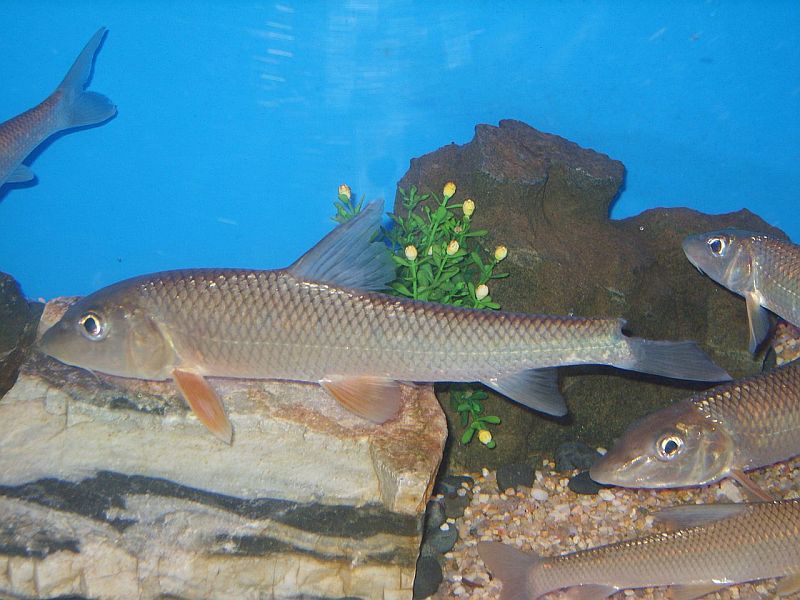
Hemibarbus labeoBarbel Steed
Pallas, 1776
Max length450mm SL18in SLTanknot recordedTempnot recordedpHnot recordedThis species can be distinguished from other members of the genus by the following combination of characters: absence of dark spots on body in adults; body elongate with slightly convex dorsal profile; head longer than body is deep; snout much longer than postorbital head length; lips well developed, lateral lobes of lower lip broad and thick with folds, median process small; barbel thickness shorter or equal to eye diameter; dorsal spine strong, ⅔ of HL; dorsal-fin origin closer to tip of snout than caudal-fin base base; 15+ gill rakers; 6½ branched anal-fin rays; posterior simple dorsal-fin rays ossified and spinous.
Hemigrammus barrigonaeBarrigona Tetra
authority not recorded
Max length40mm SL1.6in SLTank60 × 38cm24 × 15inTemp22–26°C72–79°FpH5.5–7.0Not a common species in the hobby, although it does occasionally show up as a contaminant among imports of more popular species. Like all Hemigrammus, the taxonomic status of this species is currently Incertae Sedis, meaning uncertain. The genus is currently used as something of a catch-all for over 70 species of small characin. Most experts agree that a full revision is required, with the likely outcome that many species will be placed into new or different genera....
Hemigrammus belottiiDash-dot Tetra
authority not recorded
Max length40mm SL1.6in SLTank60 × 38cm24 × 15inTemp23–27°C73–81°FpH6.0–7.0Not a common fish in the trade, most of the specimens imported come in as contaminants among batches of more popular species. Like all Hemigrammus, the taxonomic status of this species is currently Incertae Sedis, meaning uncertain. The genus is currently used as something of a catch-all for over 70 species of small characin. Most experts agree that a full revision is required, with the likely outcome that many species will be placed into new or different genera....
Hemigrammus boesemaniBoesman's Tetra
authority not recorded
Max length45mm SL1.8in SLTank60 × 38cm24 × 15inTemp23–26°C73–79°FpH5.5–7.0This species is very rare in the hobby, and should be snapped up if seen on sale. In the past it was considered a subspecies of H. micropterus. Supposedly, it's not a particularly common species in any of its natural waters. Like all Hemigrammus, the taxonomic status of this species is currently Incertae Sedis, meaning uncertain. The genus is currently used as something of a catch-all for over 70 species of small characin. Most experts agree that a full revision is required, with the lik...
Hemigrammus cupreusShiny Copper Tetra
authority not recorded
Max length35mm SL1.4in SLTank60 × 38cm24 × 15inTemp23–27°C73–81°FpH6.5–7.2Not a common species in the hobby, although it does occasionally show up as a contaminant among imports of more popular species. Like all Hemigrammus, the taxonomic status of this species is currently Incertae Sedis, meaning uncertain. The genus is currently used as something of a catch-all for over 70 species of small characin. Most experts agree that a full revision is required, with the likely outcome that many species will be placed into new or different genera....
Hemigrammus erythrozonusGlowlight Tetra
authority not recorded
Max length40mm SL1.6in SLTank60 × 38cm24 × 15inTemp24–28°C75–82°FpH5.5–7.5This species is ubiquitous in most dealers' tanks and is one of the best choices for the newcomer to fishkeeping, being both hardy and inexpensive. There is a selectively-bred albino form that has been produced for the trade and has become popular in recent years. Care for this is identical to the standard form. Like all Hemigrammus, the taxonomic status of this species is currently Incertae Sedis, meaning uncertain. The genus is currently used as something of a catch-all for over 70 spe...
Hemigrammus hyanuaryJanuary Tetra
authority not recorded
Max length40mm SL1.6in SLTank60 × 38cm24 × 15inTemp23–27°C73–81°FpH6.0–7.0Also known as the costello or green neon tetra, this species is seen much less often in the hobby than it used to be. It's occasionally confused with the common head and tail light tetra, H. ocellifer, as it resembles an elongated version of that species. Like all Hemigrammus, its taxonomic status is currently Incertae Sedis, meaning uncertain. The genus is currently used as something of a catch-all for over 70 species of small characin. Most experts agree that a full revision is require...
Hemigrammus levis
authority not recorded
Max length50mm SL2.0in SLTank60 × 38cm24 × 15inTemp24–28°C75–82°FpH5.5–7.0A rather rare fish in the UK hobby. It occasionally shows up as a contaminant among imports of more popular species. Like all Hemigrammus, the taxonomic status of this species is currently Incertae Sedis, meaning uncertain. The genus is currently used as something of a catch-all for over 70 species of small characin. Most experts agree that a full revision is required, with the likely outcome that many species will be placed into new or different genera....
Hemigrammus pulcherPretty Tetra
authority not recorded
Max length45mm SL1.8in SLTank60 × 38cm24 × 15inTemp23–27°C73–81°FpH5.5–7.0Also known as the garnet or black wedge tetra, H. pulcher is deservedly popular in the hobby. It's both hardy and inexpensive, and is a good choice for the beginner. There was previously a subspecies, H. pulcher haraldi. This has now been reclassified as a distinct species, H. haraldi. Like all Hemigrammus, the taxonomic status of this species is currently Incertae Sedis, meaning uncertain. The genus is currently used as something of a catch-all for over 70 species of small characin. Mo...