Results for “species”
Type a name: scientific, common, or one a species used to go by. Or narrow the catalogue with the filters.
Filters
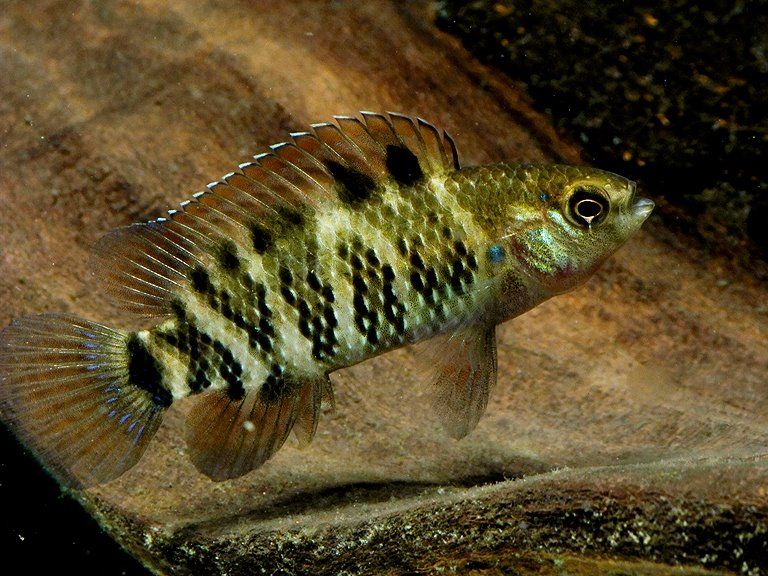
Badis badisBadis
Hamilton, 1822
Max length60mm SL2.4in SLTank80 × 30cm31 × 12inTemp15–25°C59–77°FpH6.0–7.5This species is sometimes sold under the trade name of 'chameleon fish' due to its ability to rapidly change colour, especially when breeding or stressed. It was originally described as Labrus badis by Hamilton but Bleeker reclassified it as Badis buchanani in 1854; he had adopted the species name 'badis' as the new name for the genus and wished to avoid using a tautonym. At that time the use of tautonyms was avoided in zoological taxonomy but is now permissible under ICZN ru...
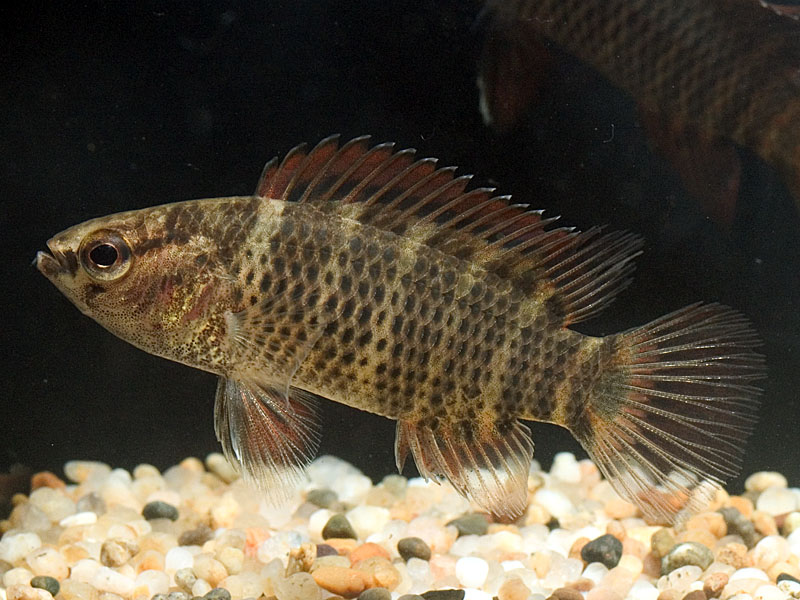
Badis corycaeus
Kullander & Britz, 2002
Max length60mm SL2.4in SLTank60 × 30cm24 × 12inTemp15–25°C59–77°FpH6.5–7.5Like most badids this species is poorly documented and has yet to find significant popularity in the aquarium hobby. Within the genus it is most closely-related to B. pyema but the two are unlikely to be confused as B. corycaeus is much the deeper, darker-bodied fish. Prior to 2002 the family Badidae included just five species of which only B. badis and, to a lesser extent, Badis dario (referred to as B. bengalensis by some sources) were popular in the aquarium hobby. However an extensive rev...
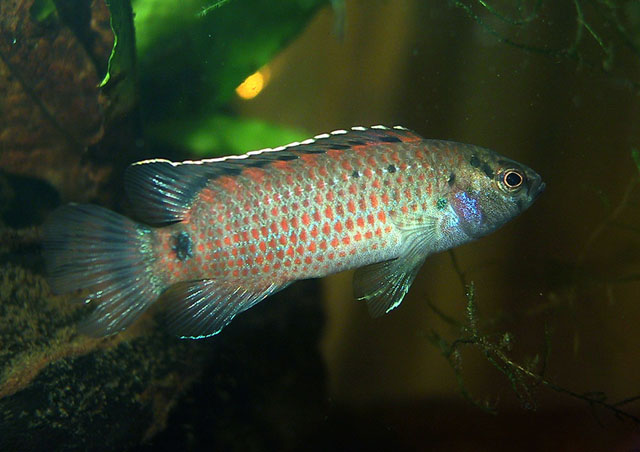
Badis khwae
Kullander & Britz, 2002
Max length60mm SL2.4in SLTank60 × 30cm24 × 12inTemp22–26°C72–79°FpH6.5–7.5Like most badids this species is poorly documented and has yet to find significant popularity in the aquarium hobby, though given its restricted natural distribution it is unlikely ever to be available in large numbers. Within the genus it is most easily confused with B. ruber and B. siamensis but both these species have rows of dark spot-like markings on the flanks which are lacking in B. khwae. The three also differ in the shape of the dark marking on the caudal peduncle; in B. ruber it is rel...
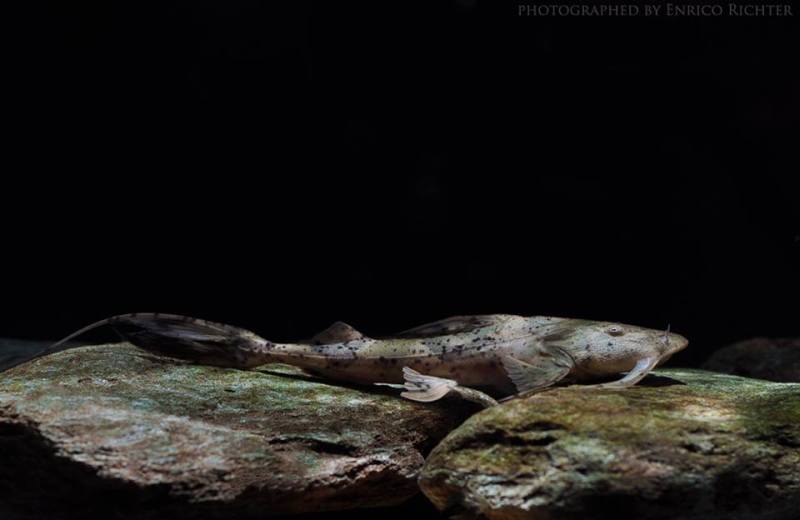
Bagarius yarrelliGoonch
Sykes, 1839
Max length2000mm SL79in SLTanknot recordedTemp16–23°C61–73°FpH6.0–7.5This species is clearly unsuitable for the home aquarium given its eventual size and natural behaviour, and we know of only a handful of private aquarists with the facilities required to house it long-term. The grouping currently contains four species but is in urgent need of review with a number of additional taxa thought to exist and B. yarrelli possibly representing a synonym of B. bagarius.
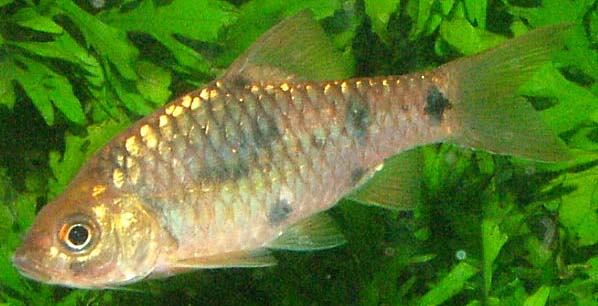
Barbodes banksi
Herre, 1940
Max length110mm SL4in SLTank120 × 45cm48 × 18inTemp22–28°C72–82°FpH6.0–7.5This species is not often seen in the aquarium hobby but occasionally exported as bycatch among shipments of other fishes. It was described as a subspecies of the closely-related 'P.' binotatus but is currently considered distinct on a tentative basis as per Ng and Tan (1999) who stated it is 'likely' that the two represent extreme colour forms of a single, variably-patterned species.
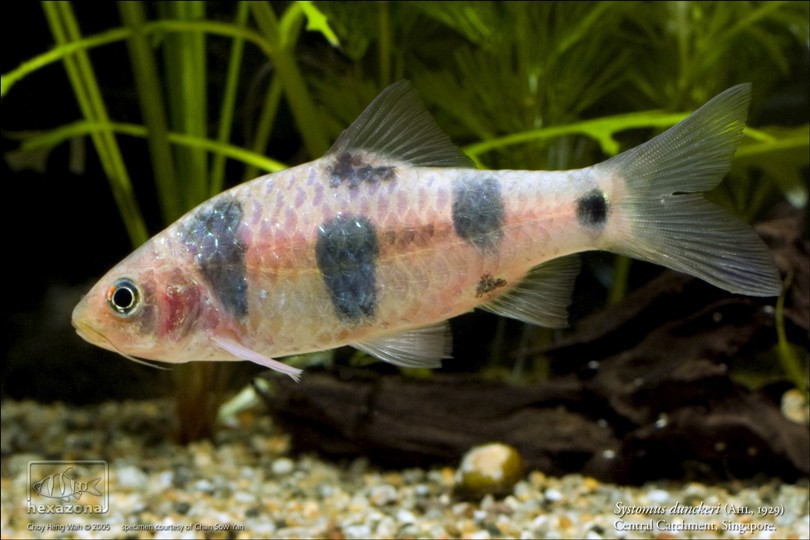
Barbodes dunckeriClown Barb
Ahl, 1929
Max length120mm SL5in SLTank120 × 45cm48 × 18inTemp18–28°C64–82°FpH6.0–7.5Although sometimes referred to by the vernacular name 'big spot barb' this species is better known in the aquarium hobby as 'clown barb'. It has been widely misidentified as the congener B. everetti, a distinct and uncommonly-traded species from Borneo and thus appears under that name in the majority of available literature. The two are quite easy to tell apart, with B. everetti an overall les...
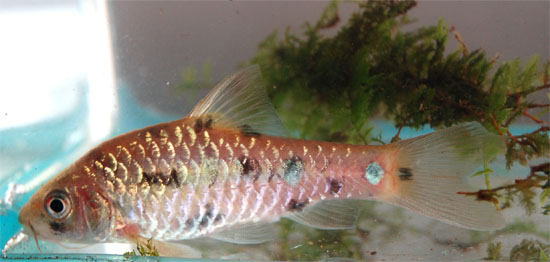
Barbodes everetti
Boulenger, 1894
Max length120mm SL5in SLTank120 × 45cm48 × 18inTemp18–28°C64–82°FpH6.0–7.0This species is uncommon in the aquarium hobby, although the scientific name is widely misapplied to Barbodes dunckeri, a similar-looking species native to Peninsular Malaysia and Singapore commonly referred to as 'clown barb' and labelled as B. everetti in the majority of available literature. The two are quite easy to tell apart, with B. everetti an overall less...
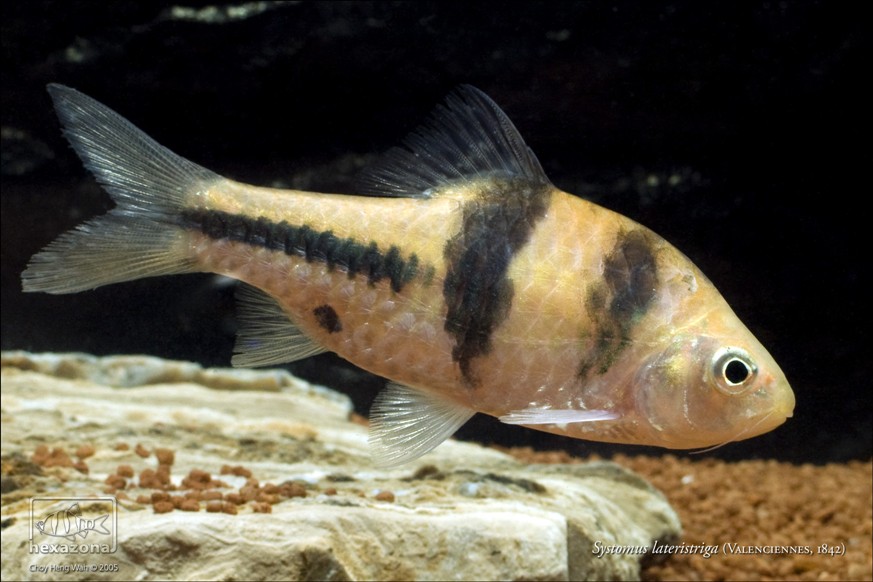
Barbodes lateristrigaSpanner Barb
Valenciennes, 1842
Max length150mm SL6in SLTank150 × 45cm60 × 18inTemp20–28°C68–82°FpH6.0–8.0This species is commonly-referred to as 'T-barb' in some countries. It's closely-affiliated with and sometimes traded as the congener B. kuchingensis but that species can be told apart by colour pattern comprising a prominent row of dark spots along the lateral line, plus a short, horizontally-orientated streak extending from the upper part of the operculum. In B. lateristriga the lateral markings usually form a solid stripe and there is no streak extending from the operculum.
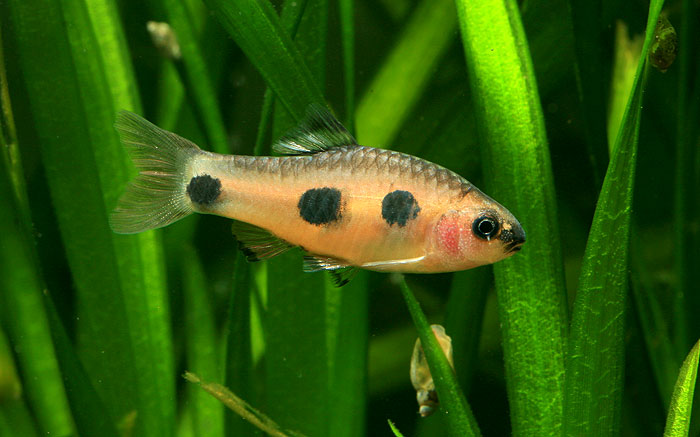
'Barbus' candens
Nichols & Griscom, 1917
Max length35mm SL1.4in SLTank45 × 30cm18 × 12inTemp17–24°C63–75°FpH5.0–7.0'B.' candens is not really suitable for most community aquaria as it has something of a shy, retiring nature and may be intimidated or outcompeted for food by larger/more boisterous tankmates. Choose similarly-sized, peaceful African species such as 'B.' jae, Aplocheilichthys spp., Ladigesia roloffi or Lepidarchus adonis. We suspect it will also do ok with many small South American characins, Otocinclus or smaller Corydoras catfish and other cyprinids like Trigonostigma or Boraras species.
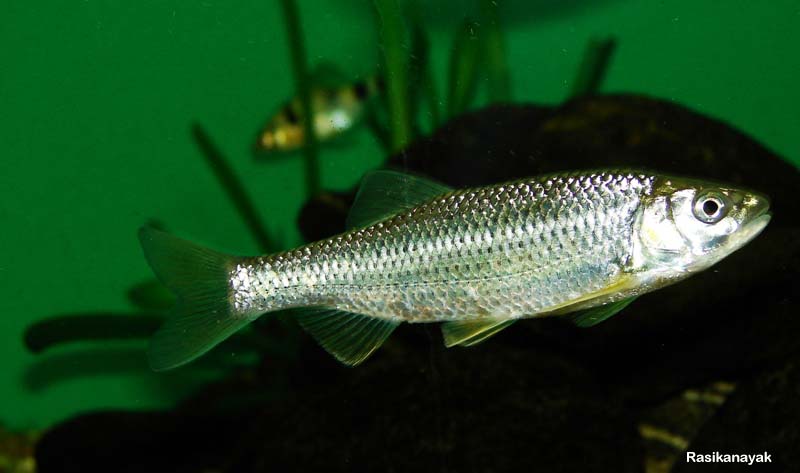
Barilius bendelisis
Hamilton, 1807
Max length200mm SL8in SLTank180 × 60cm72 × 24inTemp18–26°C64–79°FpH6.0–8.0Type locality is given as 'Cedawáti [Vedawati] stream, headwaters of Krishna River near Heriuru, Mysore, India', with the species currently considered to occur throughout India, Bangladesh, Nepal, and probably Bhutan. It's also been recorded in Pakistan, Myanmar, Thailand and Sri Lanka although some or all of these reports may refer to other species.
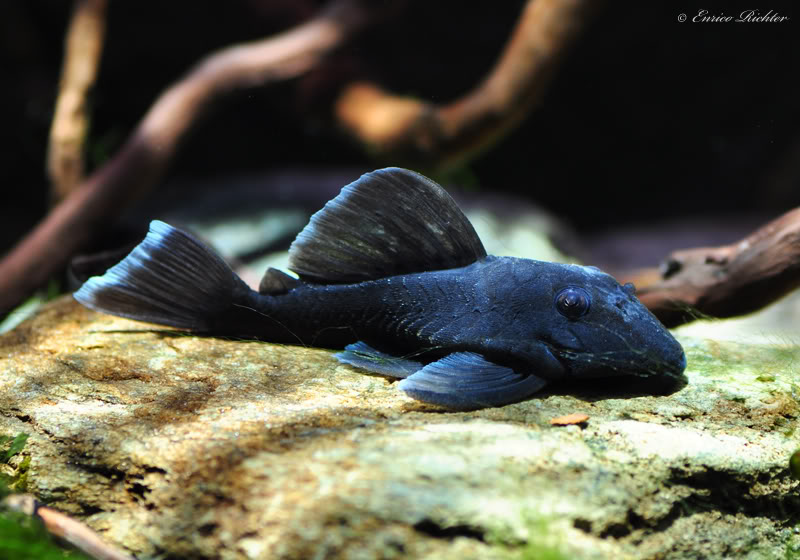
Baryancistrus begginiL239
Lujan, Arce & Armbruster, 2009
Max length81mm SL3.2in SLTank80 × 30cm31 × 12inTemp26–30°C79–86°FpH5.5–7.5Prior to description this species was traded under the DATZ code L239. It can be distinguished from other species in the genus and other hypostomines (see below for definition of this grouping) by its uniformly black to brownish body and fin colouration with a turquoise to bluish sheen, and the acutely bent shape of midventral body plates 3-5 which form a distinctive keel running along the body, above the pectoral fins...
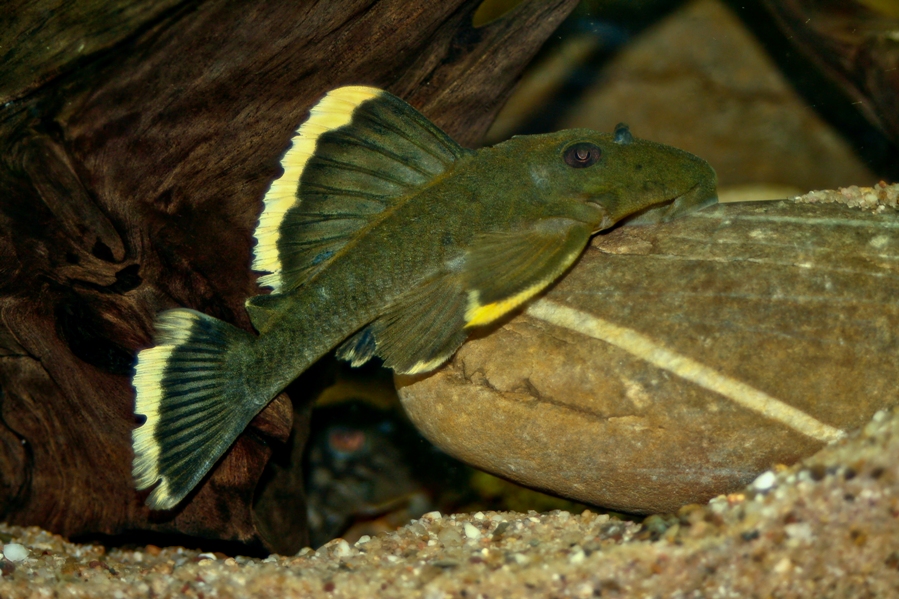
Baryancistrus chrysolomusMango Pleco
Rapp Py-Daniel, Zuanon & Ribeiro de Oliveira, 2011
Max length219mm SL9in SLTank120 × 45cm48 × 18inTemp27–32°C81–90°FpH6.0–7.5Prior to description this species was traded under the DATZ code L047 or the alternative vernacular name 'magnum pleco'. It can be distinguished from congeners by a combination of the following characters: presence of a broad, light-coloured (usually yellowish) distal band on the dorsal and caudal fins throughout life, slightly reduced in adults. The only other member of the genus to possess such bands is B. xanthellus but in that species they are reduced to small markings at the fin tips in adults, and the body is covered in pale, normally yellowish, spots.
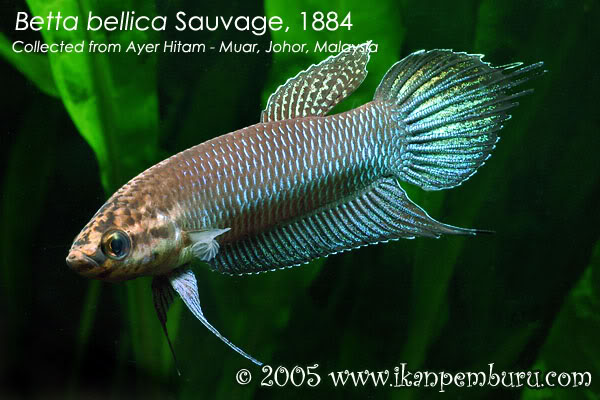
Betta bellicaSlender Betta
Sauvage, 1884
Max length90mm SL3.5in SLTank80 × 30cm31 × 12inTemp25–30°C77–86°FpH4.0–7.0This species lends it name to the B. bellica group/complex of closely-related species within the genus, an assemblage of which members share the following set of characters: long and slender body with dorsal and ventral margins almost parallel; body depth 23-28 % SL; 30-33 anal-fin rays; 11-13 dorsal-fin rays; 32-34 total vertebrae; body dark brown in colour with iridescent green markings on each individual scale.
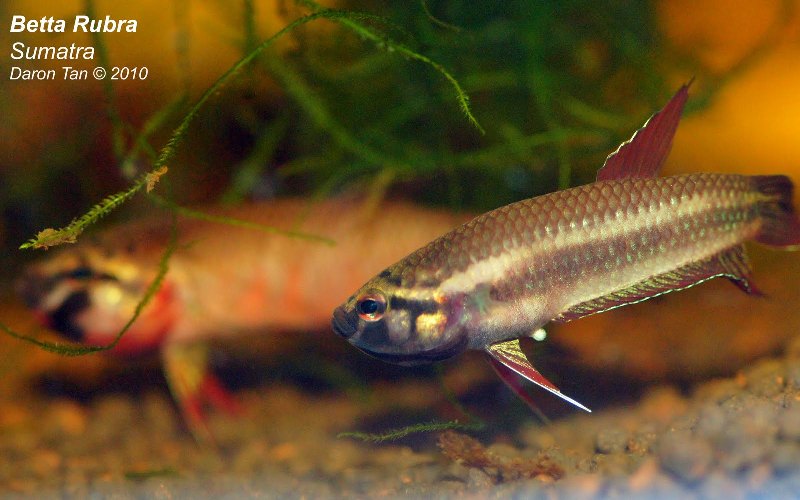
Betta dennisyongi
Tan, 2013
Max length36mm SL1.4in SLTank45 × 30cm18 × 12inTemp22–27°C72–81°FpH5.0–7.0This species is available in the aquarium hobby but is not traded in large numbers and may have been inadvertently hybridised with the similar-looking congener B. rubra prior to its description since they're typically exported mixed together. It's included in the B. rubra group of closely-related species within the genus, an assemblage erected by Schindler and van der Voort (2012) who...
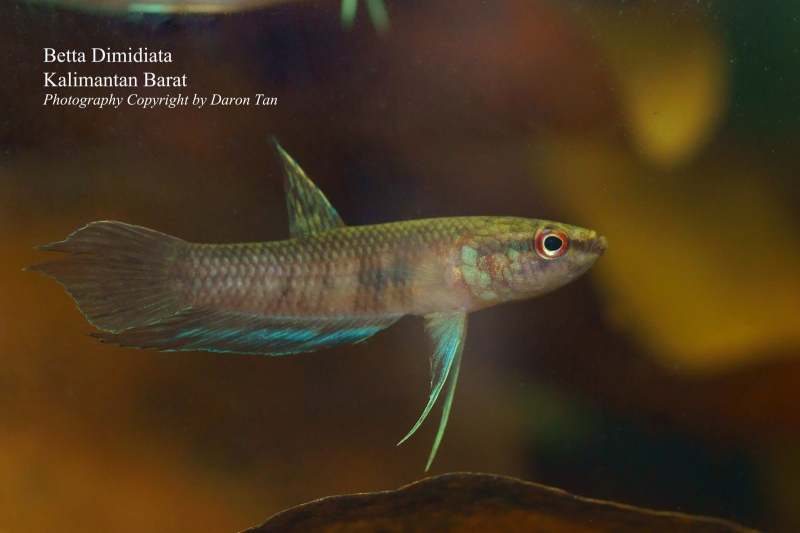
Betta dimidiata
Roberts, 1989
Max length40mm SL1.6in SLTank45 × 30cm18 × 12inTemp22–27°C72–81°FpH5.2–6.5This species is often confused with B. krataios in the aquarium trade, the latter having been known as B. sp. 'Kapuas' prior to description. The two can easily be told apart as the caudal-fin is rounded in B. krataios but spade-shaped and in adults, highly-extended in B. dimidiata. Together these two comprise the B. dimidiata group of closely-related species within the gen...
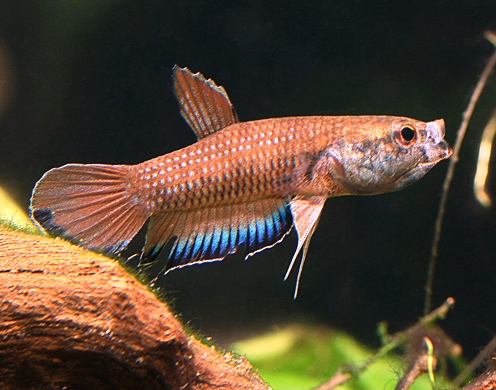
Betta falx
Tan & Kottelat, 1998
Max length50mm SL2.0in SLTank60 × 30cm24 × 12inTemp22–27°C72–81°FpH4.7–6.8B. falx is included in the Betta picta group/complex of closely-related species within the genus, an assemblage comprising species with the following shared characters: unpaired fins rounded (anal-fin sometimes tapering to a blunt point); anal-fin rays I-III, 18-24; dark marginal band on anal and caudal fins, more pronounced in mature males; presence of pre-orbital and post-orbital stripes; presence of chin bar on throat; iridescent green, gold, or blue scales on opercle.
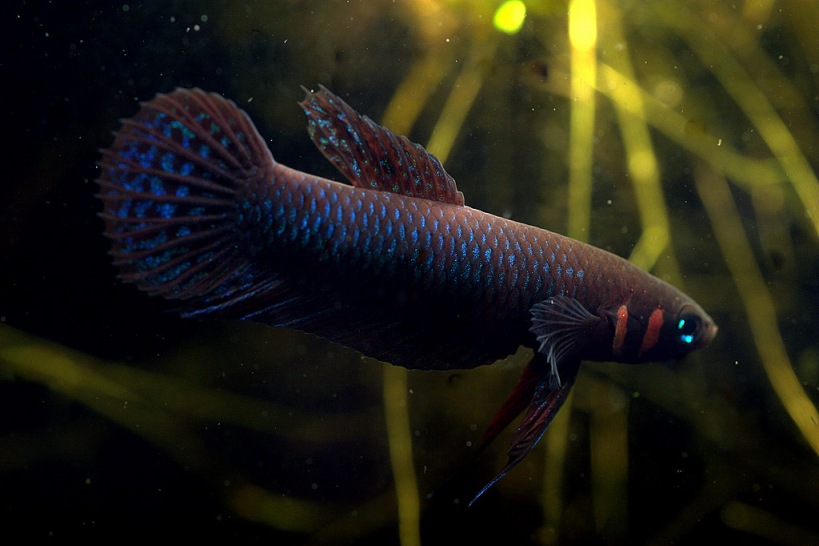
Betta hendra
Schindler & Linke, 2013
Max length45mm SL1.8in SLTank45 × 30cm18 × 12inTemp22–27°C72–81°FpH4.0–6.5This appears to be an undescribed species, and has only been available to the aquarium hobby in limited numbers to date. The rather long-winded trade name derives from the fact that it was initially marketed as two different species, i.e., B. sp. 'Sengalang' and B. sp. 'Palangka'. The spelling of the latter was later corrected but the fish may still be seen with either or both names attached. It looks very similar to fis...
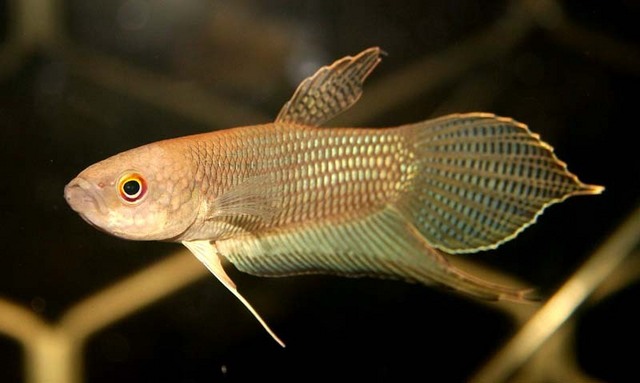
Betta ibanorum
Tan & Ng, 2004
Max length85mm SL3.3in SLTank80 × 30cm31 × 12inTemp24–28°C75–82°FpH4.0–7.0B. ibanorum is uncommon in the hobby and is apparently more frequently fished for food than the aquarium trade. It's included in the Betta akarensis group/complex of closely-related species within the genus, of which members share the following set of characters: possession of pre-orbital and post-orbital stripes (the post-orbital stripe is faint or interrupted in some species); chin bar present; caudal-fin lance...
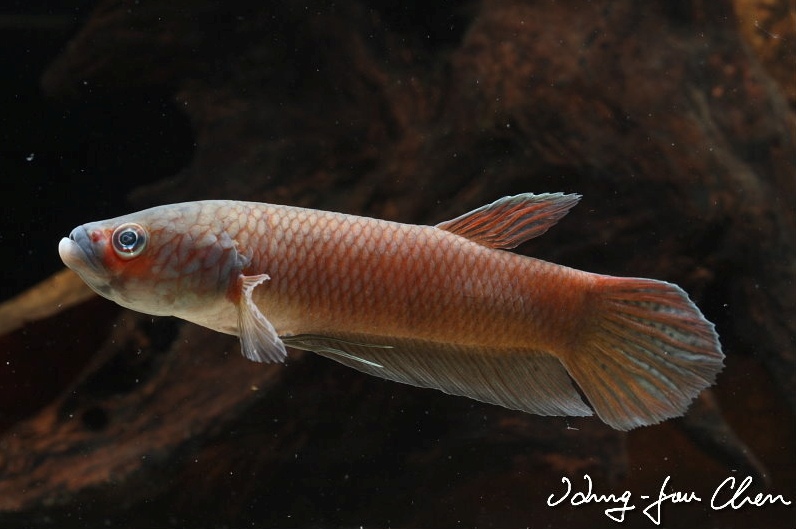
Betta ideii
Tan & Ng, 2006
Max length110mm SL4in SLTank90 × 30cm36 × 12inTemp20–26°C68–79°FpH5.5–7.5Prior to official description this species was traded as B. sp. 'Laut'. It's included in the Betta unimaculata complex of closely-related species within the genus, , of which members share the following set of characters: body long and slender with depth at dorsal fin origin 18-25 % SL; head large and blunt with width 19-24 % SL; long maxilla and lower lip with distance from tip of lower jaw to posterior end of maxilla 27-54 % HL; caudal-fin rounded in sha...
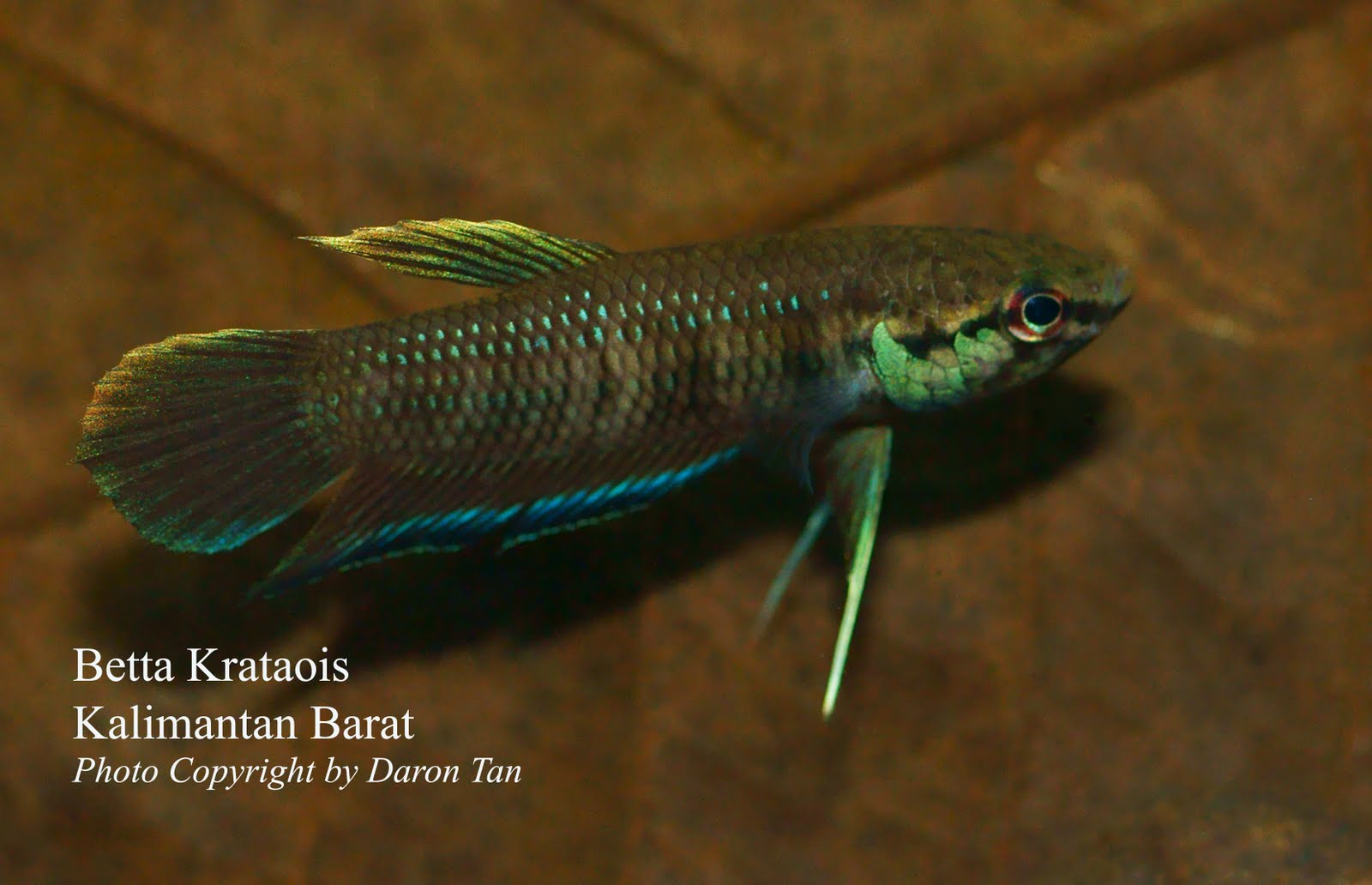
Betta krataios
Tan & Ng, 2006
Max length45mm SL1.8in SLTank45 × 30cm18 × 12inTemp22–28°C72–82°FpH5.0–7.0This species was traded as B. sp. 'Kapuas' prior to its formal description and continues to be mislabelled B. dimidiata. The two can easily be told apart as the caudal-fin is rounded in B. krataios but spade-shaped and in adults, highly-extended in B. dimidiata. Together these two comprise the B. dimidiata group/complex of closely-related species within the genus, members of which can be characterised b...