Search the catalogue
Type a name: scientific, common, or one a species used to go by. Or narrow the catalogue with the filters.
Filters
Bryconaethiops boulengeriBoulenger's Featherfin Tetra
authority not recorded
Max length250mm SL10in SLTank120 × 45cm48 × 18inTemp22–26°C72–79°FpH6.0–8.0This rarely imported species makes an attractive addition to a community of larger peaceful fish. It is farmed commercially for food in its native countries....
Buccochromis lepturusSlender Tail Hap
authority not recorded
Max length400mm SL16in SLTank150 × 45cm60 × 18inTemp24–27°C75–81°FpH7.5–8.8Also known as the green lepturus, this is a stunning species when mature. Unfortunately, it is rarely seen for sale. Its pelagic nature means it is difficult to catch for export. As a result it can be quite expensive when it is available....
Buccochromis nototaeniaStripeback Hap
authority not recorded
Max length225mm SL9in SLTank120 × 45cm48 × 18inTemp24–27°C75–81°FpH7.5–8.8Rarely seen in the trade, as it is quite difficult to collect in nature. It retreats at great speed into deeper water at the first sign of threat. As with other members of its genus, it is a hunter, feeding mainly on smaller cichlids.
Bunocephalus coracoideusBanjo Catfish
authority not recorded
Max length150mm SL6in SLTank60 × 38cm24 × 15inTemp20–27°C68–81°FpH5.8–7.8Bunocephalus is the largest genus within the Aspredinidae family and there are several undescribed species. B. coracoideus is the most common member seen in dealers' tanks. Its native name "Guitarrita" translates as "little guitar" and refers to the shape of the fish when viewed from above. Despite the regularity with which it is seen for sale, it isn't really a good catfish for the general community tank because it's a largely inactive, secretive species, ...
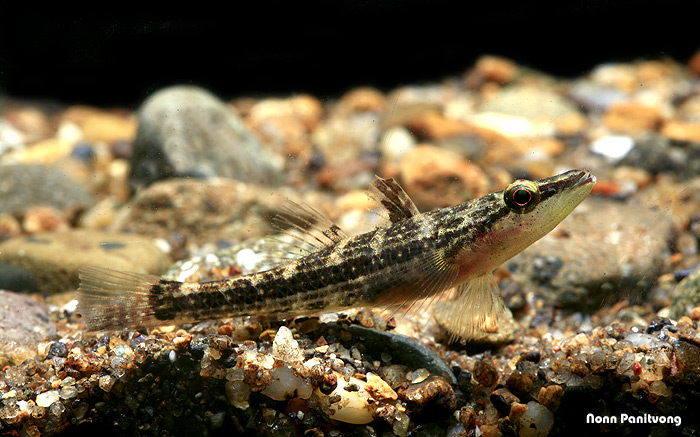
Butis amboinensisOlive Flathead Gudgeon
Bleeker, 1853
Max length140mm SL6in SLTank75 × 30cm30 × 12inTemp22–28°C72–82°FpH7.0–8.5This species is not traded for aquaria but is occasionally exported as bycatch among shipments of other species. It differs from congeners in that the outermost row of teeth are not enlarged plus the interorbital space and cheek below eye are not scaled. Butis spp. are largely nocturnal ambush predators with cryptic...
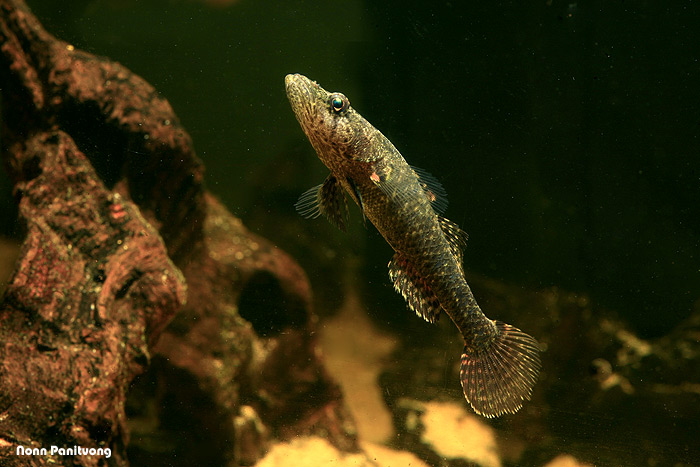
Butis butisCrazy Fish
Hamilton, 1822
Max length120mm SL5in SLTank75 × 30cm30 × 12inTemp22–27°C72–81°FpH7.0–8.5Butis spp. are largely nocturnal ambush predators with cryptic patterning to help them blend in with their surroundings. They can also lighten and darken their body colouration to an extent, have a habit of aligning themselves with solid surfaces whether horizontal, vertical, or inverted, and often swim in an upside-down position. The genus is usually included in the family Eleotridae of which members are often referred to...
Caecomastacembelus albomaculatus
authority not recorded
Max length220mm SL9in SLTank120 × 30cm48 × 12inTemp23–27°C73–81°FpH8.0–9.5This is a great oddball species for the Tanganyikan community tank, although it is not as attractive as the closely related Aethiomastacembelus ellipsifer. It is rarely seen in the hobby. The species in the family Mastacembelidae are known as "spiny" eels because the dorsal rays are stiffened. Care must therefore be exercised when handling them to avoid injuries. Spiny eels also have no swim bladder, an adaptation to their benthic lifestyle....
Caecomastacembelus plagiostomus
authority not recorded
Max length300mm SL12in SLTank120 × 45cm48 × 18inTemp23–27°C73–81°FpH8.0–9.5Very rarely seen in the hobby, this species makes an interesting oddball addition to the Tanganyikan community tank. The species in the family Mastacembelidae are known as "spiny" eels because the dorsal rays are stiffened. Care must therefore be exercised when handling them to avoid injuries. Spiny eels also have no swim bladder, an adaptation to their benthic lifestyle.....
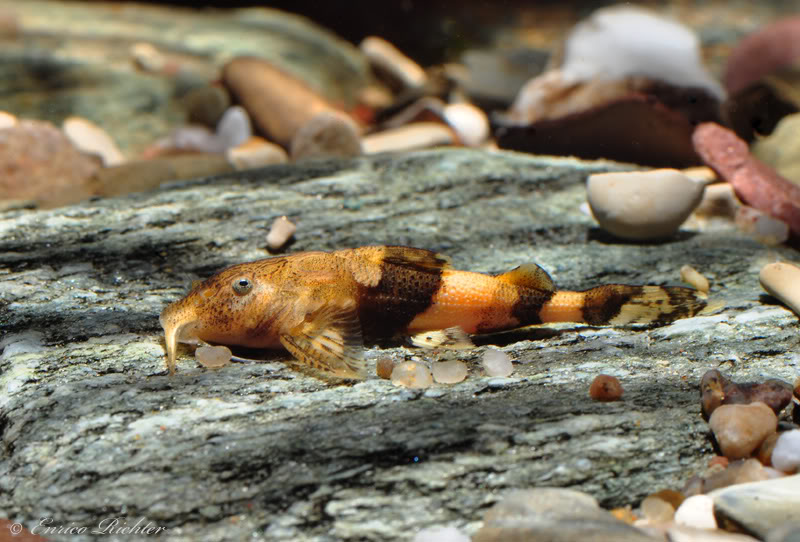
Caelatoglanis zonatus
Ng & Kottelat, 2005
Max lengthnot recordedTanknot recordedTempnot recordedpHnot recordedKnown only from the Ataran River system in Kayin state, Myanmar. The Ataran forms the headwaters of part of the larger Salween drainage, and some of its tributaries extend across the nearby border into Thailand, where it’s known as the Kasat. Type locality is 'Stream ''Chon Son' between Kyondaw and Phadaw, about 20 kilometers north...
Callochromis macropsBig-eyed Mouthbrooder
authority not recorded
Max length135mm SL5in SLTank120 × 45cm48 × 18inTemp24–27°C75–81°FpH7.8–9.5Members of the genus Callochromis feed in a similar way to the South American "eartheaters" such as Geophagus species. They extract invertebrates and other items hidden in the substrate by taking in mouthfulls of sand and sifting it through the gills. The common term "sand sifters" is applied to these and other Tanganyikan species that inhabit a similar ecological niche, such as Enantiopus and Xenotilapia spp. Several geographical colour forms of this species exist. These ...
Campylomormyrus tamanduaWorm-Jawed Mormyrid
authority not recorded
Max length400mm SL16in SLTank180 × 60cm72 × 24inTemp23–28°C73–82°FpH5.0–7.0C. tamandua is quite a rare fish in the hobby, but is imported occasionally. It's not a good beginner's fish as it requires pristine soft, acidic water conditions, will generally not feed on standard foods and attains a very respectable adult size. It's also sensitive to many aquarium medications. It can sometimes be found as a contaminant among imports of the much more common Elephant Fish, Gnathonemus petersii. Unlike this species, C. tamandua has both upper and lower jaws exten...
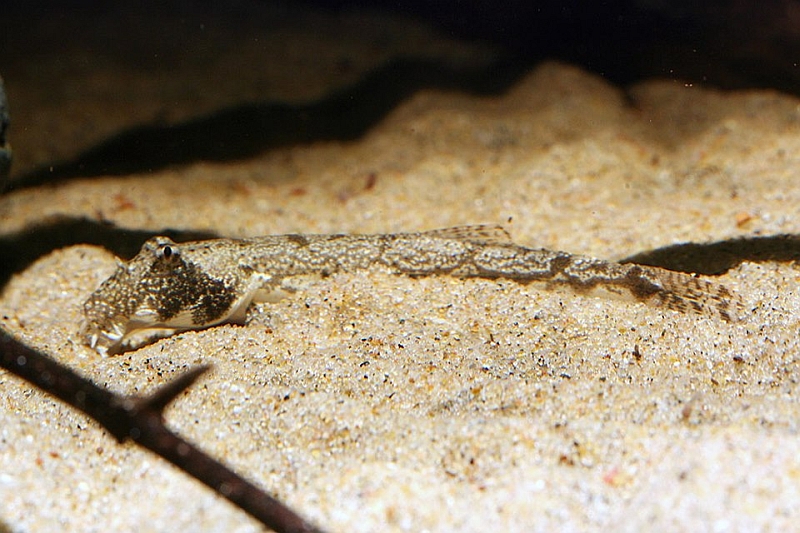
Canthophrys gongotaMoose-faced Loach
Hamilton, 1822
Max length110mm SL4in SLTank90 × 30cm36 × 12inTemp18–22°C64–72°FpH6.0–7.0Mostly known from slow-moving, relatively shallow tributaries and minor rivers with substrates of mud, sand or gravel. Aquatic plants are only occasionally present but riparian vegetation apparently grows thickly at some localities. In the Schutunga River, part of the Mansai River drinage which is itself a tributary of the Brahmaputra in West Bengal state, In...
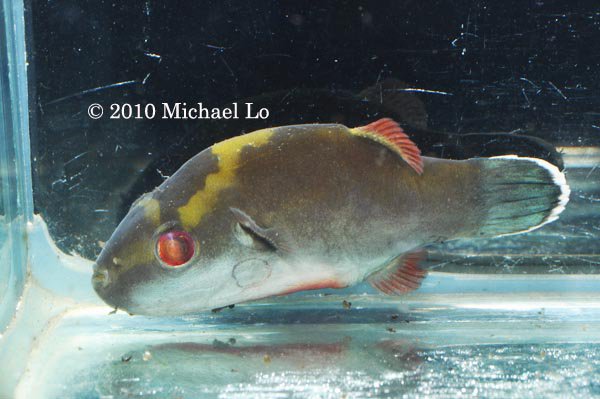
Carinotetraodon borneensis
Regan, 1903
Max length45mm SL1.8in SLTank60 × 30cm24 × 12inTemp20–28°C68–82°FpH6.0–7.5This species is relatively uncommon in the aquarium hobby but is available on occasion, sometimes mixed in among shipments of the congener C. salivator. These two can be told apart by the fact that C. salivator possesses a series of distinct dark bars on the head and body in both sexes, a colour pattern unique within the genus. It is also similar t...
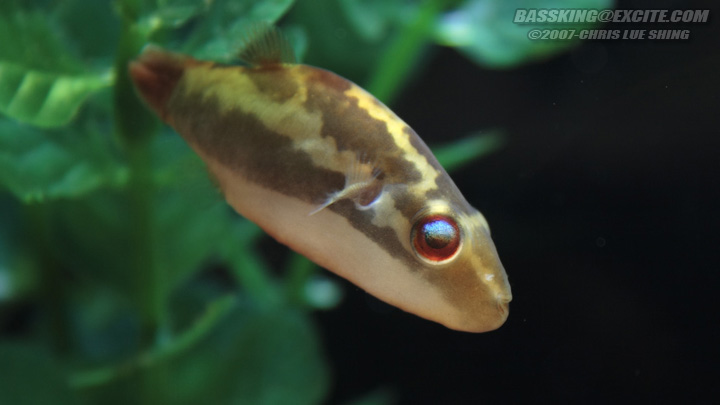
Carinotetraodon irrubescoRed-tailed Redeye Puffer
Tan, 1999
Max length45mm SL1.8in SLTank60 × 30cm24 × 12inTemp20–28°C68–82°FpH6.0–7.5This species is uncommon in the aquarium hobby. It is similar to the congeners C. borneensis and C. lorteti but can be told apart by males possessing a red (vs. bluish to greyish with black and white distal bands in C. lorteti) caudal-fin and lacking (vs. possessing) a black blotch at the base of the dorsal-fin.
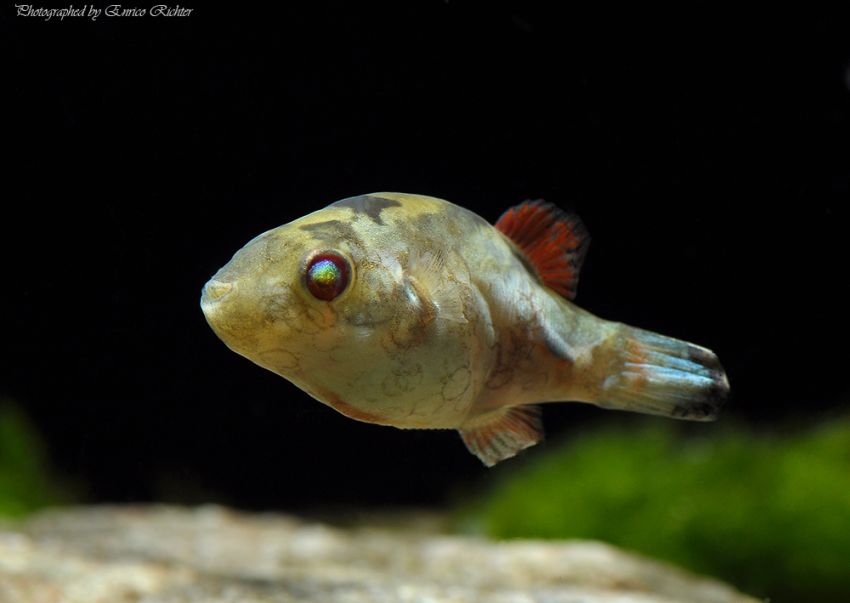
Carinotetraodon lortetiRedeye Puffer
Tirant, 1885
Max length60mm SL2.4in SLTank60 × 30cm24 × 12inTemp20–28°C68–82°FpH5.0–7.5Known from the lower Mekong basin in Thailand, Vietnam, and Cambodia, the Chao Phraya watershed in central Thailand, and may occur in smaller river systems between. Type locality is 'Thu-dâu-môt, Vietnam'.
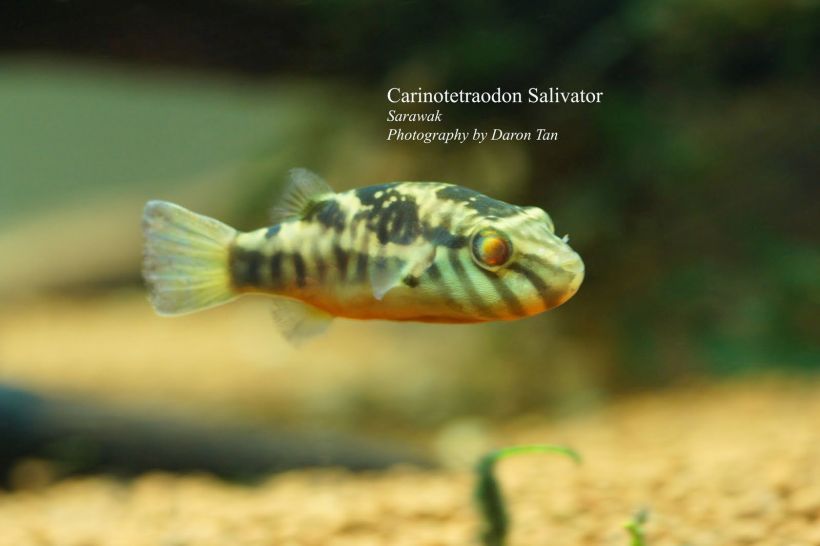
Carinotetraodon salivator
Lim & Kottelat, 1995
Max length50mm SL2.0in SLTank60 × 30cm24 × 12inTemp20–28°C68–82°FpH5.0–7.5It is included in a group often referred to as 'red-eyed puffers', which currently contains four recognised species distributed in Indochina and the Greater Sunda Islands. It can be distinguished from C. borneensis, C. irrubesco, and C. lorteti, the remaining members of this group, by the following combination of characters: 11 dorsal-fin rays; 16 pectoral-fin rays; 11-13 anal-fin rays; 11 caudal-fin rays; eyes not bulging above the head; in males dorsal-fin hyaline, black spot on dorsal-fin base present, pectoral-fin base hyaline, anal-fin hyaline with no black spot at base...
Carinotetraodon travancoricusDwarf Puffer
authority not recorded
Max length25mm SL1.0in SLTanknot recordedTemp22–28°C72–82°FpH6.8–8.0C. travancoricus is probably the smallest species of puffer, and is certainly one of the more diminutive fish regularly found in the trade. It's cute looks, amusing personality and fascinating swimming action make it a justifiably popular import, although it's all-too-often sold without the correct information needed for its long-term health and care. It's also known as the Malabar puffer, in reference to the area of southern India that contains much of the species' natural r...
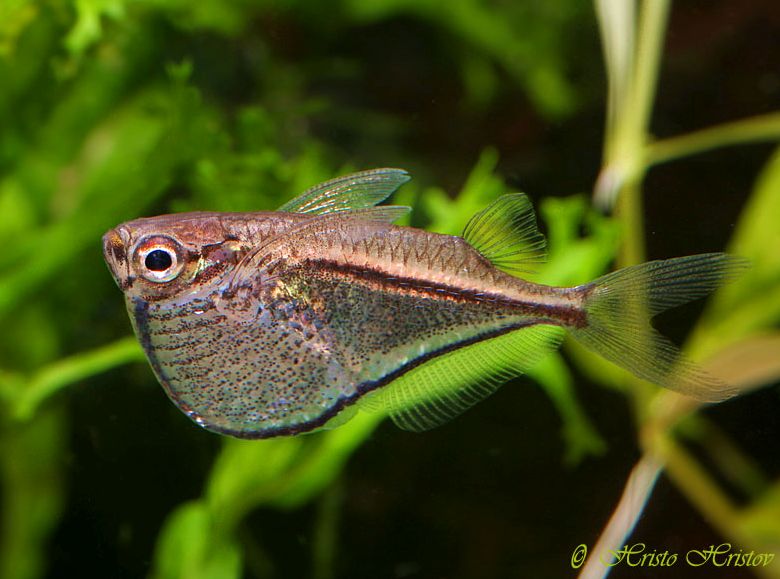
Carnegiella marthaeBlackwing Hatchetfish
Myers, 1927
Max length28mm SL1.1in SLTank60 × 30cm24 × 12inTemp20–28°C68–82°FpH4.0–7.0Gasteropelecids are commonly-referred to as 'freshwater hatchetfishes' due to their heavily-keeled body shape which has evolved in such a way due to possessing an enlarged, heavily-muscled pectoral girdle, and which resembles the shape of a hatchet head. They are sometimes said to be capable of propelled flight above the water surface by beating their pectoral fins but in fact this is not the case and was disproven by Wiest (1995) who used...
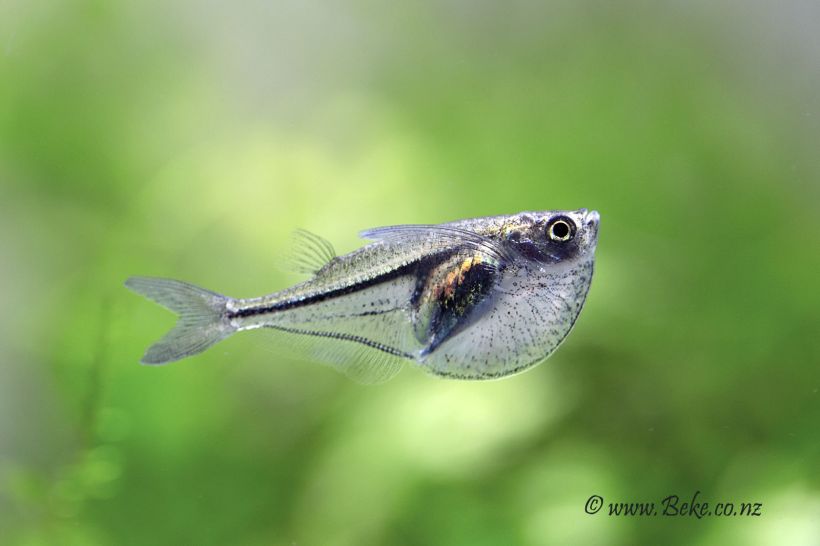
Carnegiella myersiPygmy Hatchetfish
Fernandez-Yepes, 1950
Max length25mm SL1.0in SLTank50 × 30cm20 × 12inTemp23–26°C73–79°FpH4.0–7.0The smallest and most delicate of the nominal hatchetfishes. The rounded keel is shallower than related species, giving this fish a distinctive elongate profile. The family Gasteropelecidae is separated from other Characiformes by the following combination of characters: front...
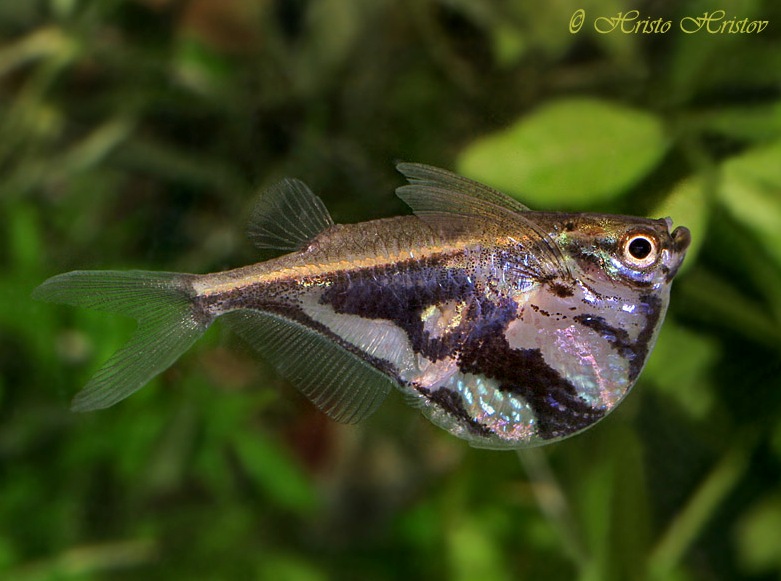
Carnegiella strigataMarbled Hatchetfish
Günther, 1864
Max length35mm SL1.4in SLTank75 × 30cm30 × 12inTemp20–28°C68–82°FpH4.0–7.0C. strigata is an enduringly popular species in the aquarium hobby but is not bred on a commercial basis with all fish offered for sale collected in the wild. It can be told apart from other members of the genus by its larger adult size and dark, marbled colour pattern appearing as a series of dark and light stripes running diagonally across the body below the lateral line. This colour pattern is variable and popul...