Results for “fin”
Type a name: scientific, common, or one a species used to go by. Or narrow the catalogue with the filters.
Filters
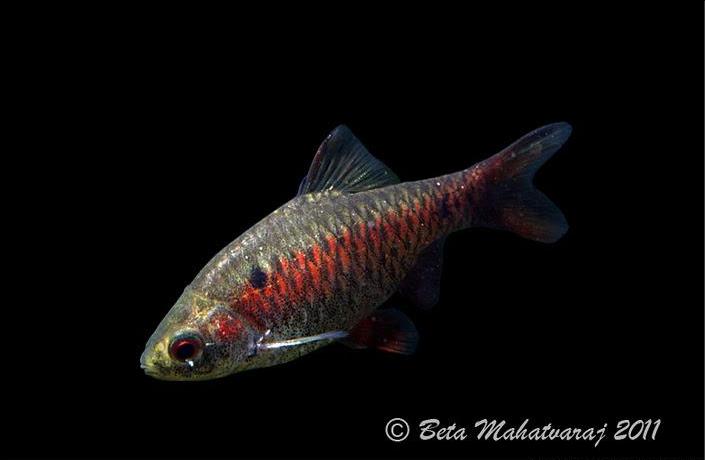
Pethia manipurensis
Menon, Rema Devi & Vishwanath, 2000
Max length62mm SL2.4in SLTank80 × 30cm31 × 12inTemp18–25°C64–77°FpH5.5–7.5Within this assemblage P. manipurensis is most similar to 'P.' meingangbii and P. padamya by virtue of the fact that males in all three possess orange-red pigmentation on the flanks and caudal-fin. It can be told apart most easily by the fact it possesses a relatively small, spot-like humeral marking, vs. a vertically-elongated, relatively large humeral marking in both the other species.
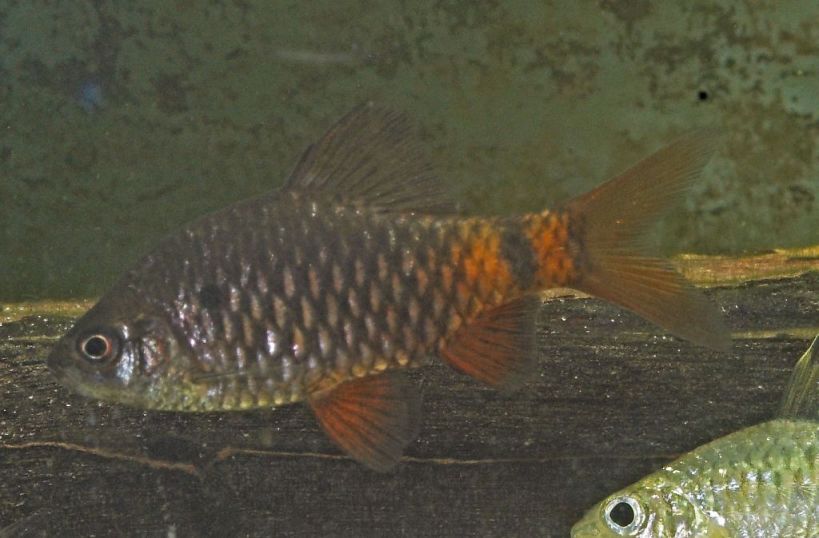
Pethia nigripinnis
Knight, Rema Devi, Indra & Arunachalam, 2012
Max length45mm SL1.8in SLTank90 × 30cm36 × 12inTemp16–21°C61–70°FpH5.5–7.5At one locality in the Kalindhi drainage the water was clear, 1 m at its deepest point and flowing either side of a small check dam, below which the flow was stronger though still not particularly fast. The substrate was composed of rocks and cobbles with a thick layer of fine silt and sand above the dam. There were no aquatic plants but marginal grasses and shrubs were growing to the margins with some submerged roots protruding into the water.
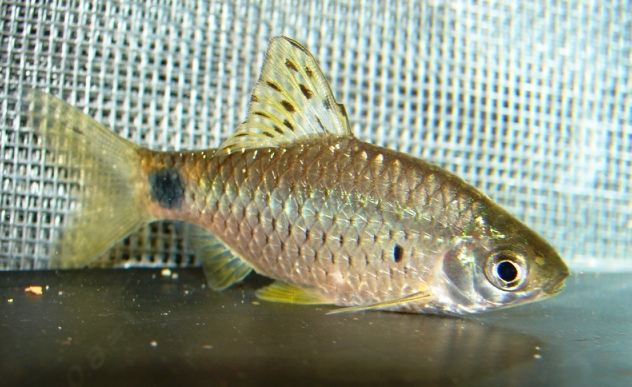
Pethia punctata
Day, 1865
Max length55mm SL2.2in SLTank75 × 30cm30 × 12inTemp21–26°C70–79°FpH6.0–7.5This species is poorly-known in the aquarium hobby and has a confusing taxonomic history having been considered both synonymous with or a subspecies of the congener P. ticto in the past. It can be distinguished from other members of the genus by the following combination of characters: lateral line complete with 27 scales (following Day); body with two dark blotches; anterior spot one scale row below lateral line; dorsal-fin with rows of spots.
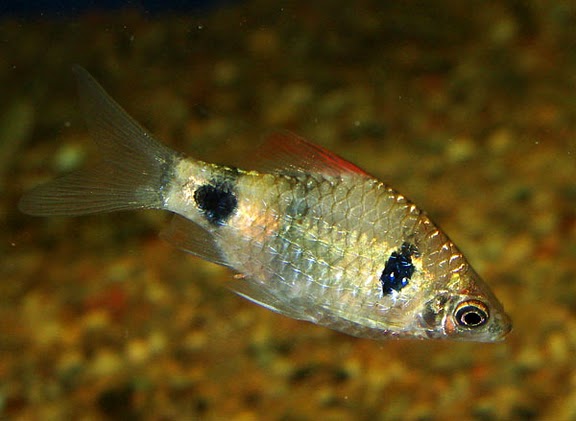
Pethia setnaiNarayan Barb
Chhapgar & Sane, 1992
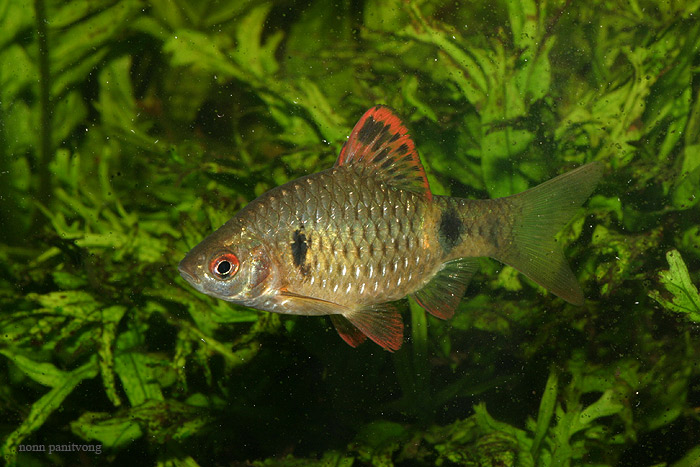
Max length65mm SL2.6in SLTank90 × 30cm36 × 12inTemp20–26°C68–79°FpH6.0–7.5This species is widely referred to and traded as the congener 'Puntius' narayani (Hora, 1937). The precise identity of the latter is in doubt, however, plus P. setnai possesses a serrated dorsal-fin spine whereas 'P.' It was formerly included in the Puntius conchonius 'group' of closely-related species alongside P. ater, P. bandula, P. conchonius, P. cumingii, P. erythromycter,...
Pethia stoliczkana
Day, 1871
Max length50mm SL2.0in SLTank75 × 30cm30 × 12inTemp18–26°C64–79°FpH6.0–7.5This species is confused with P. ticto in much of the available literature and is sometimes listed as a synonym of it. Although some populations of the two species possess a similar colour pattern (there are reports of a P. ticto variant from the south of West Bengal state in India with a red, black-flecked dorsal-fin, for example) they do not occur in the same waters in nature and can be distinguished by examining the lateral line. This is complete in...
Phenacogrammus interruptusCongo Tetra
authority not recorded
Max length80mm SL3.1in SLTank120 × 30cm48 × 12inTemp23–28°C73–82°FpH6.0–7.5P. interruptus are quite sensitive to water quality and if a high standard is not maintained the development of the males' fins may be impaired and the fish will lose colour. They are also quite an easily frightened fish, particularly if they are not maintained in numbers. This species is most often seen for sale as a fairly drab, greyish 1 1/2" fish and is often overlooked. However once they are settled into the aquarium and have begun to mature they develop spectacular colouration. ...
Poecilia reticulataGuppy
Peters, 1859
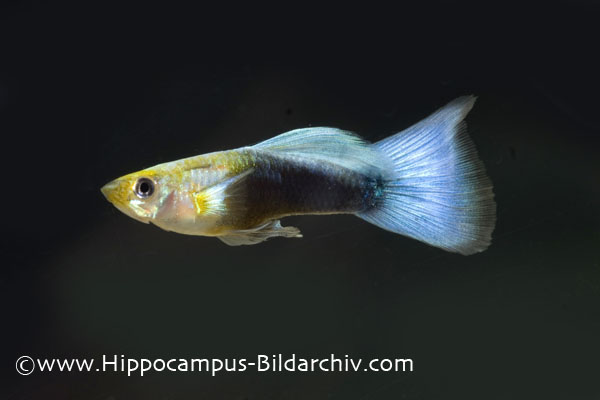
Max length60mm SL2.4in SLTank45 × 30cm18 × 12inTemp17–28°C63–82°FpH7.0–8.5One of the most popular aquarium fish in the world, the guppy is instantly recognisable to most people. There are many aquarium bred varieties of this species available, most have elongated finnage and gaudy colouration. The wild form is seldom seen for sale. Unfortunately many commercially bred guppies are not very hardy due to inbreeding and over-production and are prone to disease and premature death. We therefore recommend the purchase of quality stock from breeders or society auctions. P. ...
Polycentropsis abbreviataAfrican Leaf Fish
authority not recorded
Max length80mm SL3.1in SLTank60 × 38cm24 × 15inTemp26–31°C79–88°FpH6.0–6.5Like the closely related Polycentrus species from South America, with which it is sometimes confused, this fish is camouflaged to mimic a dead leaf, both in body shape and pattern. It can also change colour to match its surroundings. When hunting, it stalks its prey in a head-down stance, appearing to drift towards it like a dead leaf drifting in a current. In reality the fish is propelled by tiny movements of its transparent hind fins. When it strikes at an item of prey, the entire mouth pro...
Prionobrama filigeraGlass Bloodfin Tetra
authority not recorded
Max length60mm SL2.4in SLTank60 × 38cm24 × 15inTemp23–27°C73–81°FpH6.0–7.5The genus Prionobrama currently contains only one other valid species, P. paraguayensis. It is very similar in appearance to P. filigera, but lacks any red pigmentation in the caudal fin. It's probably never been imported for the hobby, although it may show up as occasional bycatch amongst shipments of more popular species. P. filigera can be easily distinguished from the "other" bloodfin tetra, Aphyocharax anisitsi by its more elongate body shape and the fact that it exhibits...
Protopterus annectens annectensAfrican Lungfish
authority not recorded
Max length1000mm SL39in SLTank180 × 75cm72 × 30inTemp24–30°C75–86°FpHnot recordedLungfish are among the most intriguing of "oddball" aquarium subjects, being able to survive in the most extreme conditions. They are very ancient fish, having remained virtually unchanged for millions of years. The natural habitat of P. a. annectens is wet for only part of the year and the fish has developed several incredible adaptations in order to counteract this. When the waters begin to recede, the fish will find a suitable nesting site, usually amongst heavy vegetation. Here...
Protopterus dolloiSlender Lungfish
authority not recorded
Max length1300mm SL51in SLTank180 × 75cm72 × 30inTemp24–30°C75–86°FpH6.0–7.5Lungfish are among the most intriguing of "oddball" aquarium subjects, being able to survive in the most extreme conditions. They are very ancient fish, having remained virtually unchanged for millions of years. Some of the natural habitats of P. dolloi are wet for only part of the year, and it has developed several incredible adaptations in order to counteract this. When the waters begin to recede, the fish will find a suitable nesting site, usually amongst heavy vegetation. Here ...
Pseudocrenilabrus nicholsi
authority not recorded
Max length85mm SL3.3in SLTank90 × 30cm36 × 12inTemp22–25°C72–77°FpH6.0–8.0Rarely seen in the hobby, P. nicholsi is a stunning but pugnacious little fish that is nevertheless well worth seeking out. Some males develop long extensions to the ventral fins.
Pseudogastromyzon laticeps
authority not recorded
Max length67mm SL2.6in SLTank75 × 30cm30 × 12inTempnot recordedpH6.0–7.5It appears that this species has not yet appeared in the western hobby, probably because commercial fish collections don't normally take place in its native waters although the goby Rhinogobius zhoui has been available occasionally. We're unable to provide details of distinguishing characters since no diagnostic key to the genus exists in English at time of writing, but based on the images available it does appear to possess reddish dorsal and caudal fins. The specimens pictured were i...
Pseudomugil furcatusForktail Blue-eye
Nichols, 1955
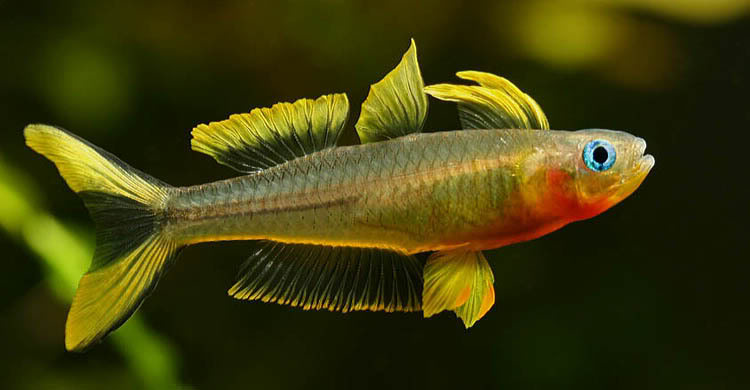
Max length60mm SL2.4in SLTank60 × 30cm24 × 12inTemp24–28°C75–82°FpH7.0–8.0This species is also traded as 'forktail rainbowfish' or 'yellow forktail', and it's also undergone several changes in scientific name since description. Pseudomugil furcatus is the original designation, but Allen (1980) created the genus Popondetta for it on the basis of morphological characters including number of anal-fin rays (16-20 in P. furcatus, 8-12 in other Pseudomugil spp.), absence of anterior...
Pseudosphromenus cupanusSpiketail Paradisefish
Cuvier, 1831
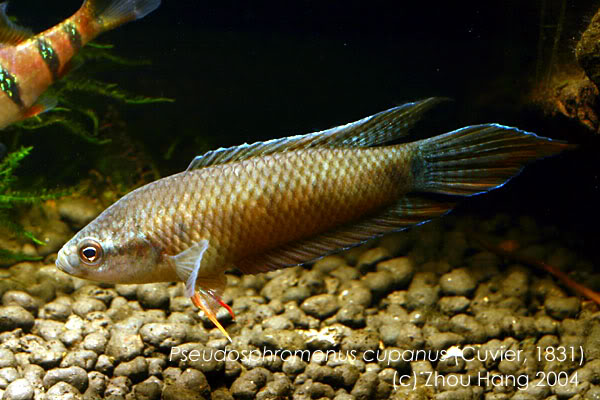
Max length65mm SL2.6in SLTank60 × 30cm24 × 12inTemp20–28°C68–82°FpH6.0–7.5This species is most easily told apart from its only congener P. dayi by lacking (vs. possessing) two dark, irregular lateral stripes on the head and body, and a shorter caudal-fin in males. The results of phylogenetic analyses by Rüber et al. (2006) suggest that Pseudosphromenus is most closely-related to Malpulutta in an evolutionary sense.
Pseudotropheus socolofiPowder Blue Cichlid
authority not recorded
Max length115mm SL5in SLTank90 × 45cm36 × 18inTemp24–28°C75–82°FpH7.6–8.8This common mbuna also goes by the names "Eduard's mbuna" and "Pindani". It is one of the most popular Rift Lake cichlids in the hobby due to its striking colouration and somewhat peaceful nature (for a mbuna). Wild fish can now be quite difficult to find, as the vast majority of specimens offered for sale are tank-bred. An albino form exists in aquaria and has achieved a fair degree of popularity. A highly recommended beginner's mbuna....
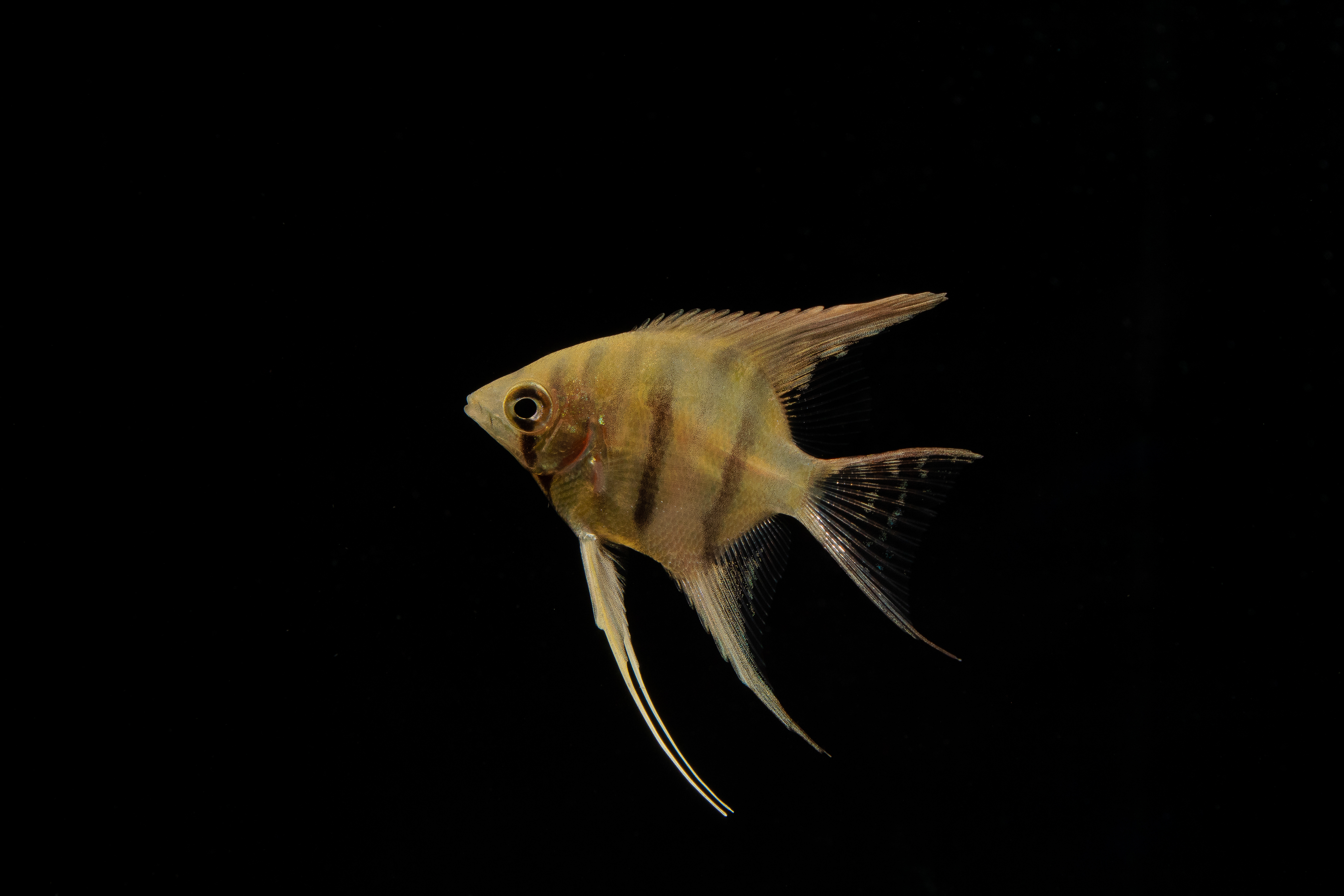
Pterophyllum leopoldiRoman Nose Angelfish
Gosse, 1963
Max length100mm SL3.9in SLTank90 × 30cm36 × 12inTemp22–29°C72–84°FpH5.0–7.0Pterophyllum leopoldi can be differentiated from other members of the genus by the presence of up to 11 vertical stripes on the body, though often only the 3 largest, boldest stripes can be seen. This species also shows a dark patch over the operculum. In adult specimens, a red/maroon hue over the back and fins is characteristic of the species, leading some to believe the most colourful natural form Angelfish. The name-sake roman nose possessed by the fish is also very distinctive and used as a meristic feature.
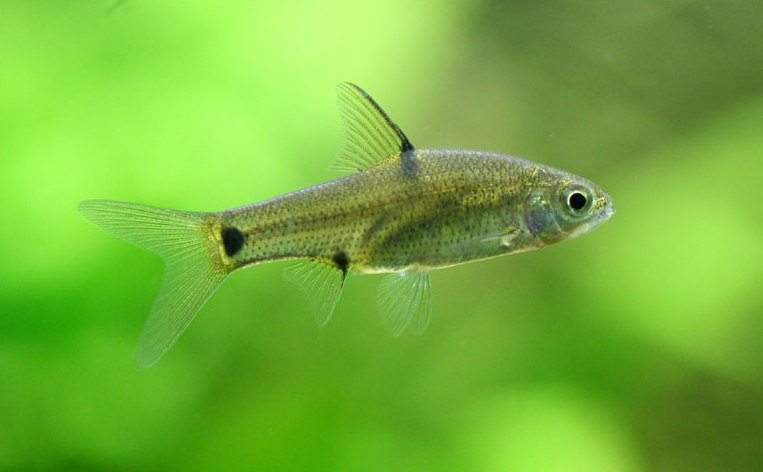
Puntius sharmai
Menon & Rema Devi, 1993
Max length40mm SL1.6in SLTank60 × 30cm24 × 12inTemp20–26°C68–79°FpH5.5–7.5This species is almost unheard of in the aquarium hobby outside of India but is maintained by some private collectors. It's distinguished from similar species by possessing a single pair of maxillary barbels, a relatively elongate body, and distinctive black spot above the anterior anal-fin base. The genus Puntius was for a number of years viewed as a polyphyletic catc...
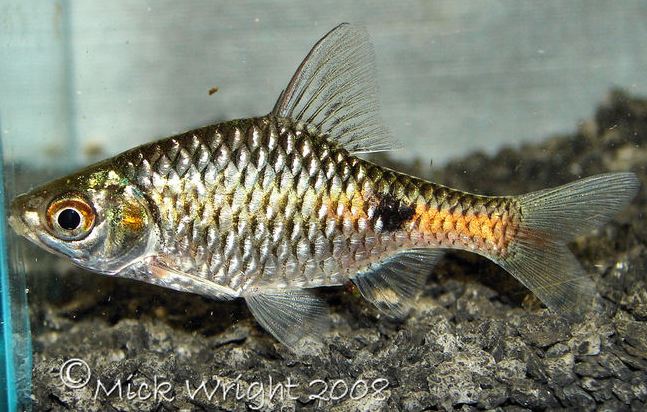
Puntius terioOnespot Barb
Hamilton, 1822
Max length90mm SL3.5in SLTank80 × 30cm31 × 12inTemp18–26°C64–79°FpH6.5–7.5This species is uncommon in the aquarium trade which is a little surprising given its huge natural range. Different populations can vary in colour pattern to an extent though all share the defining aspects given by Hamilton, comprising a diffuse yellow-golden marking on the operculum plus a dark spot on the caudal peduncle. The latter is usually surrounded by a variably-sized golden-yellow margin, and the dorsal-fin often contains irregular dark spots and streaks, these sometimes forming a longitudinal band.
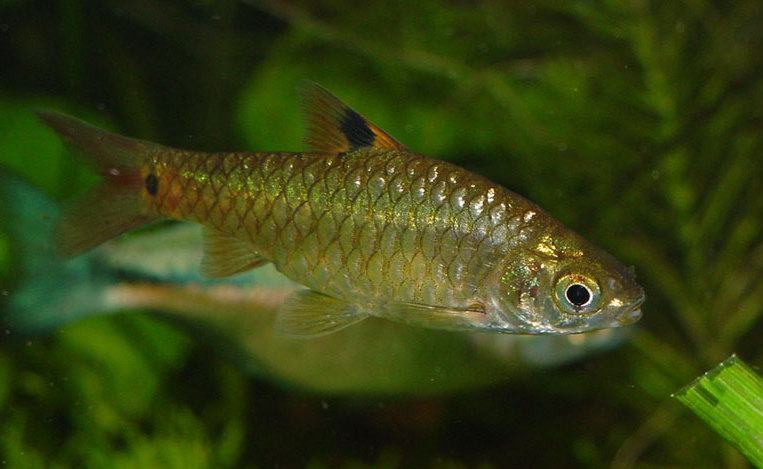
Puntius vittatusGreenstripe Barb
Day, 1865
Max length45mm SL1.8in SLTank75 × 30cm30 × 12inTemp18–26°C64–79°FpH6.0–7.5It can be told apart from similar-looking congeners such as P. crescentus and P. muzaffarpurensis by the following combination of characters: barbels absent; lateral line incomplete with up to 5 pored scales; 20-22 lateral line scales; 8 predorsal scales; dorsal-fin with a vertically-orientated black streak and a black tip with orange markings; a dark spot at the base of the caudal peduncle.