Results for “caudal peduncle”
Type a name: scientific, common, or one a species used to go by. Or narrow the catalogue with the filters.
Filters
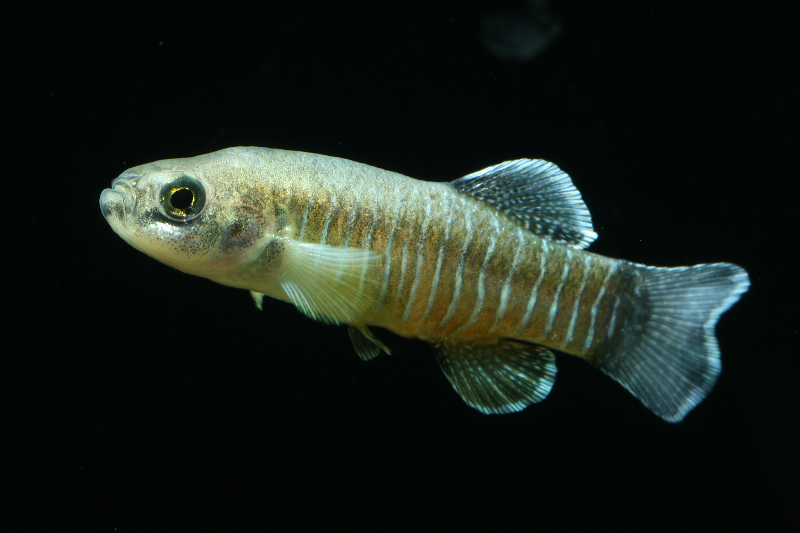
Esmaeilius arakensisArak Toothcarp
Teimori, Esmaeili, Gholami, Zarei, & Reichenbacher, 2012
Max length35mm SL1.4in SLTank120 × 30cm48 × 12inTemp8–32°C46–90°FpH7.0–8.5This species was available in the aquarium hobby for a number of years prior to publication of the official description and was generally referred to as A. sp. 'Namak' or A. sp. 'Namak River'. It can be distinguished from other members of the genus by the following combination of characters: 10–12 anal-fin rays; 28–32 lateral line scales, 10–13 caudal peduncle scales; 8–10 gill rakers; 12–19, commonly 1...
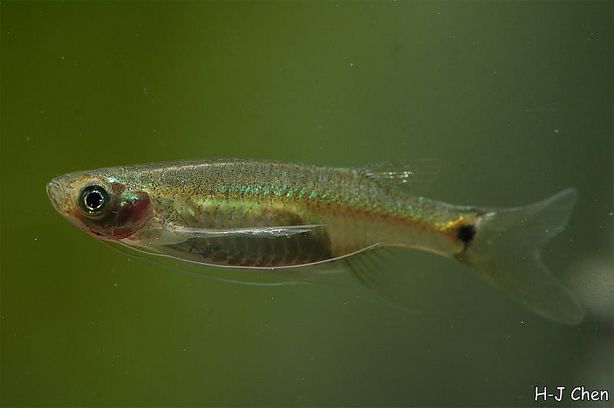
Esomus caudiocellatus
Ahl, 1924
Max length40mm SL1.6in SLTank120 × 30cm48 × 12inTemp20–26°C68–79°FpHnot recordedE. caudiocellatus can be told apart from congeners by lacking a dark lateral stripe and possessing a prominent dark marking on the caudal peduncle. In recent years a number of phylogenetic studies involving Esomus and its near relatives have been conducted and conflicting results published. For example a 2003 study by Fang et al. concluded that the genus is the sister group, i.e., most closely-related to...
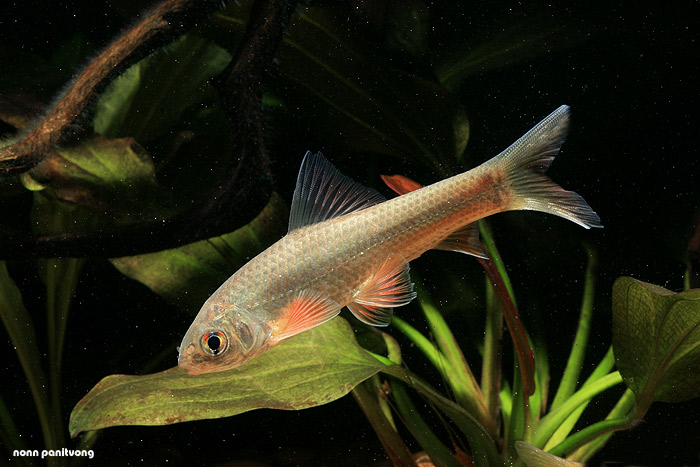
Gymnostomus ornatapinnis
Roberts, 1997
Max length100mm SL3.9in SLTanknot recordedTempnot recordedpHnot recordedG. ornatapinnis can be distinguished from congeners by the following combination of characters: head small; snout relatively short and blunt; caudal peduncle very deep; pectoral, pelvic, and anal fins usually reddish-orange or rose-tinted; pelvic and anal fins often with white tips; barbels completely absent.
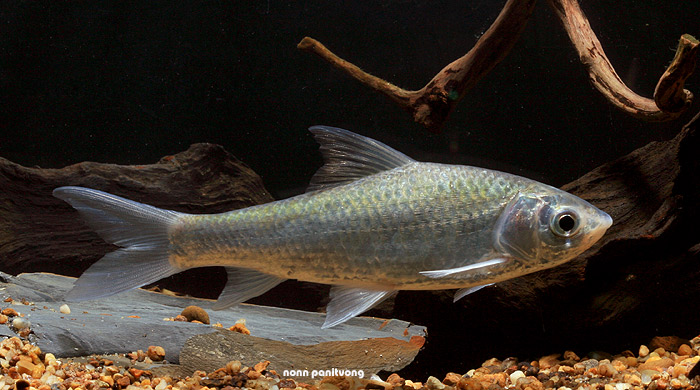
Gymnostomus siamensisSiamese Mud Carp
Sauvage, 1881
Max length150mm SL6in SLTanknot recordedTempnot recordedpHnot recordedG. siamensis can be distinguished from congeners by the following combination of characters: possession of 5½ lateral line scales; body relatively deep, depth fits 3.2-3.4 times in SL; head large and broad, width fits 5.5-6.7 times in SL; snout not or only weakly projecting; body plain silver in colour with no dark marking on caudal peduncle.
Hampala salweenensis
Doi & Taki, 1994
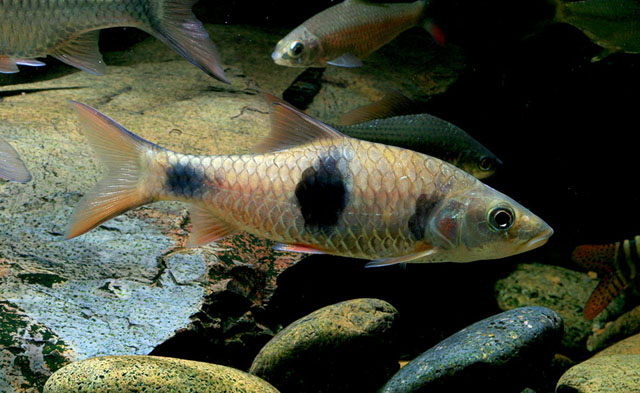
Max length201mm SL8in SLTank240 × 60cm96 × 24inTemp20–26°C68–79°FpH6.0–8.0This species is poorly-known in the aquarium hobby and may have never been maintained outside its native countries. It can be distinguished from congeners by the following combination of characters: 26-27 lateral line scales; two roundish, dark blotches on each flank, one beneath dorsal-fin origin and above the lateral line, the other on the caudal peduncle and passing thro...
Hemichromis bimaculatusJewel Cichlid
authority not recorded
Max length150mm SL6in SLTank120 × 30cm48 × 12inTemp22–28°C72–82°FpH6.0–7.8Not recommended for the beginner or for the general community tank, despite often being sold as such. The Jewel Cichlid is regularly seen in the trade. Recently, Hemichromis lifalili has become the more popular fish. These species can be easily distinguished as H. lifalili have only 2 black spots on the flanks whereas H. bimaculatus has 3, having an extra spot on the caudal peduncle....
Hemichromis lifaliliBlood-Red Jewel Cichlid
authority not recorded
Max length100mm SL3.9in SLTank75 × 30cm30 × 12inTemp23–26°C73–79°FpH6.0–7.8Often confused with Hemichromis bimaculatus. These species can be easily distinguished as H. lifalili have only two black spots on the flanks whereas H. bimaculatus has three, having an extra spot on the caudal peduncle. It can also be told apart from the similar red form of H. guttatus by comparing the midlateral markings of the two. In lifalli the marking is round and is situated above the lateral line. In guttatus the marking is oval in shape and some of it extends below the lateral line. ...
Hemigrammus ocelliferHead-and-tail light Tetra
authority not recorded
Max length45mm SL1.8in SLTank60 × 38cm24 × 15inTemp24–28°C75–82°FpH5.5–7.5Also known as the beacon tetra, this species is ubiquitous in most dealers' tanks and is one of the best choices for the newcomer to fishkeeping. It's both hardy and inexpensive. It has been popular in the hobby for several decades. There is a selectively bred albino form that has become popular in recent years, for which care is identical to the standard fish. There is possibly also a subspecies, H. ocellifer falsus that lacks the red spot at the caudal peduncle (the gold-coloured tai...
Hyphessobrycon peruvianusPeruvian Tetra
Ladiges, 1938
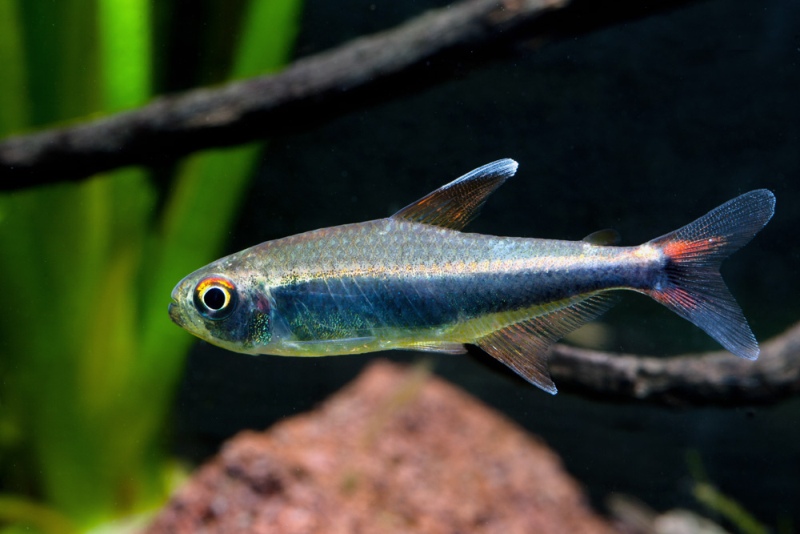
Max length40mm SL1.6in SLTank60 × 30cm24 × 12inTemp22–27°C72–81°FpH5.0–7.0This species is available on a relatively regular basis, although it's sometimes confused with the similar-looking congeners H. loretoensis and H. metae. It can be identified via the following combination of characters as per Géry (1977): elongate in shape with body depth fitting 3.8-3.9 times in its standard length; caudal peduncle narrow, its depth fitting 1.8 times in its length; head short, interorbital broad, snout short and rounded; dorsal-fin insertion an...
Laubuka dadiburjoriDadio
Menon, 1952
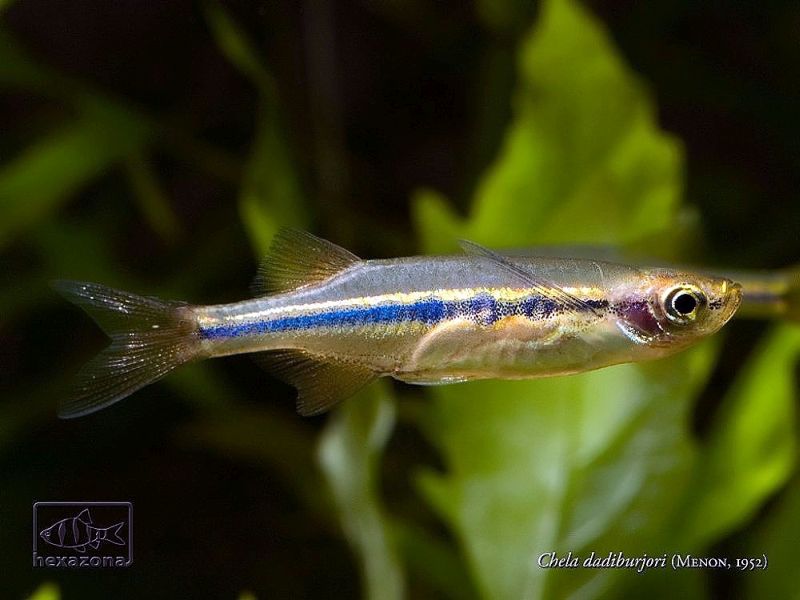
Max length30mm SL1.2in SLTank90 × 30cm36 × 12inTemp20–24°C68–75°FpH6.0–7.5It can be distinguished from other members of the genus by the following characters: lateral line absent or perforating only 2-5 scales; pharyngeal teeth hooked; body size small, not exceeding 30 mm SL; body depth less than 25 % SL; colour pattern comprising a dark bluish lateral stripe extending from the eye to the caudal peduncle, typically, but not always, forming 2-5 circular spots along its length.
Laubuka fasciataMalabar Hatchet Chela
Silas, 1958
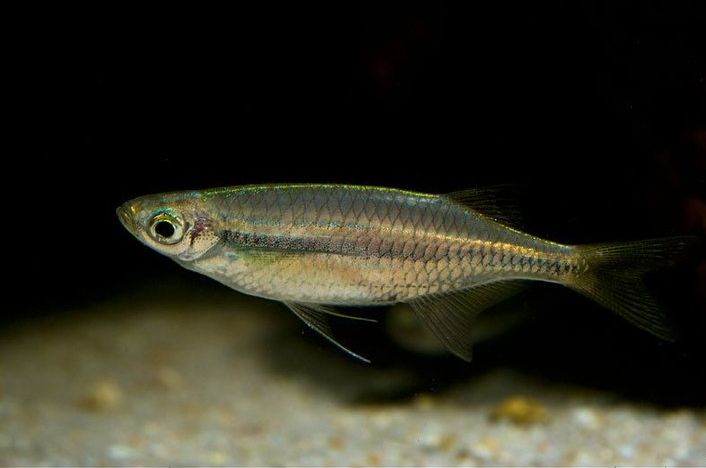
Max length50mm SL2.0in SLTank120 × 30cm48 × 12inTemp20–26°C68–79°FpH6.5–7.5It can be distinguished from other members of the genus by the following characters: dark longitudinal stripe on body, extending from eye to caudal peduncle; scattered tubercles present on lower jaw; 14½-16½ branched anal-fin rays; pelvic-fin long, reaching beyond anus.
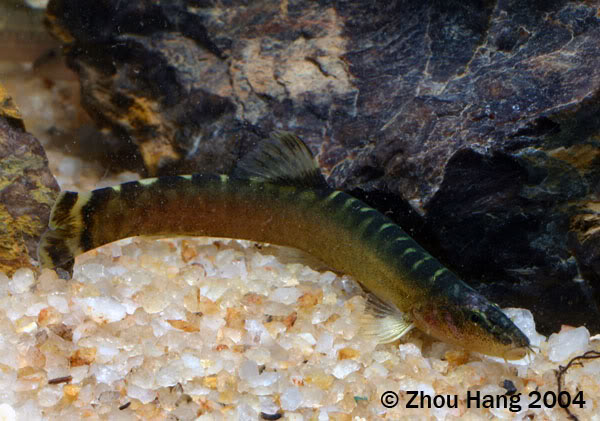
Leptobotia guilinensis
Chen, 1980
Max length100mm SL3.9in SLTank120 × 30cm48 × 12inTemp15.5–21°C60–70°FpH6.5–7.5L. elongata is the type species of the genus but according to current knowledge there exist 13 members in total, all of which are endemic to China and northern Vietnam. They're diagnosable by the following shared characters: possession of a simple (non-bifurcated), short sub-ocular spine not extending beyond the posterior edge of the eye; a laterally-compressed body; relatively deep caudal peduncle; pelvic fins reaching origin of anal-fin; anus below base of dorsal-fin and equidistant between pelvic and anal-fin origins.
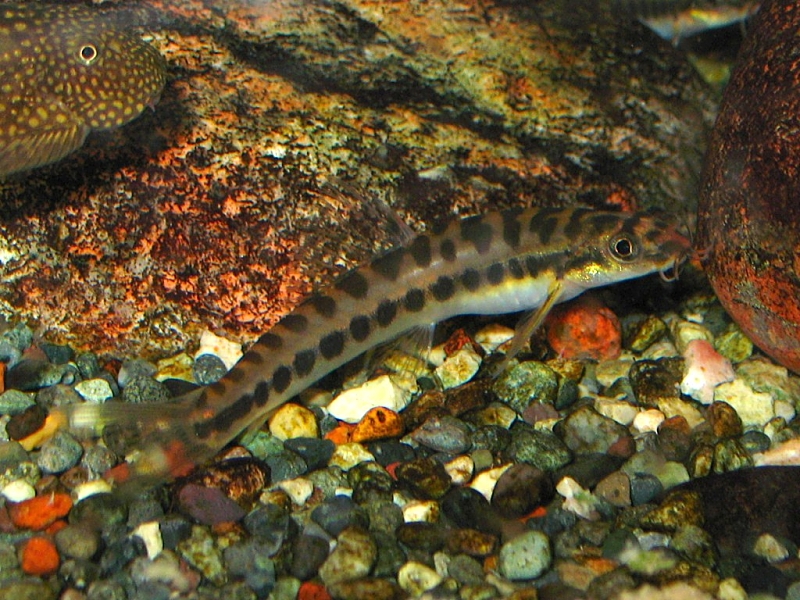
Nemacheilus masyaeArrow Loach
Smith, 1933
Max length70mm SL2.8in SLTank60 × 30cm24 × 12inTemp23–26°C73–79°FpH6.0–7.5This species was originally named Nemacheilus masyae but following ICZN rules the spelling was later corrected to N. masyai because it's named after a man. It can be distinguished from the majority of congeners by body patterning comprising 14-18 short, dark vertical bars on each flank, 12-17 saddle-like markings running along the dorsal surface, a dark spot on the caudal peduncle at the termination of the lateral line and a dark blotch in the lower half of the first few dorsal-fin rays.
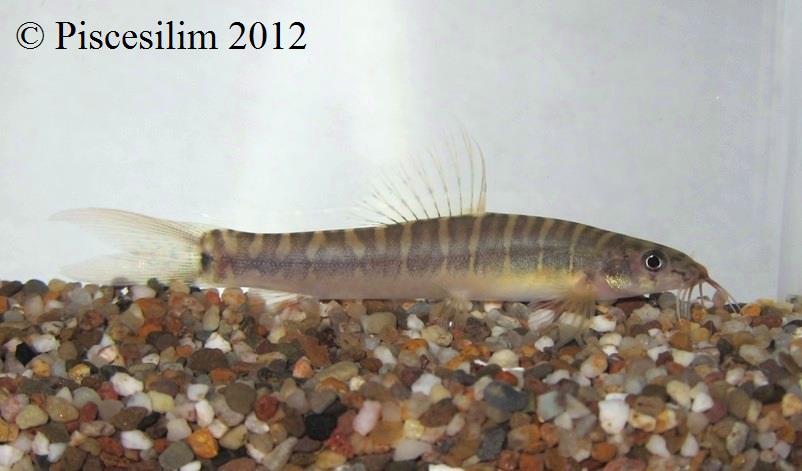
Nemacheilus selangoricus
Duncker, 1904
Max length60mm SL2.4in SLTank60 × 30cm24 × 12inTemp20–25°C68–77°FpH5.0–7.5N. selangoricus is most similar to N. spiniferus since it possesses acuminate scales above and below the lateral line on the caudal peduncle, a feature not shared with any other congener. It can however be distinguished by the following characters: presence of 8-12 very regular dark bars on flanks (vs. 10-13 irregularly-shaped bars in N. spiniferus), 3-5 times...
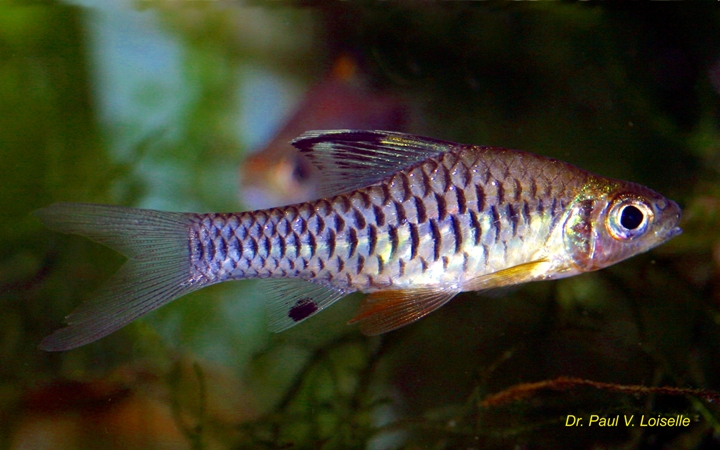
Oreichthys cosuatis
Hamilton, 1822
Max length43mm SL1.7in SLTank60 × 30cm24 × 12inTemp24–28°C75–82°FpH6.5–7.5An assortment of undescribed Oreichthys spp. from India, Myanmar and Thailand are currently traded as O. cosuatis. It can be distinguished from other described members of the genus by lacking a black blotch on the caudal peduncle, plus the following combination of characters: 2-3 perforated scales in lateral line; ½6½ between pelvic-fin origin and dorsal midline; presence of dark stripe in centre of anal-fin, forming a triangular blotch in adult individuals; dorsal-fin with whitish tip and broad, black, subdistal margin in the upper portion of the fin; 11-13 rows...
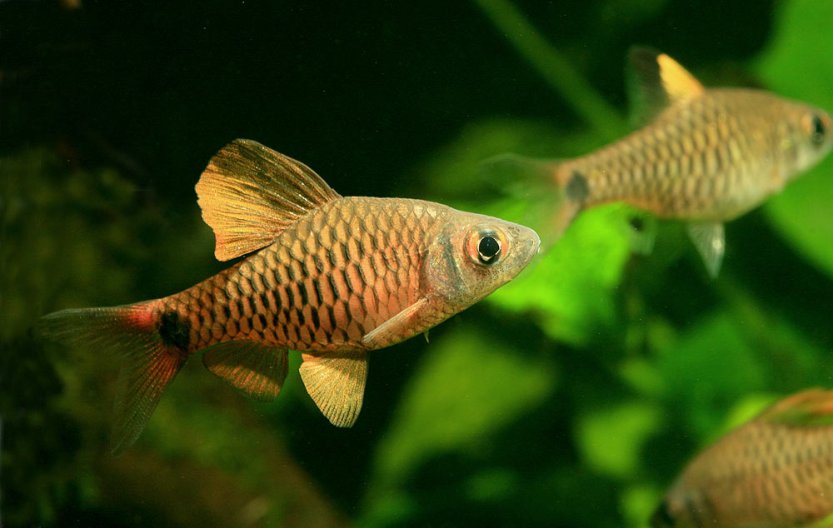
Oreichthys sp. 'Myanmar Redfin'
authority not recorded
Max length40mm SL1.6in SLTank60 × 30cm24 × 12inTemp24–28°C75–82°FpH6.5–7.5This fish is one of several sometimes imported and sold as Oreichthys cosuatis or O. parvus which has led to considerable confusion. It appears to be an undescribed species and can be most easily identified by the absence of a dark marking in the dorsal-fin of adult males (vs. presence in O. cosuatis and O. parvus) and possession of a large, well-defined black blotch on the caudal peduncle ( vs. absent in O. cosuatis, smaller and less well-defined in O. parvus).
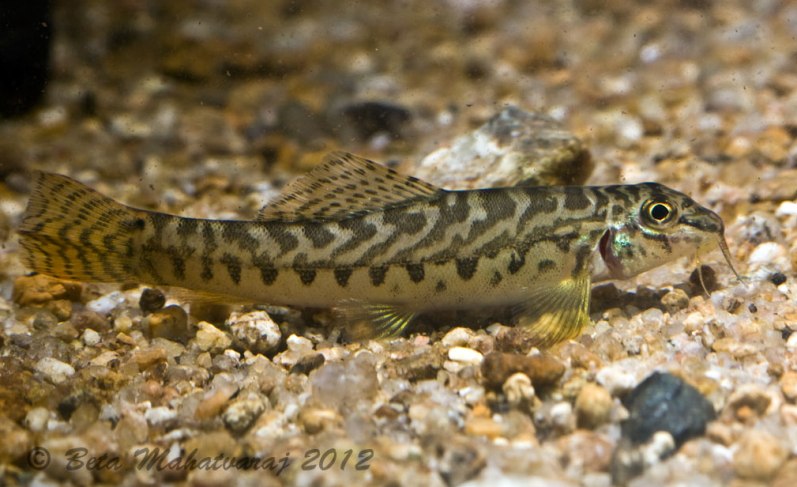
Paracanthocobitis botiaZipper Loach
Hamilton, 1822
Max length152mm SL6in SLTank75 × 30cm30 × 12inTemp21–26°C70–79°FpH6.0–7.5Traded under various names including 'mottled', 'eyepot', 'sand' and 'striped' loach. It's perhaps one of the better choices for those new to keeping nemacheilids being relatively hardy, peaceful and exhibiting some quirky behavioural traits. The characteristic ocellus, a dark marking at the top of the caudal peduncle that resembles an eye, is thought to have some function in predator distraction and is normally more intense in younger specimens.
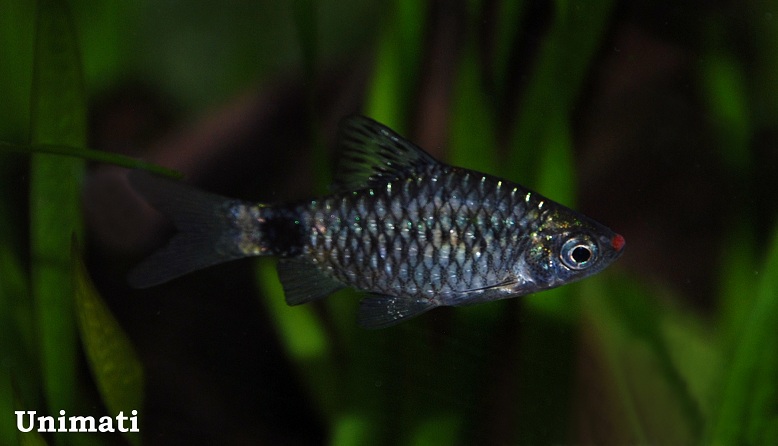
Pethia erythromycterLipstick Barb
Kullander, 2008
Max length35mm SL1.4in SLTank90 × 30cm36 × 12inTemp18–24°C64–75°FpH7.0–7.5This species first appeared in the aquarium hobby in 2006 and is sometimes traded under the name 'Tulip barb'. It was officially described by Kullander in early 2008 in a paper describing five new Puntius species from Kachin, all of which are superficially similar in possession of a dark band or blotch on the caudal peduncle. P. erythromycter can be distinguished b...
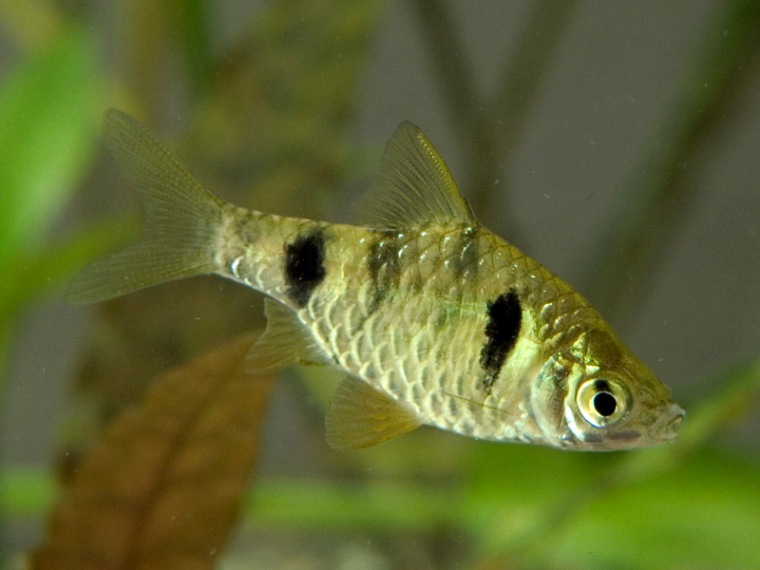
Pethia phutunioDwarf Barb
Hamilton, 1822
Max length30mm SL1.2in SLTank60 × 30cm24 × 12inTemp21–26°C70–79°FpH6.0–7.0In P. phutonio the flank markings comprise two black, vertically-orientated blotches, one posterior to the operculum and the other on the caudal peduncle, and within the P. conchonius group this patterning is shared with P. bandula, P. cumingii, P. didi, P. meingangbii, P. padamya, and P. tiantian. It can be told apart from these by the following combination of characters: smaller adult size of 25 - 30 mm vs. at least 35 - 40 mm; minute maxillary barbels; incomplete lateral line with ab...
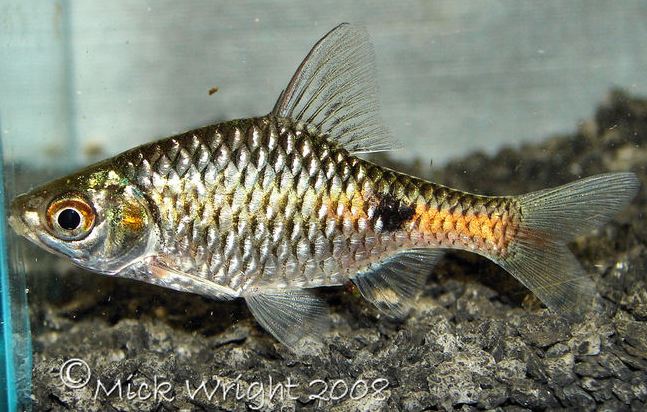
Puntius terioOnespot Barb
Hamilton, 1822
Max length90mm SL3.5in SLTank80 × 30cm31 × 12inTemp18–26°C64–79°FpH6.5–7.5This species is uncommon in the aquarium trade which is a little surprising given its huge natural range. Different populations can vary in colour pattern to an extent though all share the defining aspects given by Hamilton, comprising a diffuse yellow-golden marking on the operculum plus a dark spot on the caudal peduncle. The latter is usually surrounded by a variably-sized golden-yellow margin, and the dorsal-fin often contains irregular dark spots and streaks, these sometimes forming a longitudinal band.