Results for “od”
Type a name: scientific, common, or one a species used to go by. Or narrow the catalogue with the filters.
Filters
Oxyeleotris marmorataMarbled Goby
authority not recorded
Max length650mm SL26in SLTank150 × 60cm60 × 24inTemp22–28°C72–82°FpH6.5–7.5One of the largest goby species in the world, O. marmoratus is unsuitable for the vast majority of aquaria, but is an interesting oddball for the true enthusiast with the facilities to house it properly. It is a nocturnal ambush predator and generally remains motionless during daylight hours unless striking at food. It is a popular food fish in some of its native countries, where it is known as soon hock....
Pristolepis marginatusMalabar Leaffish
authority not recorded
Max length150mm SL6in SLTank120 × 30cm48 × 12inTemp23–28°C73–82°FpH6.5–7.5Also known as the common catopra, this is still quite a rare species in the hobby, although it's becoming more readily available due to captive breeding efforts. It makes an interesting addition to the larger community or oddball tank....
Protopterus annectens annectensAfrican Lungfish
authority not recorded
Max length1000mm SL39in SLTank180 × 75cm72 × 30inTemp24–30°C75–86°FpHnot recordedLungfish are among the most intriguing of "oddball" aquarium subjects, being able to survive in the most extreme conditions. They are very ancient fish, having remained virtually unchanged for millions of years. The natural habitat of P. a. annectens is wet for only part of the year and the fish has developed several incredible adaptations in order to counteract this. When the waters begin to recede, the fish will find a suitable nesting site, usually amongst heavy vegetation. Here...
Protopterus dolloiSlender Lungfish
authority not recorded
Max length1300mm SL51in SLTank180 × 75cm72 × 30inTemp24–30°C75–86°FpH6.0–7.5Lungfish are among the most intriguing of "oddball" aquarium subjects, being able to survive in the most extreme conditions. They are very ancient fish, having remained virtually unchanged for millions of years. Some of the natural habitats of P. dolloi are wet for only part of the year, and it has developed several incredible adaptations in order to counteract this. When the waters begin to recede, the fish will find a suitable nesting site, usually amongst heavy vegetation. Here ...
Rasbora sarawakensis
authority not recorded
Max length50mm SL2.0in SLTank60 × 38cm24 × 15inTemp22–26°C72–79°FpHnot recordedR. sarawakensis is poorly-documented in the aquarium literature and we're not even sure if it has been exported for the hobby although it may be worth looking out for among shipments of wild fish from southern/western Borneo. We find this a little odd as it is an attractive, very peaceful little fish that would suit many home aquaria and is apparently quite common across its natural range. Rainboth's 'Fishes of the Cambodian Mekong' characterised members of Rasbora by poss...
Sandelia bainsiiEastern Cape Rocky
authority not recorded
Max length325mm SL13in SLTank180 × 60cm72 × 24inTemp18–22°C64–72°FpH6.8–8.0There are only two described species in the genus Sandelia. Both have very limited natural ranges in parts of South Africa, which in itself is odd as they're completely isolated from other genera of anabantoids. This is probably due to some ancient radiation of species, but as yet remains unresolved. Sandelia spp. are also considered the most primitive of anabantoids, as they possess a less well-developed labyrinth organ than their relatives. You're unlikely to see any of these fo...
Sandelia capensisCape kurper
authority not recorded
Max length215mm SL8in SLTank120 × 45cm48 × 18inTemp18–22°C64–72°FpH6.5–7.2There are only two described species in the genus Sandelia. Both have limited natural ranges in parts of South Africa, which in itself is odd as they're completely isolated from other genera of anabantoids. This is probably due to some ancient radiation of species, but as yet remains unresolved. Sandelia spp. are also considered the most primitive of anabantids, as they possess a less well-developed labyrinth organ than their relatives. S. capensis is of considerable conservation importa...
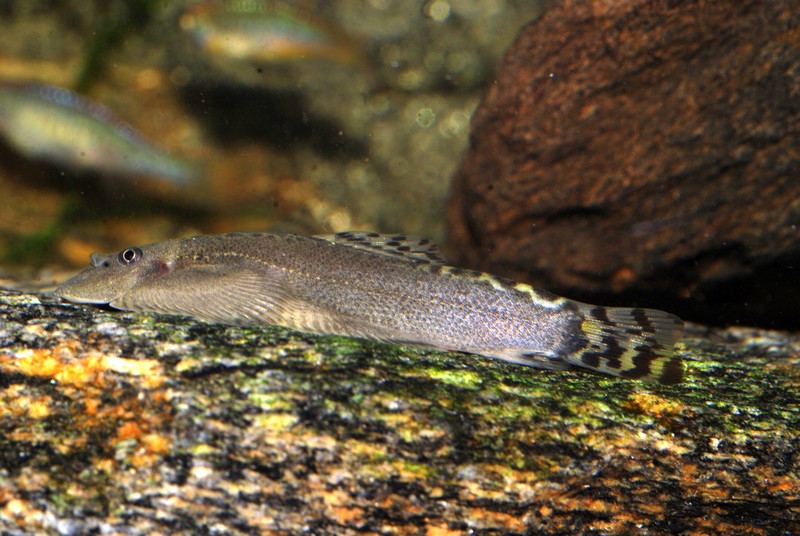
Sinogastromyzon puliensis
Liang, 1974
Max length80mm SL3.1in SLTank75 × 30cm30 × 12inTemp20–24°C68–75°FpH6.0–8.0This species is a relatively recent addition to the hobby but considering the number of specimens allowed to be collected for scientific research is highly restricted by the Taiwanese Council for Agriculture it seems odd that it's become available at all. Indeed it appears that those in the trade are collected and exported on an illegal basis (T-Y Liao, pers. comm.)...
Triportheus angulatusDusky Narrow Hatchetfish
authority not recorded
Max length165mm SL6in SLTank120 × 30cm48 × 12inTemp22–30°C72–86°FpH5.0–7.5An attractive but not often seen species in the hobby. This is quite odd considering how common it is in many of its native habitats, where it is known as sardina. It has very strong pectoral muscles, and uses these to jump from the water to catch flying insects or to escape potential predators. It can make leaps of several metres in length....