Results for “species”
Type a name: scientific, common, or one a species used to go by. Or narrow the catalogue with the filters.
Filters
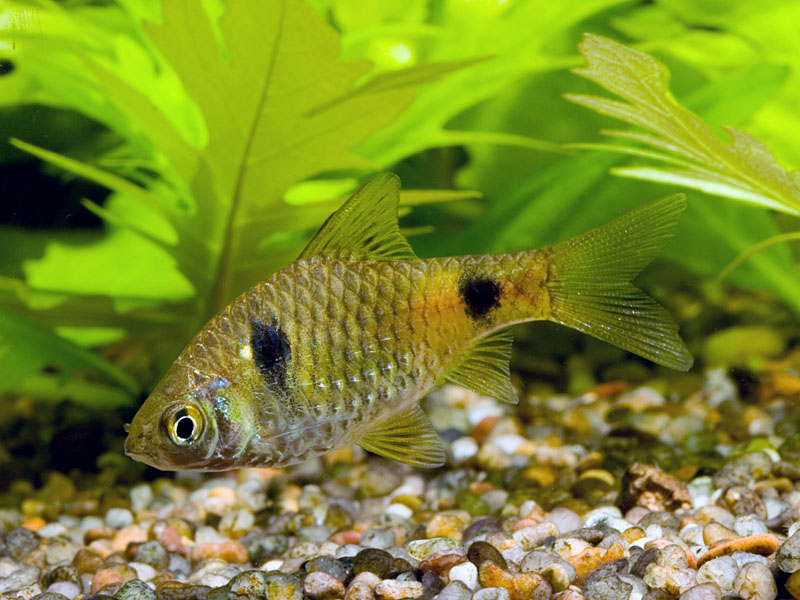
Pethia didi
Kullander & Fang, 2005
Max length41mm SL1.6in SLTank60 × 30cm24 × 12inTemp15–25°C59–77°FpH6.5–9.0The type locality is a stream with a mixed substrate of mud and stones which flows swiftly through an area of bamboo forest so is quite well-shaded. At time of collection the water was clear but slightly tannin-stained and sympatric species included Pethia thelys, Puntius sophore, Devario strigillifer, Rasbora daniconius, R. rasbora, Acanthocobitis botia, Notopterus notopterus, plus unidentified species of Oreichthys, Parambassis, Xenentodon, and Mastacembelus.
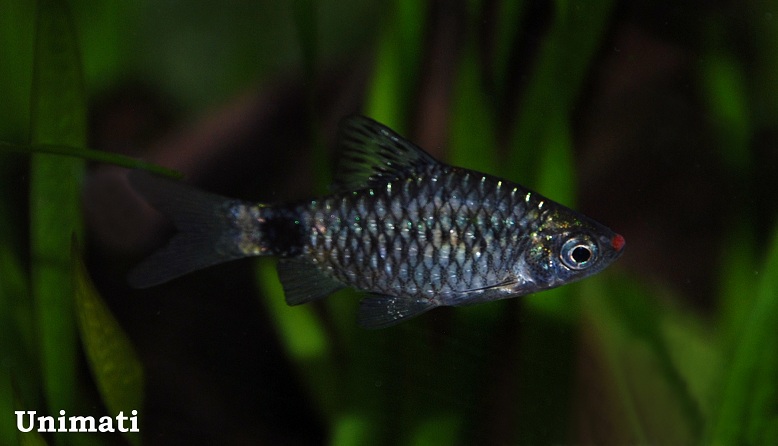
Pethia erythromycterLipstick Barb
Kullander, 2008
Max length35mm SL1.4in SLTank90 × 30cm36 × 12inTemp18–24°C64–75°FpH7.0–7.5This species first appeared in the aquarium hobby in 2006 and is sometimes traded under the name 'Tulip barb'. It was officially described by Kullander in early 2008 in a paper describing five new Puntius species from Kachin, all of which are superficially similar in possession of a dark band or blotch on the caudal peduncle. P. erythromycter can be distinguished b...
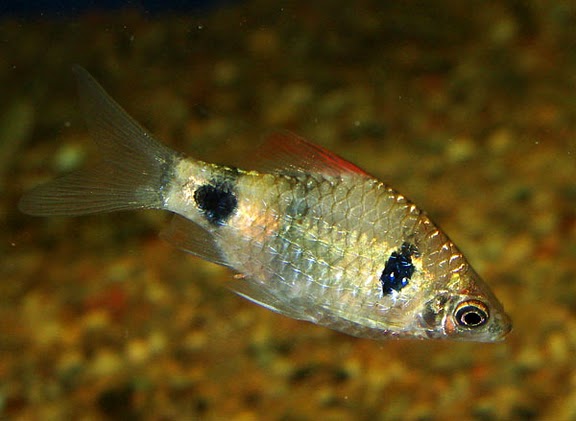
Pethia setnaiNarayan Barb
Chhapgar & Sane, 1992
Max length65mm SL2.6in SLTank90 × 30cm36 × 12inTemp20–26°C68–79°FpH6.0–7.5This species is widely referred to and traded as the congener 'Puntius' narayani (Hora, 1937). The precise identity of the latter is in doubt, however, plus P. setnai possesses a serrated dorsal-fin spine whereas 'P.' It was formerly included in the Puntius conchonius 'group' of closely-related species alongside P. ater, P. bandula, P. conchonius, P. cumingii, P. erythromycter,...
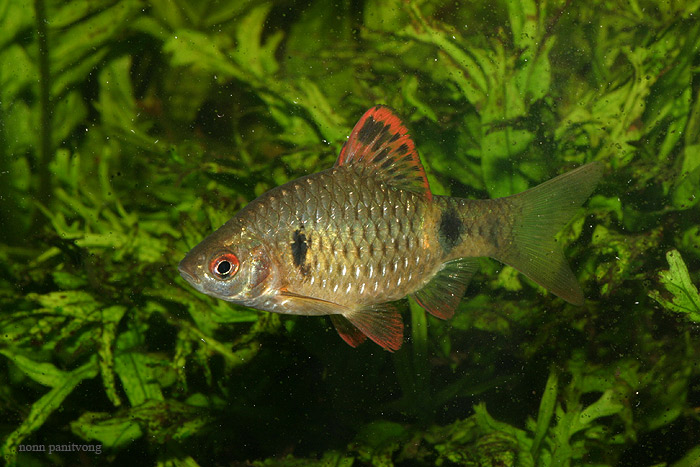
Pethia stoliczkana
Day, 1871
Max length50mm SL2.0in SLTank75 × 30cm30 × 12inTemp18–26°C64–79°FpH6.0–7.5This species is confused with P. ticto in much of the available literature and is sometimes listed as a synonym of it. Although some populations of the two species possess a similar colour pattern (there are reports of a P. ticto variant from the south of West Bengal state in India with a red, black-flecked dorsal-fin, for example) they do not occur in the same waters in nature and can be distinguished by examining the lateral line. This is complete in...
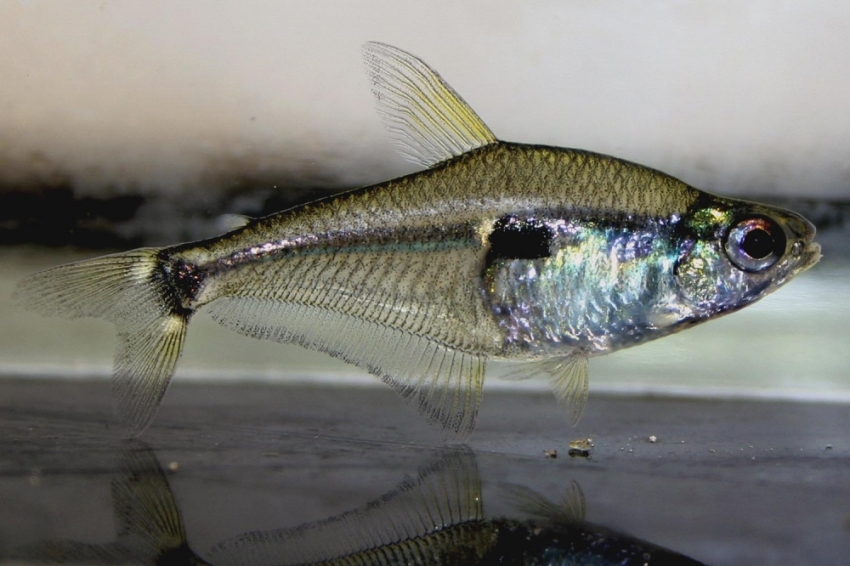
Phenacogaster tegatus
Eigenmann, 1911
Max length45mm SL1.8in SLTank60 × 30cm24 × 12inTemp20–28°C68–82°FpH6.0–7.5This species has been traded as 'six-eyed tetra' in reference to its colour pattern comprising two dark spots on each flank plus the eye. Based on the extensive review of the genus by Lucena and Malabarba (2010), in which nine new species were described, P. tegatus can be told apart from congeners by the following combination of characters: lateral line incomplete with 8-13 perforated scales; laterally elongate humera...
Piaractus brachypomusRed-bellied Pacu
authority not recorded
Max length880mm SL35in SLTank300 × 90cm118 × 36inTemp23–28°C73–82°FpH4.8–7.5Know as the pirapitinga in its native countries, this is the one of the largest species of scaled fish found in the Amazon basin. This alone should tell you much of what you need to know about its suitability as an aquarium inhabitant. In reality it's debatable as to whether the species should be considered an aquarium subject at all. While pacu rarely reach their maximum size in captivity, they're still easily capable of growing to a couple of feet in length. The myth that fish will o...
Pimelodus maculatusSpotted Pim
authority not recorded
Max length180mm SL7in SLTank120 × 60cm48 × 24inTemp20–24°C68–75°FpH6.4–7.4There are currently 32 genera and over 80 species included in the family Pimelodidae (including Pimelodus), making it the second largest and one of the most diverse amongst catfish. Most experts agree however, that a full systematic revision of the family is needed, as little information about the phylogenetic (evolutionary relatedness) relationships between the various genera exists. Taxonomy information at the species level is also basic at best. It's therefore likely that at least some o...
Pimelodus pictusPictus Cat
authority not recorded
Max length120mm SL5in SLTank120 × 45cm48 × 18inTemp22–25°C72–77°FpH5.8–6.8There are currently 32 genera and over 80 species included in the family Pimelodidae (including Pimelodus), making it the second largest and one of the most diverse amongst catfish. However most experts agree that a full systematic revision of the family is needed, as little information about the phylogenetic (evolutionary relatedness) relationships between the various genera exists. Taxonomy information at the species level is also basic at best. It's therefore likely that at least some of...
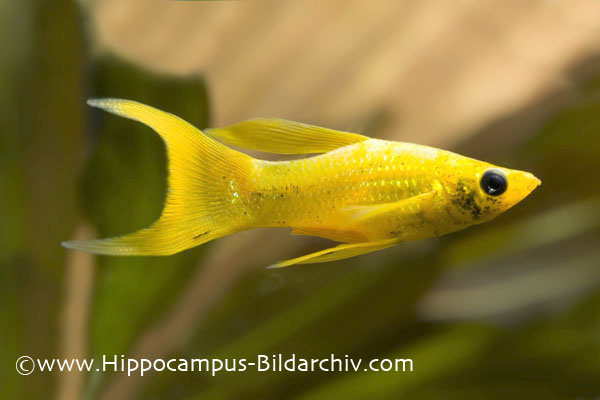
Poecilia latipinnaSailfin Molly
Lesueur, 1821
Max length125mm SL5in SLTank76 × 38cm30 × 15inTemp21–26°C70–79°FpH7.0–8.5The wild fish can exhibit several different types of patterning. P. latipinna has been selectively bred into many different colour morphs for the aquarium trade, and has also been crossbred with other molly species, particularly P. sphenops. They will also interbreed readily in the aquarium and in order to avoid this we suggest keeping only one species of molly per tank. There also exists a (in our opinion) grotesque 'balloon' variety of this fish in which the body is malformed and rou...
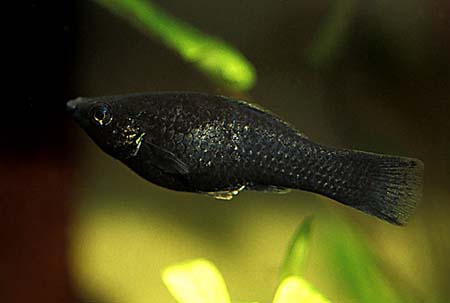
Poecilia sphenopsShort-finned Molly/Black Molly
Valenciennes, 1846
Max length80mm SL3.1in SLTank90 × 30cm36 × 12inTemp21–28°C70–82°FpH7.0–8.5A hugely popular aquarium fish. Many aquarium-bred colour morphs of this species are available, including the ubiquitous black molly. There are also Gold, Green, Lyretail, Silver and Dalmation varieties. Some of these are the results of P. sphenops being crossed with P. latipinnis. The 2 species will also interbreed readily in the aquarium and in order to avoid this we suggest keeping only one of them per tank. There also exists a (in our opinion) grotesque 'balloon' variety of this fi...
Potamotrygon henleiBlack Stingray
authority not recorded
Max length600mm SL24in SLTanknot recordedTemp23–28°C73–82°FpHnot recordedP. henlei is one of the more sought after ray species in the hobby due to its striking colours and impressive adult size. A fully grown one of these makes a stunning sight. Sadly exports from Brazil are now illegal under the IBAMA regulations, although captive bred fish are available occasionally. The price tends to be very expensive as a result. The species exists in various colour forms, with either white or yellow spots and a background colour varying between black and dark brown. The patt...
Prionobrama filigeraGlass Bloodfin Tetra
authority not recorded
Max length60mm SL2.4in SLTank60 × 38cm24 × 15inTemp23–27°C73–81°FpH6.0–7.5The genus Prionobrama currently contains only one other valid species, P. paraguayensis. It is very similar in appearance to P. filigera, but lacks any red pigmentation in the caudal fin. It's probably never been imported for the hobby, although it may show up as occasional bycatch amongst shipments of more popular species. P. filigera can be easily distinguished from the "other" bloodfin tetra, Aphyocharax anisitsi by its more elongate body shape and the fact that it exhibits...
Pseudocrenilabrus multicolorDwarf Egyptian Mouth-brooder
authority not recorded
Max length80mm SL3.1in SLTanknot recordedTemp20–26°C68–79°FpH6.5–7.2This species was one of the first cichlid species to be spawned in captivity and has been in the hobby for over a century. It is less popular than it once was but remains a good choice for the beginner as it is tolerant of a wide range of water conditions and is easily bred. There currently exist 2 subspecies, Pseudocrenilabrus multicolor multicolor and P. m. victoriae. These are quite distinct in terms of colouration and patterning and exist as separate populations in nature. Both subspecie...
Pseudomystus siamensisAsian Bumblebee Catfish
authority not recorded
Max length150mm SL6in SLTanknot recordedTemp20–26°C68–79°FpH5.8–7.8This species was formerly included in the genus Leiocassis, and is still referred to as such in a great deal of the available literature. The current genus Pseudomystus contains many similarly patterned species, some of which may be being imported and sold as P. siamensis. Its commonly encountered congener is P. stenomus, but this can be plainly distinguished by its lack of "bumblebee" patterning. The Asian bumblebee can also be easily told apart from the South American Pimelodid &q...
Pseudomystus sp. cf stenomusFalse Asian Bumblebee Catfish
authority not recorded
Max length150mm SL6in SLTanknot recordedTemp20–27°C68–81°FpH6.0–7.6This fish is usually imported as Pseudomystus stenomus but actually seems to be an undescribed species, as it's collected from the Malay Peninsula. P. stenomus is endemic to the island of Java and supposedly exhibits a higher degree of light-coloured patterning on the body. The genus Pseudomystus contains many similarly-patterned species, of which the most common in the hobby is the Asian bumblebee catfish, P. siamensis. This can easily be distinguished from P. sp. cf stenomus by its cha...
Pseudoplatystoma fasciatumBarred Shovelnose
authority not recorded
Max length1040mm SL41in SLTanknot recordedTemp22–26°C72–79°FpH6.0–7.6It's debatable as to whether this species should be considered an aquarium subject at all, given its eventual size. All too often juveniles are sold without adequate information regarding their long term care. These cats can and will attain something close to their maximum size in captivity, and will do so quite quickly. The myth that they will only grow to match the size of the tank they're kept in is just that - a myth. It's also worth noting that species such as this can live f...
Pseudoplatystoma tigrinumTiger Shovelnose
authority not recorded
Max length1050mm SL41in SLTanknot recordedTemp22–26°C72–79°FpH6.0–7.6It's debatable as to whether this species should be considered an aquarium subject at all, given its eventual size. All too often juveniles are sold without adequate information regarding their long term care. These cats can and will attain something close to their maximum size in captivity, and will do so quite quickly. The myth that they will only grow to match the size of the tank they're kept in is just that - a myth. It's also worth noting that species such as this can live f...
Pseudotropheus elongatusElongate Mbuna
authority not recorded
Max length135mm SL5in SLTank120 × 38cm48 × 15inTemp24–28°C75–82°FpH7.6–8.8Over 30 different forms of this species occur in Lake Malawi. These should not be mixed in the aquarium as they will hybridise freely. P. elongatus differs morphologically from other mbuna, being relatively slender and elongate. In nature females protect territories which contain 'gardens' of algae which they leave to breed before returning once they are holding eggs. Juvenile fish from previous spawns also inhabit the territory, protecting it when the female is away. This species i...
Pseudotropheus estheraeRed Zebra
authority not recorded
Max length135mm SL5in SLTank120 × 38cm48 × 15inTemp24–28°C75–82°FpH7.6–8.8A deservedly popular mbuna, there is ongoing debate as to the true genus of this species, it having been variously grouped in both Maylandia and Metriaclima, as well as the currently valid Pseudotropheus. It is unlikely it will remain in Pseudotropheus. To add to the confusion, it was only described as a distinct species in 1995, having previously been regarded as a morph of Maylandia zebra. Several colour forms are available and these should not be kept together under any circumstances as they ...
Pseudotropheus flavus
authority not recorded
Max length90mm SL3.5in SLTank90 × 45cm36 × 18inTemp24–28°C75–82°FpH7.6–8.8Although it is a good choice for the general mbuna community, as mentioned above P. flavus should not be kept together with any member of the P. elongatus complex. Not only will these species interbreed, producing undesirable hybrid offspring, but males of these species will clash very heavily. As with other members of the genus it possesses flat, bicuspid teeth which are designed for scraping algae and other organisms from the surface of rocks....