Results for “species”
Type a name: scientific, common, or one a species used to go by. Or narrow the catalogue with the filters.
Filters
Pseudotropheus tropheops tropheops
authority not recorded
Max length200mm SL8in SLTank120 × 38cm48 × 15inTemp24–28°C75–82°FpH7.6–8.8This species has a confusing taxonomic past. There are currently 3 subspecies, Pseudotropheus tropheops tropheops, P. t. romandi and P. t. gracilior. P. macrophthalmus and P. microstoma were also once considered as subspecies of tropheops, but are now classed as distinct species. Furthermore, it is likely that the current subspecies and their various colour forms (of which there are many) will be themselves reclassifed into the currently invalid genus Tropheops! Incidentally, none of the subspec...
Pungu maclareni
authority not recorded
Max length100mm SL3.9in SLTank75 × 30cm30 × 12inTemp28–30°C82–86°FpH7.5–8.5This is currently the only described species in the genus Pungu. Because of it's its tiny natural range, habitat destruction due to excess water removal (the nearby town of Kumba relies on the lake for it's water supply), deforestation, the introduction of non-native species and overfishing, it is considered to be critically endangered and all efforts at captive breeding are to be encouraged. It is correspondingly rare in the hobby, and we suggest purchasing some only if you intend to ...
Puntius mahecola
Valenciennes, 1844
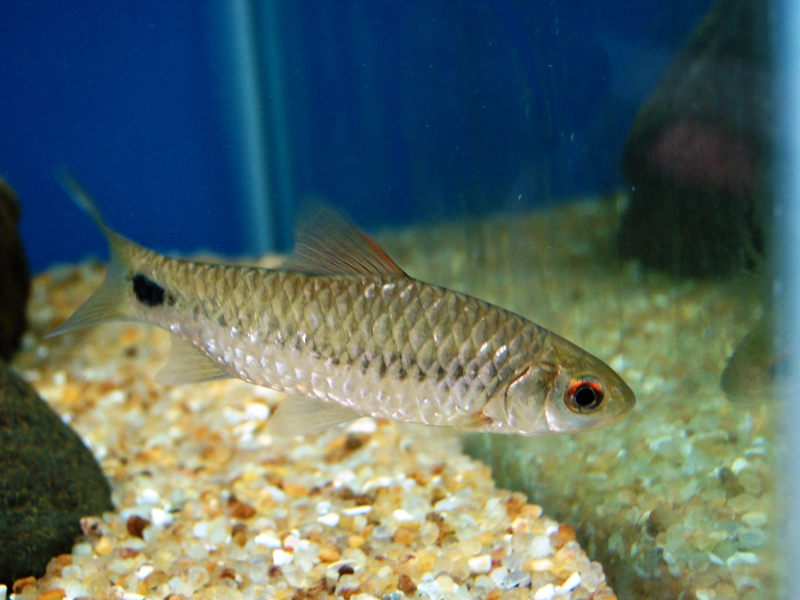
Max length75mm SL3.0in SLTank90 × 30cm36 × 12inTemp18–24°C64–75°FpH6.0–7.5This species has a chaotic taxonomic history with certain issues still to be resolved. While the name P. mahecola was misapplied to members of the genus Dawkinsia for over a century the fish itself has been widely misidentified as the congener P. amphibius (Valenciennes 1842). Its identity was partially resolved by Pethiyagoda and Kottelat (2005b) who demonstrated that though valid P. mahecola is not a Dawkinsia spp. but rather a smaller, relatively plain species with a single dark blotc...
Puntius sharmai
Menon & Rema Devi, 1993
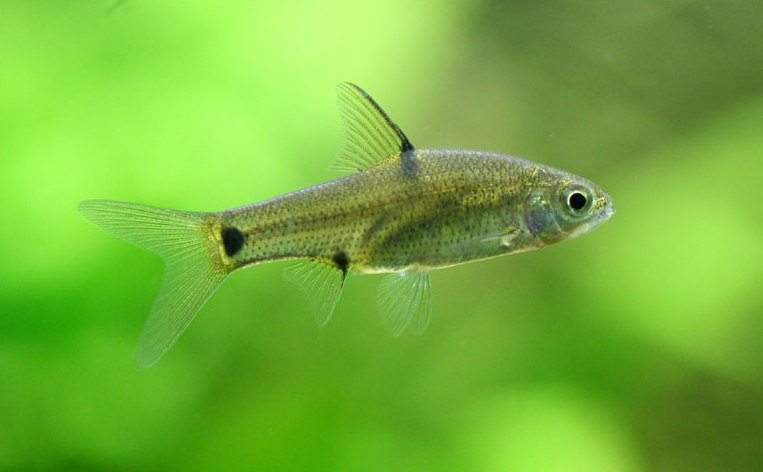
Max length40mm SL1.6in SLTank60 × 30cm24 × 12inTemp20–26°C68–79°FpH5.5–7.5This species is almost unheard of in the aquarium hobby outside of India but is maintained by some private collectors. It's distinguished from similar species by possessing a single pair of maxillary barbels, a relatively elongate body, and distinctive black spot above the anterior anal-fin base. The genus Puntius was for a number of years viewed as a polyphyletic catc...
'Puntius' snyderi
Oshima, 1919
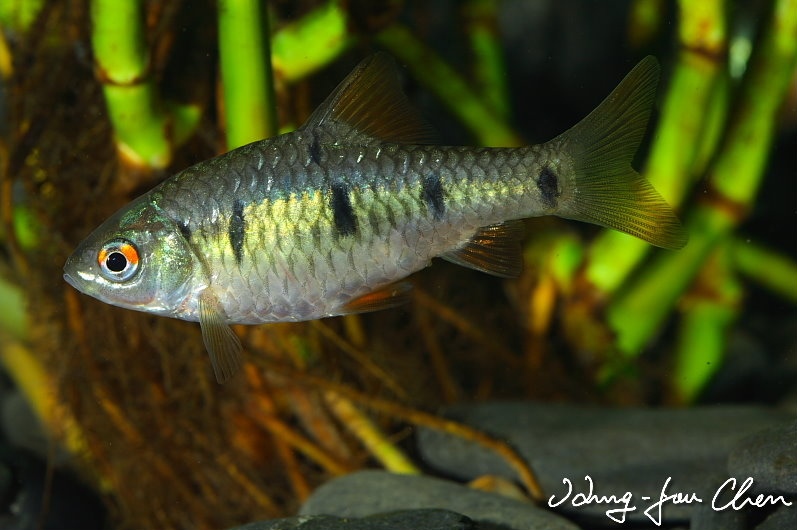
Max length75mm SL3.0in SLTank90 × 30cm36 × 12inTemp18–24°C64–75°FpH6.0–8.0This species is almost identical to the wild form of 'P.' semifasciolatus which is best known as the 'golden barb' in the aquarium hobby due to the popularity of a yellowish ornamental strain. The natural colour pattern is greenish in both species, however, and in terms of external characters they're only reliably distinguished by the fact that 'P.' semifasciolatus possesses a pair of prominent maxillary barbels wherea...
Rasbora cephalotaeniaPorthole Rasbora
authority not recorded
Max length130mm SL5in SLTank120 × 45cm48 × 18inTemp22–25°C72–77°FpHnot recordedThis species is not often exported which is a shame as it makes an elegant, peaceful resident of the larger community tank. It can be easily distinguished from similar-looking congeners such as R. einthovenii and R. jacobsoni by examining the dark lateral stripe that extends lengthways along the body of the fish as in R. cephalotaenia it is composed of a series of dark spots whereas in the other species it forms a continous solid line. Rainboth's 'Fishes of the Cambodian Mekong'...
Rasbora cf. dandia
authority not recorded
Max length99mm SL3.9in SLTank120 × 45cm48 × 18inTemp22–25°C72–77°FpHnot recordedThis fish may well be a form of R. dandia itself but in the absence of scientific confirmation we list it with a 'cf' abbreviation for the time being. It appears to be widely available in the trade but is often (mis)identified as R. wilpita, a species now confirmed as endemic to a small number of streams in Sri Lanka and which is probably much rarer in the hobby than previously thought. Valenciennes initially described Leuciscus dandia as a new species from Sri Lanka in 1844 but the...
Rasbora paviana
authority not recorded
Max length90mm SL3.5in SLTank120 × 30cm48 × 12inTemp22–26°C72–79°FpHnot recordedIn much of the literature this species is pictured with the invalid name R. paviei, due to an issue with spelling which was corrected by Kottelat (2005), and the common name 'sidestripe rasbora' although the latter has yet to find popularity in the aquarium hobby. There are a number of similar-looking species including R. sumatrana, R. hobelmani and R. laticlavia and it can be problematic to separate members of this 'group'. If the collection locality of the fish is known ide...
Rita kuturneeDeccan Rita
authority not recorded
Max length260mm SL10in SLTank120 × 30cm48 × 12inTemp22–27°C72–81°FpH6.0–7.0Rita species are not often seen in the hobby. When available, R. kuturnee makes a fine bottom dweller for communities containing other robust species....
Sandelia bainsiiEastern Cape Rocky
authority not recorded
Max length325mm SL13in SLTank180 × 60cm72 × 24inTemp18–22°C64–72°FpH6.8–8.0There are only two described species in the genus Sandelia. Both have very limited natural ranges in parts of South Africa, which in itself is odd as they're completely isolated from other genera of anabantoids. This is probably due to some ancient radiation of species, but as yet remains unresolved. Sandelia spp. are also considered the most primitive of anabantoids, as they possess a less well-developed labyrinth organ than their relatives. You're unlikely to see any of these fo...
Sandelia capensisCape kurper
authority not recorded
Max length215mm SL8in SLTank120 × 45cm48 × 18inTemp18–22°C64–72°FpH6.5–7.2There are only two described species in the genus Sandelia. Both have limited natural ranges in parts of South Africa, which in itself is odd as they're completely isolated from other genera of anabantoids. This is probably due to some ancient radiation of species, but as yet remains unresolved. Sandelia spp. are also considered the most primitive of anabantids, as they possess a less well-developed labyrinth organ than their relatives. S. capensis is of considerable conservation importa...
Satanoperca acuticepsSharphead Eartheater
Heckel, 1840
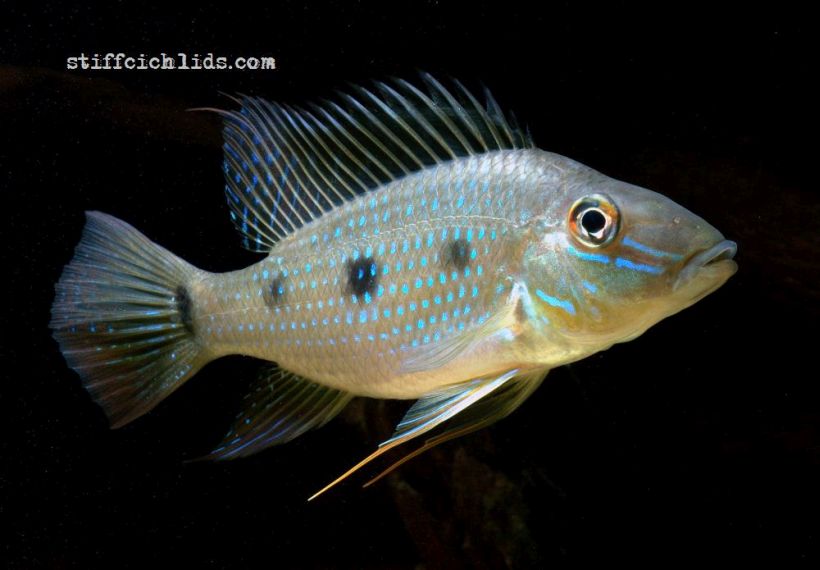
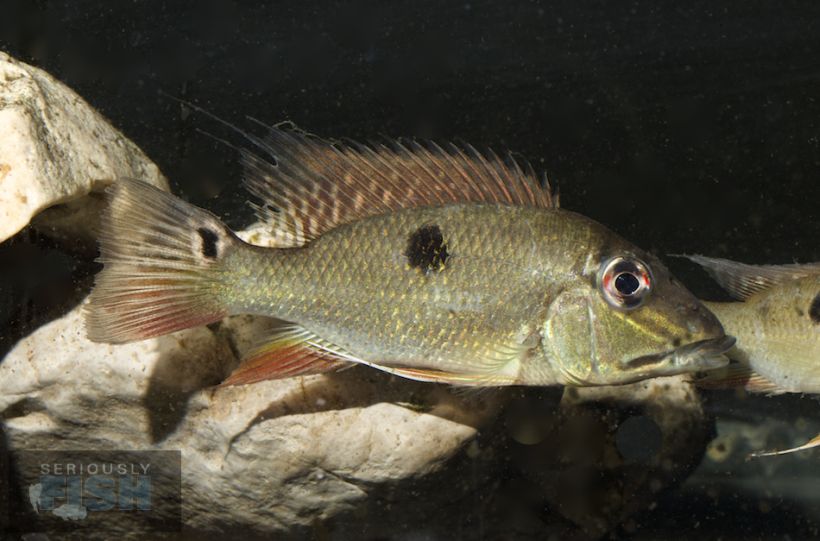
Max length170mm SL7in SLTank180 × 60cm72 × 24inTemp20–28°C68–82°FpH5.5–7.5This species is relatively rare in the ornamental trade, where it is sometimes confused with its similarly-patterned congeners S. daemon and S. lilith. These three species all possess 1-3 dark blotches on the side of the body and a relatively large ocellus on the upper caudal-fin base, characters that immediately separate them from the remainder of the genus which lack blotches on the body and have a relatively small ocellus on the upper caudal-fin base.
Satanoperca lilith
Kullander & Ferreira, 1988
Max length255mm SL10in SLTank210 × 60cm84 × 24inTemp20–28°C68–82°FpH5.0–7.5Despite its extensive natural distribution S. lilith is uncommon in the ornamental trade, where it is sometimes referred to as 'one-spotted demon fish' or 'one spot eartheater'. It can be distinguished from other members of the genus by possessing a single dark blotch on the flank and a prominent ocellus at the caudal-fin base. Among the named species it is most similar to S. daemon, but that species possesses two blotches on the flank.
Satanoperca rhynchitis
Kullander, 2012
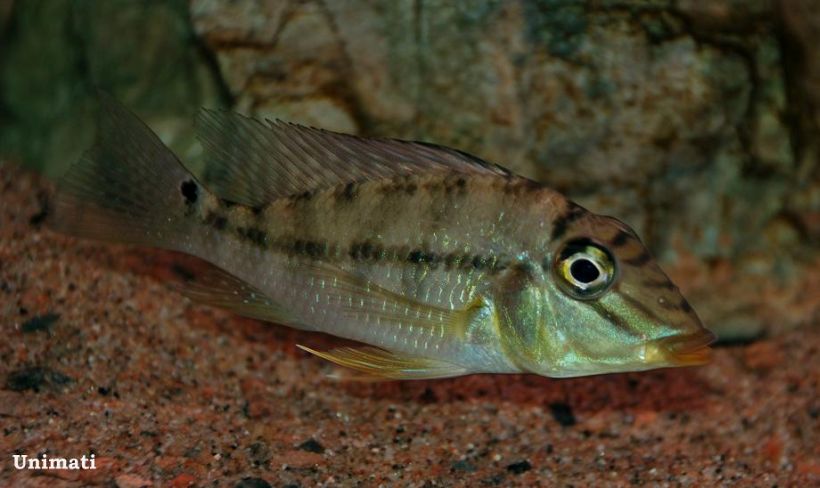
Max length145mm SL6in SLTank180 × 60cm72 × 24inTemp22–28°C72–82°FpHfrom 5.5Based on current knowledge, it thus remains impossible to deduce whether the group of putative species currently comprising S. jurupari, S. mapiritensis, and S. rhynchitis, plus populations from Amapá and the upper Negro/upper Orinoco region, represent distinct taxa or a single meta-population which can be referred to as S. jurupari sensu lato. Here on SF we include the named species separately, since they continue to be considered valid.
Schistura denisonii
Day, 1867
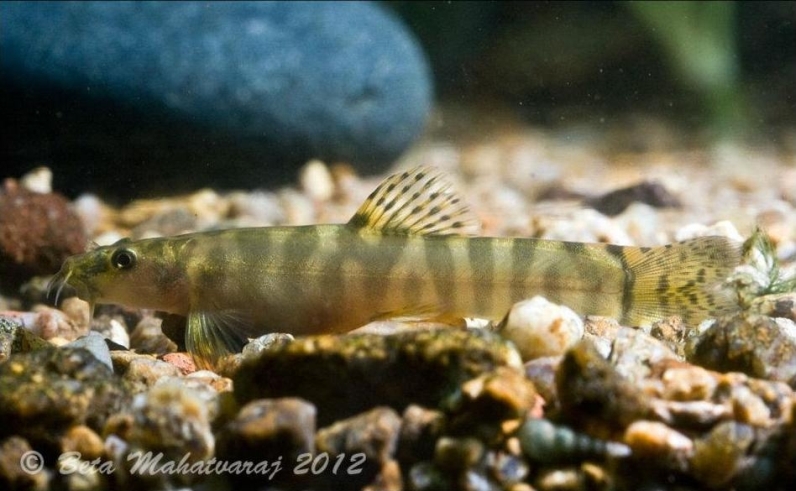
Max length52mm SL2.0in SLTank75 × 30cm30 × 12inTemp18–24°C64–75°FpH6.0–7.5This species is feisty and largely unsuitable for the general community aquarium. This is not to say it must be kept alone, rather that tankmates must be selected with care and proper research. Slow-moving or long-finned species should certainly be omitted because they're likely to struggle with the necessary level of water movement and may end up with nipped fins.
Schistura jarutanini
Kottelat, 1990
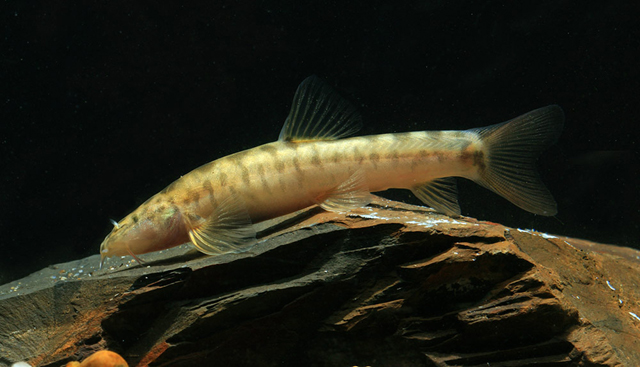
Max length67mm SL2.6in SLTanknot recordedTempnot recordedpHnot recordedThis species' conservation status clearly precludes its suitability as an aquarium fish so it's included here for reasons of interest only. It's protected by Thai national law and illegal to remove from its habitat. Species exhibiting morphological, physiological or behavioral adaptations to a subterranean existence are often referred to as troglomorphic.
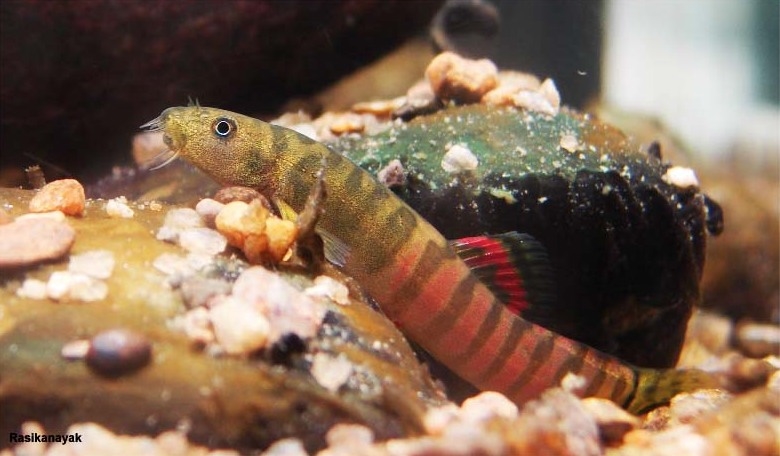
Schistura kodaguensis
Menon, 1987
Max length36mm SL1.4in SLTank60 × 30cm24 × 12inTemp20–25°C68–77°FpH6.0–7.5This species is not a well-known aquarium fish but is maintained by a number of Indian enthusiasts. It can be told apart from related species by the following combination of characters as per Sreekantha et al. (2006): pectoral-fin rays 10; absence of black spot at base of dorsal-fin; presence of rows of spots on caudal-fin; lateral line incomplete; caudal-fin slightly emarginate; 11-14 vertical bars on the body.
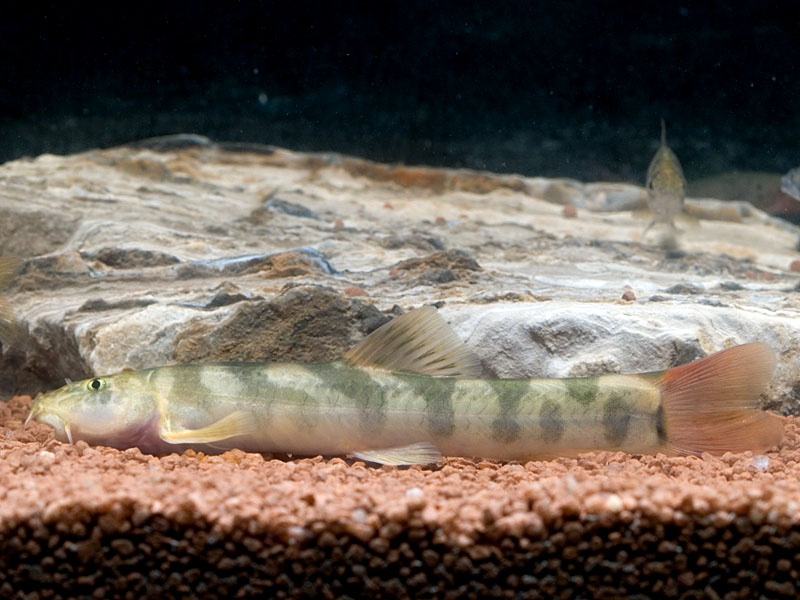
Schistura spilota
Fowler, 1934
Max length100mm SL3.9in SLTank120 × 30cm48 × 12inTemp20–26°C68–79°FpH6.0–7.5Not a commonly species in the aquarium hobby but sporadically available in shipments of wild fishes from Thailand. Following Kottelat (1990) it's a member of a group of species possessing a complete or near-complete lateral line, 8 ½ branched dorsal-fin rays, 17 branched caudal-fin rays and lacking sexual dimorphism (the latter is not strictly true - see above). Its colour pattern is quite distinctive, howe...
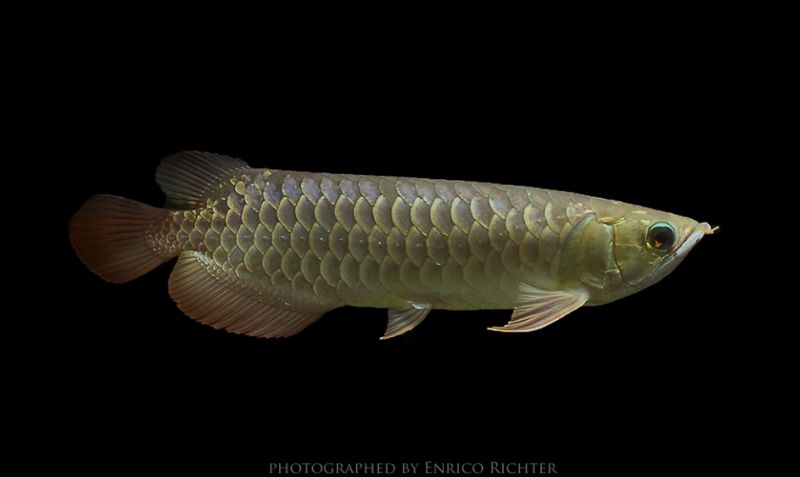
Scleropages formosusAsian Arowana
Müller & Schlegel, 1840
Max length900mm SL35in SLTanknot recordedTemp22–28°C72–82°FpH5.0–8.0This species is distinguished from its Australian congeners S. jardinii and S. leichardti by possessing a lower number of lateral line scales (21-26 vs 32-36). It occurs naturally in a number of colour forms of which three were elevated to distinct species status in 2003, but the current majority view is that all represent S. formosus pending a detailed review. Kottelat (2013) mentions that the red form may...
Semaprochilodus insignisFlagtail Prochilodus
authority not recorded
Max length350mm SL14in SLTank150 × 60cm60 × 24inTemp23–29°C73–84°FpH5.5–7.2Semaprochilodus are one of the most common and widespread shoaling fish found in South America. Over a dozen species have been described but most are never imported. They are used as food fish in their native countries. It makes a stunning addition to a community of larger fish. Along with some congeners, S. insignis is commonly known as the Jaraqui in Brazil. It is an interesting species both ecologically and biologically. In nature it migrates over large distances in huge shoals according ...