Results for “species”
Type a name: scientific, common, or one a species used to go by. Or narrow the catalogue with the filters.
Filters
Semaprochilodus taeniurusFlagtail Characin
authority not recorded
Max length300mm SL12in SLTank150 × 60cm60 × 24inTemp23–29°C73–84°FpH5.5–7.5Semaprochilodus are one of the most common and widespread shoaling fish found in South America. Over a dozen species have been described but most are never imported. They are used as food fish in their native countries. It makes a stunning addition to a community of larger fish. S. taeniurus is also sold as the Silver Prochilodus or Fei Feng. Along with some congeners, it is commonly known as the Jaraqui in Brazil. It is an interesting species both ecologically and biologically. In nature it...
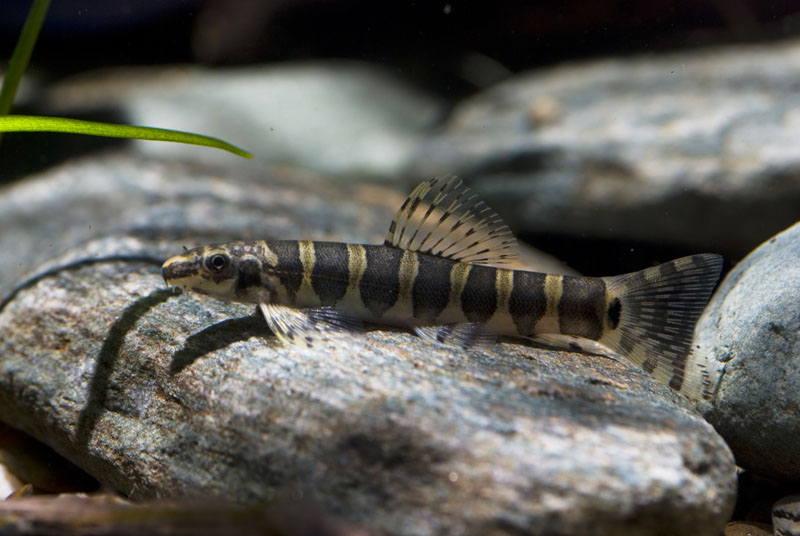
Serpenticobitis octozona
Roberts, 1997
Max length55mm SL2.2in SLTank75 × 30cm30 × 12inTemp23–26°C73–79°FpH6.0–7.0This species exhibits some interesting behaviour including a degree of social interaction plus the ability to cling to vertical or overhanging surfaces. It's sometimes sold under the name 'serpent loach'. The genus currently contains just three members all of which are known only from the Mekong basin. S. octozona is the type species and separated from the others mainly by body patterning which consists of 7-8 dark bars on each flank, these extending the full depth of the body and much wider than the pale interspaces between.
Serrasalmus marginatus
authority not recorded
Max length221mm SL9in SLTank120 × 38cm48 × 15inTemp22–25°C72–77°FpHnot recordedThere are currently 24 described species of Serrasalmus, many of which look superficially similar. S. marginatus has at various times been considered a synonym of S. rhombeus and S. humeralis, but is currently considered to be distinct. It's main distinguishing feature is usually given as the thick, black, v-shaped marking in the anterior portion of the caudal fin. Juveniles are said to differ from similar-looking species such as S. compressus and S. altuvei because the dark body "spot...
Serrasalmus rhombeusBlack Piranha/Rhom
authority not recorded
Max length450mm SL18in SLTank210 × 45cm84 × 18inTemp22.2–27.8°C72–82°FpHnot recordedThere are in excess of 30 described species of Serrasalmus many of which appear superficially similar and have confusing taxonomic histories. S. rhombeus is among the most convoluted of all with numerous synonyms of which S. niger is the most well-known. There has also been a muddle surrounding the common names "white" and "black" piranha, both of which have been used to describe the species. Of greater interest to both scientists and hobbyists has been the discovery of n...
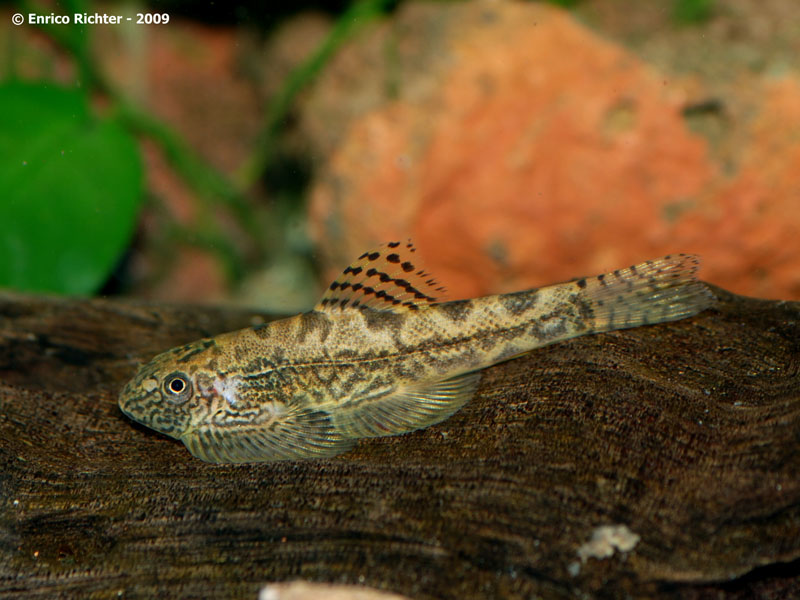
Sewellia sp. 'SEW02'
authority not recorded
Max length65mm SL2.6in SLTank75 × 30cm30 × 12inTemp18–24°C64–75°FpH6.0–7.5This species first became available in early 2009 and was initially identified as S. breviventralis (Freyhof and Serov, 2000) because there is a clear space between the pelvic and anal fins and body patterning is vaguely similar to that species, and also appears quite similar to S. elongata (Roberts, 1998) and S. sp. 'SEW03'. It does not fully match the original descriptions of either, however, and therefore remains in need of identification.
Sorubim limaDuckbill Catfish
authority not recorded
Max length501mm SL20in SLTank200 × 75cm79 × 30inTemp23.3–30°C74–86°FpHnot recordedThis species is also known by the vernacular names "Hockey Stick Catfish", "Lima Shovelnose", "Chiripira", "Chucharón" and "Pico de pato". The genus Sorubim currently contains five recognised species. Of the others S. cuspicaudus is recorded from the parts of the Rio Essequibo, Rio Orinoco, Amazon and Lake Maracaibo basins, S. elongatus from the Rio Essequibo, Rio Orinoco Rio Mamore and Amazon and S. maniradii from the mid-to-upper Amaz...
Sperata aorIndian Shovelnose Catfish
authority not recorded
Max length1800mm SL71in SLTank720 × 180cm283 × 72inTemp20–25°C68–77°FpH6.0–7.0This "shovelnose" is unique amongst bagrids, but superficially resembles several unrelated South American catfish species. It's common name is derived from it's flattened, extended head. We cannot stress strongly enough that this is a species totally unsuited to aquarium life. Alarmingly, it is can sometimes be spotted in dealer's tanks. When small, it makes an interesting and undeniably impressive addition to a large aquarium but bearing in mind its enormous adult size,...
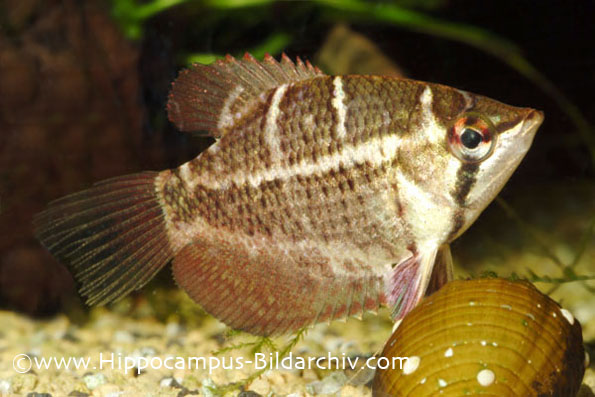
Sphaerichthys selatanensisCrossband Chocolate Gourami
Vierke, 1979
Max length45mm SL1.8in SLTank60 × 30cm24 × 12inTemp26–31°C79–88°FpH4.0–6.5This species is only occasionally seen in the hobby and sometimes sold as 'cherry chocolate gourami'. It was originally described as a subspecies of S. osphromenoides since the two are very similar-looking but has been considered a species in its own right since the late 1980s. The two differ in the number ofrays (7 in S. selatanensis vs. 9-10 in S. osphromenoides),rays (7 vs. 8),...
Stigmatogobius sadanundioKnight Goby
authority not recorded
Max length90mm SL3.5in SLTank75 × 30cm30 × 12inTemp20–26°C68–79°FpH7.0–8.5Until recently the genus Stigmatogobius contained 18 species, but most have now been reclassified, leaving just 7 species currently assigned to it. S. sadanundio is by far the most common of these in the hobby. It makes an attractive addition to the brackish or hardwater community with medium-sized tankmates....
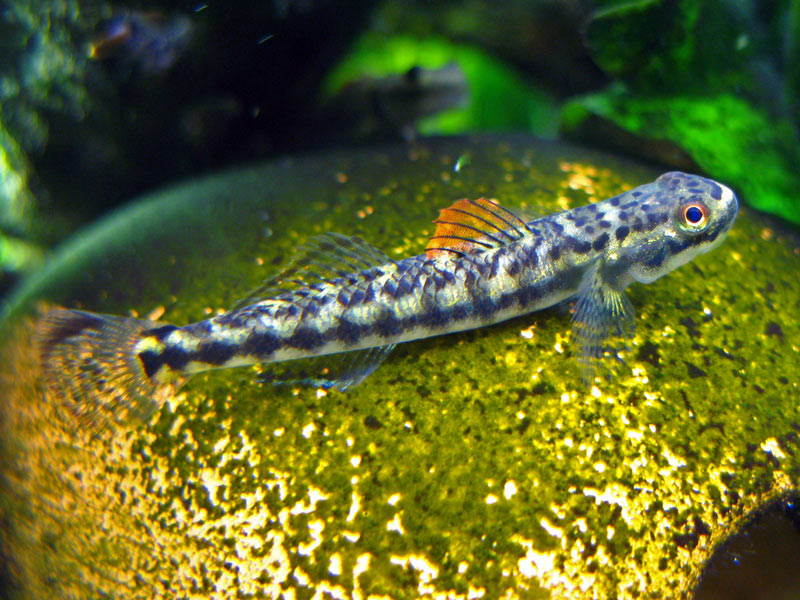
Stiphodon maculidorsalisOrange-fin Stiphodon
Maeda & Tan, 2013
Max length80mm SL3.1in SLTank80 × 30cm31 × 12inTemp20–28°C68–82°FpH6.5–7.5This species was referred to as S. sp. 'orange fin' or S. sp. 'ST01' prior to being offically named and is one of the more commonly-traded members of the genus, though often in batches containing only one gender, a mixture of species, or misidentified under an incorrect name such as S. zebrinus. It can be told apart from congeners by the following combination of characters: usually 9 soft second dorsal-fin rays; 15 soft pectoral-fin rays; first dorsal-fin in male poin...
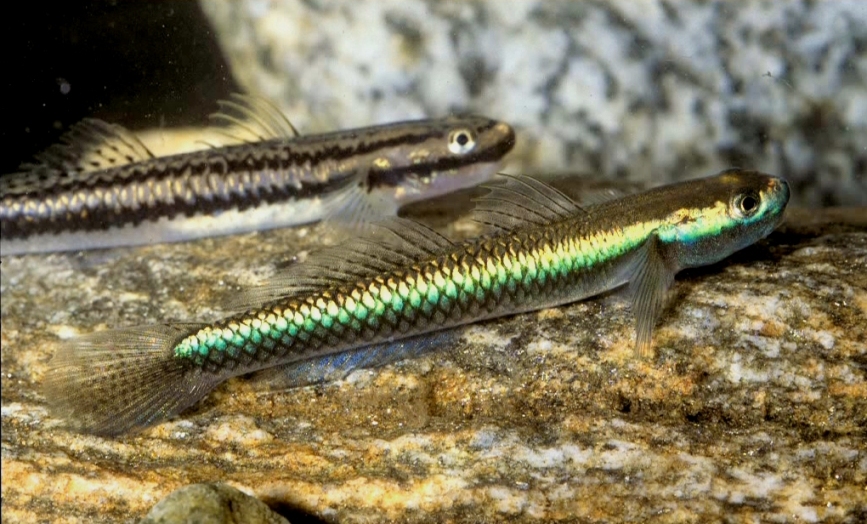
Stiphodon semoniCobalt Blue Goby
Weber, 1895
Max length50mm SL2.0in SLTank60 × 30cm24 × 12inTemp22–28°C72–82°FpH6.5–7.5This species has been traded for a number of years, though not always under the correct name. We've seen it on sale as S. elegans or S. atropurpureus on numerous occasions, for example, and other trade names include 'Sumatran blue neon goby', 'cobalt blue goby' and 'freshwater neon goby'. Further confusion has arisen because other species are sometimes sold as S. semoni meaning identification has not always been easy and there ...
Sundadanio axelrodi
authority not recorded
Max length22mm SL0.9in SLTank30 × 20cm12 × 8inTemp23–26°C73–79°FpHnot recordedThis species was initially described as Rasbora axelrodi and is referred to as such in older literature, but in 1999 was moved into the new genus Sundadanio where it remains the monotype. Its wider placement within the family Cyprinidae is still not fully resolved. Following Rüber et al. (2007) it is most closely-related to the miniature species of the genus Paedocypris, the two genera characteristically lacking bones in the roof of the skull as well as exhibiting genetic similarities. Howe...
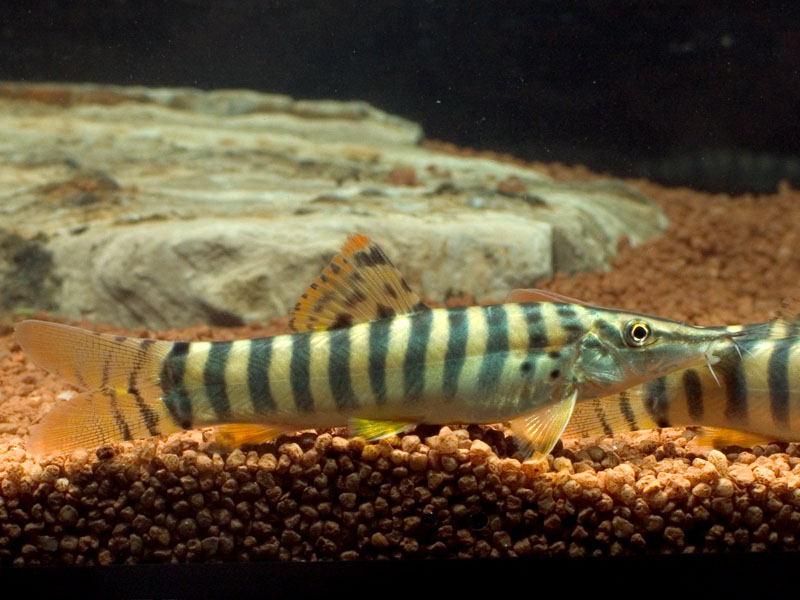
Syncrossus berdmoreiRedfin Tiger Loach
Blyth, 1860
Max length250mm SL10in SLTank180 × 45cm72 × 18inTemp21–26°C70–79°FpH6.5–7.5Interestingly some observations suggest that the character of the highest-ranked, or alpha, fish appears to affect that of the whole group though it must be said that scientific studies of botiid loach behaviour are virtually non-existent. It certainly seems that they display a degree of 'personality' with some specimens being naturally bolder/more aggressive than others. The alpha is normally the largest specimen within the group and often female. Sound also appears to be an important factor in communication since these loaches are able...
Synodontis acanthomiasBlack-spotted Synodontis
authority not recorded
Max length300mm SL12in SLTank120 × 60cm48 × 24inTemp22–24°C72–75°FpH6.5–8.0This is one of the species of Synodontis seen less frequently in the trade and it ranks alongside S. schall as one of the more aggressive members of the genus. It is very hardy however and makes a good tankmate for large aggressive cichlid species. One unique characteristic of S. acanthomias is that the humeral process (the bony extension just above the pectoral fins) is long and tapered with a curved end....
Synodontis brichardiBrichard's Synodontis
authority not recorded
Max length150mm SL6in SLTank120 × 30cm48 × 12inTemp22–26°C72–79°FpH6.2–7.5An unusual and highly adapted species, S. brichardi is one of our favourite Synos and really deserves to be kept in a biotope aquarium to be appreciated at its best. Here, it will be seen moving in and out of areas of high and low current and rasping at algae attached to rocks as in nature. It is much more diurnal than many Synodontis species, if maintained correctly. The colours of this fish intensify with age....
Synodontis granulosa
authority not recorded
Max length270mm SL11in SLTank150 × 60cm60 × 24inTemp24–28°C75–82°FpH7.8–8.5One of the most stunning and sought after species of Synodontis and though the cost of ownership has dropped slightly, it still commands a high price. Its natural deep water habitat, limited range and solitary lifestyle make collection for the hobby difficult and so it is rarely seen for sale. It also appears that the areas of the lake in which it occurs are threatened with ecological disaster. In the aquarium S. granulosa is intelligent and can develop into a real character, with many speci...
Synodontis notataOne-spot Synodontis
authority not recorded
Max length275mm SL11in SLTank120 × 30cm48 × 12inTemp22–25°C72–77°FpH6.5–7.5Also known as the Domino Synodontis or the One-spot Squeaker, several regional variants of S. notata are known, some of which have 3, 6 or 12 spots and others none at all. Some of these are seen for sale under the invalid name S. ocellata. It is also often imported with similar species such as S. nummifer or S.congica. These are usually then all sold as notata. S. notata is more active during the day than many Syno species and therefore makes a good addition to aquariums with more boisterous...
Synodontis pleuropsBig Eyed Synodontis
authority not recorded
Max length230mm SL9in SLTank120 × 30cm48 × 12inTemp22–26°C72–79°FpH6.0–7.0S. pleurops is a very nocturnal species and unless the light in the aquarium is dim will rarely be seen. It is also very distinctive and is hard to confuse with other species. It has very large eyes and a downturned mouth, denoting its algae grazing habits. It will rarely venture into open water in the aquarium, preferring to hug the surface of pieces of driftwood, rocks and broad plant leaves. The colouration and patterning can vary considerably depending on type locality....
Synodontis schall
authority not recorded
Max length375mm SL15in SLTank120 × 60cm48 × 24inTemp22–27°C72–81°FpH6.0–8.0S. schall is regarded as the 'bad boy' of the genus in aquarium circles. It is randomly aggressive and not particularly attractive. It is often confused with other similar species of Synodontis such as S. budgetti or S. clarias but can be distinguished by the length of thewhich, in this species, is very long and runs from just past the base of the to just before the caudal fin. It is an important food fish in some of its native countries....
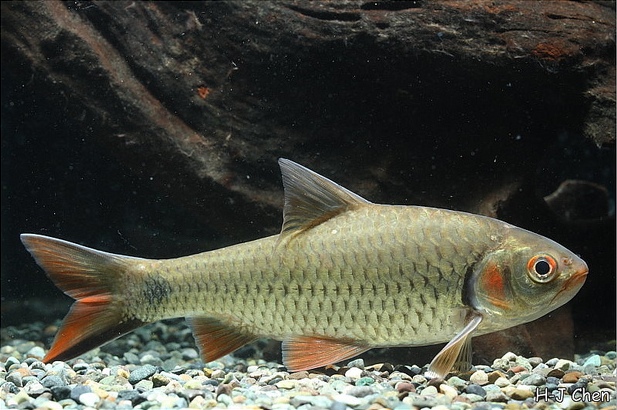
Systomus orphoides
Valenciennes, 1842
Max length250mm SL10in SLTank200 × 60cm79 × 24inTemp18–26°C64–79°FpH6.0–8.0The genus Puntius is currently viewed as something of a catch-all for well over 100 species of small to mid-sized cyprinid. Most experts agree that a full revision is required with the likely outcome that many species will be placed into new or different genera since it is clearly polyphyletic. When describing the grouping in 1822 Hamilton identified the defining characteristics as: presence or absence o...