Results for “fish tank”
Type a name: scientific, common, or one a species used to go by. Or narrow the catalogue with the filters.
Filters
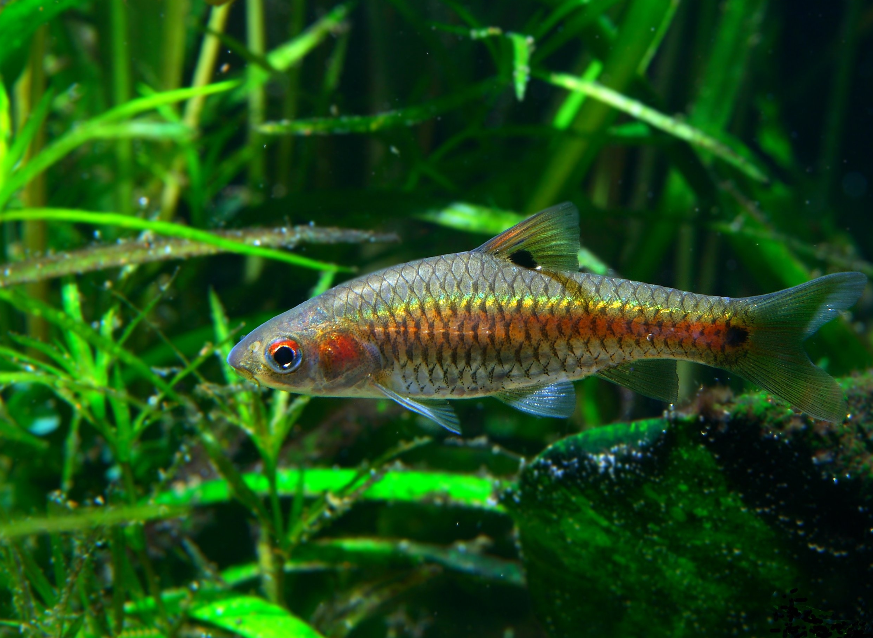
Puntius bimaculatusTwo-spotted Barb
Bleeker, 1863
Max length50mm SL2.0in SLTank60 × 30cm24 × 12inTemp18–24°C64–75°FpH6.0–7.5Generally very peaceful making it an ideal resident of the well-researched community tank. As it places no special demands in terms of water chemistry it can be combined with many of the most popular fish in the hobby including other small cyprinids as well as tetras, livebearers, rainbowfishes, anabantoids, catfishes and loaches. It's a schooling species by nature, and at least 6-10 specimens should be purchased. Maintaining it in such...
Mogurnda mogurndaNorthern Purple Spotted Gudgeon
authority not recorded
Max length170mm SL7in SLTank120 × 30cm48 × 12inTemp24–26°C75–79°FpH6.0–8.0A good species of gudgeon for the beginner, being tolerant of a wide range of water conditions, hardy and easily bred. We've even seen them spawning in dealer's tanks on more than one occasion. It's easily confused with the similar looking, but rarer Southern purple spotted gudgeon, Mogurnda adspersa, a fish which is now being farmed for the trade despite being endangered in nature....
Hemichromis bimaculatusJewel Cichlid
authority not recorded
Max length150mm SL6in SLTank120 × 30cm48 × 12inTemp22–28°C72–82°FpH6.0–7.8Not recommended for the beginner or for the general community tank, despite often being sold as such. The Jewel Cichlid is regularly seen in the trade. Recently, Hemichromis lifalili has become the more popular fish. These species can be easily distinguished as H. lifalili have only 2 black spots on the flanks whereas H. bimaculatus has 3, having an extra spot on the caudal peduncle....
Herichthys carpintisPearlscale Cichlid
authority not recorded
Max length305mm SL12in SLTank120 × 38cm48 × 15inTemp24–26°C75–79°FpH7.0The Pearlscale Cichlid is an extremely attractive fish, showing some gorgeous bluey green hues and reflective flecks on their flanks. They aren't difficult to look after or breed, but be careful when choosing tankmates. The only problem with spawning is that the male may become aggressive towards the female - it is certainly wise to have a tank divider, just in case. Look out for Pearlscale Cichlids labelled as Texas Cichlids, as it is a misleading common name that is often given to Heri...
Hassar orestisBlack-top Mouse Catfish
authority not recorded
Max length180mm SL7in SLTank120 × 38cm48 × 15inTemp22–27°C72–81°FpH6.0–7.5This species can be quite delicate when first imported, but once settled is usually quite hardy. When buying the fish, check that it has a rounded belly and that its eyes aren't sunken. These are classic signs of emaciation in newly imported specimens, and fish in this condition do not often survive for long. If you can find healthy specimens for sale, it is a charming addition to the larger community tank. It is superficially similar to the closely related Nemadoras leporhinus. The two ...
Rasbora trilineataScissortail Rasbora
authority not recorded
Max length150mm SL6in SLTank120 × 45cm48 × 18inTemp22–25°C72–77°FpHnot recordedThis popular species is also known as the 'three-lined' rasbora and provided a large enough tank is available it is an excellent choice for those new to the hobby. The 'scissortail' moniker is derived from the characteristic twitching motion of the when the fish is at rest. It can be distinguished from the similar R. caudimaculata by lacking red colouration in the and from R. spilocerca by its much larger size. Several geographical forms appear to exist as some wild populatio...
Rasbora cephalotaeniaPorthole Rasbora
authority not recorded
Max length130mm SL5in SLTank120 × 45cm48 × 18inTemp22–25°C72–77°FpHnot recordedThis species is not often exported which is a shame as it makes an elegant, peaceful resident of the larger community tank. It can be easily distinguished from similar-looking congeners such as R. einthovenii and R. jacobsoni by examining the dark lateral stripe that extends lengthways along the body of the fish as in R. cephalotaenia it is composed of a series of dark spots whereas in the other species it forms a continous solid line. Rainboth's 'Fishes of the Cambodian Mekong'...
Hepsetus odoeAfrican Pike Characin
authority not recorded
Max length700mm SL28in SLTank180 × 60cm72 × 24inTemp25–28°C77–82°FpH6.0–7.5The only species in the genus, and a popular game fish in its native range, H. odoe superficially resembles our native European Pike. It is an ambush predator with a fearsome set of teeth, and should be handled very carefully, particularly when maintaining its tank. Although juvenile specimens have become relatively common in the trade in the last few years, this is strictly a species for the specialist who is able to provide it with a suitably large aquarium and the correct conditions. In sm...
Ctenopoma acutirostreLeopard Bushfish
Pellegrin, 1899
Max length150mm SL6in SLTank120 × 30cm48 × 12inTemp20–28°C68–82°FpH5.5–7.5An ideal species for the newcomer to 'oddballs'. It is exceptionally hardy, long-lived (it can survive for over 15 years when cared for properly) and exhibits some interesting behaviour. It appears to have evolved convergently with leaf fish of the genera Polycentrus and Monocirrhus (they're not closely related). All these species mimic leaves and other aquatic debris to assist them in hunting their prey. If you add live food to its tank, you will see the typical stalking behaviou...
Lates angustifronsTanganyika Lates
authority not recorded
Max length2000mm SL79in SLTanknot recordedTemp22–28°C72–82°FpH7.5–9.5We've included this species on the site purely because there have been an alarming number of juvenile fish showing up in some aquatic stores, and as a result, in hobbyists tanks. This species is simply not suited to captive life in any respect. If you see one for sale, and they are undeniably an attractive fish, please don't be tempted to buy it. As responsible fishkeepers, we should consider the long term well-being of any fish that we buy, and housing a L. angustifrons for life is ev...
Potamotrygon orbignyiSmooth-back Stingray
authority not recorded
Max length375mm SL15in SLTanknot recordedTemp24–26°C75–79°FpH6.0–7.5P. orbignyi is one of the species often labelled as "teacup ray" in dealers' tanks. It can be tricky to identify when young, and we have seen it misidentified on numerous occasions. The species it resembles most closely is P. humerosa, although these can be distinguished by examining the skin of the fish. The texture of this is typically rough in P. humerosa and noticeably smooth in P. orbignyi. Provided you're sure what you're buying, it is one of the best species for t...
Gnathonemus petersiiElephantnose Fish
authority not recorded
Max length225mm SL9in SLTank120 × 45cm48 × 18inTemp23–28°C73–82°FpH6.0–7.5Also known as Peter's elephantnose, this fascinating species is currently the most common Mormyrid in the hobby. Sadly, its popularity means it is often kept in unsuitable conditions. To deny the fish a soft substrate really is cruel, as it uses its "trunk" to locate food hidden in the substrate. It also needs dim lighting, and will commonly become withdrawn and pine away if kept under bright lights. If you cannot provide suitable lighting, add food to the tank at lights out to al...
Nannacara anomalaGolden Dwarf Cichlid
authority not recorded
Max length76mm SL3.0in SLTank46 × 38cm18 × 15inTemp22–25°C72–77°FpHnot recordedNannacara Anomala are widely available in the trade, and are generally regarded as an excellent beginner's fish. If a beginner is interested in keeping Cichlids and learning about breeding, then these fish are absolutely ideal. Anomala are attractive, hardy and usually quite cheap to purchase. Like some species of the Apistogramma genus, the mother may use fascinating body language to communicate with her fry when she is caring for them. If there is more than one male in a tank smalle...
Cichlasoma trimaculatumThree Spot Cichlid
authority not recorded
Max length400mm SL16in SLTank122 × 38cm48 × 15inTemp23–30°C73–86°FpH7.0Cichlasoma Trimaculatus is a large colourful cichlid, if a little aggressive. It is believed to be one of the fish that was used to create the hybrid Flowerhorn cichlid. We prefer it in its natural state. As with most large cichlids they can be fairly messy eaters so ensure decent filtration is provided. It is recommended to use a spraybar to disperse the water returning to the tank as trimacs will not appreciate strong flow....
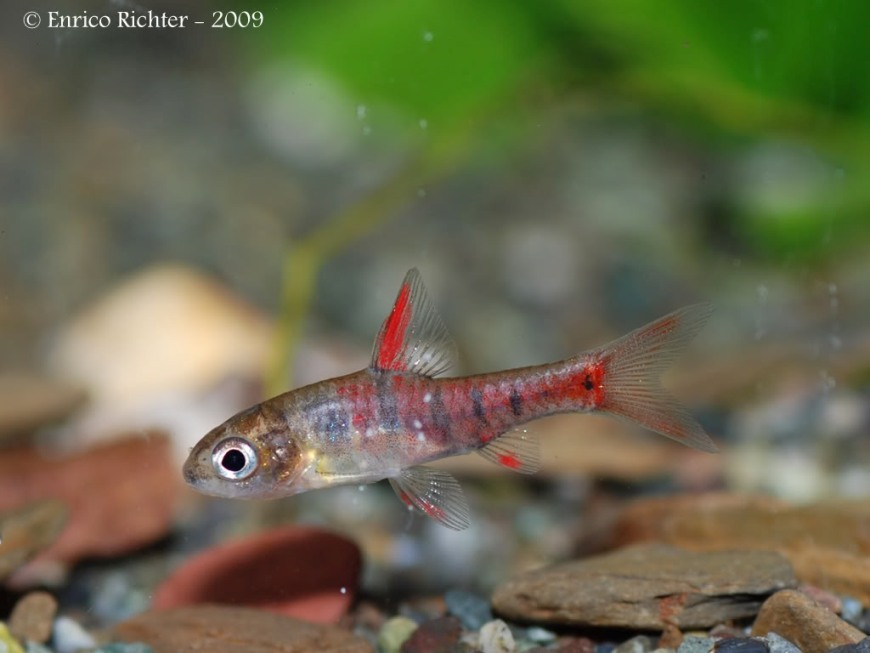
'Barbus' jae
Boulenger, 1903
Max length40mm SL1.6in SLTank45 × 30cm18 × 12inTemp17–24°C63–75°FpH5.0–6.5Although gregarious by nature it is a shoaling rather than schooling species which develops a distinct pecking order between males. It should ideally be maintained in a group of 8 or more but the tank must be of a sufficient size which will allow weaker individuals some respite from dominant conspecifics and decorated in such a way that many broken lines of sight are provided. Conversely if kept singly, in a very small group or in cramped conditions it can become withdrawn and subdominant fish may be bullied incessantly.
Ophthalmotilapia ventralis
authority not recorded
Max length150mm SL6in SLTank135 × 45cm53 × 18inTemp23–27°C73–81°FpH7.5–9.0This is a truly stunning species that does well in a Tanganyikan community with well-chosen tankmates. It exists in well over 20 colour morphs, too many to list here. Obviously these should not be mixed in aquaria as they will hybridise freely. In nature, it is only the largest dominant males that build nests whilst the subdominant males and females shoal together. The territories of these dominant fish may measure several metres across....
Tramitichromis intermedius
authority not recorded
Max length160mm SL6in SLTank120 × 38cm48 × 15inTemp24–28°C75–82°FpH7.6–8.8Sand dwelling Malawian cichlid species such as this can be somewhat delicate in the aquarium. A rigorous tank maintenance schedule is recommended to keep them in top shape; with small, regular partial water changes a necessity. Also take care with feeding as discussed above. It is likely this species will eventually be assigned to a different genus, as there is some confusion surrounding Tramitichromis and it's scientific validity. The fish included in the genus differ from Lethrinops sp...
Distichodus sexfasciatusSix-banded Distichodus
authority not recorded
Max length750mm SL30in SLTank150 × 60cm60 × 24inTemp22–26°C72–79°FpH6.0–7.5This is the most common of the few Distichodus species regularly seen in the hobby, and sadly, it is often sold as being suitable for the general community tank. This is clearly not the case in terms of both its temperament and potential size. Do not buy one unless you have the facilities to house it for life. It is usually seen for sale at a couple of inches long, and at this size is a very attractive orange and black striped fish with bright red finnage. Unfortunately, much of this colour and ...
Tateurndina ocellicaudaPeacock Goby
authority not recorded
Max length75mm SL3.0in SLTank45 × 30cm18 × 12inTemp22–26°C72–79°FpH6.5–7.5This beautiful little fish is not actually a goby, it's a member of the Eleotridae family, commonly known as sleepers or gudgeon. Members of this family lack the fused pectoral fins of true gobies. This species is one of the smallest and most attractive in the family, and makes an ideal resident of the planted community tank....
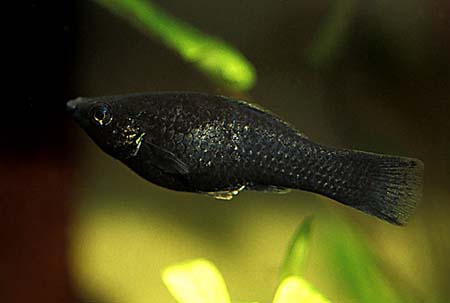
Poecilia sphenopsShort-finned Molly/Black Molly
Valenciennes, 1846
Max length80mm SL3.1in SLTank90 × 30cm36 × 12inTemp21–28°C70–82°FpH7.0–8.5A hugely popular aquarium fish. Many aquarium-bred colour morphs of this species are available, including the ubiquitous black molly. There are also Gold, Green, Lyretail, Silver and Dalmation varieties. Some of these are the results of P. sphenops being crossed with P. latipinnis. The 2 species will also interbreed readily in the aquarium and in order to avoid this we suggest keeping only one of them per tank. There also exists a (in our opinion) grotesque 'balloon' variety of this fi...