Results for “hybrid”
Type a name: scientific, common, or one a species used to go by. Or narrow the catalogue with the filters.
Filters
Pseudotropheus flavus
authority not recorded
Max length90mm SL3.5in SLTank90 × 45cm36 × 18inTemp24–28°C75–82°FpH7.6–8.8Although it is a good choice for the general mbuna community, as mentioned above P. flavus should not be kept together with any member of the P. elongatus complex. Not only will these species interbreed, producing undesirable hybrid offspring, but males of these species will clash very heavily. As with other members of the genus it possesses flat, bicuspid teeth which are designed for scraping algae and other organisms from the surface of rocks....
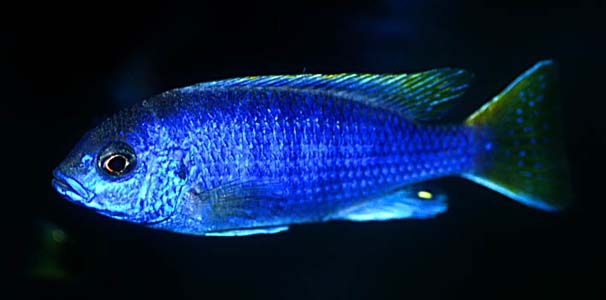
Pseudotropheus sp. 'acei'
authority not recorded
Max length125mm SL5in SLTanknot recordedTemp24–28°C75–82°FpH7.6–8.8This is an excellent beginner's species as it is relatively peaceful and easily bred. Despite being undescribed to science it is widely available in the hobby. It is sometimes sold as Gephyrochromis acei. Several colour forms are available, including "yellow tail acei" and "white tail acei". None of these should be kept together in aquaria to prevent hybridisation. In nature it feeds specifically on algae and other organisms growing on submerged wood, and is the only ...
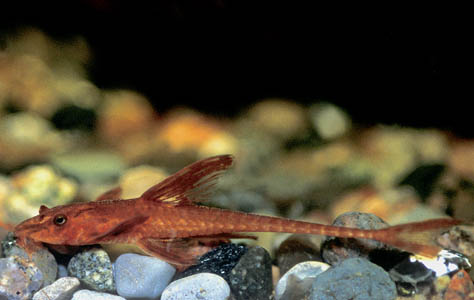
Rineloricaria sp.Red Lizard Catfish
authority not recorded
Max length110mm SL4in SLTank75 × 30cm30 × 12inTemp24–29°C75–84°FpH6.0–7.5As mentioned above, this fish may or may not be a man-made, or even hybrid, species. There are a few theories regarding this currently in circulation. Some believe that the fish are derived from a true wild caught fish, possibly of Paraguayan origin. These wild-caught red whiptails are supposed to breed true, producing all red fry, although there is no concrete evidence that they actually exist. The second possibility is that it's a selectively-bred form of Rineloricaria lanceolata, but thi...
Sciaenochromis fryeriElectric Blue Hap
authority not recorded
Max length200mm SL8in SLTank150 × 45cm60 × 18inTemp24–28°C75–82°FpH7.6–8.8This popular species was previously imported and classified as Sciaenochromis ahli, and is still named as such in much of the available literature. Many morphs exist, although males of all these exhibit the characteristic blue colouration, differing only in fin colouration and patterning. These should not be mixed in aquaria as they will hybridise. Extra care must be taken regarding tankmates, too, as male S. fryeri have been known to spawn with females of other genera, particularly Aulonoca...
Synodontis ocelliferOcellated Synodontis
authority not recorded
Max length200mm SL8in SLTank90 × 30cm36 × 12inTemp23–28°C73–82°FpH6.2–8.0S. ocellifer is often confused with other similar species of Synodontis but can be distinguished by the length of thewhich in this species is very long and runs from just past the base of the to just before the caudal fin. In recent years many alarming hybrids of this species have been appearing on the market and these should be avoided in our opinion. Besides being attractively marked this is one of the hardiest Synos available and is a good choice for the beginner....
Xiphophorus helleriiGreen Swordtail
Heckel, 1848
Max length140mm SL6in SLTank120 × 30cm48 × 12inTemp16–28°C61–82°FpH7.0–8.0Wild swordtails are a fairly basic green colur. However the vast majority of swordtails available in the hobby today are hybrids of X.helleri with X.maculatus or X.variatus. There are a huge number of selectively-bred varieties available, including wagtail, lyretail, tuxedo, albino, neon, red, green and hi-fin. Swordtails may undergo what appears to be a change in sex. In young fish this may simply be late development. However some adult females develop male characteristics which is thought ...