Results for “native”
Type a name: scientific, common, or one a species used to go by. Or narrow the catalogue with the filters.
Filters
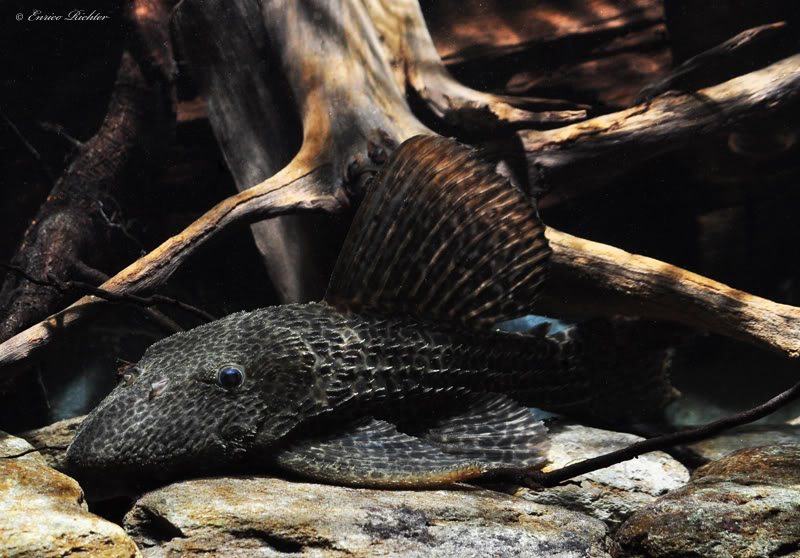
Megalancistrus sp.L234
authority not recorded
Max length600mm SL24in SLTanknot recordedTemp20–30°C68–86°FpH6.0–7.5L234 was previously applied to M. paranus, which has also has the L-number L113 assigned to it. However M. paranus is native to the Paraná, Paraguay and Uruguay drainages, whereas L234 is collected in the rio São Francisco so appears to represent an unidentified species. M. barrae and M. sp. 'LDA097' are also exported from the São Francisco system.
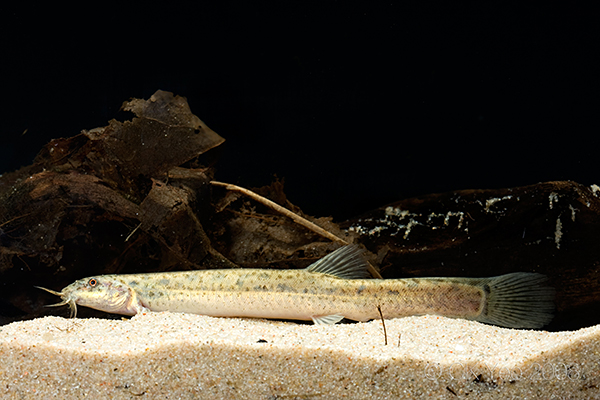
Misgurnus anguillicaudatusOriental Weather Loach
authority not recorded
Max length280mm SL11in SLTank120 × 45cm48 × 18inTempnot recordedpH6.0–8.0An exceptionally hardy and adaptable species tolerant of a wide range of physiological variables and flexible of diet, factors which have allowed it to become established as an alien species around the globe. Its high reproductive potential and low vulnerability to predation have made it a cause for concern to conservation scientists although as yet there remains no proof of it exerting a negative effect on native fishes in countries outside its natural range.
Mogurnda adspersaSouthern Purple Spotted Gudgeon
authority not recorded
Max length140mm SL6in SLTank120 × 30cm48 × 12inTemp16–24°C61–75°FpH7.0–7.5This species is considered endangered across its native range, but has recently begun to appear in the hobby a little more often as a result of commercial farming. It's still by no means common though. Superficially it looks very similar to the much commoner Northern purple spotted gudgeon (Mogurnda mogurnda), but can be distinguished by the presence of only 30-36 scales along its lateral line, (as opposed to 37-48 in M. mogurnda), and a higher degree of red spotting in the second dorsal fi...
Mystus singaringan
authority not recorded
Max length300mm SL12in SLTank120 × 45cm48 × 18inTemp22–27°C72–81°FpH5.6–7.0This large Mystus is not often seen in the hobby. It makes a fine bottom dweller for communities containing other robust species. It is used as a food fish in many of it's native countries....
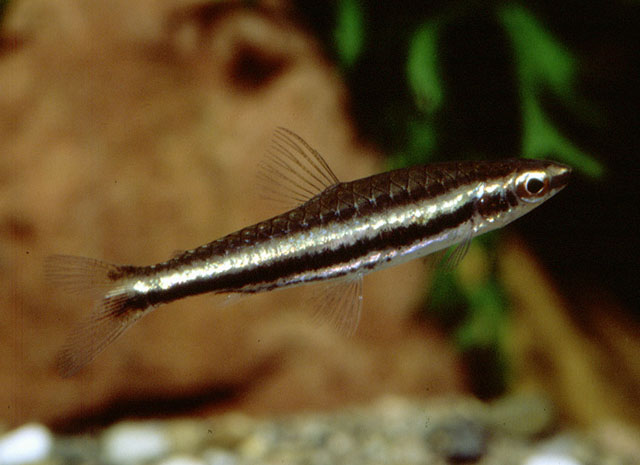
Nannostomus digrammusTwostripe Pencilfish
Fowler, 1913
Max length30mm SL1.2in SLTank45 × 30cm18 × 12inTemp22–28°C72–82°FpH5.0–7.0Native to the central Amazon basin with records existing from the Madeira, Branco, Trombetas, and Tapajós river drainages, plus the Rupununi basin in Guyana. Although an affluent of the rio Essequibo and thus not officially part of the Amazon basin, the latter is connected to the rio Takutu, a tributary of the upper rio Branco, during the annual wet season. Type locality is given by Fowler as 'Rio Madeira about 200 miles east of W. Long. 62°20', Brazil'.
Oreochromis mossambicusMozambique Mouthbrooder
authority not recorded
Max length390mm SL15in SLTank210 × 60cm84 × 24inTemp21–27°C70–81°FpH6.2–8.5One of the most invasive fish species in the world, O. mossambicus is one of the species farmed for supermarkets and restaurants across the globe. Several colour varieties have been selectively bred from the natural green fish to make the fish more appealing to consumers and unsurprisingly, it is these more brightly coloured forms which are usually seen in aquaria. Some of these variants are cross breeds with other species of Oreochromis. The destructive effect of O. mossambicus on non-nativ...
Oreochromis niloticus niloticusNile Tilapia
authority not recorded
Max length600mm SL24in SLTank210 × 60cm84 × 24inTemp21–27°C70–81°FpH6.2–8.5One of the most invasive fish species in the world but also one of the most economically important, O. niloticus is bred in huge numbers in many countries as a food fish. It is often cross-bred with other Oreochromis species for colour in order to make the fish more appealing to consumers. The destructive effect of O. niloticus on non-native ecosystems into which it escapes or is released is mainly due to it's adaptibility. It has been recorded over a temperature range of 60-110°F an...
Oxyeleotris marmorataMarbled Goby
authority not recorded
Max length650mm SL26in SLTank150 × 60cm60 × 24inTemp22–28°C72–82°FpH6.5–7.5One of the largest goby species in the world, O. marmoratus is unsuitable for the vast majority of aquaria, but is an interesting oddball for the true enthusiast with the facilities to house it properly. It is a nocturnal ambush predator and generally remains motionless during daylight hours unless striking at food. It is a popular food fish in some of its native countries, where it is known as soon hock....
Parambassis wolffiiDuskyfin Glass Fish
authority not recorded
Max length200mm SL8in SLTank120 × 30cm48 × 12inTemp18–25°C64–77°FpH6.5–8.0This species is an infrequent import. It is very common in it's native countries, where it is used as a food fish.
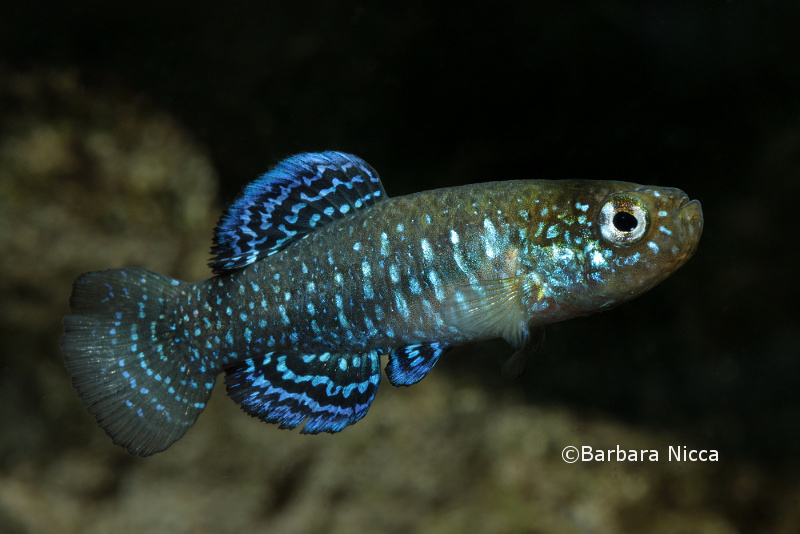
Paraphanius mentoIridescent Toothcarp
Heckel, 1843
Max length70mm SL2.8in SLTank120 × 30cm48 × 12inTemp2–30°C36–86°FpH7.5–9.0This species has something of a confused history having been previously been considered synonymous with both A. sophiae (a separate species native to Iraq and Iran) and A. cypris (currently considered a junior synonym of A. mento). Although some populations occur close to and even sympatric with other members of the genus in Turkey phylogenetic studies have shown it to be more closely-related to the Middle Eastern species A. dispar dispar, A. d. richardsoni, A. ginaonis and A. sirhani. It's...
Paratilapia polleni
authority not recorded
Max length280mm SL11in SLTank120 × 45cm48 × 18inTemp17–28°C63–82°FpH6.5–8.0Now the only species in the genus Paratilapia, P. polleni is known as the "marakely" to many natives in Madagascar, which means "black fish". As with most Madagascan cichlid species, it is highly endangered in the wild due to habitat destruction and competition from introduced species and all attempts at captive breeding are to be encouraged. There is still some confusion as to the identity of the "true" P. polleni as there are both large and small-spotted forms...
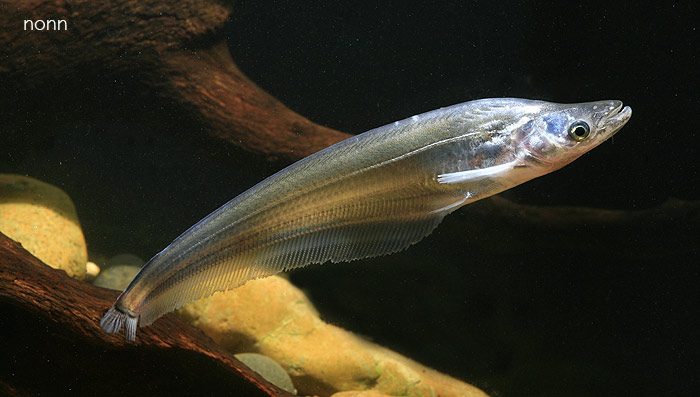
Phalacronotus apogon
Bleeker, 1851
Max length700mm SL28in SLTanknot recordedTemp20–27°C68–81°FpH6.0–7.5P. apogon has formerly been placed within the genera Kryptopterus, Micronema (Rainboth, 1996) and more recently Phalacronotus (Ferraris, 2007) and is an important food fish across much of its native range. It's very similar to P. micronema but can be told apart by its longer head (HL fits 4.6± 5.3 times in...
Piaractus brachypomusRed-bellied Pacu
authority not recorded
Max length880mm SL35in SLTank300 × 90cm118 × 36inTemp23–28°C73–82°FpH4.8–7.5Know as the pirapitinga in its native countries, this is the one of the largest species of scaled fish found in the Amazon basin. This alone should tell you much of what you need to know about its suitability as an aquarium inhabitant. In reality it's debatable as to whether the species should be considered an aquarium subject at all. While pacu rarely reach their maximum size in captivity, they're still easily capable of growing to a couple of feet in length. The myth that fish will o...
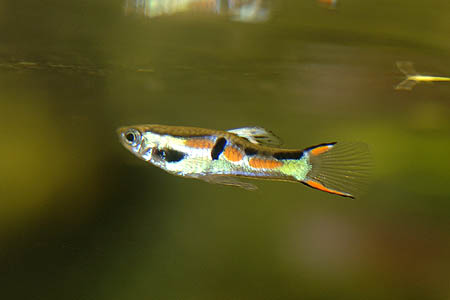
Poecilia wingeiEndler's Livebearer
Poeser, Kempkes & Isbrucker, 2005
Max length25mm SL1.0in SLTank45 × 30cm18 × 12inTemp24–30°C75–86°FpH7.0–8.5Endler's Livebearer was actually discovered in 1937 by Franklyn F. Bond before being rediscovered by John Endler in 1975 in Laguna de Patos, Cumana, northeastern Venezuela. It was found coexisting, but not interbreeding with, a wild form of P. reticulata. Both species are native to this area of Venezuela, but P. reticulata was much less common in areas where P. wingei was thriving. This is thought to be partially related to habitat type, as guppies are usually found in colder, running water...
Pseudogastromyzon laticeps
authority not recorded
Max length67mm SL2.6in SLTank75 × 30cm30 × 12inTempnot recordedpH6.0–7.5It appears that this species has not yet appeared in the western hobby, probably because commercial fish collections don't normally take place in its native waters although the goby Rhinogobius zhoui has been available occasionally. We're unable to provide details of distinguishing characters since no diagnostic key to the genus exists in English at time of writing, but based on the images available it does appear to possess reddish dorsal and caudal fins. The specimens pictured were i...
Pungu maclareni
authority not recorded
Max length100mm SL3.9in SLTank75 × 30cm30 × 12inTemp28–30°C82–86°FpH7.5–8.5This is currently the only described species in the genus Pungu. Because of it's its tiny natural range, habitat destruction due to excess water removal (the nearby town of Kumba relies on the lake for it's water supply), deforestation, the introduction of non-native species and overfishing, it is considered to be critically endangered and all efforts at captive breeding are to be encouraged. It is correspondingly rare in the hobby, and we suggest purchasing some only if you intend to ...
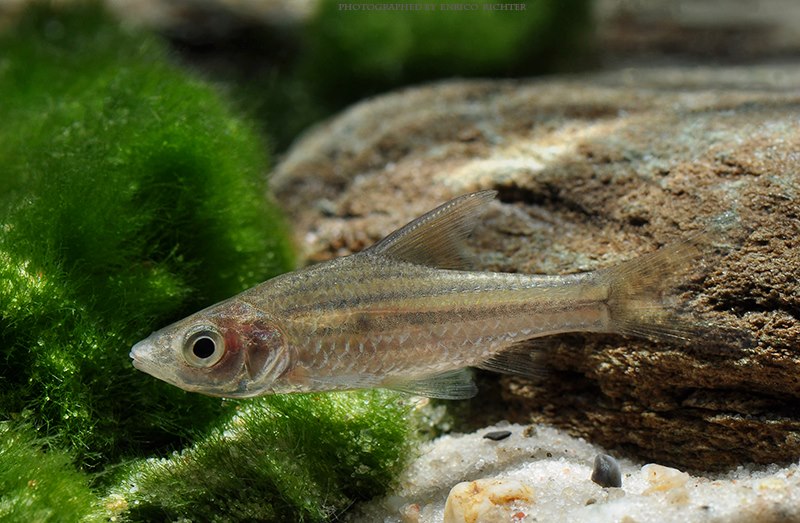
'Puntius' lineatusLined Barb
Duncker, 1904
Max length55mm SL2.2in SLTank80 × 30cm31 × 12inTemp20–26°C68–79°FpH4.0–7.0One of four similar-looking, laterally-striped 'Puntius' spp. native to Southeastern Asia alongside 'P.' gemellus, 'P.' johorensis, and 'P.' trifasciatus. Of these 'P.' lineatus is most often confused with 'P.' johorensis by virtue of the fact that these two seem most common in the aquarium trade. Telling them apart is relatively simple since 'P.' lineatus has 0 - 1 pairs of barbels (vs. 2 pairs in the other three species), juv...
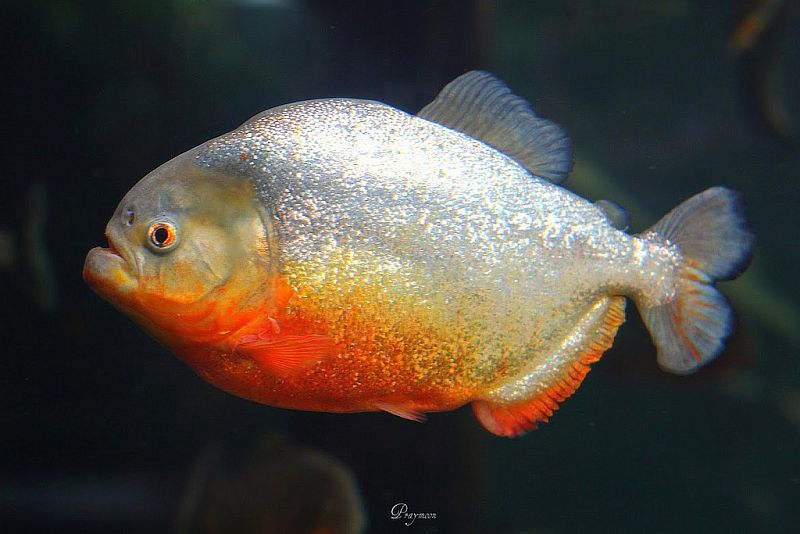
Pygocentrus nattereriRed Bellied Piranha
Kner, 1858
Max length350mm SL14in SLTank240 × 90cm96 × 36inTemp24–28°C75–82°FpH5.5–7.5Famed as a rapacious predator capable of rapidly stripping flesh from bone and a danger to any animal entering its native waters, P. nattereri is among the most notorious freshwater fishes in the world. As a result, displays featuring this “bloodthirsty” creature are found in most public aquaria, grisly Hollywood movies have been released, and the species has become popular in the aquarium trade. Little of this infamy is based on factual evidence, however.
Rasbora kottelati
authority not recorded
Max length70mm SL2.8in SLTank120 × 30cm48 × 12inTemp23–28°C73–82°FpHnot recordedIt is unclear if this species has been available in the aquatic trade as collections from its native waters only occur sporadically, therefore we have based much of the information here on experience with its closest relative R. kalochroma. These two are almost identical in appearance and share some meristic features but R. kottelati possesses an additional, oval-shaped dark blotch on the caudal peduncle, lacks the stripe in the middle of the seen in R. kalochroma and is consequently easy to dis...
Semaprochilodus insignisFlagtail Prochilodus
authority not recorded
Max length350mm SL14in SLTank150 × 60cm60 × 24inTemp23–29°C73–84°FpH5.5–7.2Semaprochilodus are one of the most common and widespread shoaling fish found in South America. Over a dozen species have been described but most are never imported. They are used as food fish in their native countries. It makes a stunning addition to a community of larger fish. Along with some congeners, S. insignis is commonly known as the Jaraqui in Brazil. It is an interesting species both ecologically and biologically. In nature it migrates over large distances in huge shoals according ...