Results for “synonymous”
Type a name: scientific, common, or one a species used to go by. Or narrow the catalogue with the filters.
Filters
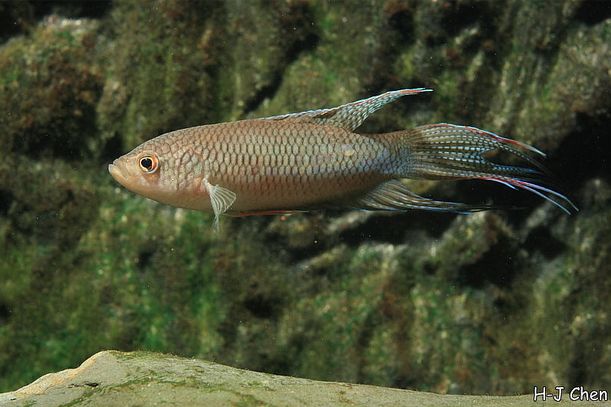
Macropodus erythropterus
Freyhof & Herder, 2002
Max length80mm SL3.1in SLTank80 × 30cm31 × 12inTemp20–30°C68–86°FpH6.0–8.0This species is frequently mistaken for the similar-looking congener M. spechti Schreitmüller 1936, which is easily-identified by the absence of reddish pigmentation in the dorsal, anal, and caudal fins. There has been some debate as to whether these two represent the same taxon, however, with Winstanley and Clements (2008) proposing that M. erythropterus be considered a synonym of M. spechti because they were unable to separate the two species by morphological characters, and specimens with red pigmentation on the unpaired fins were coll...
Megalodoras uranoscopusGiant Raphael Catfish
authority not recorded
Max length700mm SL28in SLTank240 × 120cm96 × 48inTemp21.1–25°C70–77°FpHnot recordedThis species is also known by the vernacular name "ripsaw catfish" (U.S.) and was often referred to by the scientific name M. irwini, now considered a junior synonym of M. uranoscopus, in older literature. Within the family Doradidae the genus Megalodoras is considered most closely-related to Lithodoras, Centrodoras and Platydoras, respectively. Members of the family Doradidae can be distinguished from all other Siluriformes by possession of a unique infranuchal scute, a dermal bon...
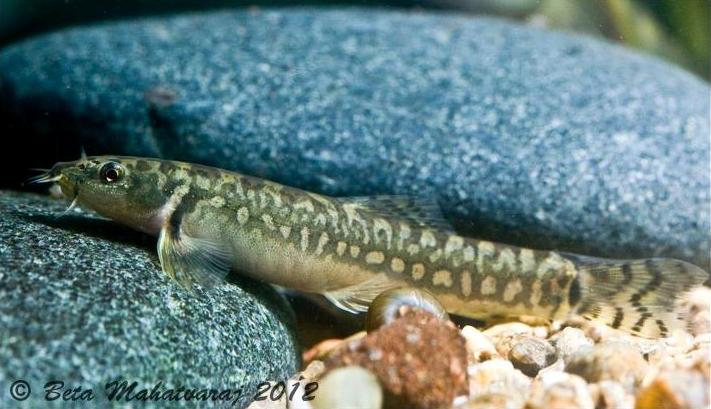
Mesonoemacheilus herrei
Nalbant & Bãnãrescu, 1982
Max length60mm SL2.4in SLTank60 × 30cm24 × 12inTemp18–25.5°C64–78°FpH6.0–7.5It's unclear if this species has ever been exported for the aquarium hobby outside of India but there may be a chance of finding the occasional specimen mixed in with shipments of M. guentheri or M. triangularis. It was earlier considered synonymous and may still be confused with M. guentheri since both species share similar body patterning consisting of rows of yellowish, dark-edged spots.
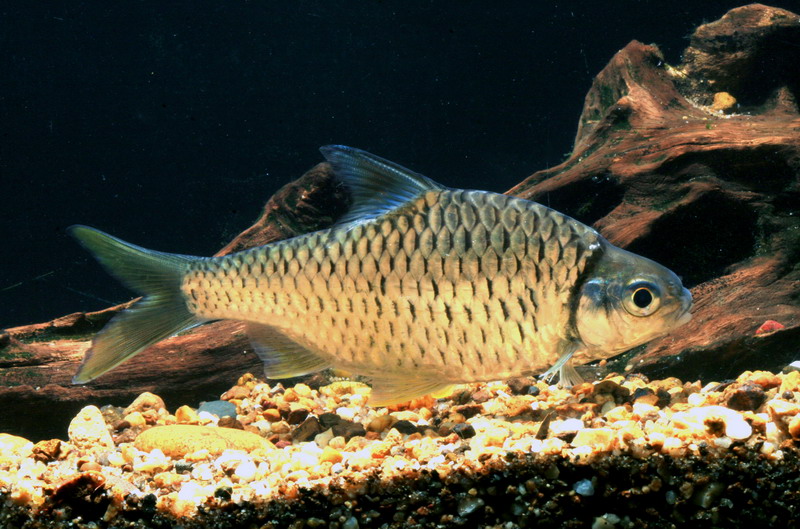
Mystacoleucus obtusirostris
Valenciennes, 1842
Max length140mm SL6in SLTank120 × 45cm48 × 18inTemp20–27°C68–81°FpH6.0–8.0This species is occasionally marketed as 'Burmese Rainbow Barb' in the ornamental trade. others may have been exported in small numbers or as bycatch among shipments of other species. It was referred to as Mystacoleucus marginatus for decades, but that name is a simultaneous subjective synonym of M. obtusirostris following Kottelat (2013).
Neolamprologus olivaceous
authority not recorded
Max length80mm SL3.1in SLTanknot recordedTemp23–27°C73–81°FpH7.5–9.0This species is included in the so-called "Brichardi complex", which also includes N. brichardi, crassus, falcicula, gracilis, pulcher, savoryi and splendens. These should not be mixed in aquaria, as they will hybridise freely. N. olivaceouscan be distinguished from others in the complex by the two curved markings on the gill cover. It is possible that it is synonymous with N. pulcher, as proposed by Konings (1993)....
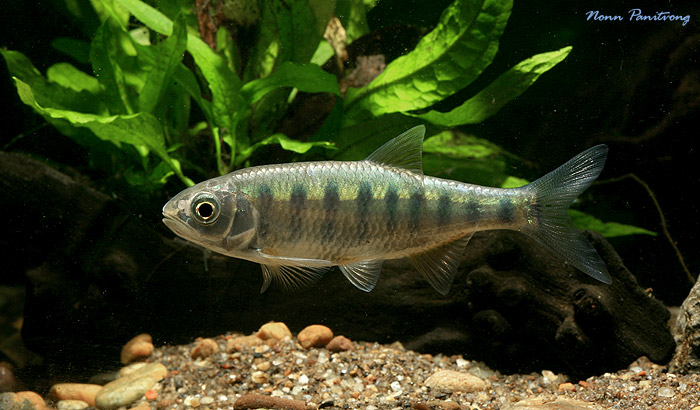
Opsarius infrafasciatus
Fowler, 1934
Max length100mm SL3.9in SLTank120 × 45cm48 × 18inTemp18–26°C64–79°FpH6.0–8.0This species has previously been considered synonymous with both O. ornatus and O. pulchellus but is currently considered to be distinct following (Tejavej, 2012). It can be distinguished from congeners by a combination of characters including: small caudal spot presen...
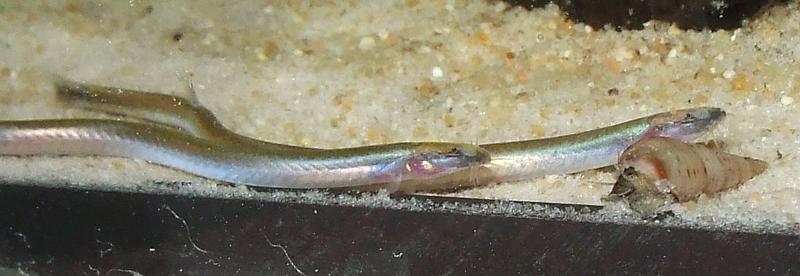
Pangio doriae
Perugia, 1892
Max length90mm SL3.5in SLTank60 × 30cm24 × 12inTemp21–26°C70–79°FpH3.5–7.0One of a handful of Pangio spp. traded under the generic name 'eel loach', though it's most commonly available as bycatch among shipments of other fishes. Some authors have suggested it may be synonymous with P. anguillaris bu...
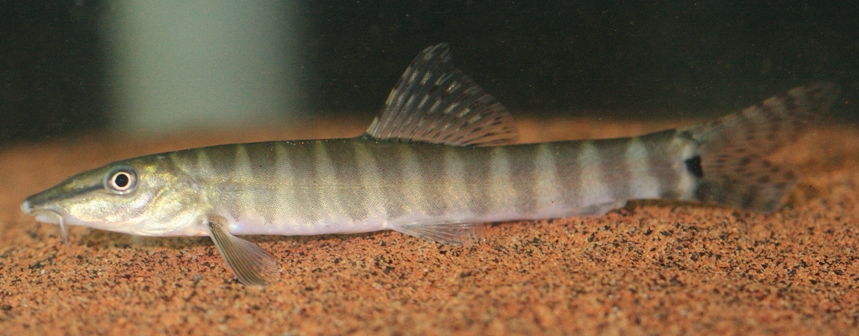
Parabotia fasciata
Dabry de Thiersant, 1872
Max length150mm SL6in SLTank120 × 45cm48 × 18inTemp20–24°C68–75°FpH6.0–7.5P. fasciata is rarely seen in the trade and is typically available only as bycatch among shipments of Sinibotia spp., particularly S. robusta. According to current classification numerous species from several genera are considered synonymous with it.
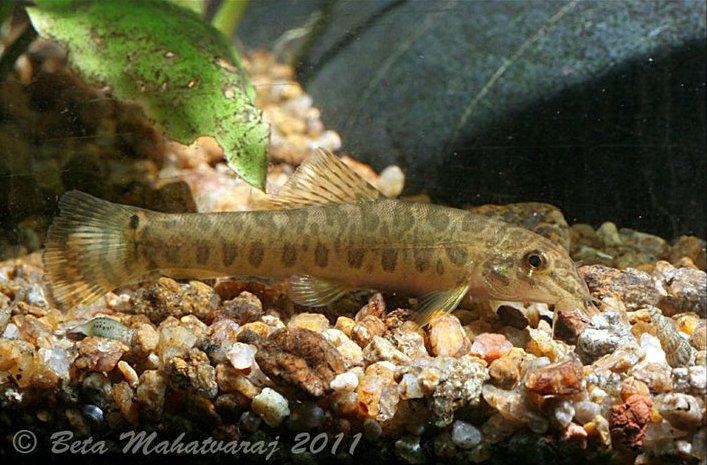
Paracanthocobitis mooreh
Sykes, 1839
Max length75mm SL3.0in SLTank75 × 30cm30 × 12inTemp20–26°C68–79°FpH6.0–7.5This species is still considered a member of the genus Nemacheilus by some sources, but it was reclassified and placed in Acanthocobitis by Grant (2008). Acanthocobitis sinuata, generally considered a junior synonym of A. mooreh (Kottelat, 2012b), also appears distinct and differs in geographical distribution plus number of dorsal-fin rays (2-3/9-10 in A. mooreh vs. 2/8-9 in A. sinuata) and some aspects of colour pattern.
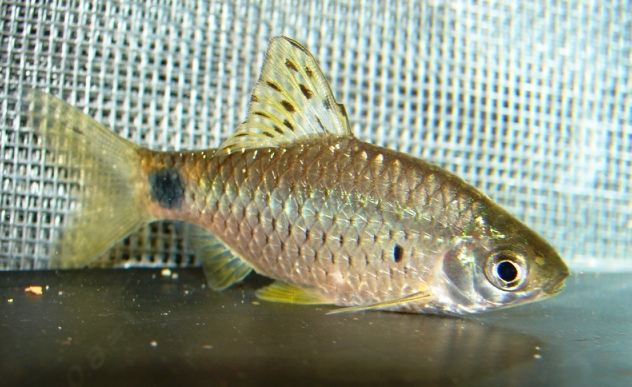
Pethia punctata
Day, 1865
Max length55mm SL2.2in SLTank75 × 30cm30 × 12inTemp21–26°C70–79°FpH6.0–7.5This species is poorly-known in the aquarium hobby and has a confusing taxonomic history having been considered both synonymous with or a subspecies of the congener P. ticto in the past. It can be distinguished from other members of the genus by the following combination of characters: lateral line complete with 27 scales (following Day); body with two dark blotches; anterior spot one scale row below lateral line; dorsal-fin with rows of spots.
Pethia stoliczkana
Day, 1871
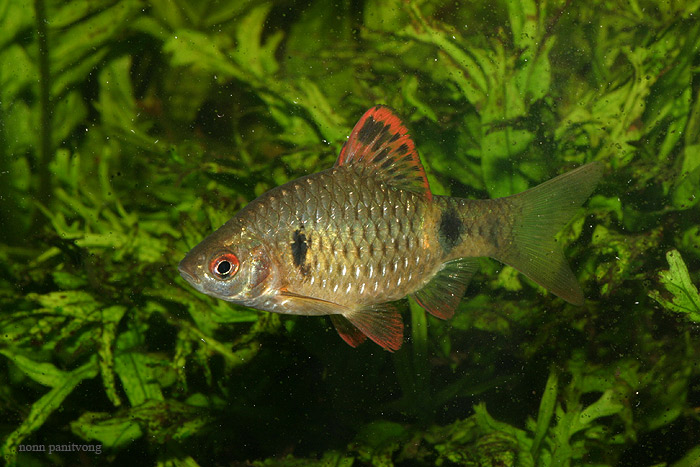
Max length50mm SL2.0in SLTank75 × 30cm30 × 12inTemp18–26°C64–79°FpH6.0–7.5This species is confused with P. ticto in much of the available literature and is sometimes listed as a synonym of it. Although some populations of the two species possess a similar colour pattern (there are reports of a P. ticto variant from the south of West Bengal state in India with a red, black-flecked dorsal-fin, for example) they do not occur in the same waters in nature and can be distinguished by examining the lateral line. This is complete in...
Protomelas fenestratusFenestratus
authority not recorded
Max length140mm SL6in SLTank120 × 45cm48 × 18inTemp24–28°C75–82°FpH7.6–8.8This species has an interesting method of feeding in nature. It will 'blow' sediment from the surface of rocks and feed on morsels that are uncovered. Protomelas sp. "steveni taiwan reef" is often sold as a subspecies of P. fenestratus but is actually thought not to be synonymous. P. taeniolatus is also very similar to fenestratus, and several colour forms of both these species exist. It is likely that some of these may be reclassified as distinct species in the future. None ...
Protomelas sp. steveni "Taiwan reef"
authority not recorded
Max length140mm SL6in SLTank120 × 45cm48 × 18inTemp24–28°C75–82°FpH7.6–8.8Protomelas sp. "steveni taiwan reef" is often sold as a subspecies of P. fenestratus, but is actually thought not to be synonymous and is currently undescribed. It can be distinguished from similar species such as P. fenestratus and P. taeniolatus by the bright redof adult males. None of these related species or morphs should be kept together in aquaria as they may hybridise. Some captive spawns of this species have resulted in albino fry. It is one of the more popular and readily a...
Puntigrus pulcher
Rendahl, 1922
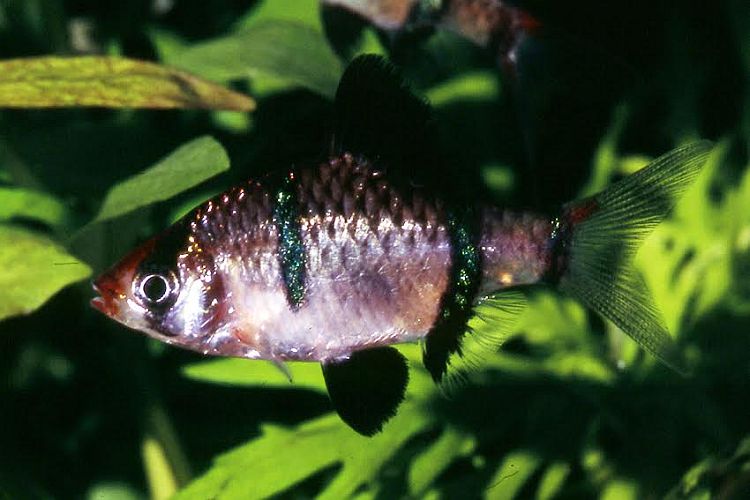
Max length60mm SL2.4in SLTank80 × 30cm31 × 12inTemp20–26°C68–79°FpH5.0–7.5This species occasionally appears in the aquarium hobby, but the trade is largely reliant on commercially-produced 'tiger barbs' of questionable origin. It was considered a synonym of P. anchisporus for a number of decades following Alfred (1963), but revalidated by Kottelat and Tan (2011).
Rasboroides vateriflorisFire Rasbora
Deraniyagala, 1930
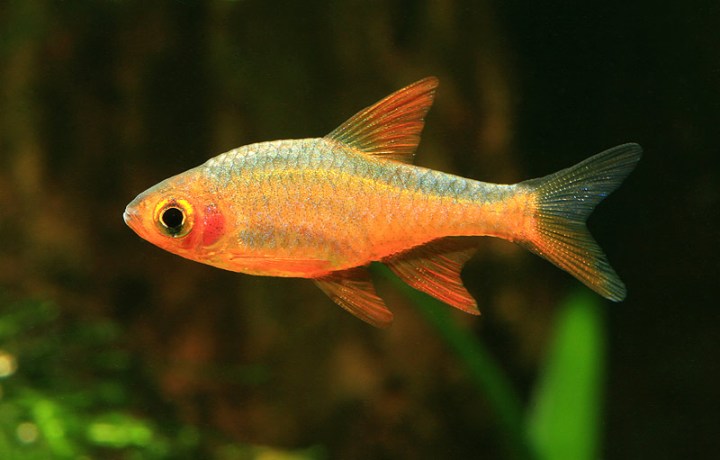
Max length40mm SL1.6in SLTank60 × 30cm24 × 12inTemp23–27°C73–81°FpH5.5–7.0These are still regarded as valid by some authorities although it's widely accepted that they represent variants of R. vaterifloris due to a lack of type material hindering conclusive study. Rasboroides nigromarginata (Meinken, 1956) has also been used to refer to a reddish form in which males differ from other populations in possessing dark fin margins, but the name is currently considered synonymous with R. vaterifloris by most sources despite the fish being rediscovered in 2010.
Schistura laterivittata
Zhu & Wang, 1985
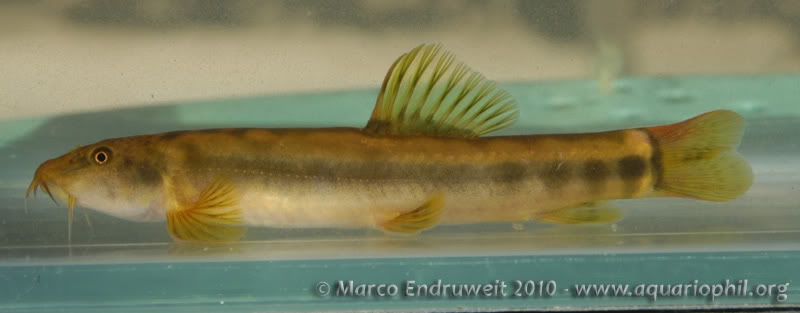
Max length80mm SL3.1in SLTank120 × 30cm48 × 12inTemp10–22°C50–72°FpH7.0–9.0It's been considered a synonym of Schistura caudofurca (Mai, 1978) by the majority of recent authors following Kottelat (2001) but this appears to be a case of misidentification since the two species exhibit several notable differences based on their respective descriptions (Endruweit, 2010).
Serrasalmus marginatus
authority not recorded
Max length221mm SL9in SLTank120 × 38cm48 × 15inTemp22–25°C72–77°FpHnot recordedThere are currently 24 described species of Serrasalmus, many of which look superficially similar. S. marginatus has at various times been considered a synonym of S. rhombeus and S. humeralis, but is currently considered to be distinct. It's main distinguishing feature is usually given as the thick, black, v-shaped marking in the anterior portion of the caudal fin. Juveniles are said to differ from similar-looking species such as S. compressus and S. altuvei because the dark body "spot...
Serrasalmus rhombeusBlack Piranha/Rhom
authority not recorded
Max length450mm SL18in SLTank210 × 45cm84 × 18inTemp22.2–27.8°C72–82°FpHnot recordedThere are in excess of 30 described species of Serrasalmus many of which appear superficially similar and have confusing taxonomic histories. S. rhombeus is among the most convoluted of all with numerous synonyms of which S. niger is the most well-known. There has also been a muddle surrounding the common names "white" and "black" piranha, both of which have been used to describe the species. Of greater interest to both scientists and hobbyists has been the discovery of n...
Serrasalmus serrulatus
authority not recorded
Max length190mm SL7in SLTank120 × 45cm48 × 18inTemp24–28°C75–82°FpHnot recordedThere are currently 24 described species of Serrasalmus, many of which look superficially similar. S. serrulatus occupies a particularly confusing taxonomic position and is very tricky to identify positively. According to scientific literature it is very close in appearance to several congeners, most notably S. eigenmanni, S. hollandi, S. humeralis and S. nalseni. The separation of these is largely based on geographical range and it's possible that some of them may turn out to be synonymous...
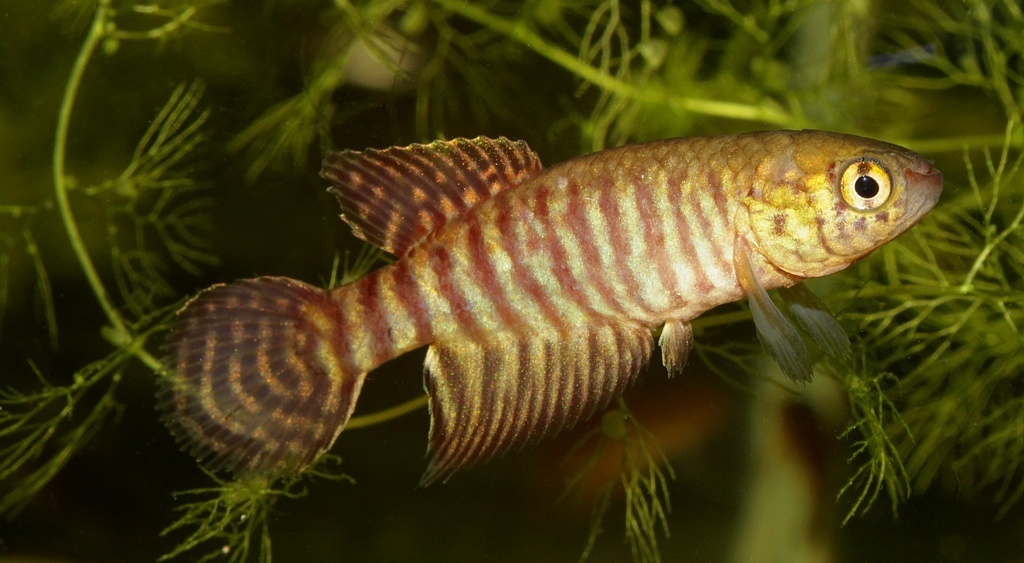
Simpsonichthys myersi
de Carvalho, 1971
Max length40mm SL1.6in SLTank45 × 30cm18 × 12inTemp20–27°C68–81°FpH5.5–7.0This species has a somewhat confusing taxonomic history and it remains unclear whether it is conspecific with S. izecksohni (Da Cruz, 1983) or not. The latter is considered to represent a synonym of S. myersi by Costa (2007), but the majority of authors do not follow the conclusions of that study (see below) and continue to view both as valid.