Results for “várzea”
Type a name: scientific, common, or one a species used to go by. Or narrow the catalogue with the filters.
Filters
Potamotrygon falkneriLarge Spot Stingray
authority not recorded
Max length470mm SL19in SLTank180 × 60cm72 × 24inTemp23.9–28.9°C75–84°FpH6.0–7.5P. falkneri is arguably among the most beautiful Potamotrygonids seen in the hobby. It's not imported with any great degree of regularity, and is usually expensive when available. There are currently three genera in the family Potamotrygonidae, all of which hail from South America. Paratrygon and Plesiotrygon are both monotypic genera (contain only a single described species) and are rarely seen in the hobby. The vast majority of imported rays belong to the biggest genus, Potamotrygon. T...
Potamotrygon hystrixPorcupine Stingray
authority not recorded
Max length375mm SL15in SLTanknot recordedTemp24–26°C75–79°FpH6.0–7.5P. hystrix is sometimes sold as P. sp. "C", and is much sought after in the hobby. The species is usually recommended as a good beginners' ray due to its relatively small adult size. However due to current Brazilian legislation regarding the export of rays it's almost never available at present, and tends to command a high price when it is. The fish sold as hystrix in the trade are almost always Peruvian in origin and erroneously labelled. We've seen P. humerosa, P. yep...
Potamotrygon motoroMotoro Stingray
authority not recorded
Max length900mm SL35in SLTank240 × 90cm96 × 36inTemp24–26°C75–79°FpH6.0–7.5P. motoro is one of the most popular members of the genus with aquarists. Whilst it is quite easily obtainable and hardy once settled in, it does grow very large so make sure you can house it adequately long term. It should also be noted that the males of this species are among the most violent when in the mood for spawning and females can end up on the wrong end of a serious beating. If you're keeping a pair or group of these keep a close eye on proceedings and be prepared to separate them...
Potamotrygon scobinaMosaic Stingray
authority not recorded
Max length350mm SL14in SLTank180 × 75cm72 × 30inTemp24–26°C75–79°FpH6.0–7.5There are currently three genera in the family Potamotrygonidae, all of which hail from South America. Paratrygon and Plesiotrygon are both monotypic genera (contain only a single described species) and are rarely seen in the hobby. The vast majority of captive rays belong to the biggest genus, Potamotrygon. This contains 17 species at present, and its members are sometimes referred to as "big-eyed" stingrays for fairly obvious reasons. There are also a number of undescribed species th...
Potamotrygon sp. "itaituba"P14
authority not recorded
Max length400mm SL16in SLTank210 × 90cm84 × 36inTemp23–29°C73–84°FpH6.0–7.5This stunning fish is one of the more sought after rays in the hobby. Taxonomically it remains unclear whether it is a geographical variant of P. leopoldi or a distinct species. It has a smaller adult size and both pups (see section above) and adults exhibit different patterning than it's relative. In P. leopoldi the light spotted markings tend to be quite large, spaced out and do not extend to the edge of the disc. In P14 they are typically much smaller, more randomly distributed and prese...
Potamotrygon sp. "pearl"Pearl Ray
authority not recorded
Max length600mm SL24in SLTank240 × 90cm96 × 36inTemp23–29°C73–84°FpHnot recordedThis undescribed species must rank among the most jaw-dropping freshwater fish yet seen in the hobby. A good-sized adult makes a truly incredible sight. Unfortunately due to the current ban on ray exports from Brazil it is almost unobtainable and correspondingly expensive when it is. The handful of captive-bred specimens released each year can cost up to £1000 each, and we know of only a single breeder in the UK. The patterning of this "species" is highly variable, with...
Prionobrama filigeraGlass Bloodfin Tetra
authority not recorded
Max length60mm SL2.4in SLTank60 × 38cm24 × 15inTemp23–27°C73–81°FpH6.0–7.5The genus Prionobrama currently contains only one other valid species, P. paraguayensis. It is very similar in appearance to P. filigera, but lacks any red pigmentation in the caudal fin. It's probably never been imported for the hobby, although it may show up as occasional bycatch amongst shipments of more popular species. P. filigera can be easily distinguished from the "other" bloodfin tetra, Aphyocharax anisitsi by its more elongate body shape and the fact that it exhibits...
Pseudocrenilabrus multicolorDwarf Egyptian Mouth-brooder
authority not recorded
Max length80mm SL3.1in SLTanknot recordedTemp20–26°C68–79°FpH6.5–7.2This species was one of the first cichlid species to be spawned in captivity and has been in the hobby for over a century. It is less popular than it once was but remains a good choice for the beginner as it is tolerant of a wide range of water conditions and is easily bred. There currently exist 2 subspecies, Pseudocrenilabrus multicolor multicolor and P. m. victoriae. These are quite distinct in terms of colouration and patterning and exist as separate populations in nature. Both subspecie...
Pseudocrenilabrus nicholsi
authority not recorded
Max length85mm SL3.3in SLTank90 × 30cm36 × 12inTemp22–25°C72–77°FpH6.0–8.0Rarely seen in the hobby, P. nicholsi is a stunning but pugnacious little fish that is nevertheless well worth seeking out. Some males develop long extensions to the ventral fins.
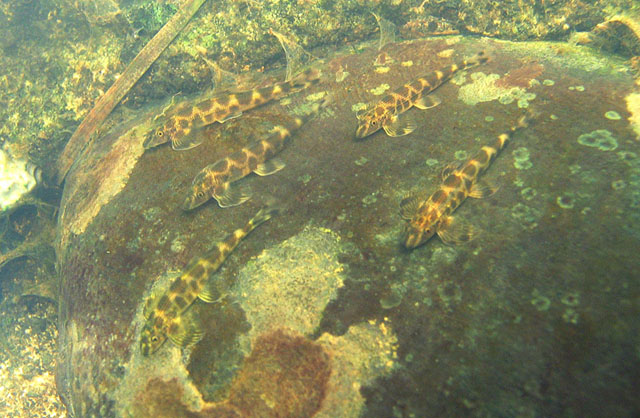
Pseudohomaloptera sexmaculata
Fowler, 1934
Max length70mm SL2.8in SLTank80 × 30cm31 × 12inTemp20–25.5°C68–78°FpH6.0–7.5H. sexmaculata is very similar to H. leonardi but can be told apart since it possesses 2 simple and 12-14 branched pectoral-fin rays (versus 6 simple and 11 branched rays). Both of these species are sometimes misidentified as H. yunnanensis which has 7 simple and 12 branched pectoral-fin rays.
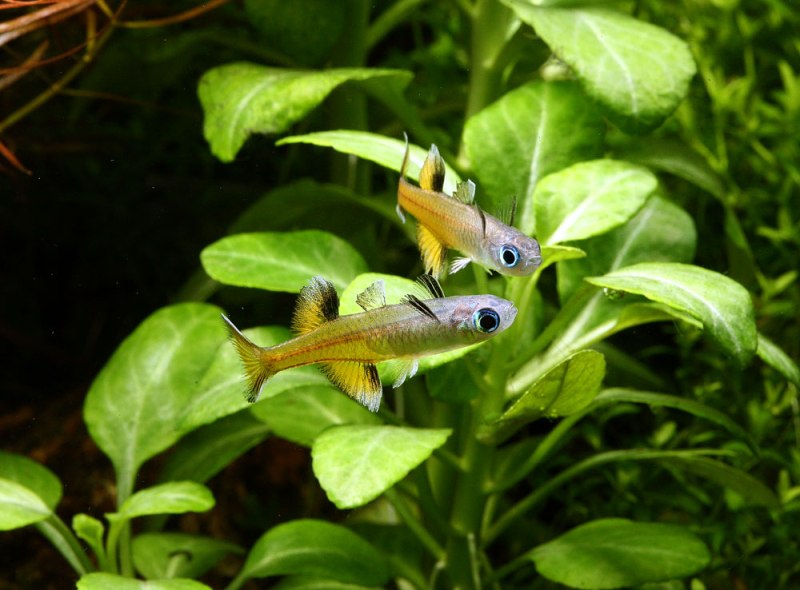
Pseudomugil signiferPacific Blue-eye
Kner, 1866
Max length70mm SL2.8in SLTank60 × 30cm24 × 12inTemp20–26°C68–79°FpH6.5–7.5Generally found within 15-20 km of the sea but habitat-type is extremely variable. It's been recorded in full marine conditions as well as pure freshwater environments, and commonly inhabits coastal mangrove creeks, swamps, and salt marshes. Freshwater habitats tend to comprise lowland swamps or forest streams with clear water but some populations inhabit acidic, tannin-stained, black waters. It's also abundant in the artificial canals typical of residential zones in the Gold Coast, southern Queensland.
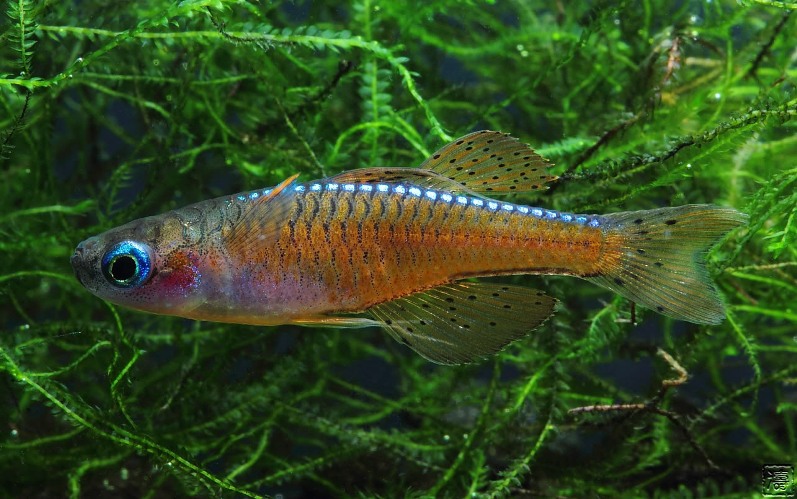
Pseudomugil sp. 'red neon'
authority not recorded
Max length35mm SL1.4in SLTank45 × 30cm18 × 12inTemp18–26°C64–79°FpH6.5–7.5This fish first appeared in the aquarium hobby in 2011 and has been traded under various names including P. sp. cf. paskai, P. sp. 'red orange neon', P. sp. 'neon orange', P. sp. 'Irian' and P. 'iriani'. The majority of fish available tend to be male, presumably due to their brighter colour pattern. It was initially suspected to be a hybrid or sele...
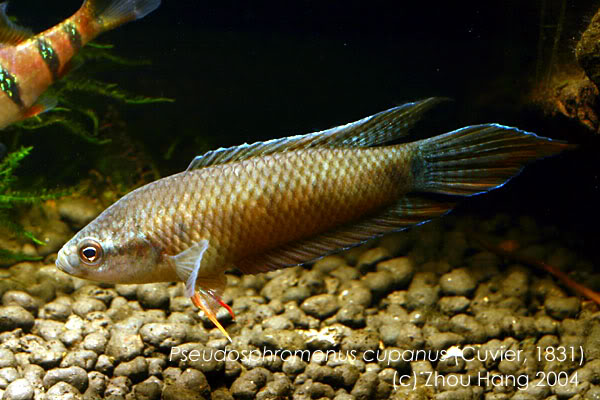
Pseudosphromenus cupanusSpiketail Paradisefish
Cuvier, 1831
Max length65mm SL2.6in SLTank60 × 30cm24 × 12inTemp20–28°C68–82°FpH6.0–7.5This species is most easily told apart from its only congener P. dayi by lacking (vs. possessing) two dark, irregular lateral stripes on the head and body, and a shorter caudal-fin in males. The results of phylogenetic analyses by Rüber et al. (2006) suggest that Pseudosphromenus is most closely-related to Malpulutta in an evolutionary sense.
Pseudotropheus socolofiPowder Blue Cichlid
authority not recorded
Max length115mm SL5in SLTank90 × 45cm36 × 18inTemp24–28°C75–82°FpH7.6–8.8This common mbuna also goes by the names "Eduard's mbuna" and "Pindani". It is one of the most popular Rift Lake cichlids in the hobby due to its striking colouration and somewhat peaceful nature (for a mbuna). Wild fish can now be quite difficult to find, as the vast majority of specimens offered for sale are tank-bred. An albino form exists in aquaria and has achieved a fair degree of popularity. A highly recommended beginner's mbuna....
Pseudotropheus tropheops tropheops
authority not recorded
Max length200mm SL8in SLTank120 × 38cm48 × 15inTemp24–28°C75–82°FpH7.6–8.8This species has a confusing taxonomic past. There are currently 3 subspecies, Pseudotropheus tropheops tropheops, P. t. romandi and P. t. gracilior. P. macrophthalmus and P. microstoma were also once considered as subspecies of tropheops, but are now classed as distinct species. Furthermore, it is likely that the current subspecies and their various colour forms (of which there are many) will be themselves reclassifed into the currently invalid genus Tropheops! Incidentally, none of the subspec...
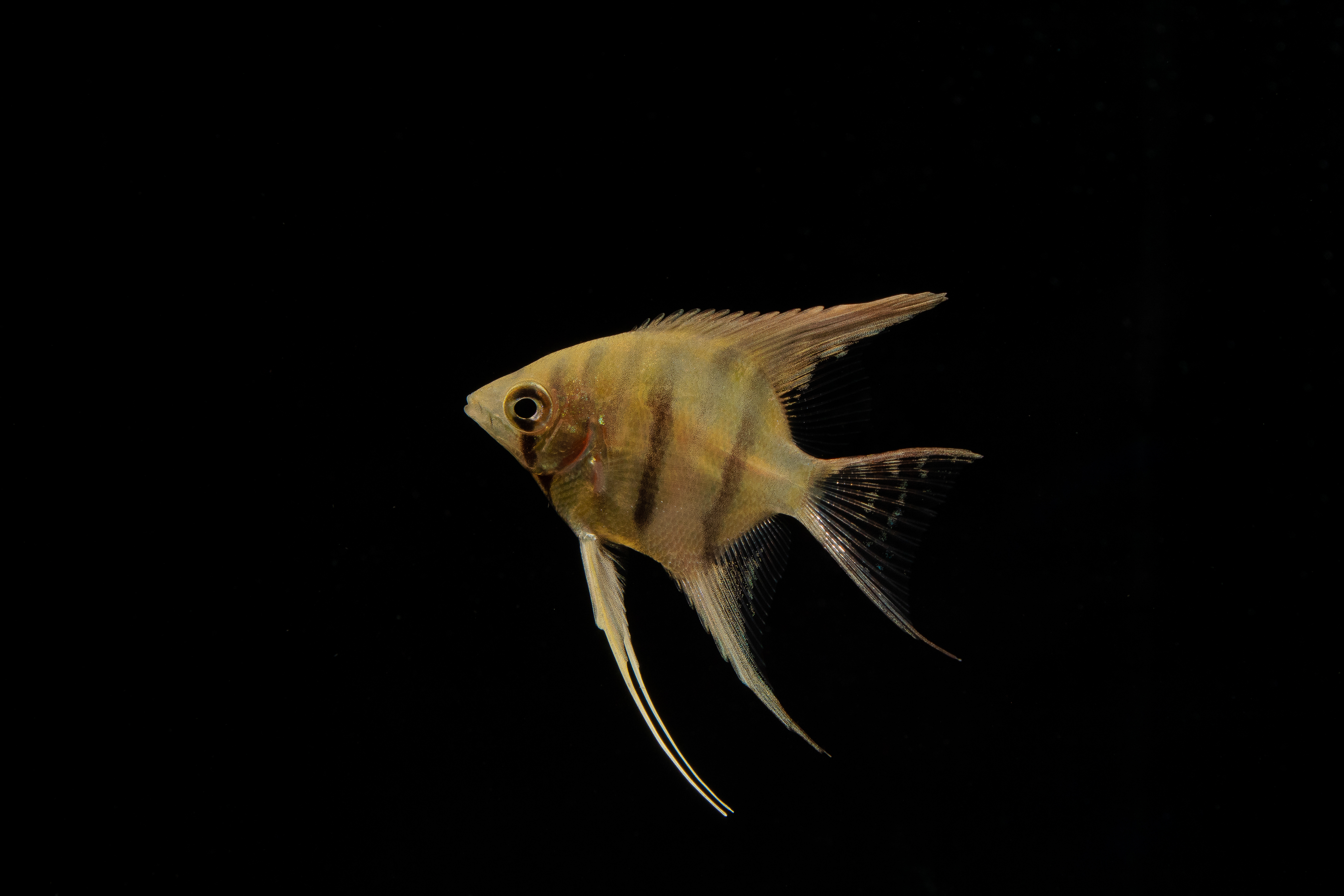
Pterophyllum leopoldiRoman Nose Angelfish
Gosse, 1963
Max length100mm SL3.9in SLTank90 × 30cm36 × 12inTemp22–29°C72–84°FpH5.0–7.0Pterophyllum leopoldi can be differentiated from other members of the genus by the presence of up to 11 vertical stripes on the body, though often only the 3 largest, boldest stripes can be seen. This species also shows a dark patch over the operculum. In adult specimens, a red/maroon hue over the back and fins is characteristic of the species, leading some to believe the most colourful natural form Angelfish. The name-sake roman nose possessed by the fish is also very distinctive and used as a meristic feature.
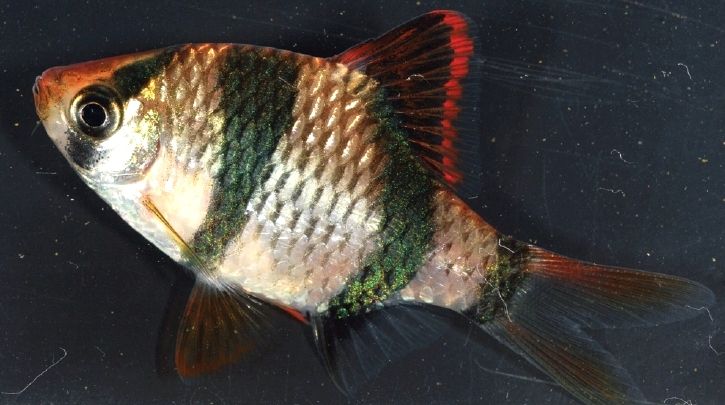
Puntigrus navjotsodhii
Tan, 2012
Max length48mm SL1.9in SLTanknot recordedTempnot recordedpHnot recordedThe type series was collected from a small clear-water stream with a pH of 6.0, forming a series of riffles and deeper pools, with a maximum width of 5 metres and depth ranging from 10 cm to 1 metre. The substrate was composed of sand gravel and rocks, with some leaf litter and overhanging marginal vegetation.
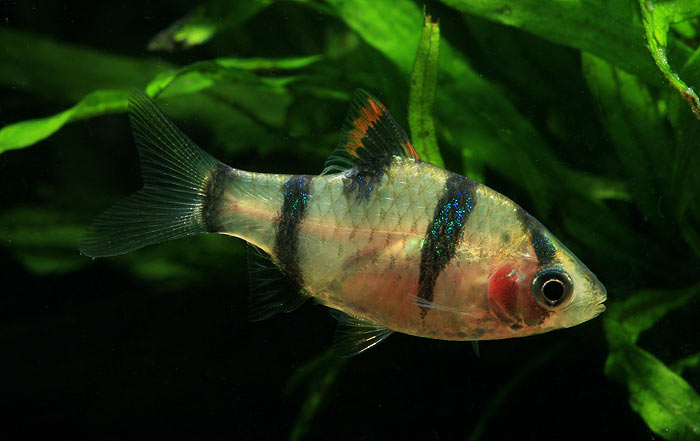
Puntigrus partipentazona
Fowler, 1934
Max length40mm SL1.6in SLTank80 × 30cm31 × 12inTemp20–26°C68–79°FpH5.0–7.0Recorded from numerous river basins in Vietnam, Cambodia, Laos, Thailand, and Peninsular Malaysia, including the Mekong, Chao Phraya, Mae Khlong, Chanthaburi, Tapi, Golok, Terengganu, Pahang, Endau, and Muar. Type locality is 'Kratt, southeastern Siam', which corresponds to modern-day Trat Province, Thailand.
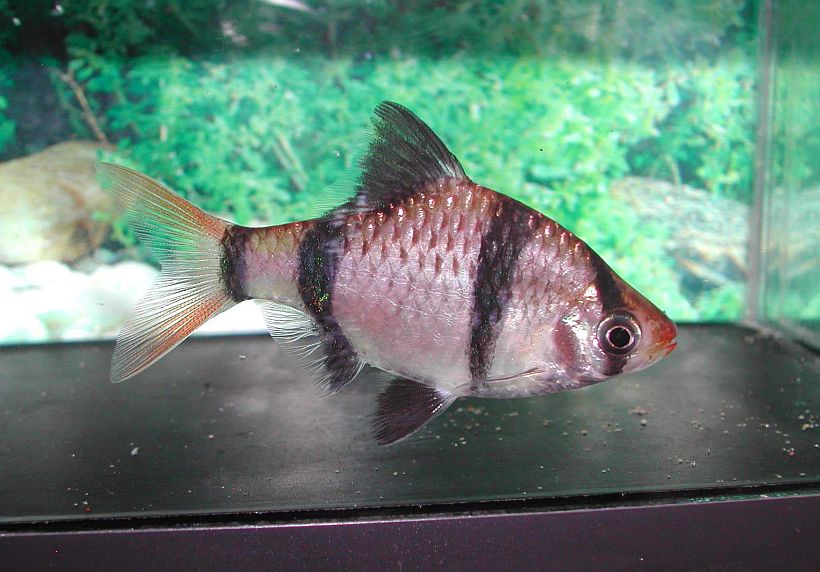
Puntigrus tetrazonaTiger Barb
Bleeker, 1855
Max length60mm SL2.4in SLTank80 × 30cm31 × 12inTemp20–26°C68–79°FpH5.0–8.0P. tetrazona is traditionally considered to be among the most ubiquitous species available in the aquarium trade. Wild examples are rarely traded, however, and there exists ongoing confusion as to the identity of the commercially-produced 'aquarium' tiger barb. A number of selectively-bred, ornamental strains are available. The albino, 'green' (aka 'moss'), and 'golden' (leucistic) variants are particularly pop...
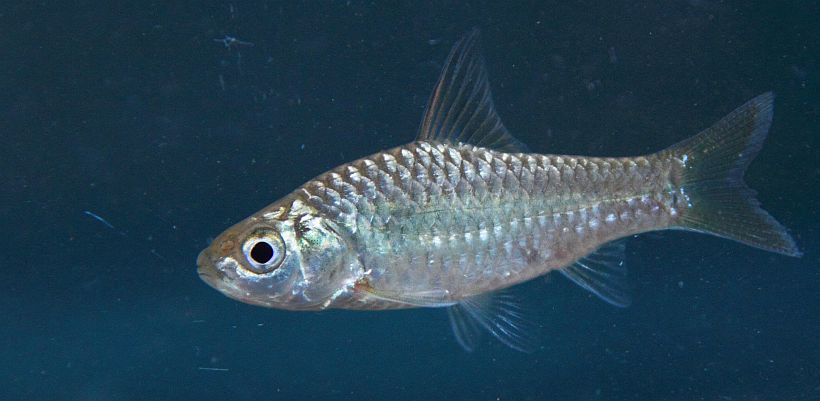
Puntius kamalikaKami's Barb
Silva, Maduwage & Pethiyagoda, 2008
Max length75mm SL3.0in SLTank120 × 30cm48 × 12inTemp20–27°C68–81°FpHnot recordedPrior to its description P. kamalika was referred to as P. amphibius, a putatively valid species probably restricted to western India. It differs from all congeners in the following combination of characters: 4½/1/2½ scales in a transverse line between the mid-dorsal...