Results for “species”
Type a name: scientific, common, or one a species used to go by. Or narrow the catalogue with the filters.
Filters
Bryconaethiops boulengeriBoulenger's Featherfin Tetra
authority not recorded
Max length250mm SL10in SLTank120 × 45cm48 × 18inTemp22–26°C72–79°FpH6.0–8.0This rarely imported species makes an attractive addition to a community of larger peaceful fish. It is farmed commercially for food in its native countries....
Buccochromis lepturusSlender Tail Hap
authority not recorded
Max length400mm SL16in SLTank150 × 45cm60 × 18inTemp24–27°C75–81°FpH7.5–8.8Also known as the green lepturus, this is a stunning species when mature. Unfortunately, it is rarely seen for sale. Its pelagic nature means it is difficult to catch for export. As a result it can be quite expensive when it is available....
Campylomormyrus tamanduaWorm-Jawed Mormyrid
authority not recorded
Max length400mm SL16in SLTank180 × 60cm72 × 24inTemp23–28°C73–82°FpH5.0–7.0C. tamandua is quite a rare fish in the hobby, but is imported occasionally. It's not a good beginner's fish as it requires pristine soft, acidic water conditions, will generally not feed on standard foods and attains a very respectable adult size. It's also sensitive to many aquarium medications. It can sometimes be found as a contaminant among imports of the much more common Elephant Fish, Gnathonemus petersii. Unlike this species, C. tamandua has both upper and lower jaws exten...
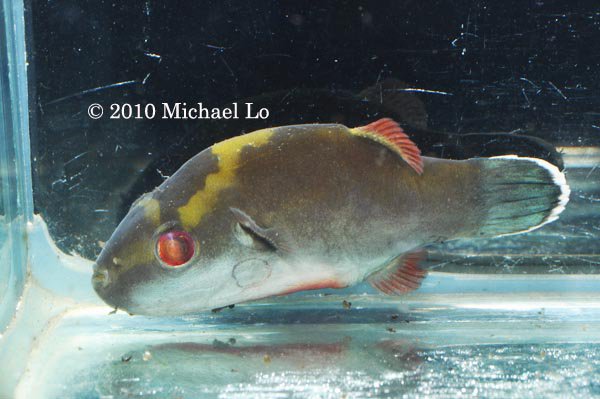
Carinotetraodon borneensis
Regan, 1903
Max length45mm SL1.8in SLTank60 × 30cm24 × 12inTemp20–28°C68–82°FpH6.0–7.5This species is relatively uncommon in the aquarium hobby but is available on occasion, sometimes mixed in among shipments of the congener C. salivator. These two can be told apart by the fact that C. salivator possesses a series of distinct dark bars on the head and body in both sexes, a colour pattern unique within the genus. It is also similar t...
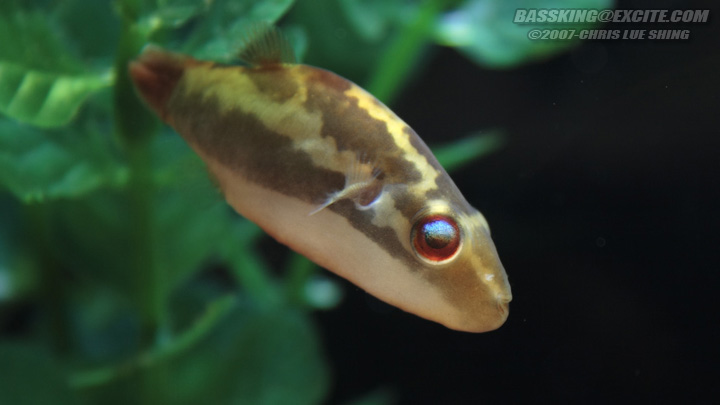
Carinotetraodon irrubescoRed-tailed Redeye Puffer
Tan, 1999
Max length45mm SL1.8in SLTank60 × 30cm24 × 12inTemp20–28°C68–82°FpH6.0–7.5This species is uncommon in the aquarium hobby. It is similar to the congeners C. borneensis and C. lorteti but can be told apart by males possessing a red (vs. bluish to greyish with black and white distal bands in C. lorteti) caudal-fin and lacking (vs. possessing) a black blotch at the base of the dorsal-fin.
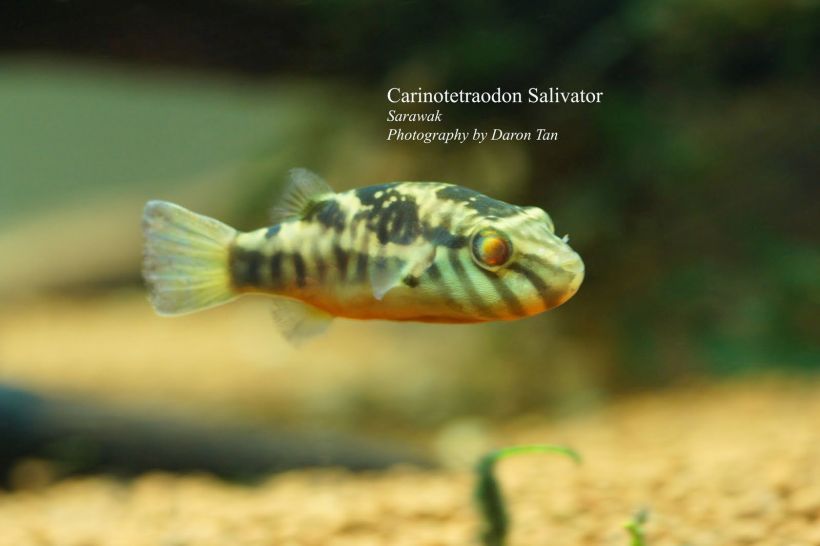
Carinotetraodon salivator
Lim & Kottelat, 1995
Max length50mm SL2.0in SLTank60 × 30cm24 × 12inTemp20–28°C68–82°FpH5.0–7.5It is included in a group often referred to as 'red-eyed puffers', which currently contains four recognised species distributed in Indochina and the Greater Sunda Islands. It can be distinguished from C. borneensis, C. irrubesco, and C. lorteti, the remaining members of this group, by the following combination of characters: 11 dorsal-fin rays; 16 pectoral-fin rays; 11-13 anal-fin rays; 11 caudal-fin rays; eyes not bulging above the head; in males dorsal-fin hyaline, black spot on dorsal-fin base present, pectoral-fin base hyaline, anal-fin hyaline with no black spot at base...
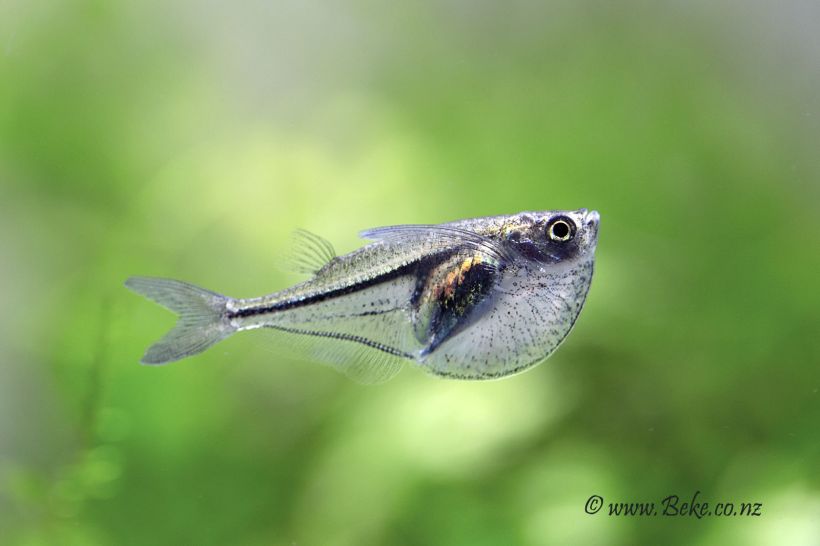
Carnegiella myersiPygmy Hatchetfish
Fernandez-Yepes, 1950
Max length25mm SL1.0in SLTank50 × 30cm20 × 12inTemp23–26°C73–79°FpH4.0–7.0The smallest and most delicate of the nominal hatchetfishes. The rounded keel is shallower than related species, giving this fish a distinctive elongate profile. The family Gasteropelecidae is separated from other Characiformes by the following combination of characters: front...
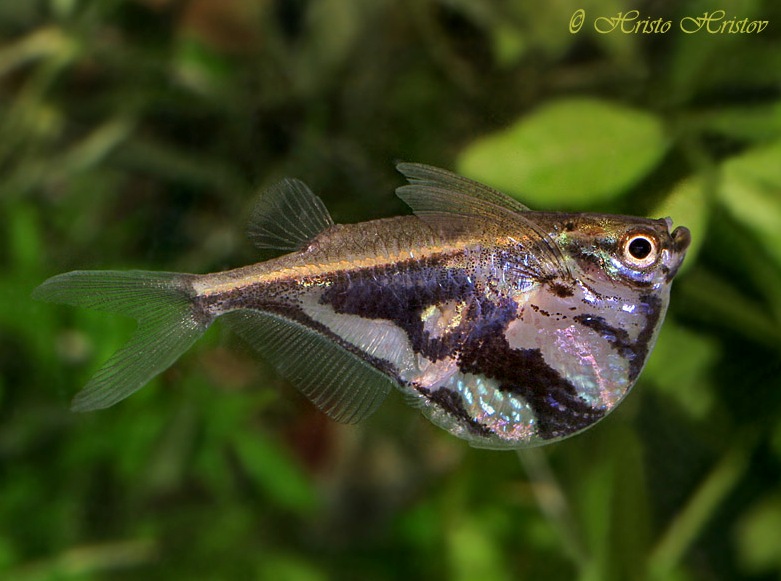
Carnegiella strigataMarbled Hatchetfish
Günther, 1864
Max length35mm SL1.4in SLTank75 × 30cm30 × 12inTemp20–28°C68–82°FpH4.0–7.0C. strigata is an enduringly popular species in the aquarium hobby but is not bred on a commercial basis with all fish offered for sale collected in the wild. It can be told apart from other members of the genus by its larger adult size and dark, marbled colour pattern appearing as a series of dark and light stripes running diagonally across the body below the lateral line. This colour pattern is variable and popul...
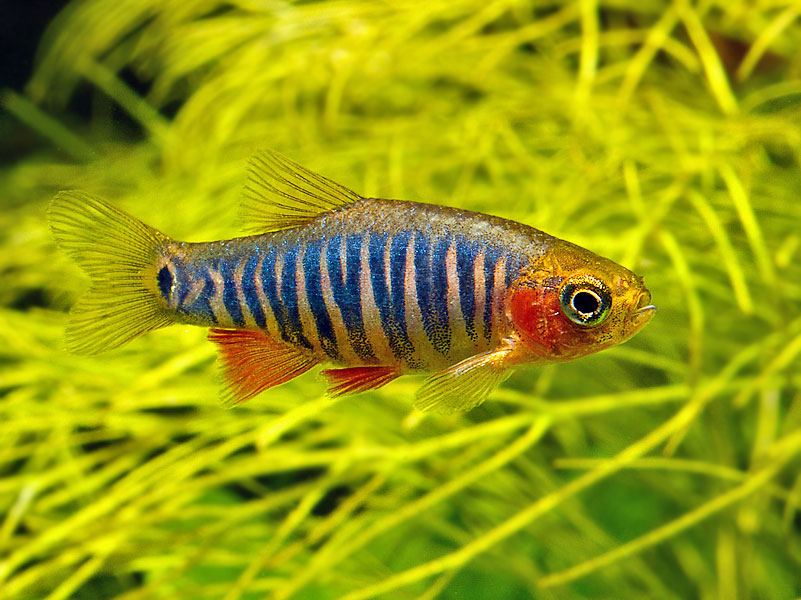
Celestichthys erythromicron
Annandale, 1918
Max length20mm SL0.8in SLTank60 × 30cm24 × 12inTemp20–24°C68–75°FpH7.0–8.0This species was formerly included in the genus Microrasbora although it's long-been considered a danionin by certain authors, e.g., Kottelat and Witte (1999) and was placed within the genus Danio for a period. In the aquarium trade it's marketed under various names including 'emerald dwarf danio', 'thick band purple zebra danio' and 'cross-banded dwarf rasbora'.
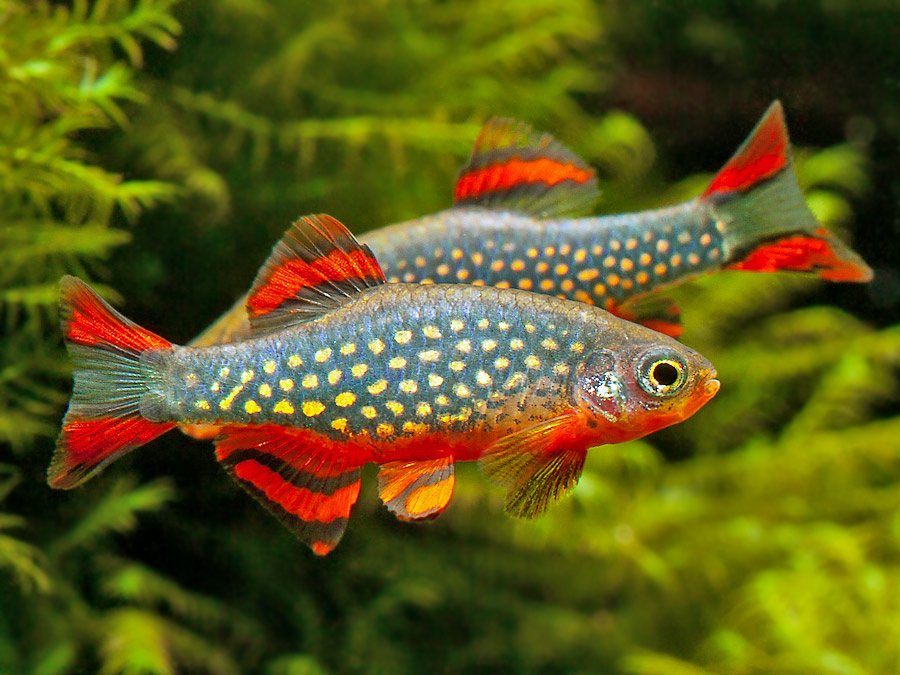
Celestichthys margaritatusCelestial Pearl 'Danio'
Roberts, 2007
Max length21mm SL0.8in SLTank45 × 30cm18 × 12inTemp20–26°C68–79°FpH6.5–7.5The type locality is an area of permanently-flooded grassland formed by the damming of a spring for agricultural purposes. The water is only around 30cm deep, transparent and supports dense growths of aquatic plants, mostly from the family Hydrocharitaceae which includes such genera as Elodea, Egeria and Blyxa. Sympatric species included Devario sondhii, a Microrasbora very similar to M. rubescens, an undescribed Yunnanilus known to aquarists as the 'rosy' loach and Channa harcourtbutleri.
Chaetostoma formosaeStriped Bulldog Pleco
Ballen, 2011
Max length105mm SL4in SLTank120 × 30cm48 × 12inTemp20–24°C68–75°FpH6.5–7.8This species is traded under a number of English vernacular names, of which some others include 'blonde bulldog pleco', 'blonde rubber pleco', 'blonde rubbernose pleco', 'striped rubber pleco', and 'striped rubbernose pleco'. It may also be seen referred to as 'L146', 'L146a', or 'L187b', these codes having been used for it in the Aqualog series of books. It can be told apart from all congeners except C. anale and C. jegui by...
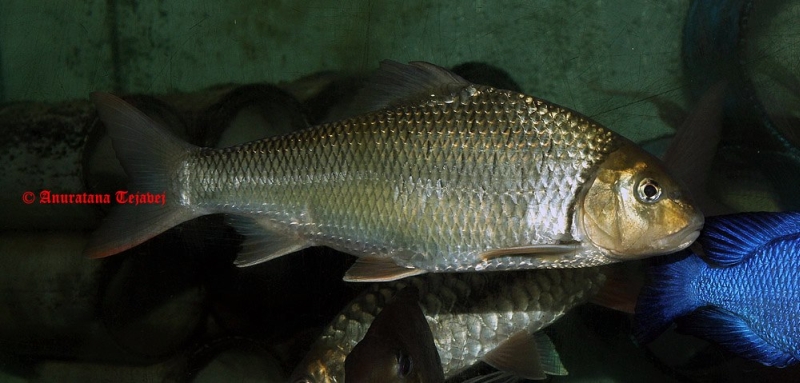
Chagunius baileyi
Rainboth, 1986
Max length200mm SL8in SLTank180 × 60cm72 × 24inTemp18–25°C64–77°FpH6.0–7.5There are currently three species which look almost identical and are most easily separated by collection details since their ranges do not overlap in nature; C. chagunio is endemic to the Ganges and Brahmaputra drainages and C. nicholsi to the Ayeyarwady/Irrawaddy.
Chagunius chagunio
Hamilton, 1822
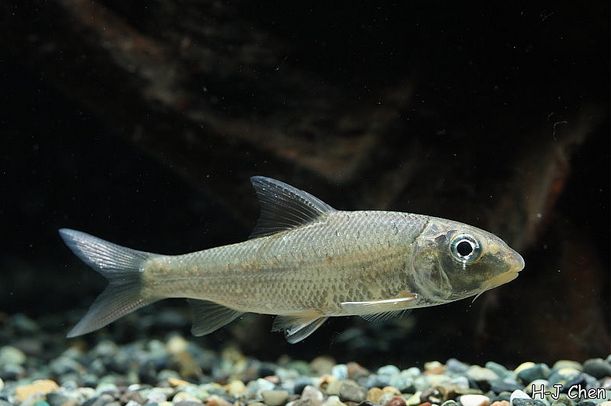
Max length450mm SL18in SLTank240 × 90cm96 × 36inTemp20–25°C68–77°FpH6.0–7.5Endemic to the Ganges and Brahmaputra river basins and thus occurs in northern India, Nepal and Bangladesh. Type locality is 'the Yamuna River, and northern rivers of Behar and Bengal'. The distribution of the genus as a whole is interesting because these fish occupy the area that geographically separates Indian and Southeast Asia barbs and it has been theorised that they may represent an evolutionary 'link' species...
Chalceus erythrurusTucanfish
authority not recorded
Max length200mm SL8in SLTank120 × 45cm48 × 18inTemp22–26°C72–79°FpH6.0–7.0This species can be distinguished from its congener C. macrolepidotus mainly by the red or yellow (as opposed to pink) caudal fin. In addition, it has yellow pectoral and pelvic fins and may also have some yellow colouration on the body. It is seen for sale as often as its relative, although it's quite abundant in nature....
Chalinochromis sp. 'ndobhoi'
authority not recorded
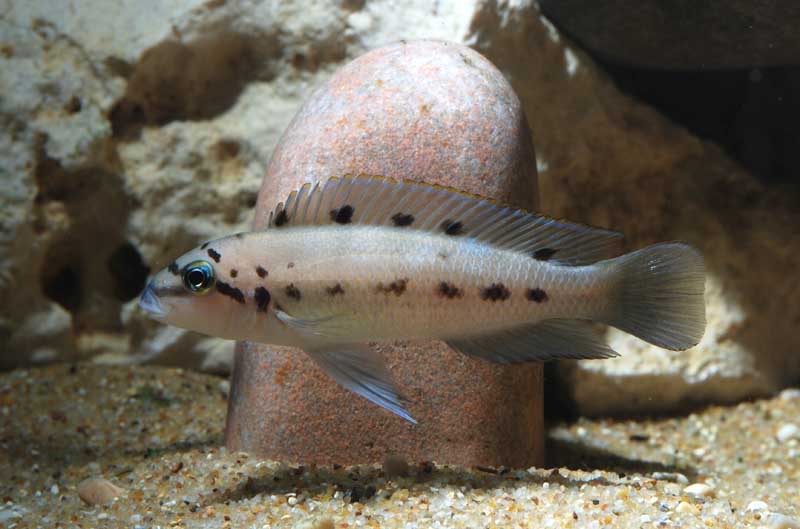
Max length120mm SL5in SLTank120 × 45cm48 × 18inTemp24–28°C75–82°FpH8.0–9.0This undescribed species is also traded as C. sp. 'ndoboi' or 'ndobnoi', and despite its lack of official recognition it's the most commonly-encountered member of the genus in the aquarium trade at time of writing. It can be easily-distinguished from the congeners C. brichardi and C. popelini by its adult body patterning which comprises two or three series of irregular, dark, laterally-orientated blotches, the upper of which is often contained entirely within the dorsal ...
Channa andraoLal Cheng
Britz, 2013
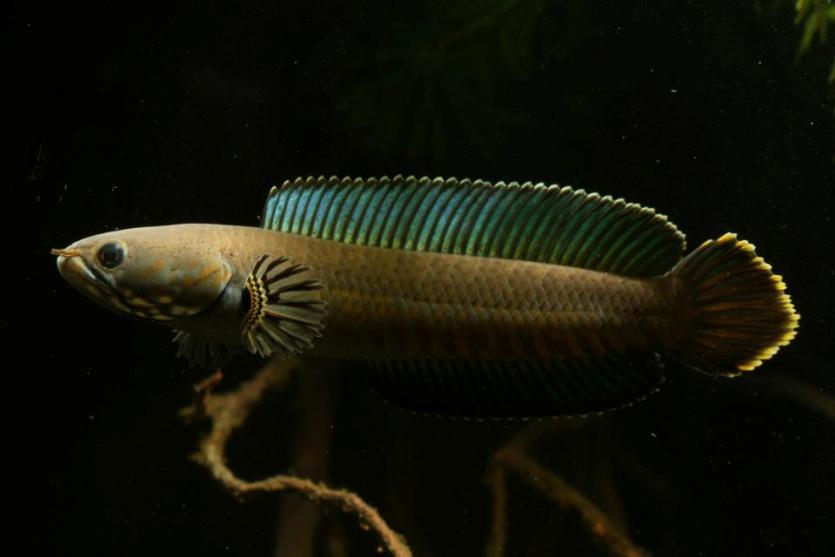
Max length110mm SL4in SLTank80 × 30cm31 × 12inTemp14–28°C57–82°FpH6.0–8.0This species was available in the aquarium hobby for a number of years prior to description and continues to be traded under various names including C. sp. 'Lal Cheng', C. sp. 'Assam', C. sp. 'blue bleheri', C. sp. 'himalayanus', and C. sp. 'red'. The names of valid, but distinct, congeners such as C. amphibeus, C. bleheri or C. stewartii have also been misapplied to it.
Channa bleheriRainbow snakehead
Vierke, 1991
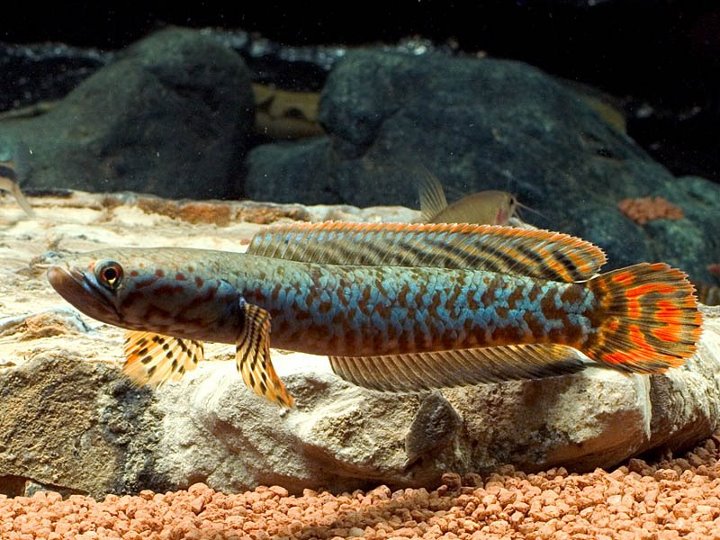
Max length170mm SL7in SLTank120 × 30cm48 × 12inTemp14–28°C57–82°FpH6.0–8.0C. bleheri is a popular aquarium fish though it remains unclear whether collection for the ornamentaol trade is having a detrimental effect on wild populations (see 'Habitat'). It's one of several genus members to lack pelvic fins and can be further distinguished from other Channa species by the following combination of characters: sides of lower jaw with one large cycloid scale; lateral line complete with 46-50 scales; 14 pectoral-fin rays; 25 anal-fin rays; 4-11 irregular reddish orange markings on the caudal-fin
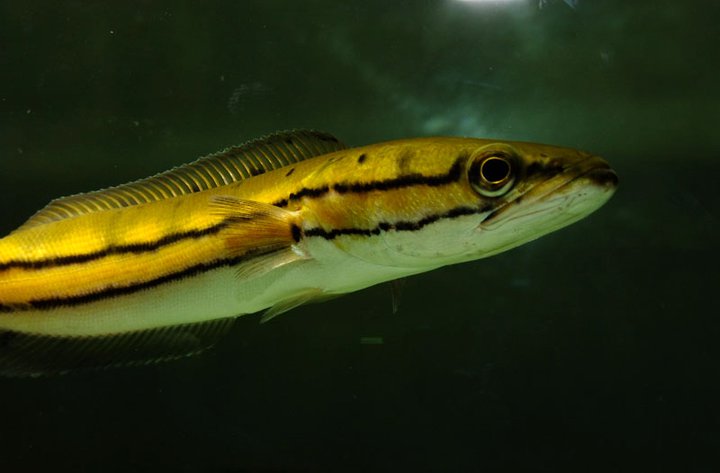
Channa diplogrammaMalabar Snakehead
Day, 1865
Max length480mm SL19in SLTanknot recordedTemp22–32°C72–90°FpH6.0–8.0This species was considered synonymous with the Indochinese congener C. micropeltes for over a century before being revalidated in 2011. Like in C. micropeltes colour pattern varies depending on the age of the fish. Juveniles possess two longitudinal black stripes on the head and body with the are...
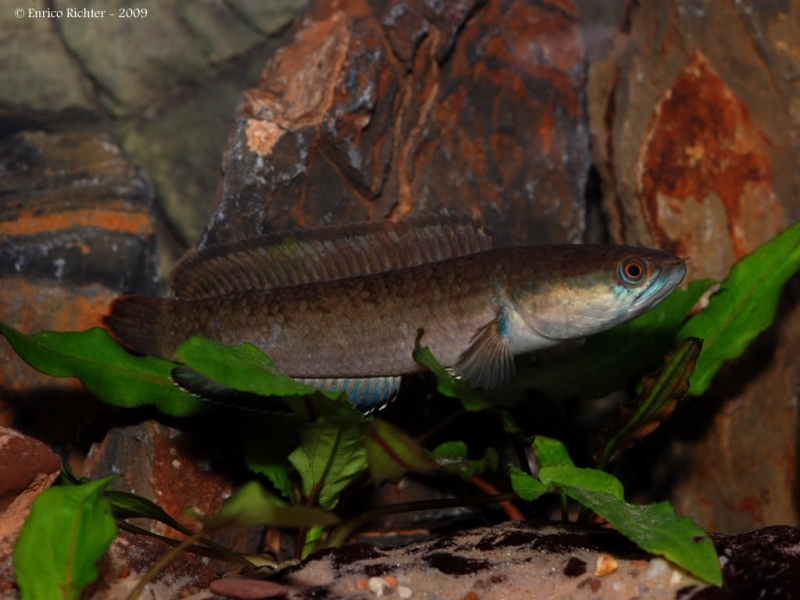
Channa gachuaDwarf Snakehead
Hamilton, 1822
Max length200mm SL8in SLTank120 × 45cm48 × 18inTemp18–28°C64–82°FpH5.0–8.0Generally considered to have an enormous natural range extending from Iran to Taiwan and Bali, with records existing from Iran, Iraq, Afghanistan, Pakistan, Nepal, India, Sri Lanka, Bangladesh, Bhutan, China, Myanmar, Thailand, Laos, Cambodia, Vietnam, Malaysia, Indonesia, and Singapore. However there exists significant evidence to suggest that C. gachua as currently understood represents a complex of similar-looking species, and a taxonomic review of the group is clearly required.
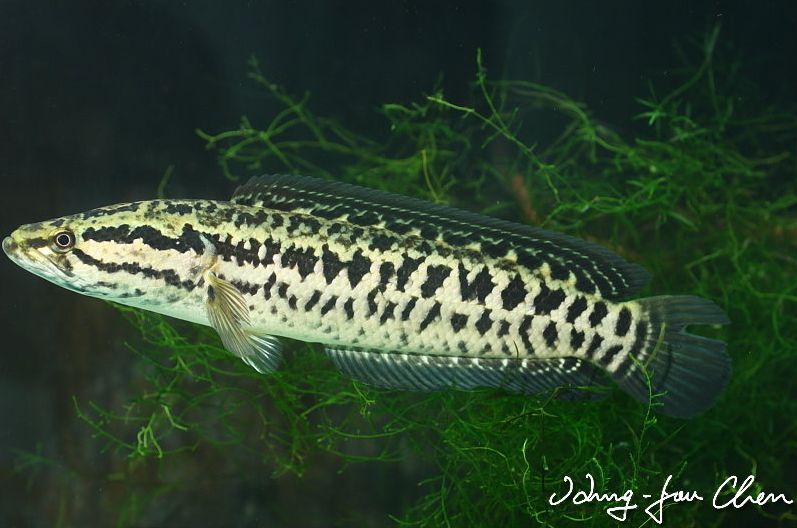
Channa maculataBlotched Snakehead
Lacepède, 1801
Max length300mm SL12in SLTanknot recordedTempnot recordedpHnot recordedThis species is frequently confused with C. argus but can be distinguished by the following characters: dorsal-fin rays 38-45 (vs. 47-50 in C. argus); anal fin rays 26-29 (vs. 31-36); lateral line scales 50-56 (vs. 60-66); 2-3 rounded blotches on caudal peduncle (vs. no blotches on caudal peduncle). It is widely-distributed in Pacific coastal drainages of southeastern China (e.g. the Yangtze, Minjiang, Hangjiang River, and Pearl (Nanjiu...