Results for “tank”
Type a name: scientific, common, or one a species used to go by. Or narrow the catalogue with the filters.
Filters
Nannacara anomalaGolden Dwarf Cichlid
authority not recorded
Max length76mm SL3.0in SLTank46 × 38cm18 × 15inTemp22–25°C72–77°FpHnot recordedNannacara Anomala are widely available in the trade, and are generally regarded as an excellent beginner's fish. If a beginner is interested in keeping Cichlids and learning about breeding, then these fish are absolutely ideal. Anomala are attractive, hardy and usually quite cheap to purchase. Like some species of the Apistogramma genus, the mother may use fascinating body language to communicate with her fry when she is caring for them. If there is more than one male in a tank smalle...
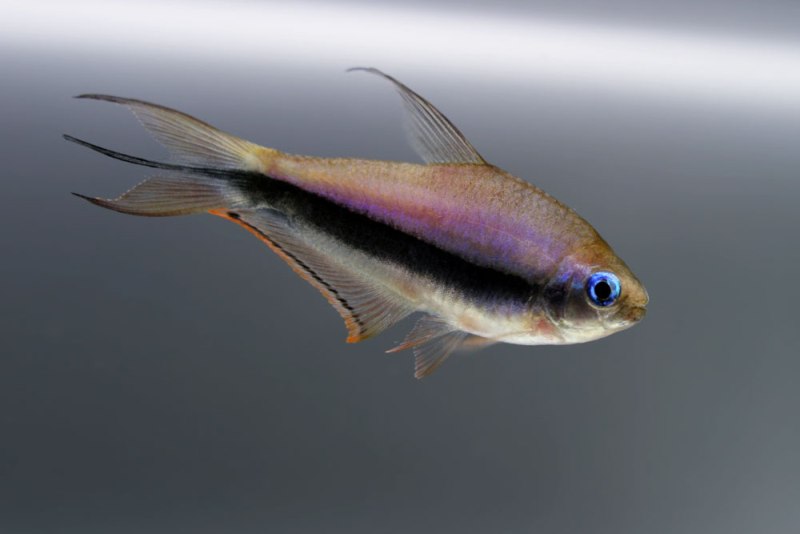
Nematobrycon palmeriEmperor Tetra
Eigenmann, 1911
Max length42mm SL1.7in SLTank90 × 30cm36 × 12inTemp23–27°C73–81°FpH5.0–7.5This species can be found in most dealers' tanks and is one of the best choices for the newcomer to fishkeeping, being attractive, hardy and inexpensive. As virtually all the fish sold in the trade have been captive bred they tend to be relatively unfussy regarding water chemistry and diet. It's occasionally confused with N. lacortei, which is currently the only other species in the genus. They can easily be told apart by looking at the eye of the fish in question, as the male N. l...
Neolebias ansorgiiAnsorge's Neolebias
authority not recorded
Max length35mm SL1.4in SLTank45 × 30cm18 × 12inTemp24–28°C75–82°FpH5.0–6.0This species is rarely offered for sale and often appears to be a fairly plain fish when it is seen in dealer's tanks. However, when kept in the correct conditions it is a stunning little fish that comes highly recommended.
Ophthalmotilapia ventralis
authority not recorded
Max length150mm SL6in SLTank135 × 45cm53 × 18inTemp23–27°C73–81°FpH7.5–9.0This is a truly stunning species that does well in a Tanganyikan community with well-chosen tankmates. It exists in well over 20 colour morphs, too many to list here. Obviously these should not be mixed in aquaria as they will hybridise freely. In nature, it is only the largest dominant males that build nests whilst the subdominant males and females shoal together. The territories of these dominant fish may measure several metres across....
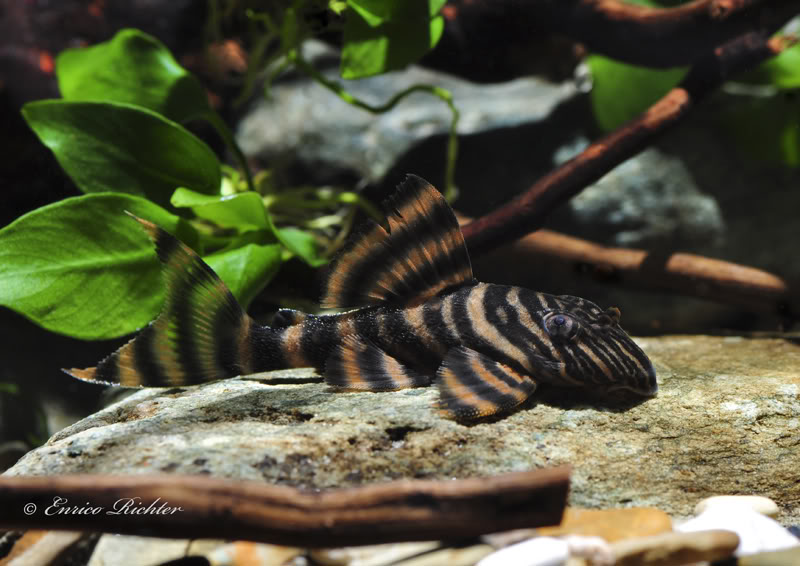
Panaqolus sp.L403
authority not recorded
Max length120mm SL5in SLTank120 × 30cm48 × 12inTemp24–30°C75–86°FpH6.0–7.0Not difficult to maintain under the correct conditions; we strongly recommend keeping it in a tank designed to simulate a flowing stream with a substrate of variably-sized rocks, sand, fine gravel, and some water-worn boulders. This can be further furnished with driftwood branches, terracotta pipes, plant pots, etc., arranged to form a network of nooks, crannies, and shaded spots, thus providing broken lines of sight.
Pangasionodon hypophthalmusIridescent Shark Catfish
authority not recorded
Max length1300mm SL51in SLTanknot recordedTemp22–26°C72–79°FpH6.5–7.5Previously referred to as Pangasius sutchi, this is the commonest of the Pangasiid catfish seen in the aquatic trade. It's usually seen for sale as a cute silvery-blue 2-3" youngster, most often without adequate information regarding its long term care requirements and potential size. Unfortunately this means it makes it's way into many a beginner's community tank, as it's undeniably attractive when small. The use of common names such as the one stated here don't he...
Parachromis managuensisJaguar Cichlid
authority not recorded
Max length610mm SL24in SLTank120 × 38cm48 × 15inTemp23–25°C73–77°FpH6.0–8.0Parachromis Managuense are your typical north/central American large predatory cichlid. They are extremely attractive, but a large aquarium is required. They are not difficult to look after, as long as filtration is up to standard. Choose tankmates carefully - if you are hoping to breed Managuense, house a breeding pair or grow 6 juveniles up until a pair is formed. One of the biggest problems with breeding Managuense is the fact that a single spawn from 12" parents can produce 3000 f...
Parachromis motaguensisFalse Yellowjacket Cichlid
authority not recorded
Max length305mm SL12in SLTank120 × 38cm48 × 15inTemp20–30°C68–86°FpH6.0–8.0Parachromis Motaguensis are a truly stunning fish. They exhibit gorgeous colours, but can be a nightmare to keep. Do not even consider housing any other fish with Motaguensis when they are breeding, as the other fish will be hurt - even if significantly bigger than the pair of False Yellowjackets. Motaguensis make a nice addition to a big central/north American cichlid tank, with similarly aggressive fish - but be careful that you don't choose a compatible pair of Motaguensis or you wil...
Placidochromis milomoSuper VC 10 Hap
authority not recorded
Max length250mm SL10in SLTank120 × 45cm48 × 18inTemp24–28°C75–82°FpH7.6–8.8Wild caught specimens of this fish possess a truly amazing set of lips! They are massively enlarged and designed for scraping algae and invertebrates from rock surfaces. In nature, these actually develop in direct proportion to the amount of turbidity in a given locality. Fish inhabiting more turbulent waters have larger lips, as the algae in these areas is anchored to the rocks more firmly. In the aquarium, the lips usually recede or, in tank bred fish, do not develop at all, as they are not re...
Platydoras armatulusHumbug Catfish
authority not recorded
Max length240mm SL9in SLTank120 × 30cm48 × 12inTemp24–30°C75–86°FpH5.8–7.5This popular species is also sold as the striped dora, striped raphael or striped talking catfish. It's often seen as an ideal beginner's cat, being hardy and tolerant of a wide range of water conditions. However its secretive nature, adult size and tendency to snack on smaller tankmates mean it should only be considered for communities of larger fish. The 'talking catfish' moniker is derived from the fish's ability to produce sounds when communicating with conspecif...
Platystacus cotylephorusBanded Banjo Catfish
authority not recorded
Max length320mm SL13in SLTank120 × 30cm48 × 12inTemp22–25°C72–77°FpH6.0–8.2Not a particularly good catfish for the general community tank, as it's a largely inactive, secretive species that will only emerge and become active under cover of darkness. It is, nonetheless, an interesting aquarium subject for the enthusiast, exhibiting an incredible degree of camouflage. It's designed to resemble a dead leaf, and usually will not even swim to escape a net. When released into the aquarium will simply drift in the current until it hits the bottom. All members of the...
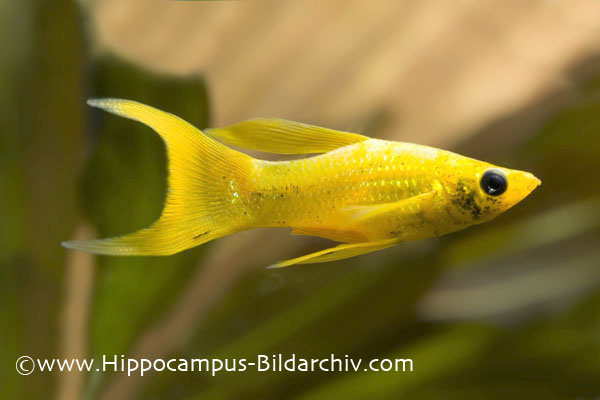
Poecilia latipinnaSailfin Molly
Lesueur, 1821
Max length125mm SL5in SLTank76 × 38cm30 × 15inTemp21–26°C70–79°FpH7.0–8.5The wild fish can exhibit several different types of patterning. P. latipinna has been selectively bred into many different colour morphs for the aquarium trade, and has also been crossbred with other molly species, particularly P. sphenops. They will also interbreed readily in the aquarium and in order to avoid this we suggest keeping only one species of molly per tank. There also exists a (in our opinion) grotesque 'balloon' variety of this fish in which the body is malformed and rou...
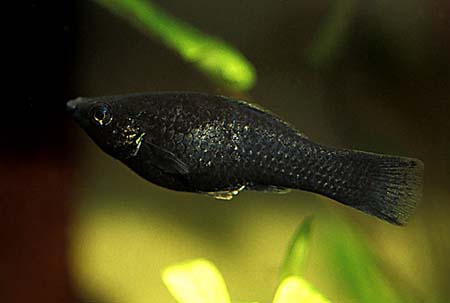
Poecilia sphenopsShort-finned Molly/Black Molly
Valenciennes, 1846
Max length80mm SL3.1in SLTank90 × 30cm36 × 12inTemp21–28°C70–82°FpH7.0–8.5A hugely popular aquarium fish. Many aquarium-bred colour morphs of this species are available, including the ubiquitous black molly. There are also Gold, Green, Lyretail, Silver and Dalmation varieties. Some of these are the results of P. sphenops being crossed with P. latipinnis. The 2 species will also interbreed readily in the aquarium and in order to avoid this we suggest keeping only one of them per tank. There also exists a (in our opinion) grotesque 'balloon' variety of this fi...
Potamotrygon orbignyiSmooth-back Stingray
authority not recorded
Max length375mm SL15in SLTanknot recordedTemp24–26°C75–79°FpH6.0–7.5P. orbignyi is one of the species often labelled as "teacup ray" in dealers' tanks. It can be tricky to identify when young, and we have seen it misidentified on numerous occasions. The species it resembles most closely is P. humerosa, although these can be distinguished by examining the skin of the fish. The texture of this is typically rough in P. humerosa and noticeably smooth in P. orbignyi. Provided you're sure what you're buying, it is one of the best species for t...
Pristolepis marginatusMalabar Leaffish
authority not recorded
Max length150mm SL6in SLTank120 × 30cm48 × 12inTemp23–28°C73–82°FpH6.5–7.5Also known as the common catopra, this is still quite a rare species in the hobby, although it's becoming more readily available due to captive breeding efforts. It makes an interesting addition to the larger community or oddball tank....
Pseudoplatystoma fasciatumBarred Shovelnose
authority not recorded
Max length1040mm SL41in SLTanknot recordedTemp22–26°C72–79°FpH6.0–7.6It's debatable as to whether this species should be considered an aquarium subject at all, given its eventual size. All too often juveniles are sold without adequate information regarding their long term care. These cats can and will attain something close to their maximum size in captivity, and will do so quite quickly. The myth that they will only grow to match the size of the tank they're kept in is just that - a myth. It's also worth noting that species such as this can live f...
Pseudoplatystoma tigrinumTiger Shovelnose
authority not recorded
Max length1050mm SL41in SLTanknot recordedTemp22–26°C72–79°FpH6.0–7.6It's debatable as to whether this species should be considered an aquarium subject at all, given its eventual size. All too often juveniles are sold without adequate information regarding their long term care. These cats can and will attain something close to their maximum size in captivity, and will do so quite quickly. The myth that they will only grow to match the size of the tank they're kept in is just that - a myth. It's also worth noting that species such as this can live f...
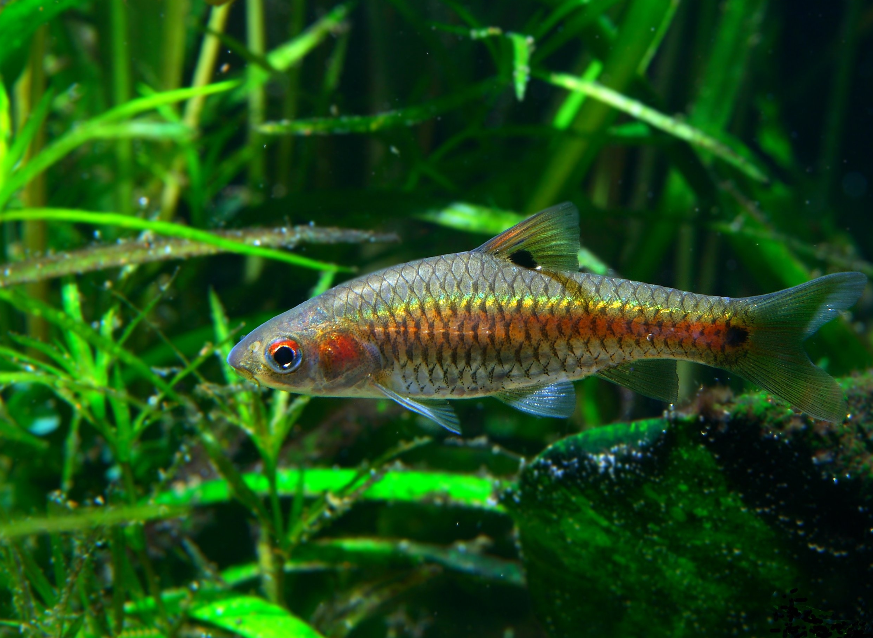
Puntius bimaculatusTwo-spotted Barb
Bleeker, 1863
Max length50mm SL2.0in SLTank60 × 30cm24 × 12inTemp18–24°C64–75°FpH6.0–7.5Generally very peaceful making it an ideal resident of the well-researched community tank. As it places no special demands in terms of water chemistry it can be combined with many of the most popular fish in the hobby including other small cyprinids as well as tetras, livebearers, rainbowfishes, anabantoids, catfishes and loaches. It's a schooling species by nature, and at least 6-10 specimens should be purchased. Maintaining it in such...
Rasbora cephalotaeniaPorthole Rasbora
authority not recorded
Max length130mm SL5in SLTank120 × 45cm48 × 18inTemp22–25°C72–77°FpHnot recordedThis species is not often exported which is a shame as it makes an elegant, peaceful resident of the larger community tank. It can be easily distinguished from similar-looking congeners such as R. einthovenii and R. jacobsoni by examining the dark lateral stripe that extends lengthways along the body of the fish as in R. cephalotaenia it is composed of a series of dark spots whereas in the other species it forms a continous solid line. Rainboth's 'Fishes of the Cambodian Mekong'...
Rasbora trilineataScissortail Rasbora
authority not recorded
Max length150mm SL6in SLTank120 × 45cm48 × 18inTemp22–25°C72–77°FpHnot recordedThis popular species is also known as the 'three-lined' rasbora and provided a large enough tank is available it is an excellent choice for those new to the hobby. The 'scissortail' moniker is derived from the characteristic twitching motion of the when the fish is at rest. It can be distinguished from the similar R. caudimaculata by lacking red colouration in the and from R. spilocerca by its much larger size. Several geographical forms appear to exist as some wild populatio...