Results for “sp.”
Type a name: scientific, common, or one a species used to go by. Or narrow the catalogue with the filters.
Filters
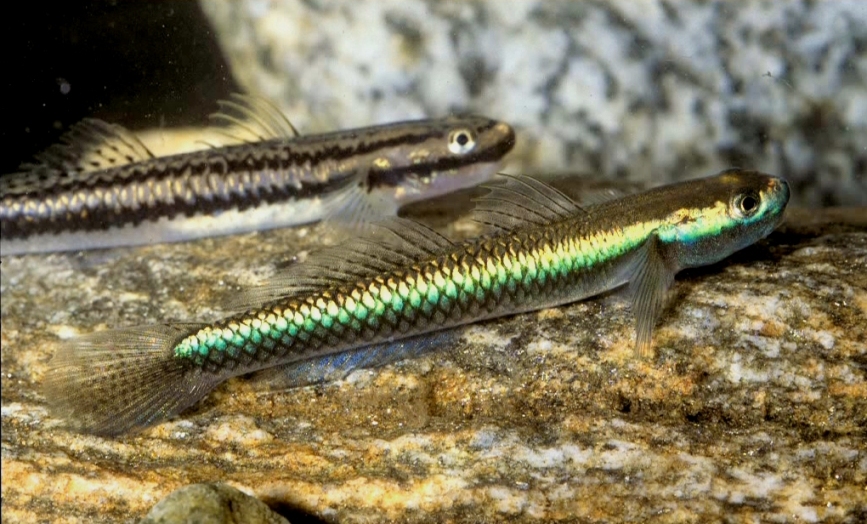
Stiphodon semoniCobalt Blue Goby
Weber, 1895
Max length50mm SL2.0in SLTank60 × 30cm24 × 12inTemp22–28°C72–82°FpH6.5–7.5This species has been traded for a number of years, though not always under the correct name. We've seen it on sale as S. elegans or S. atropurpureus on numerous occasions, for example, and other trade names include 'Sumatran blue neon goby', 'cobalt blue goby' and 'freshwater neon goby'. Further confusion has arisen because other species are sometimes sold as S. semoni meaning identification has not always been easy and there ...
Sundadanio axelrodi
authority not recorded
Max length22mm SL0.9in SLTank30 × 20cm12 × 8inTemp23–26°C73–79°FpHnot recordedThis species was initially described as Rasbora axelrodi and is referred to as such in older literature, but in 1999 was moved into the new genus Sundadanio where it remains the monotype. Its wider placement within the family Cyprinidae is still not fully resolved. Following Rüber et al. (2007) it is most closely-related to the miniature species of the genus Paedocypris, the two genera characteristically lacking bones in the roof of the skull as well as exhibiting genetic similarities. Howe...
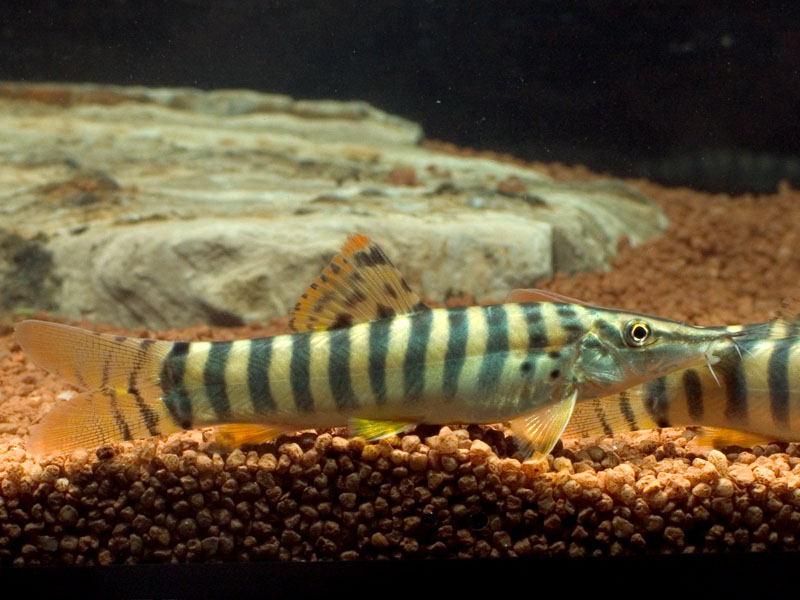
Syncrossus berdmoreiRedfin Tiger Loach
Blyth, 1860
Max length250mm SL10in SLTank180 × 45cm72 × 18inTemp21–26°C70–79°FpH6.5–7.5Interestingly some observations suggest that the character of the highest-ranked, or alpha, fish appears to affect that of the whole group though it must be said that scientific studies of botiid loach behaviour are virtually non-existent. It certainly seems that they display a degree of 'personality' with some specimens being naturally bolder/more aggressive than others. The alpha is normally the largest specimen within the group and often female. Sound also appears to be an important factor in communication since these loaches are able...
Synodontis brichardiBrichard's Synodontis
authority not recorded
Max length150mm SL6in SLTank120 × 30cm48 × 12inTemp22–26°C72–79°FpH6.2–7.5An unusual and highly adapted species, S. brichardi is one of our favourite Synos and really deserves to be kept in a biotope aquarium to be appreciated at its best. Here, it will be seen moving in and out of areas of high and low current and rasping at algae attached to rocks as in nature. It is much more diurnal than many Synodontis species, if maintained correctly. The colours of this fish intensify with age....
Synodontis granulosa
authority not recorded
Max length270mm SL11in SLTank150 × 60cm60 × 24inTemp24–28°C75–82°FpH7.8–8.5One of the most stunning and sought after species of Synodontis and though the cost of ownership has dropped slightly, it still commands a high price. Its natural deep water habitat, limited range and solitary lifestyle make collection for the hobby difficult and so it is rarely seen for sale. It also appears that the areas of the lake in which it occurs are threatened with ecological disaster. In the aquarium S. granulosa is intelligent and can develop into a real character, with many speci...
Synodontis pleuropsBig Eyed Synodontis
authority not recorded
Max length230mm SL9in SLTank120 × 30cm48 × 12inTemp22–26°C72–79°FpH6.0–7.0S. pleurops is a very nocturnal species and unless the light in the aquarium is dim will rarely be seen. It is also very distinctive and is hard to confuse with other species. It has very large eyes and a downturned mouth, denoting its algae grazing habits. It will rarely venture into open water in the aquarium, preferring to hug the surface of pieces of driftwood, rocks and broad plant leaves. The colouration and patterning can vary considerably depending on type locality....
Synodontis schall
authority not recorded
Max length375mm SL15in SLTank120 × 60cm48 × 24inTemp22–27°C72–81°FpH6.0–8.0S. schall is regarded as the 'bad boy' of the genus in aquarium circles. It is randomly aggressive and not particularly attractive. It is often confused with other similar species of Synodontis such as S. budgetti or S. clarias but can be distinguished by the length of thewhich, in this species, is very long and runs from just past the base of the to just before the caudal fin. It is an important food fish in some of its native countries....
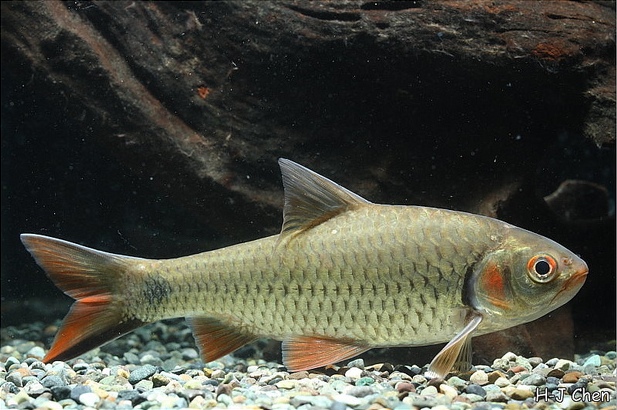
Systomus orphoides
Valenciennes, 1842
Max length250mm SL10in SLTank200 × 60cm79 × 24inTemp18–26°C64–79°FpH6.0–8.0The genus Puntius is currently viewed as something of a catch-all for well over 100 species of small to mid-sized cyprinid. Most experts agree that a full revision is required with the likely outcome that many species will be placed into new or different genera since it is clearly polyphyletic. When describing the grouping in 1822 Hamilton identified the defining characteristics as: presence or absence o...
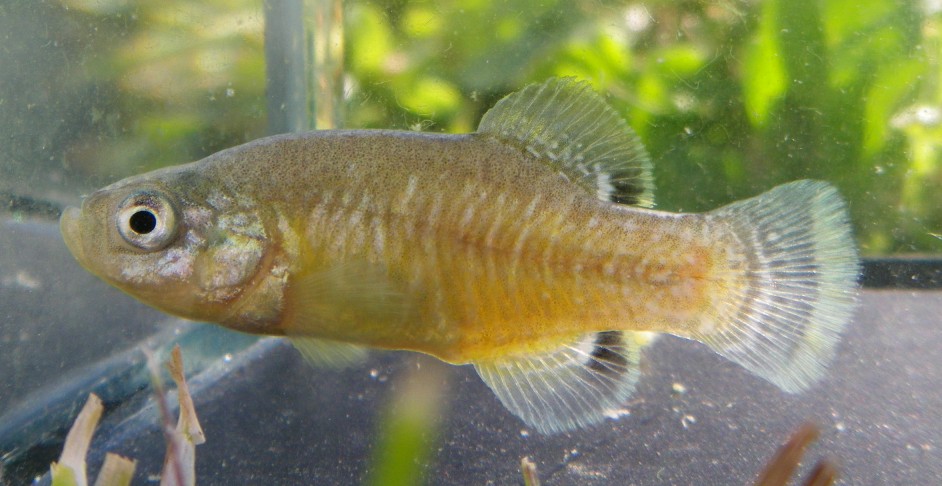
Tellia apodaFootless Toothcarp
Gervais, 1853
Max length45mm SL1.8in SLTank120 × 30cm48 × 12inTemp16–30°C61–86°FpH7.0–9.0The genus Aphanius currently contains 22 species and subspecies which are thought to have derived from a common ancestor originally distributed around the periphery of the former Tethys Sea. These can be separated into two main phylogenetic groups usually referred to as the 'eastern' and 'western' clades by scientists and aquarists because they broadly correspond to those coastlines of the Tethys. The eastern clade comprises the species now found in the Arabian Peninsula and ...
Thalassophryne amazonicaPrehistoric Monster Fish
authority not recorded
Max length150mm SL6in SLTank75 × 30cm30 × 12inTemp24–28°C75–82°FpHnot recordedThere are currently six described species in the genus Thalassophryne, of which T. amazonica is the only freshwater representative. The others (T. nattereri, T. maculosa, T. megalops, T. montevidensis and T. punctata) are all estuarine animals distributed along the western Atlantic coastlines of Central and South America and inhabit brackish-to-marine waters. They are members of the family Batrachoididae or toadfishes, of which most are exclusively marine species. All batrachoidids are ambush pr...
Thayeria boehlkeiFalse Penguin Tetra
authority not recorded
Max length36mm SL1.4in SLTank60 × 38cm24 × 15inTemp22–28°C72–82°FpHnot recordedThere are only three species in the genus Thayeria, of which T. boehlkei is by far the most popular in the hobby. Of its congeners, it was the type species T. obliqua that was originally given the common name of "penguin" fish or tetra, although T. boehlkei is usually sold under the same name (we've also seen it on sale as "hockeystick" tetra). The two are easy to tell apart, as in T. boehlkei the thick black stripe extending from the lower lobe of the travels laterally ...
Tilapia guinasana
authority not recorded
Max length140mm SL6in SLTank120 × 30cm48 × 12inTemp19–25°C66–77°FpH7.0–7.8Rare in the hobby, this species is unfortunately considered critically endangered in the wild. The lake in which it is found is receiving less groundwater than it once was, due to extraction of water for agriculture. Even if this were not the case, the species is found over such an enclosed range that it would still be at extreme risk. All attempts at captive breeding are therefore to be encouraged, with care being taken to keep the different lines pure. Interestingly, as there are no natural...
Trichogaster labiosaThick-lipped Gourami
authority not recorded
Max length100mm SL3.9in SLTank74 × 30cm29 × 12inTemp22–27°C72–81°FpH6.0–7.5Despite its ease of keeping and peaceable nature, this species is not particularly popular in the hobby, although it is imported quite regularly. A gold or 'sunset' strain exists, in which the barred patterning is replaced by an overall orange/gold colouration. This is not a natural variation, but has been selectively bred for the trade. The female of this form is almost as colourful as the male. Like others in the suborder Anabantoidei, the species possesses an accessory breathing...
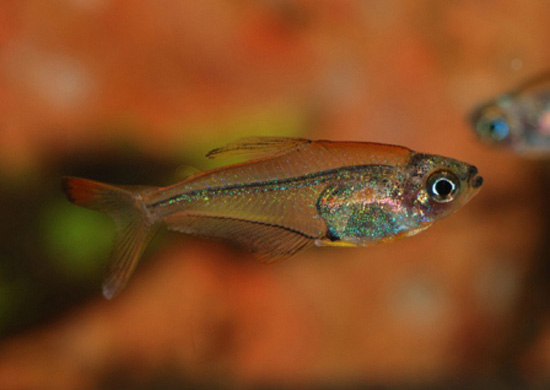
Trochilocharax ornatusHummingbird Tetra
Zarske, 2010
Max length17mm SL0.7in SLTank45 × 30cm18 × 12inTemp20–28°C68–82°FpH4.0–6.5This species is not often available and is much sought after in the aquarium hobby where it's been traded as 'crystal rainbow tetra' and 'orange-tailed glass tetra'. It's also been referred to as a Heterocharax or Tyttocharax species in the past. It's currently the only member of its genus which is separated fr...
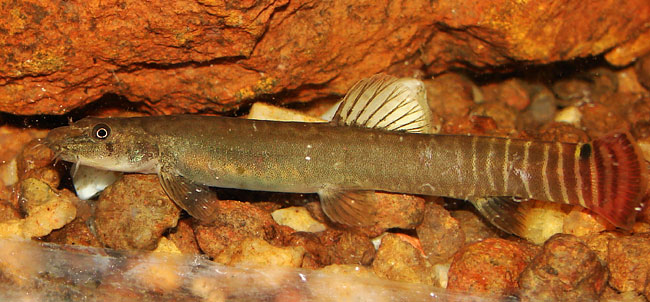
Aborichthys elongatusRed-Tailed Squirrel Loach
Hora, 1921
Max length75mm SL3.0in SLTank60 × 30cm24 × 12inTemp15–21°C59–70°FpH6.5–7.5This species may be seen listed as a member of Nemacheilus or the nomen nudum Noemacheilus in older literature and is sometimes sold as 'red tailed, striped sand loach' or 'red tailed squirrel loach'. Only two other Aborichthys have been described to...
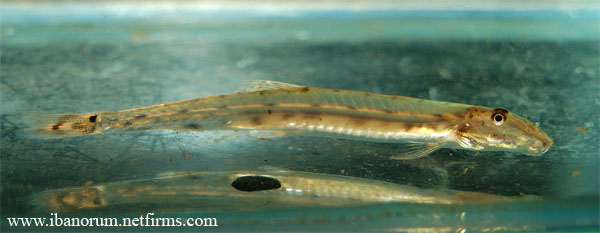
Acanthopsoides robertsi
Siebert, 1991
Max length75mm SL3.0in SLTank60 × 30cm24 × 12inTemp20–24°C68–75°FpH5.5–7.0Acanthopsoides spp. are most closely related to the horse-faced loaches of the genus Acantopsis with which they often co-occur in nature, and thus commonly referred to as 'dwarf horse-face loaches'. Most are very difficult to tell apart but A. robertsi is quite easily identified since it's the only...
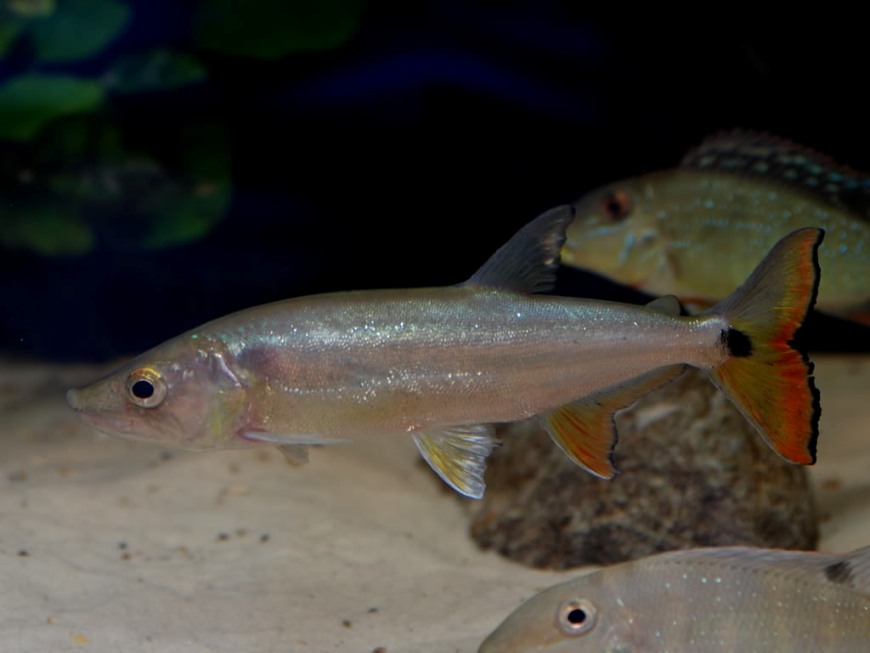
Acestrorhynchus altusRed Barracuda Tetra
Menezes, 1969
Max length233mm SL9in SLTank250 × 90cm98 × 36inTemp22–28°C72–82°FpH6.0–7.5This species is not normally aggressive towards conspecifics with juveniles in particular exhibiting a marked schooling instinct. Older individuals tend to be more solitary but still group together from time-to-time, and it's best maintained in numbers of four or more. One important point to note is that acestrorhynchids are can...
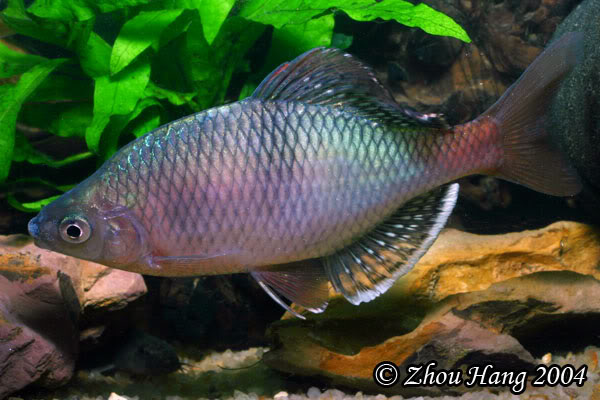
Acheilognathus macropterusGiant Chinese Bitterling
Bleeker, 1871
Max length275mm SL11in SLTank180 × 60cm72 × 24inTemp14–22°C57–72°FpH6.0–8.0A. macropterus appears in the ornamental trade on an irregular basis and should only be considered by more experienced aquarists with sufficiently large facilities. Given its wide geographical distribution there is a possibility that it represents a group of closely-related species, with genetic studies indicating the existence of several distinct clades.
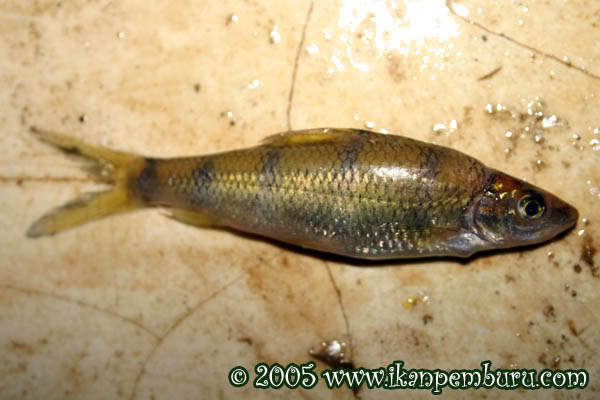
Acrossocheilus iridescens
Nichols & Pope, 1927
Max length300mm SL12in SLTanknot recordedTempnot recordedpHnot recordedA. iridescens and its closest relative A. longipinnis can be distinguished from all other barred species of Acrossocheilus by the following characters: wider (vs. narrower) black vertical bars on the flank in adults, each five to eight (vs. no more than four) scales in width; a horse-shoe shaped (vs. arched) mouth gape; rostral barbel located posteriorly (vs. anteriorly) to a horizontal line through the anteriormost margin of the lower jaw; two postlabial grooves extending anteromedially beyond (vs. away from) a horizontal line through the roots of the rostral barbels.
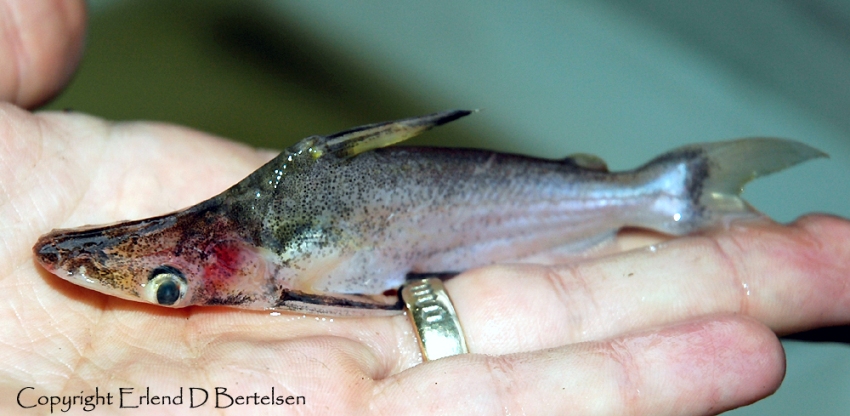
Ageneiosus ucayalensisDuck Catfish
Castelnau, 1855
Max length290mm SL11in SLTank180 × 60cm72 × 24inTemp22.5–28°C73–82°FpH5.5–7.5Apparently this species is polymorphic with body patterning varying significantly depending on locality. Individuals collected from black water habitats tend to be noticeably darker in overall colouration, for example, with this being particularly evident among populations from the Guiana Shield. The genus Ageneiosus was at one point classified in...