Search the catalogue
Type a name: scientific, common, or one a species used to go by. Or narrow the catalogue with the filters.
Filters
Mchenga flavimanus
authority not recorded
Max length120mm SL5in SLTank120 × 45cm48 × 18inTemp25–29°C77–84°FpH7.5–8.5The genus Mchenga was erected in 2006 by Stauffer and Konings and currently numbers half a dozen species, all of which are previous members of Copadichromis. The reclassification was based on various morphological and behavioural traits, including habitat preference and breeding strategy. Together with Copadichromis, Mchenga spp. form an exclusive group of Malawian cichlids commonly referred to as "Utaka" (prounounced "ooh-taw-kuh"). They're specialised to a pelagic l...
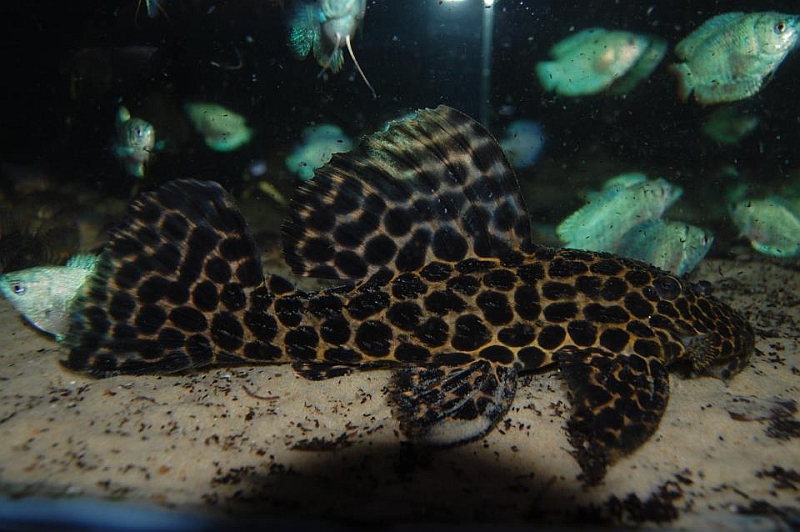
Megalancistrus parananusL113
Peters, 1881
Max length588mm SL23in SLTanknot recordedTemp20–28°C68–82°FpH6.0–7.5This species was formerly considered to be represented by the L-numbers L113 and L234 but it appears that only the former is native to the Paraná, Paraguay and Uruguay drainages, whereas L234 is collected in the rio São Francisco in eastern Brazil. M. barrae and M. sp. 'LDA097' are also exported from the São Francisco system.
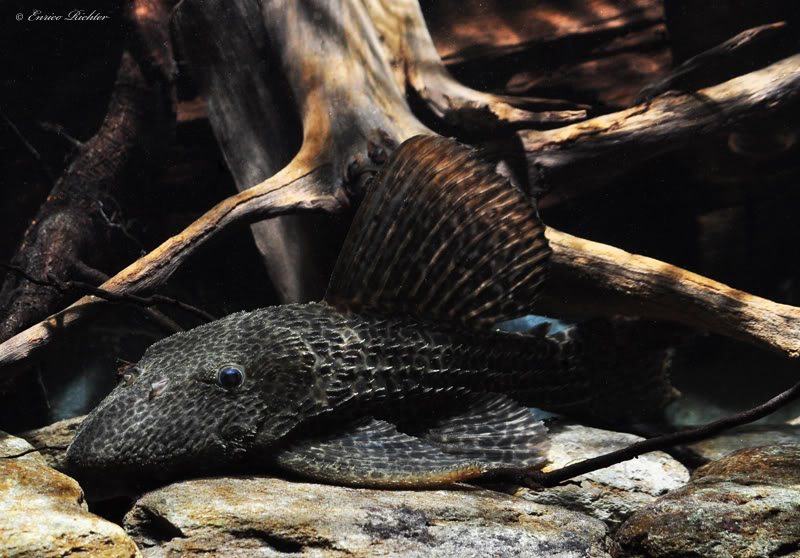
Megalancistrus sp.L234
authority not recorded
Max length600mm SL24in SLTanknot recordedTemp20–30°C68–86°FpH6.0–7.5L234 was previously applied to M. paranus, which has also has the L-number L113 assigned to it. However M. paranus is native to the Paraná, Paraguay and Uruguay drainages, whereas L234 is collected in the rio São Francisco so appears to represent an unidentified species. M. barrae and M. sp. 'LDA097' are also exported from the São Francisco system.
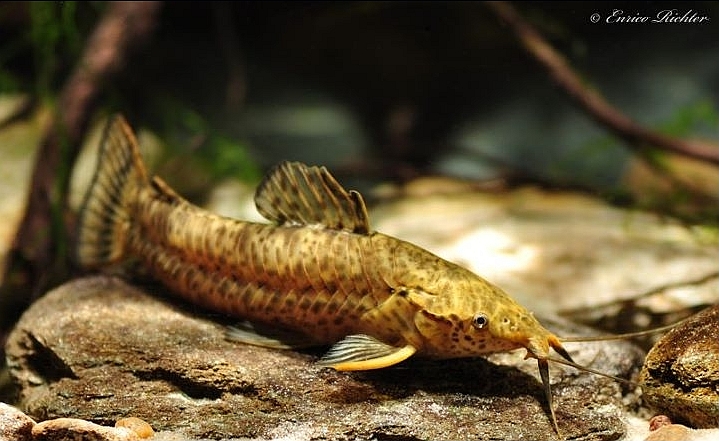
Megalechis pictaBar-tailed Hoplo
Müller & Troschel, 1849
Max length120mm SL5in SLTank120 × 45cm48 × 18inTemp18–28°C64–82°FpH5.0–7.5This species was previously referred to as M. thoracata, but that name is now applied to the species with a relatively short dorsal-fin spine which was formerly known as M. personata. M. picta can be told apart from M. thoracata by presence of a dark vertical bar in the caudal-fin, a comparatively longer dorsal-fin spine (52.0-64.0% vs. 32.0-48.0% of dorsal-fin base in specimens measur...
Megalechis thoracataSpotted Hoplo
authority not recorded
Max length150mm SL6in SLTank120 × 38cm48 × 15inTemp18–28°C64–82°FpH6.0–8.0Still widely referred to as hoplosternum thoracatum the hoplo cat is a popular and hardy fish. These fish have the ability to breathe atmospheric air by gulping down mouthfuls of air and the oxygen is then absorbed into the bloodstream through the intestine. This allows the fish to endure poor conditions in the wild but it can still be observed exhibiting this behaviour in captivity. The hoplo is also eaten as a food fish in parts of South America....
Megalodoras uranoscopusGiant Raphael Catfish
authority not recorded
Max length700mm SL28in SLTank240 × 120cm96 × 48inTemp21.1–25°C70–77°FpHnot recordedThis species is also known by the vernacular name "ripsaw catfish" (U.S.) and was often referred to by the scientific name M. irwini, now considered a junior synonym of M. uranoscopus, in older literature. Within the family Doradidae the genus Megalodoras is considered most closely-related to Lithodoras, Centrodoras and Platydoras, respectively. Members of the family Doradidae can be distinguished from all other Siluriformes by possession of a unique infranuchal scute, a dermal bon...
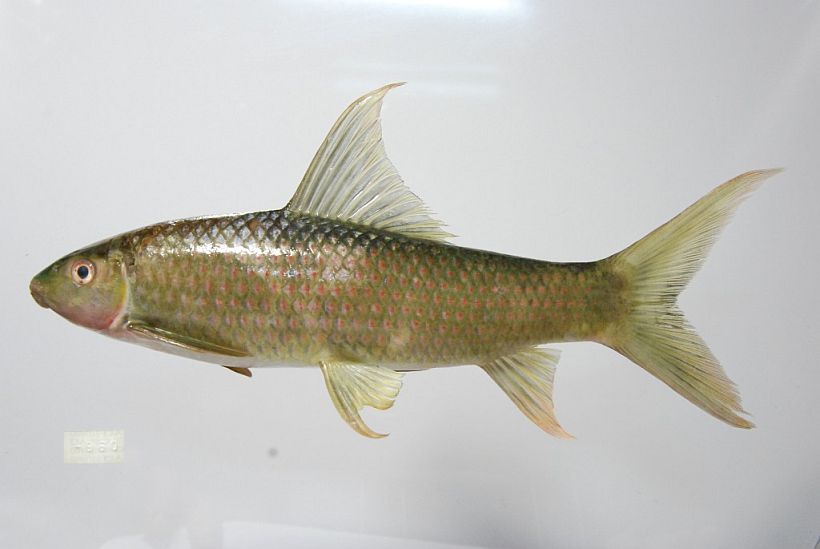
Mekongina erythrospila
Fowler, 1937
Max length450mm SL18in SLTanknot recordedTemp20–26°C68–79°FpH6.0–8.0Endemic to the middle and lower Mekong River system in Laos, Thailand, Cambodia, and Vietnam. Its known range extends from Chiang Rai province, Thailand in the north to Kratie province, Cambodia in the south, and it occurs in several important tributary systems including the Sesan, Srepok, and Tonlé Sap. Type locality is 'Mekong River at Kemarat, Thailand'.
Melanochromis auratusGolden Mbuna
authority not recorded
Max length110mm SL4in SLTank120 × 45cm48 × 18inTemp24–28°C75–82°FpH7.6–8.8Despite its ready availability, M. auratus is not recommended for the beginner due to its intolerant nature. Do not keep it with other Melanochromis species as they may hybridise. Male fish can revert to the golden colouration when stressed, and older females often darken with age until they superficially resemble males....
Melanochromis chipokae
authority not recorded
Max length120mm SL5in SLTank120 × 45cm48 × 18inTemp24–28°C75–82°FpH7.6–8.8This species belongs to the group of Melanochromis often called "Pike Auratus". These species predate on the fry of other species, although M. chipokae will also eat crustaceans and algae. Female and juvenile male M. chipokae are easily confused with M. auratus. However, it can be distinguished by its noticeably more pointed mouth, denoting the predatory nature of this species (auratus has a rounded mouth which is designed for feeding on algae). The striped patterning in the also exten...
Melanochromis cyaneorhabdos
authority not recorded
Max length100mm SL3.9in SLTank90 × 45cm36 × 18inTemp24–28°C75–82°FpH7.6–8.8M. cyaneorhabdos was formerly known as M. "maingano", after a village located on the shore off which it is found. It can be distinguished from the similar M. johanni by the overall blueish colouration of dominant males, as opposed to the more black patterning of johanni. It is sometimes incorrectly sold as "electric blue" johanni. Do not keep it with other Melanochromis species as they may hybridise....
Melanochromis johanni
authority not recorded
Max length120mm SL5in SLTank90 × 45cm36 × 18inTemp23–27°C73–81°FpH7.6–8.8This species can be distinguished from the similar M. cyaneorhabdos by the overall black colouration of dominant males, as opposed to the more blueish patterning of cyaneorhabdos. It is sometimes sold as "electric blue johanni". Do not keep it with other Melanochromis species as they may hybridise....
Melanochromis lepidiadaptes
authority not recorded
Max length120mm SL5in SLTank90 × 45cm36 × 18inTemp24–28°C75–82°FpH7.6–8.8This species was originally sold as M. fuscus and then M. sp. "lepidophage. The name refers to the act of lepidophagy, which is the act of a fish eating the scales of another fish. In nature M. lepidiadaptes apparently lives an opportunistic lifestyle, feeding almost solely on the scales of other species, although interestingly not other mbuna. However in aquaria this behaviour has never been witnessed. Do not keep it with other Melanochromis species as they may hybridise....
Melanotaenia affinisNew Guinea Rainbowfish
authority not recorded
Max length120mm SL5in SLTank120 × 30cm48 × 12inTemp20–30°C68–86°FpH6.5–8.0M. affinis was one of the first rainbowfish species to be imported for the hobby in any numbers. There are several geographical variants, three of which can be found in the hobby. The "standard" form has a large natural range and is the most commonly encountered. The "Pagwi" form has a very limited distribution, being known only from a tributary of the Sepik River in New Guinea, while the "Bluewater Creek" form has only been collected from a single location close t...
Melanotaenia australisWestern rainbowfish
authority not recorded
Max length120mm SL5in SLTank120 × 30cm48 × 12inTemp22–27°C72–81°FpH6.5–8.0This species was formerly classified as part of the Melanotaenia splendida complex, but more recent research into the genetics of the species has shown that not only is M. australis genetically dissimilar to the splendida group, but also that there are 2 clear lineages within australis This may yet result in another official member of the genus. M. australis exhibits a wide variation in colour and patterning depending on locality, and is probably the commonest rainbowfish species in Australi...
Melanotaenia boesemaniBoeseman's rainbowfish
authority not recorded
Max length110mm SL4in SLTank120 × 30cm48 × 12inTemp27–30°C81–86°FpH7.0–8.0This uniquely-patterned species is one of the most popular rainbowfish in the hobby and can be found swimming in most dealers' tanks. However, virtually all these fish are mass-produced on fish farms in the Far East and Eastern Europe. M. boesmani is actually quite rare in nature, and is on the IUCN red list of endangered species. Unfortunately this is one species on which the aquarium trade has had a massively detrimental effect, with an estimated one million fish a year being collected to...
Melanotaenia fluviatilisAustralian Rainbowfish
authority not recorded
Max length100mm SL3.9in SLTank90 × 30cm36 × 12inTemp20–25°C68–77°FpH6.5–8.0Also known as the Murray River or crimson-spotted rainbowfish, this species is not as common in the hobby as some of its relatives, but can still be found from time to time. It is easily confused with the very similar M. duboulayi, indeed these two were once grouped together as a single species. However, there are clear differences in patterning, fin ray counts and the way in which their eggs and fry develop. The range of M. fluviatilis extends further south than any other rainbowfish, and a...
Melanotaenia gracilisSlender Rainbowfish
authority not recorded
Max length75mm SL3.0in SLTank75 × 30cm30 × 12inTemp22–28°C72–82°FpH7.0–8.0This uniquely-shaped rainbow is an uncommonly seen species in the hobby, mainly because it hails from such a remote area in Australia. It is currently listed on the IUCN list of threatened species as being at risk, so all attempts at captive spawning are to be encouraged....
Melanotaenia herbertaxelrodiLake Tebera Rainbowfish
authority not recorded
Max length90mm SL3.5in SLTank90 × 30cm36 × 12inTemp20–26°C68–79°FpH7.0–8.0One of the more beautifull-coloured rainbowfish available when mature, M. herbertaxelrodi is probably at risk from overfishing, but not enough data is available to consider it an endangered species as yet....
Melanotaenia irianjayaIrian Jaya Rainbowfish
authority not recorded
Max length120mm SL5in SLTank90 × 30cm36 × 12inTemp23–26°C73–79°FpH6.5–8.0This beautiful rainbow is not often seen in the hobby. It can be identified by the fact that the middle rays in the dorsal and anal fins are longer than the other fin rays. This feature is usually associated with the closely-realated Glossolepis genus of rainbowfish....
Melanotaenia lacustrisLake Kutubu Rainbowfish
authority not recorded
Max length120mm SL5in SLTank120 × 30cm48 × 12inTemp20–25°C68–77°FpH7.0–9.0Unfortunately the prisitine environment form where this fish comes is being threatened by overfishing (much of it for the aquarium trade) and industry, with an oil development being built at one end of the lake during the 1990s. M. lacustris has therefore been given "vulnerable" status on the IUCN red list. The lake was designated a Wetland of International Importance in 1998, as both it and the Kikori Basin where it lies contain some of the earth's greatest biodiversity in terms ...