Results for “species”
Type a name: scientific, common, or one a species used to go by. Or narrow the catalogue with the filters.
Filters
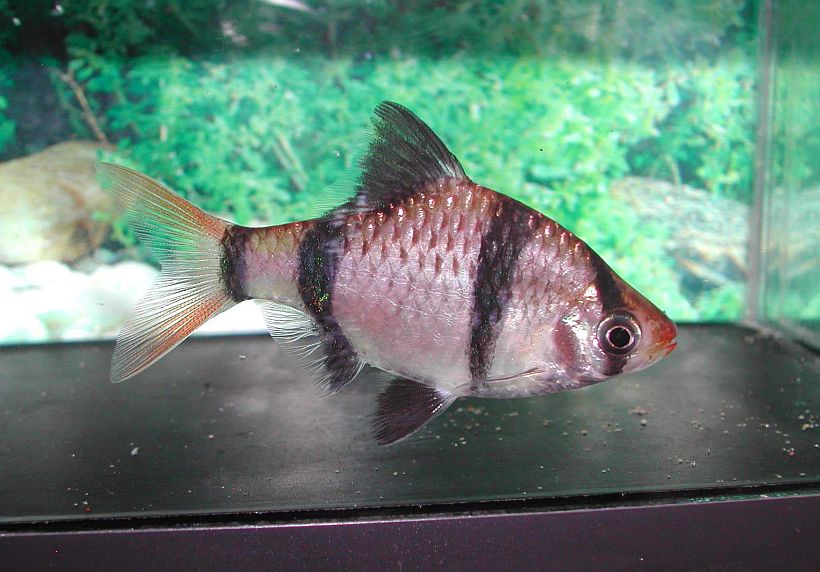
Puntigrus tetrazonaTiger Barb
Bleeker, 1855
Max length60mm SL2.4in SLTank80 × 30cm31 × 12inTemp20–26°C68–79°FpH5.0–8.0P. tetrazona is traditionally considered to be among the most ubiquitous species available in the aquarium trade. Wild examples are rarely traded, however, and there exists ongoing confusion as to the identity of the commercially-produced 'aquarium' tiger barb. A number of selectively-bred, ornamental strains are available. The albino, 'green' (aka 'moss'), and 'golden' (leucistic) variants are particularly pop...
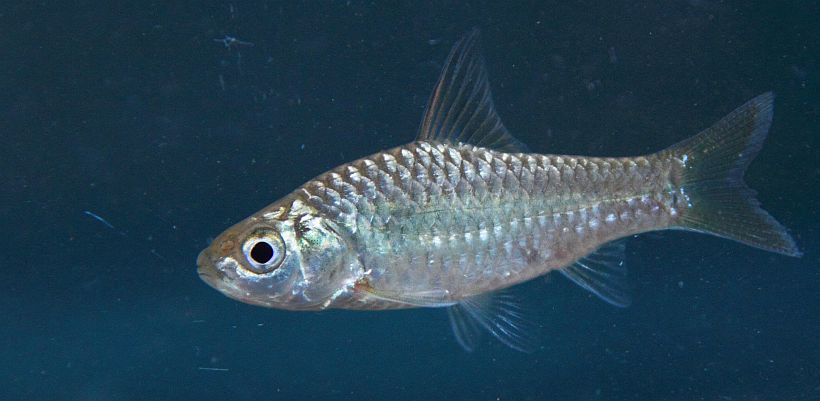
Puntius kamalikaKami's Barb
Silva, Maduwage & Pethiyagoda, 2008
Max length75mm SL3.0in SLTank120 × 30cm48 × 12inTemp20–27°C68–81°FpHnot recordedPrior to its description P. kamalika was referred to as P. amphibius, a putatively valid species probably restricted to western India. It differs from all congeners in the following combination of characters: 4½/1/2½ scales in a transverse line between the mid-dorsal...
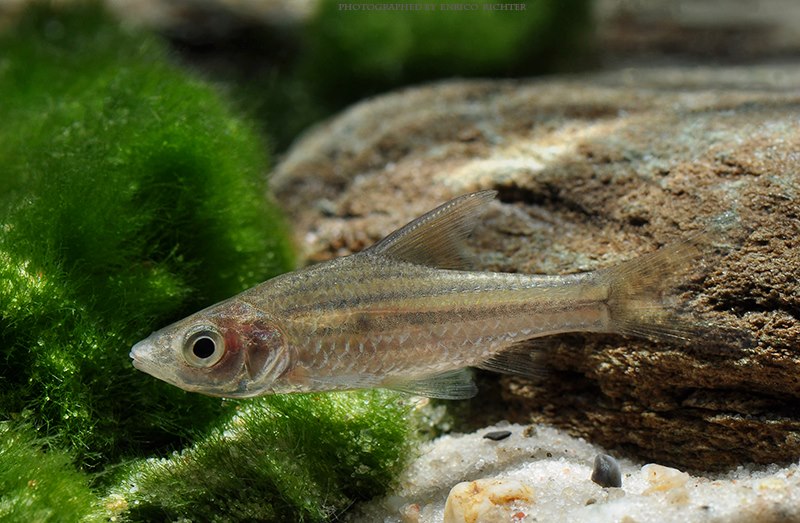
'Puntius' lineatusLined Barb
Duncker, 1904
Max length55mm SL2.2in SLTank80 × 30cm31 × 12inTemp20–26°C68–79°FpH4.0–7.0One of four similar-looking, laterally-striped 'Puntius' spp. native to Southeastern Asia alongside 'P.' gemellus, 'P.' johorensis, and 'P.' trifasciatus. Of these 'P.' lineatus is most often confused with 'P.' johorensis by virtue of the fact that these two seem most common in the aquarium trade. Telling them apart is relatively simple since 'P.' lineatus has 0 - 1 pairs of barbels (vs. 2 pairs in the other three species), juv...
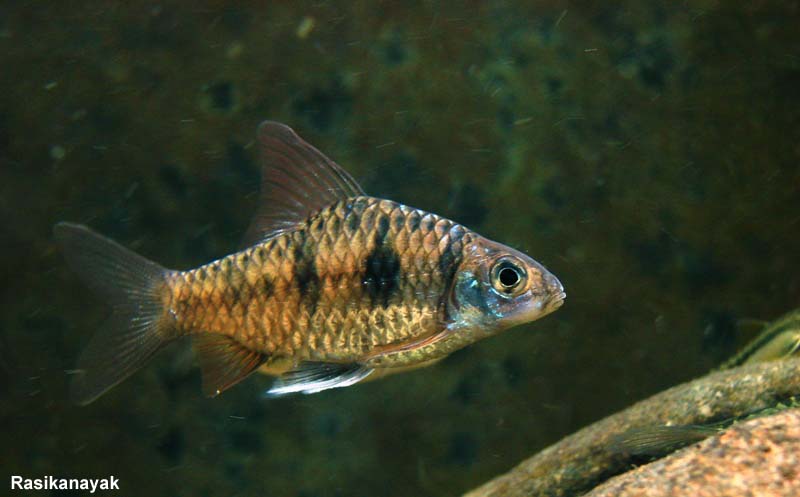
Puntius sahyadriensisMaharaja Barb
Silas, 1953
Max length65mm SL2.6in SLTank80 × 30cm31 × 12inTemp18–24°C64–75°FpH6.0–7.8The hill streams in which this fish can be found are generally shaded by the forest canopy and dense marginal vegetation. Substrates are typically composed of boulders, smaller stones, sand or gravel with submerged tree roots around the margins and quieter areas in which fallen branches and leaf litter collect. Other fish species occurring in the Tunga...
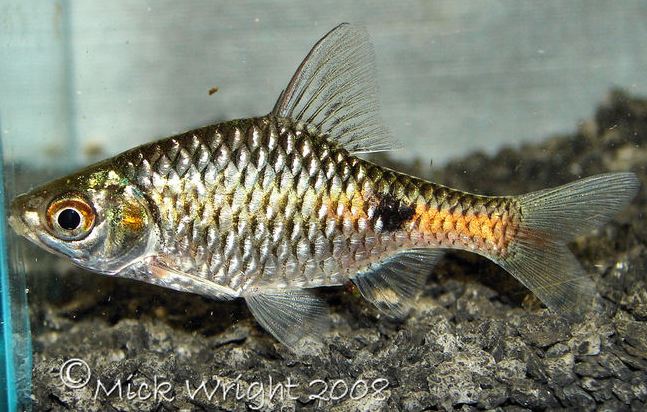
Puntius terioOnespot Barb
Hamilton, 1822
Max length90mm SL3.5in SLTank80 × 30cm31 × 12inTemp18–26°C64–79°FpH6.5–7.5This species is uncommon in the aquarium trade which is a little surprising given its huge natural range. Different populations can vary in colour pattern to an extent though all share the defining aspects given by Hamilton, comprising a diffuse yellow-golden marking on the operculum plus a dark spot on the caudal peduncle. The latter is usually surrounded by a variably-sized golden-yellow margin, and the dorsal-fin often contains irregular dark spots and streaks, these sometimes forming a longitudinal band.
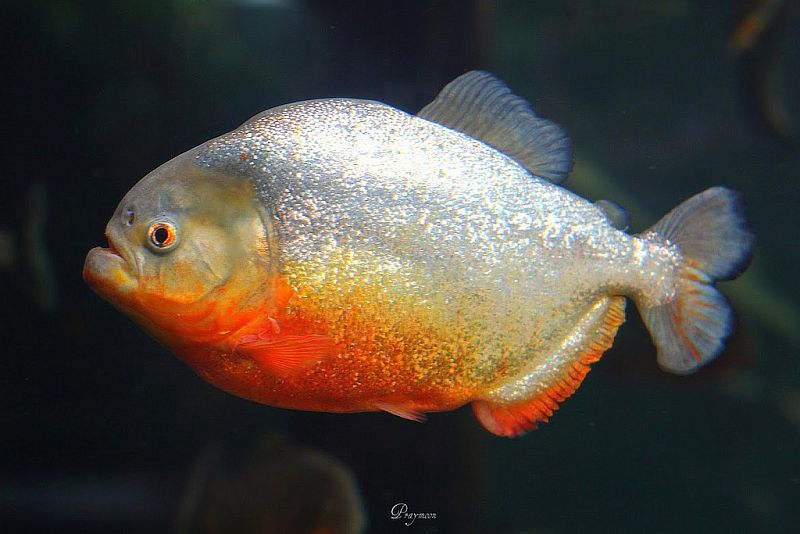
Pygocentrus nattereriRed Bellied Piranha
Kner, 1858
Max length350mm SL14in SLTank240 × 90cm96 × 36inTemp24–28°C75–82°FpH5.5–7.5Famed as a rapacious predator capable of rapidly stripping flesh from bone and a danger to any animal entering its native waters, P. nattereri is among the most notorious freshwater fishes in the world. As a result, displays featuring this “bloodthirsty” creature are found in most public aquaria, grisly Hollywood movies have been released, and the species has become popular in the aquarium trade. Little of this infamy is based on factual evidence, however.
Rasbora caudimaculataGreater Scissortail Rasbora
authority not recorded
Max length150mm SL6in SLTank150 × 45cm60 × 18inTemp20–26°C68–79°FpHnot recordedThis striking species may also be seen on sale with the trade name of 'red scissortail'. It can be distinguished from the similar-looking R. trilineata by the presence of orange/red colouration in the with other diagnostic features including black tips to the caudal lobes, 11-12 predorsal scale rows and a dark reticulated pattern to the edges of the scales. The 'scissortail' moniker is derived from the characteristic twitching motion of the when the fish is at rest. Rainb...
Rasbora einthoveniiBrilliant Rasbora
authority not recorded
Max length90mm SL3.5in SLTank120 × 30cm48 × 12inTemp22–26°C72–79°FpHnot recordedThis is one of the more commonly-seen rasboras in the hobby and is ideal for the medium-sized community set-up. It shares some close similarities with R. jacobsoni but can be most easily identified by the fact it lacks dark reticulated scales above the lateral stripe. This stripe also has noticeably more uneven or "crinkly" edges in R. einthovenii than in R. jacobsoni or indeed any other species of laterally-striped Rasbora. A further distinguishing combination of characters for both t...
Rasbora elegansElegant Rasbora
authority not recorded
Max length200mm SL8in SLTank120 × 45cm48 × 18inTemp22–25°C72–77°FpHnot recordedThis species is not especially popular in the hobby and is only infrequently seen on sale. It is clearly distinguishable from similar-looking members of the genus by lacking a dark stripe along the lateral line. Instead it possesses two spot-like markings on each flank, one below theorigin and lateral line and another at the caudal peduncle. The intensity of these can vary depending on the collection locality of the fish and they can be quite faint in some forms. There is also a third, smaller m...
Rasbora kottelati
authority not recorded
Max length70mm SL2.8in SLTank120 × 30cm48 × 12inTemp23–28°C73–82°FpHnot recordedIt is unclear if this species has been available in the aquatic trade as collections from its native waters only occur sporadically, therefore we have based much of the information here on experience with its closest relative R. kalochroma. These two are almost identical in appearance and share some meristic features but R. kottelati possesses an additional, oval-shaped dark blotch on the caudal peduncle, lacks the stripe in the middle of the seen in R. kalochroma and is consequently easy to dis...
Rasbora rasboraGangetic Scissortail Rasbora
authority not recorded
Max length130mm SL5in SLTank120 × 45cm48 × 18inTemp20–25°C68–77°FpHnot recordedThis species is rarely seen in the trade and little has been written regarding its captive care. It's possible that several colour forms may exist depending on collection locality. Rainboth's 'Fishes of the Cambodian Mekong' characterised members of Rasbora by possession of an unbranched, non-spiny firstray and seven soft dorsal rays, origin of thein the middle of the body, five branchedrays, a small mouth not extending below the eye and a lack of barbels. It's long b...
Rasbora rubrodorsalis
authority not recorded
Max length30mm SL1.2in SLTank45 × 30cm18 × 12inTemp24–28°C75–82°FpHnot recordedR. rubrodorsalis occurs sympatrically with the very similar-looking R. borapetensis over some of its natural range but is much the rarer of the two in the aquarium hobby. They are easily distinguishable from one another because R. rubrodorsalis has a bright red blotch in thewhilst in R. borapetensis the dorsal is colourless and only the base of the is coloured red. This species is sometimes sold under the erroneous name(s) R. beauforti or R. sp. cf. beauforti, probably because it was picture...
Rasbora trilineataScissortail Rasbora
authority not recorded
Max length150mm SL6in SLTank120 × 45cm48 × 18inTemp22–25°C72–77°FpHnot recordedThis popular species is also known as the 'three-lined' rasbora and provided a large enough tank is available it is an excellent choice for those new to the hobby. The 'scissortail' moniker is derived from the characteristic twitching motion of the when the fish is at rest. It can be distinguished from the similar R. caudimaculata by lacking red colouration in the and from R. spilocerca by its much larger size. Several geographical forms appear to exist as some wild populatio...
Rasbora vulcanus
authority not recorded
Max length40mm SL1.6in SLTank60 × 38cm24 × 15inTemp23–26°C73–79°FpHnot recordedThis species was described in 1999 and may still occasionally be seen on sale under the incorrect names R. reticulata or R. cf. reticulata as well as the trade name 'volcano rasbora'. The real reticulata is endemic to the small island of Nias which lies off Sumatra's northwestern coast and is virtually inaccessible to fish collectors so is unlikely to be in the hobby although it may have been exported on a couple of occasions. It's a deeper-bodied fish and does not exhibit th...
Reganochromis calliurus
authority not recorded
Max length150mm SL6in SLTank120 × 45cm48 × 18inTemp24–27°C75–81°FpH8.0–9.2A rarely seen species in the hobby due to its deep water lifestyle and the associated difficulties with collecting it.
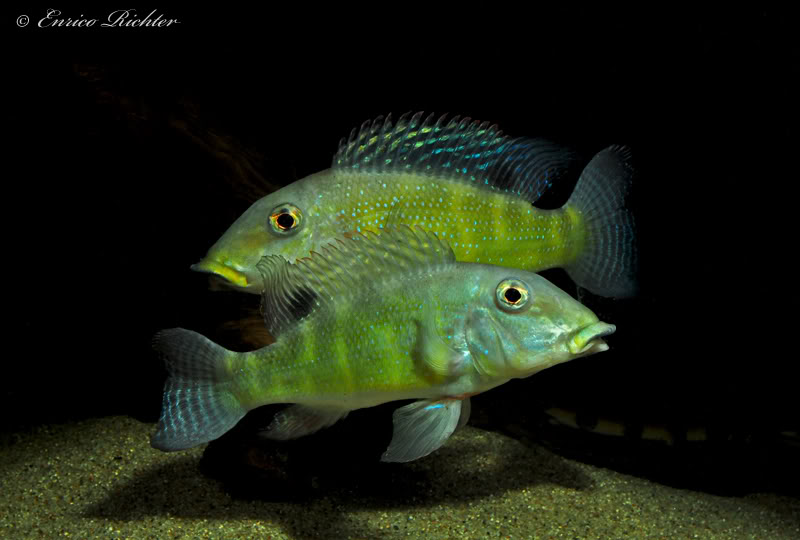
Retroculus xinguensis
Gosse, 1971
Max length200mm SL8in SLTank210 × 60cm84 × 24inTemp26–32°C79–90°FpH6.0–8.0The precise extent of this species' range is unclear. The majority of records pertain to the lower rio Xingu basin in the state of Pará, northern Brazil, including middle and lower reaches of its major tributary the rio Iriri, although the type locality is in Mato Grosso state several hundred kilometres upstream. There also exist a handful of records from the rio Jamanxim (a major affluent of the rio Tapajós which drain...
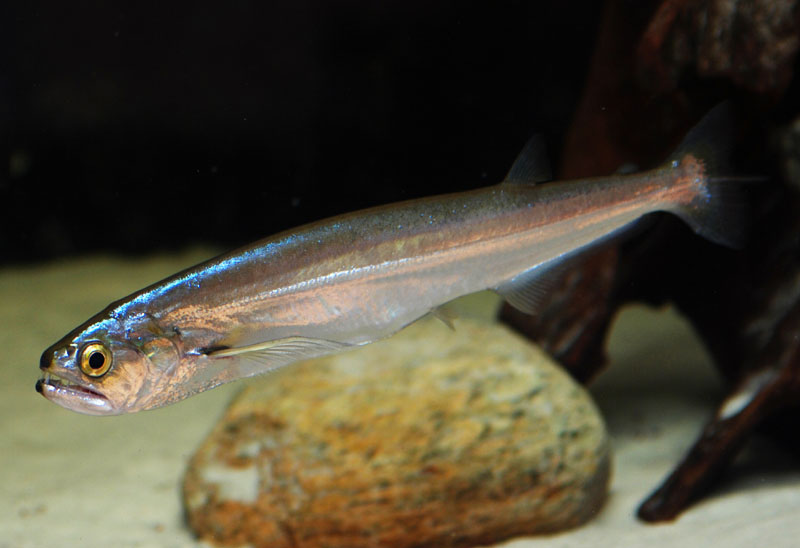
Rhaphiodon vulpinusBiara
Spix & Agassiz, 1829
Max length800mm SL31in SLTanknot recordedTemp24–28°C75–82°FpH6.0–8.0R. vulpinus is the most widely-distributed member of the family Cynodontidae. Type locality is given simply as 'Brazilian rivers', but this species is currently understood to be distributed in the Amazon basin from the Río Ucayali system in Peru, eastward as far as the rio Xingu in Brazil, plus the rio Tocantins and Rio Capim basins. It's also known from the Río Orinoco ba...
Rhinodoras boehlkeiFog Talking Catfish
authority not recorded
Max length130mm SL5in SLTank120 × 30cm48 × 12inTemp24–26°C75–79°FpH5.8–7.0At present there's not a great deal of information available regarding this species. It seems to be fairly easy to keep, and makes a good addition to larger community tanks.
Rhinodoras dorbygnyi
authority not recorded
Max length300mm SL12in SLTank120 × 60cm48 × 24inTemp20–25°C68–77°FpH6.0–7.0At present there's not a great deal of information available regarding this species. It seems to be fairly easy to keep, and makes a nice, unusual addition to larger community tanks.
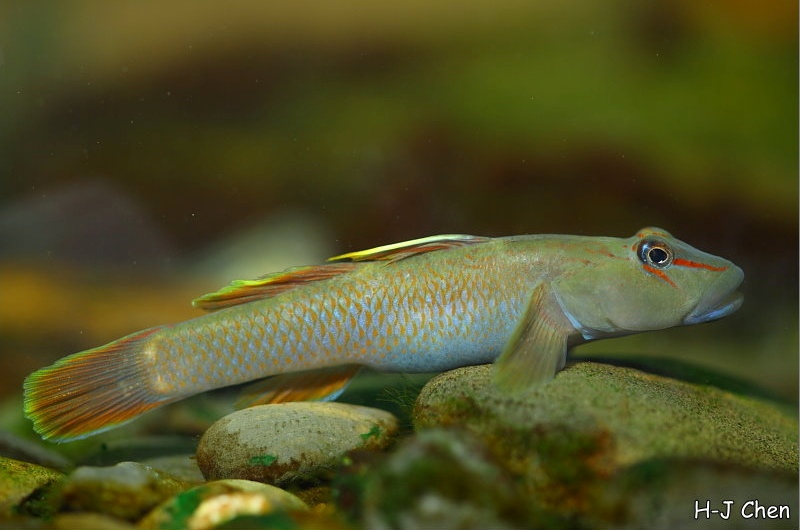
Rhinogobius candidianus
Regan, 1908
Max length80mm SL3.1in SLTank80 × 30cm31 × 12inTemp18–28°C64–82°FpH6.0–8.0This species is normally imported alongside a smaller-growing, near-identical congener currently listed as R. cf. nantaiensis with both traded as R. candidianus. They can be separated by snout length, which is noticeably longer in R. candidianus, and adult size with R. cf. nantaiensis reaching just 50-55 mm. R. candidianus can be distinguished from other congeners by a combination of cha...