Search the catalogue
Type a name: scientific, common, or one a species used to go by. Or narrow the catalogue with the filters.
Filters
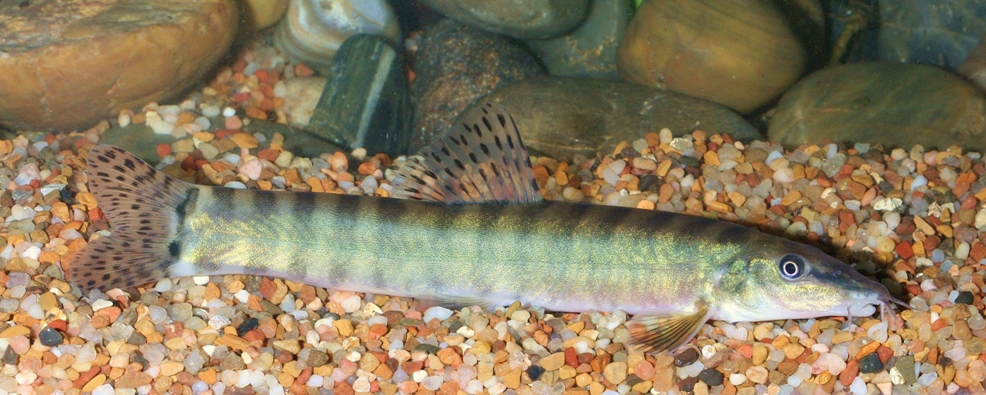
Parabotia bimaculata
Chen, 1980
Max length140mm SL6in SLTank120 × 45cm48 × 18inTemp20–24°C68–75°FpH6.0–7.5Type locality is the town of Luxian, located north of Luzhou city, Sichuan province, southwest China. Luxian lies on the Laixi River, one of several tributaries converging with the main Yangtze river channel near Luzhou and forming part of the latter's upper drainage basin. The full extent o...
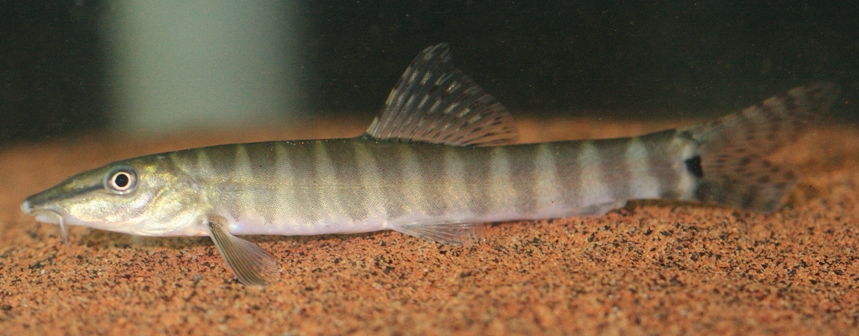
Parabotia fasciata
Dabry de Thiersant, 1872
Max length150mm SL6in SLTank120 × 45cm48 × 18inTemp20–24°C68–75°FpH6.0–7.5P. fasciata is rarely seen in the trade and is typically available only as bycatch among shipments of Sinibotia spp., particularly S. robusta. According to current classification numerous species from several genera are considered synonymous with it.
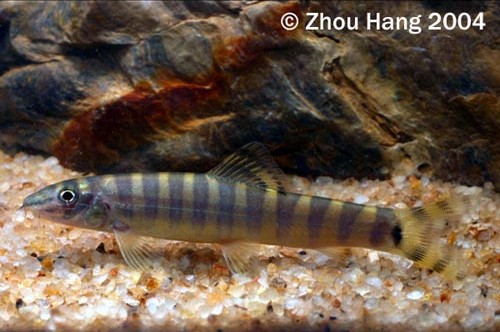
Parabotia lijiangensis
Chen, 1980
Max length83mm SL3.3in SLTank120 × 30cm48 × 12inTemp20–24°C68–75°FpH6.0–7.5It's told apart from congeners by a combination of characters as follows: large scales present on body and sides of head; caudal fin deeply forked with subequal lobes; 10-13 dark, vertical bars on the body; a dark, ocellated spot in the centre of the caudal-fin base; two bars on top of head, dorsal-fin with two rows of greyish spots; caudal-fin lobes with 3-4 dark bands on each; anal-fin with one indistinct band and another, more distinct, submarginal band; ventral fins with two indistinct bands.
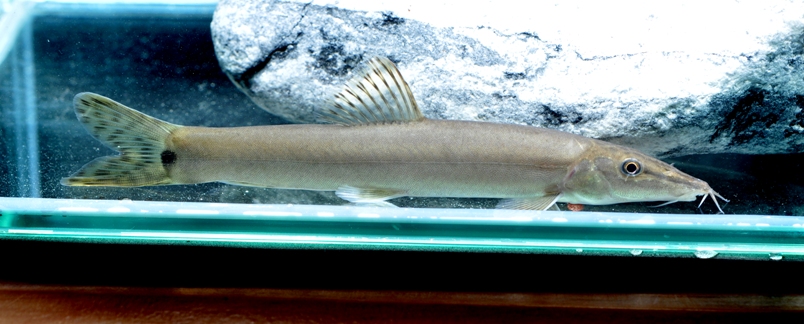
Parabotia sp. 'PB01'
authority not recorded
Max length100mm SL3.9in SLTank120 × 45cm48 × 18inTemp20–24°C68–75°FpH6.0–7.5The name of this fish is unclear with the fact that diagnoses for several members of this genus do not appear to exist in the English language making identification even trickier. It's not common in the aquarium trade, either.
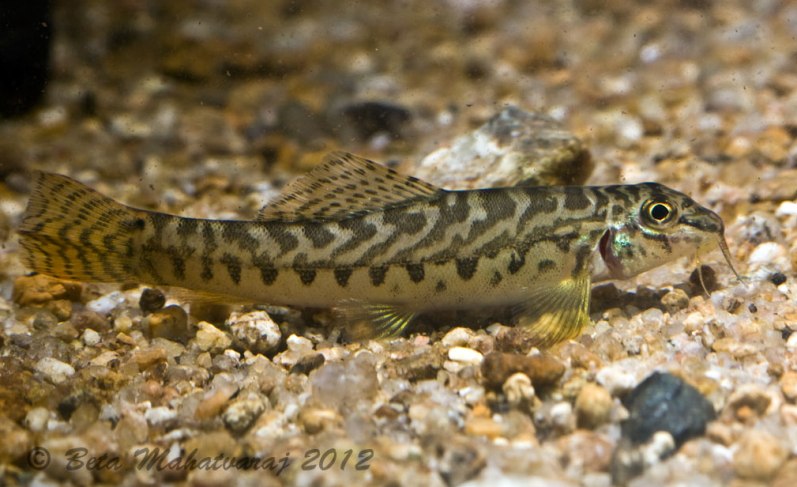
Paracanthocobitis botiaZipper Loach
Hamilton, 1822
Max length152mm SL6in SLTank75 × 30cm30 × 12inTemp21–26°C70–79°FpH6.0–7.5Traded under various names including 'mottled', 'eyepot', 'sand' and 'striped' loach. It's perhaps one of the better choices for those new to keeping nemacheilids being relatively hardy, peaceful and exhibiting some quirky behavioural traits. The characteristic ocellus, a dark marking at the top of the caudal peduncle that resembles an eye, is thought to have some function in predator distraction and is normally more intense in younger specimens.
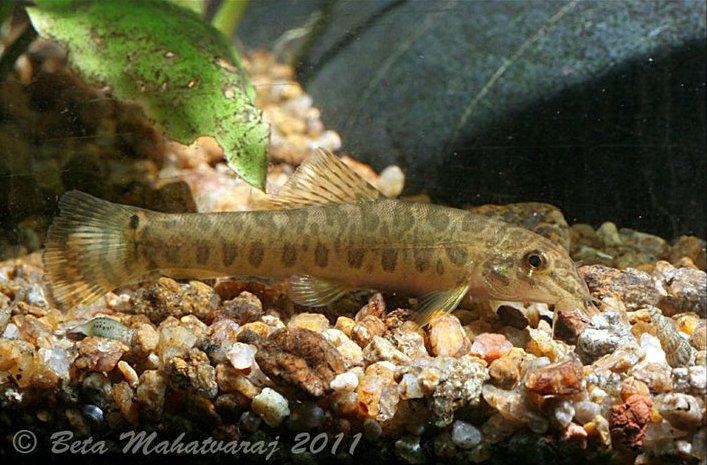
Paracanthocobitis mooreh
Sykes, 1839
Max length75mm SL3.0in SLTank75 × 30cm30 × 12inTemp20–26°C68–79°FpH6.0–7.5This species is still considered a member of the genus Nemacheilus by some sources, but it was reclassified and placed in Acanthocobitis by Grant (2008). Acanthocobitis sinuata, generally considered a junior synonym of A. mooreh (Kottelat, 2012b), also appears distinct and differs in geographical distribution plus number of dorsal-fin rays (2-3/9-10 in A. mooreh vs. 2/8-9 in A. sinuata) and some aspects of colour pattern.
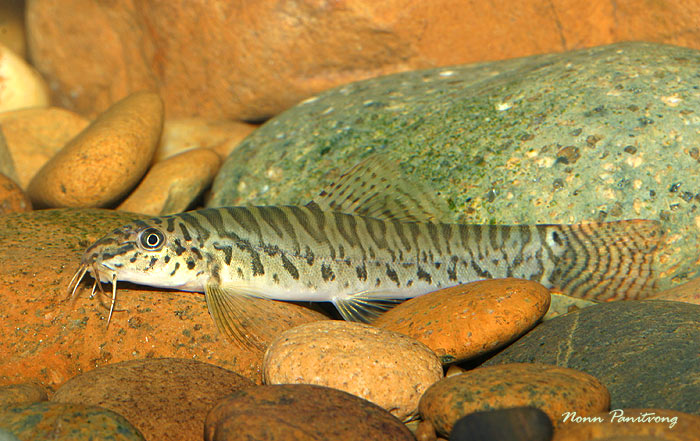
Paracanthocobitis pictilisCherry-fin Loach
Kottelat, 2012
Max length91mm SL3.6in SLTank90 × 30cm36 × 12inTemp21–26°C70–79°FpH6.5–7.5Prior to description this species was considered to represent, and traded as, A. rubidipinnis, but that species is apparently endemic to the lower Irrawaddy basin in Myanmar and unknown in the aquarium hobby. Male individuals of A. pictilis, A. botia and A. mandalaysensis possess a suborbital slit rather than suborbital flap which immediately distinguishes...
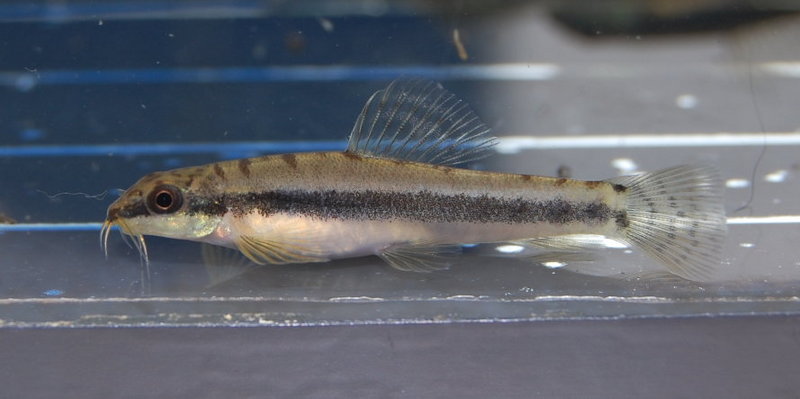
Paracanthocobitis zonalternans
Blyth, 1860
Max length78mm SL3.1in SLTank60 × 30cm24 × 12inTemp20–25°C68–77°FpH6.0–7.5According to Kottelat (1990) the chief distinguishing characters for the genus are: possession of 9-18½ branched dorsal-fin rays; colour pattern without black basal caudal bar, but with an ocellus at upper base of caudal-fin; upper lip with or without several rows of papillae; lower lip with a broad median interruption and a widened, papillated pad on each side.
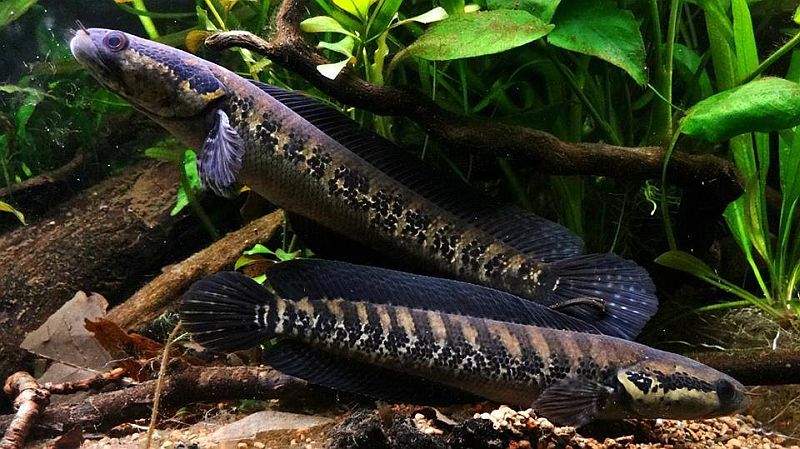
Parachanna africana
Steindachner, 1879
Max length300mm SL12in SLTank120 × 60cm48 × 24inTemp20–25°C68–77°FpH5.0–7.5Following Bonou and Teugels (1985), P. africana can be distinguished from congeners by the following combination of characters: colour pattern unique, comprising a series of 8-11 dark, chevron-shaped markings extending along the body posterior to the pectoral fins; 19-24 scales in the transverse series; lateral line complete with 73-83 pored scales; 45-48 dorsal-fin rays 45-48; 32-35 anal-fin rays.
Parachanna obscuraAfrican snakehead
authority not recorded
Max length406mm SL16in SLTank38 × 38cm15 × 15inTemp26–30°C79–86°FpH6.0–7.5This fish is spawned very infrequently in captivity but some reports have been made. Fish are sexually mature from 4" and a pair should be obtained by growing on a group of youngsters and allowing a pair to form naturally. Once this occurs the other fish will most likely be eliminated so it is wise to be vigilant in order to avoid uneccessary losses. Apparently courtship occurs in an open section of water surrounded by floating plant material. The courtship consists of the fish circling ...
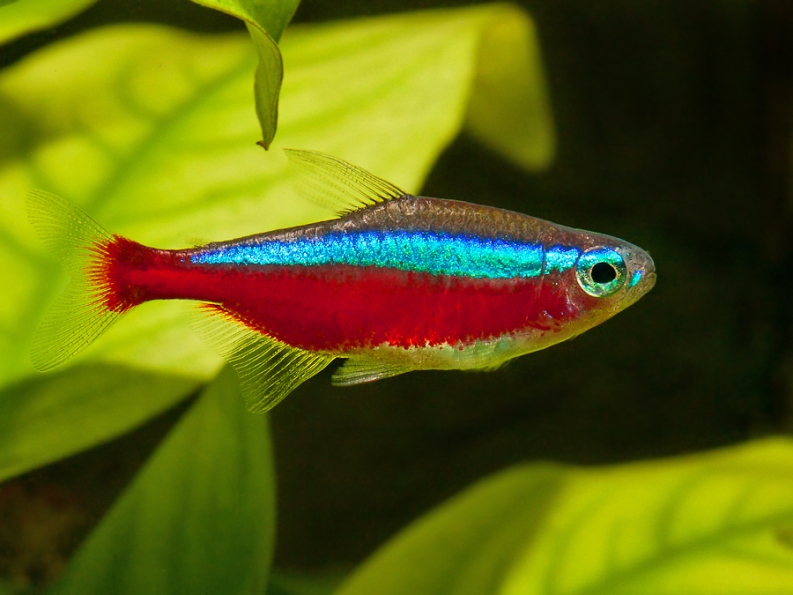
Paracheirodon axelrodiCardinal Tetra
Schultz, 1956
Max length35mm SL1.4in SLTank60 × 30cm24 × 12inTemp23–29°C73–84°FpH3.5–7.5It was initially going to be described as Hyphessobrycon cardinalis by Myers and Weitzman (1956) but just before this was due to be published Schultz presented an alternative description in the hobbyist magazine 'Tropical Fish Hobbyist' and named the fish after the publication's founder, Dr. Herbert R. Axelrod. A significant proportion of the fish available in the aquarium trade are still wild caught or derive from community-led breeding projects such as Project Piaba in the middle Negro region, where this sp...
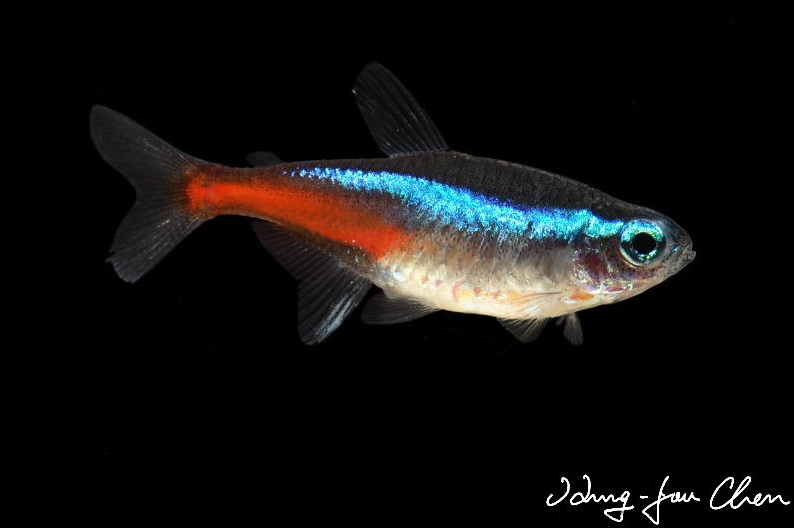
Paracheirodon innesiNeon Tetra
Myers, 1936
Max length30mm SL1.2in SLTank60 × 30cm24 × 12inTemp21–25°C70–77°FpH4.0–7.5One of the most popular and instantly recognisable fishes in the aquarium hobby, this species has been selectively-bred to produce a number of additional strains including albino, 'golden' (leucistic), short-bodied, long-finned and 'diamond' (in which the dorsal surface is covered in reflective scales). Unfortunately years of commercial breeding have somewhat affected the genetic vigour of the ornamental strain meaning morphological defects an...
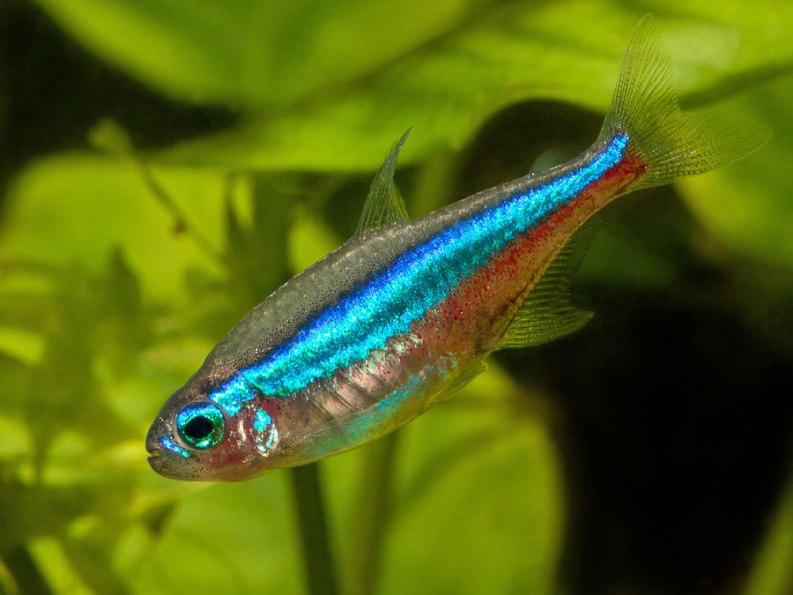
Paracheirodon simulansGreen Neon Tetra
Géry, 1963
Max length25mm SL1.0in SLTank45 × 30cm18 × 12inTemp21–35°C70–95°FpH3.0–6.5For aquarists perhaps more useful are the subtle differences in colour pattern with P. simulans differing from both P. innesi and P. axelrodi in possessing a greener (vs. bluer) lateral stripe which covers more (vs. less) of the eye/head and extends to the caudal-fin base (vs. terminating anterior to caudal-fin base), a lesser (vs. greater) amount of relatively duller (vs. brighter) red pigmentation on the flanks. The taxonomic history of all three species is complicated with earlier authors such as Géry (1960, 1977) ten...
Parachromis managuensisJaguar Cichlid
authority not recorded
Max length610mm SL24in SLTank120 × 38cm48 × 15inTemp23–25°C73–77°FpH6.0–8.0Parachromis Managuense are your typical north/central American large predatory cichlid. They are extremely attractive, but a large aquarium is required. They are not difficult to look after, as long as filtration is up to standard. Choose tankmates carefully - if you are hoping to breed Managuense, house a breeding pair or grow 6 juveniles up until a pair is formed. One of the biggest problems with breeding Managuense is the fact that a single spawn from 12" parents can produce 3000 f...
Parachromis motaguensisFalse Yellowjacket Cichlid
authority not recorded
Max length305mm SL12in SLTank120 × 38cm48 × 15inTemp20–30°C68–86°FpH6.0–8.0Parachromis Motaguensis are a truly stunning fish. They exhibit gorgeous colours, but can be a nightmare to keep. Do not even consider housing any other fish with Motaguensis when they are breeding, as the other fish will be hurt - even if significantly bigger than the pair of False Yellowjackets. Motaguensis make a nice addition to a big central/north American cichlid tank, with similarly aggressive fish - but be careful that you don't choose a compatible pair of Motaguensis or you wil...
Paracyprichromis brieni
authority not recorded
Max length110mm SL4in SLTank120 × 45cm48 × 18inTemp24–27°C75–81°FpH7.5–9.0Although P. brieni is better kept in a group, it tends to form much looser shoals than the similar Cyprichromis species. Male fish form territories under overhangs if they are available and can often be seen hanging upside down under these or vertically against rock walls. In the aquarium if it is not provided with such retreats, or if it is housed under bright lighting or with boisterous fish it will rapidly lose its best colouration. It is quite easily confused with P. nigripinnis, it'...
Paracyprichromis nigripinnis
authority not recorded
Max length110mm SL4in SLTank120 × 45cm48 × 18inTemp24–27°C75–81°FpH7.5–9.0Although P. nigripinnis is better kept in a group, it tends to form much looser shoals than the similar Cyprichromis species. Male fish form territories under overhangs if they are available and can often be seen hanging upside down under these or vertically against rock walls. In the aquarium, if it is not provided with such retreats, or if it is housed under bright lighting or with boisterous fish, it will rapidly lose it's best colouration. It is quite easily confused with P. brieni,...
Parambassis pulcinellaHumphead Perchlet
authority not recorded
Max length100mm SL3.9in SLTank90 × 30cm36 × 12inTemp23–27°C73–81°FpH7.0–7.5A new species that was only described to science in 2003, little is known about the natural behaviour of P. pulcinella. It has started to be imported quite regularly over the last couple of years, although it is still quite expensive. Unfortunately this species has suffered the same fate as some of it's close relatives, and artificiallly dyed specimens have been making their way onto the market. These should be avoided at all costs, as the processes involved are cruel and unecessary, and us...
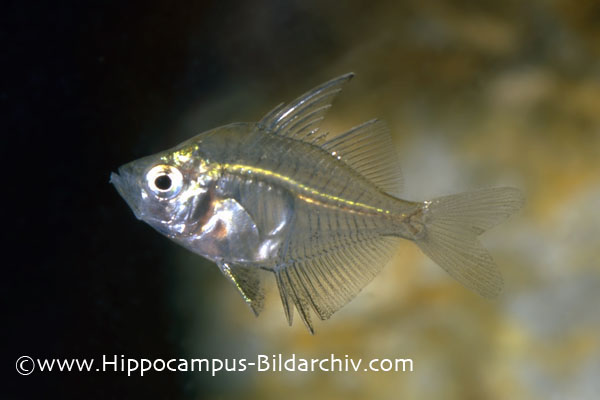
Parambassis rangaIndian Glass Fish
authority not recorded
Max length80mm SL3.1in SLTank80 × 30cm31 × 12inTemp20–30°C68–86°FpH6.5–8.0Previously known as Chanda ranga, the common name of this species arose because it's translucent skin means that the bone structure and internal organs are clearly visible. For many years it has been artificially injected with luminous dyes on fish farms in Asia and then sold as "Painted" glass fish or "Disco fish". This abhorrent act involves injecting the fish repeatedly with a large needle and most fish do not survive more than a few months afterwards. Whilst painted ...
Parambassis siamensis
authority not recorded
Max length60mm SL2.4in SLTank45 × 30cm18 × 12inTemp22–27°C72–81°FpH6.5–7.5This occasional import is sometimes offered for sale as P. ranga, the Indian glass fish. Unlike that species however, P. siamensis is an exclusively freshwater fish and should never be kept under brackish conditions. It can be distinguished from ranga by the lack of patterning behind the eye and it's generally more elongate body....