Results for “spot”
Type a name: scientific, common, or one a species used to go by. Or narrow the catalogue with the filters.
Filters
Ompok bimaculatusButter Catfish
authority not recorded
Max length450mm SL18in SLTank180 × 60cm72 × 24inTemp20–26°C68–79°FpH6.0–8.0This infrequently seen (in the trade) species is also known as the two spot glass catfish, for fairly obvious reasons. It is more than likely that a number of separate species are currently considered within this one, as there are clear morphological differences between populations. Pending a taxonomic revision, these currently all remain classified as O.bimaculatus. This would also seem to explain the apparent toleration of the fish to wildly different water chemistry. Xanthic and albino forms ...
Opsarius caudiocellatus
Chu, 1984
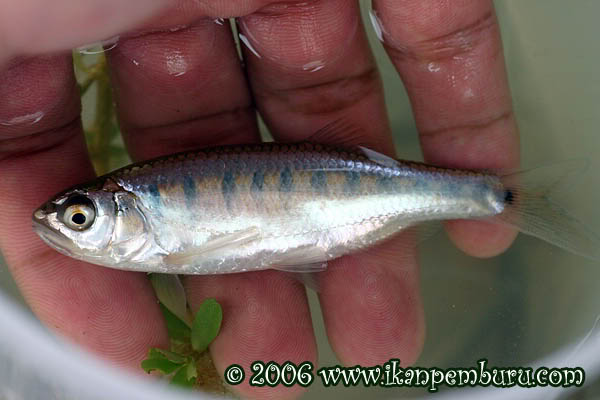
Max length86mm SL3.4in SLTank150 × 45cm60 × 18inTemp18–24°C64–75°FpH6.5–8.0This species may have appeared in the aquarium trade though probably not under the correct name. It can be told apart from similar-looking congeners by the following combination of characters: presence of a black round spot at the caudal base; dorsal-fin rays black with connecting membranes transparent; posterior dorsal-fin origin located midway between upper angle of gill aperture and caudal-fin base, or slightly closer to the latter.
Opsarius infrafasciatus
Fowler, 1934
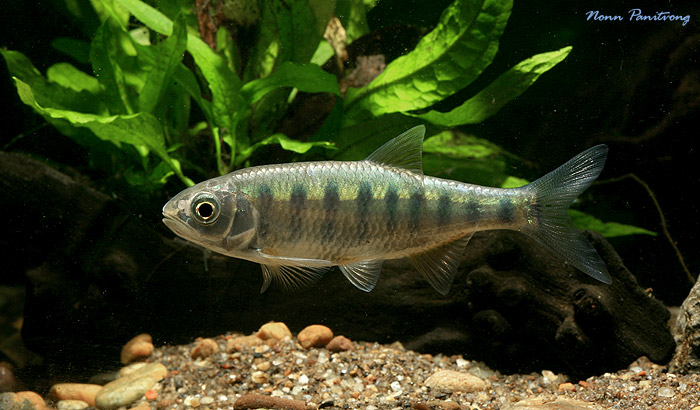
Max length100mm SL3.9in SLTank120 × 45cm48 × 18inTemp18–26°C64–79°FpH6.0–8.0This species has previously been considered synonymous with both O. ornatus and O. pulchellus but is currently considered to be distinct following (Tejavej, 2012). It can be distinguished from congeners by a combination of characters including: small caudal spot presen...
Oryzias dancenaIndian Ricefish
Hamilton, 1822
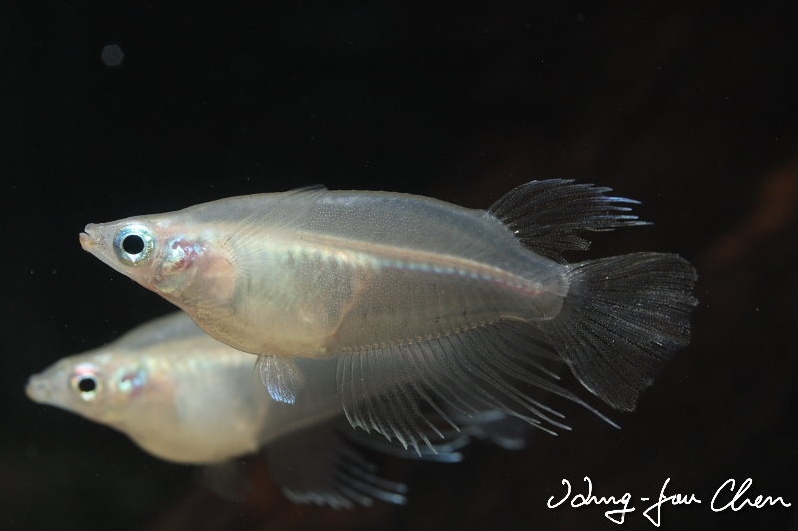
Max length35mm SL1.4in SLTank45 × 30cm18 × 12inTemp23–27°C73–81°FpH6.5–8.5This species continues to be mislabelled as O. melastigma, a name currently considered invalid by the majority of recent workers, or O. javanicus, a valid but distinct taxon. Roberts (1998) demonstrated that MClelland's description of Aplocheilus melastigmus, later renamed O. melastigma, does not correspond with any known Oryzias species from the Indian subcontinent or Myanmar since it's said to have a dark spot in the dorsal-fin and an excessively slim body, among other anomalies.
Otopharynx lithobatesSulphur-headed Hap
authority not recorded
Max length160mm SL6in SLTank90 × 45cm36 × 18inTemp24–28°C75–82°FpH7.6–8.8O. lithobates is a true rock dweller and is hardly ever seen in open water, even in aquaria. In fact, the scientific name lithobates literally translates as "rock dweller". Breeding males of this species rank among the most stunning of Lake Malawi Haplochromine cichlids. The three characteristic spots on the flanks disappear and are masked by a stunning neon blue patterning. Almost the entireand top of the head turn a deep yellow-orange colour. The most colourful variant is the "...
Panaqolus sp.L403
authority not recorded
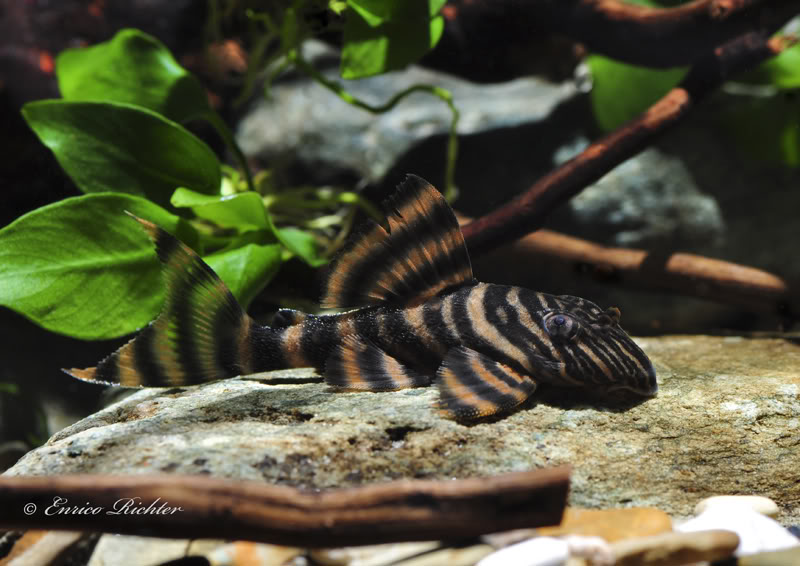
Max length120mm SL5in SLTank120 × 30cm48 × 12inTemp24–30°C75–86°FpH6.0–7.0Not difficult to maintain under the correct conditions; we strongly recommend keeping it in a tank designed to simulate a flowing stream with a substrate of variably-sized rocks, sand, fine gravel, and some water-worn boulders. This can be further furnished with driftwood branches, terracotta pipes, plant pots, etc., arranged to form a network of nooks, crannies, and shaded spots, thus providing broken lines of sight.
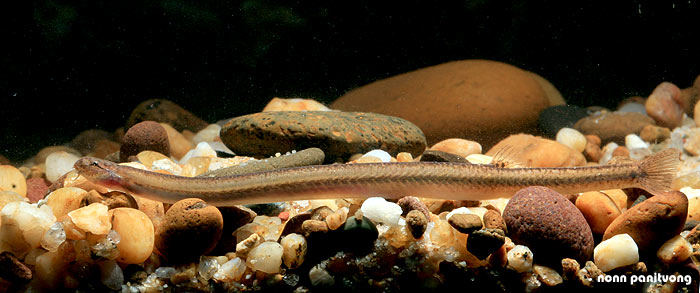
Pangio anguillaris
Vaillant, 1902
Max length120mm SL5in SLTank60 × 30cm24 × 12inTemp22–29°C72–84°FpH6.0–7.5One of a handful of Pangio spp. traded under the generic name 'eel loach'. Wild populations tend to differ in colour pattern to some extent, with some exhibiting a more intense lateral stripe while others display an irregular pattern of fine dark spots on the body, for example.
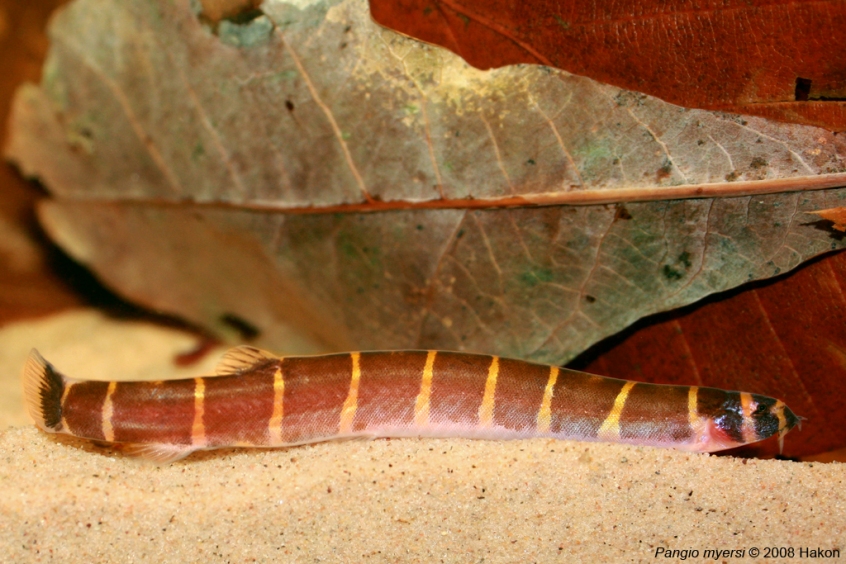
Pangio myersiGiant Kuhli Loach
Harry, 1949
Max length100mm SL3.9in SLTank60 × 30cm24 × 12inTemp21–26°C70–79°FpH3.5–7.0It's included in the P. kuhlii group of closely-related species and can be distinguished from other members by the following combination of characters: 8-11 very broad, quadrangular, regular dark body bars; orange base body colour; caudal-fin either entirely black or with a large black blotch at the base and a submarginal dark bar or row of spots. The latter feature can be useful in identifying young or newly-imported, undernourished specimens which can...
Paratilapia polleni
authority not recorded
Max length280mm SL11in SLTank120 × 45cm48 × 18inTemp17–28°C63–82°FpH6.5–8.0Now the only species in the genus Paratilapia, P. polleni is known as the "marakely" to many natives in Madagascar, which means "black fish". As with most Madagascan cichlid species, it is highly endangered in the wild due to habitat destruction and competition from introduced species and all attempts at captive breeding are to be encouraged. There is still some confusion as to the identity of the "true" P. polleni as there are both large and small-spotted forms...
Pareutropius buffeiThree Striped African Glass Catfish
authority not recorded
Max length80mm SL3.1in SLTank75 × 30cm30 × 12inTemp24–28°C75–82°FpH6.0–7.5Formerly known as Eutropiellus buffei, this midwater swimming, diurnal catfish is very often sold as "Debauwi catfish". Pareutropius debauwi is a closely related species which is, in fact, seldom imported. Adults of the two species can be distinguished by several characteristics. In buffei there are three lateral stripes along the body, whilst debauwi possesses only one. Buffei also has black spots in the upper and lower parts of the caudal fin, and the fin itself has rounded lobes. Th...
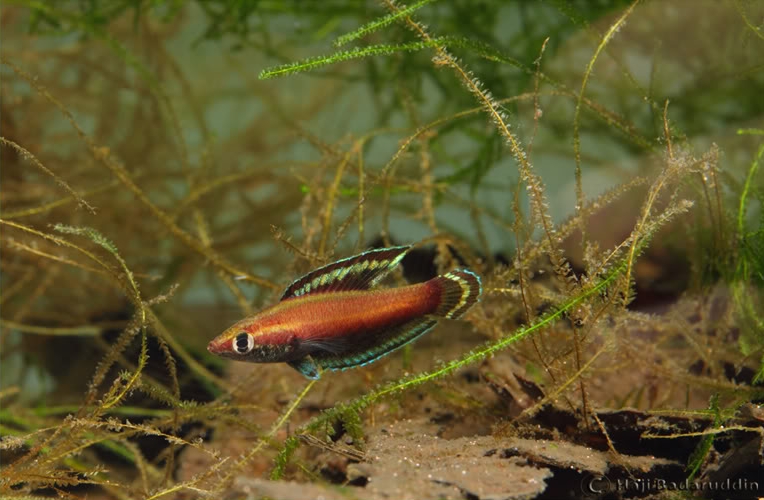
Parosphromenus nagyi
Schaller, 1985
Max length35mm SL1.4in SLTank40 × 20cm16 × 8inTemp22–28°C72–82°FpH3.0–6.5In males the dorsal, anal and caudal have a black subdistal band bordered on either side by bluish iridescent bands, with the inner one significantly thicker. The pelvic fins are iridescent emerald green with a dark blotch at the base and a subdistal dark spot, while the pectoral fins are hyaline.
Pelvicachromis subocellatusOcellated Kribensis
authority not recorded
Max length80mm SL3.1in SLTanknot recordedTemp22–26°C72–79°FpH5.5–7.5This is one of the less commonly seen Pelvicachromis species in the hobby. There are a few morphs available, including "Matadi" and "Moanda". Males and females of these should not be cross bred in order to keep the lines pure. It can be distinguished from others in the genus by it's higher, shorter body shape and by the fact that the spotting in the upper part of the is much lighter in this species than in others. A female condition is hard to confuse with anything else....
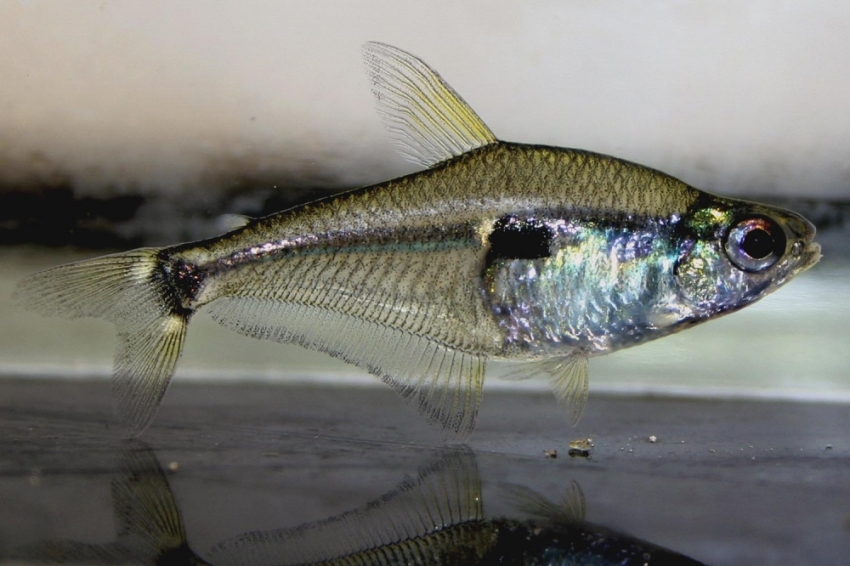
Phenacogaster tegatus
Eigenmann, 1911
Max length45mm SL1.8in SLTank60 × 30cm24 × 12inTemp20–28°C68–82°FpH6.0–7.5This species has been traded as 'six-eyed tetra' in reference to its colour pattern comprising two dark spots on each flank plus the eye. Based on the extensive review of the genus by Lucena and Malabarba (2010), in which nine new species were described, P. tegatus can be told apart from congeners by the following combination of characters: lateral line incomplete with 8-13 perforated scales; laterally elongate humera...
Potamotrygon henleiBlack Stingray
authority not recorded
Max length600mm SL24in SLTanknot recordedTemp23–28°C73–82°FpHnot recordedP. henlei is one of the more sought after ray species in the hobby due to its striking colours and impressive adult size. A fully grown one of these makes a stunning sight. Sadly exports from Brazil are now illegal under the IBAMA regulations, although captive bred fish are available occasionally. The price tends to be very expensive as a result. The species exists in various colour forms, with either white or yellow spots and a background colour varying between black and dark brown. The patt...
Potamotrygon leopoldiPolka Dot Stingray
authority not recorded
Max length600mm SL24in SLTank240 × 90cm96 × 36inTemp20–29°C68–84°FpH6.0–7.5P. leopoldi is aruably one of the most stunning freshwater species in the hobby and comes with a price tag to match. A fully grown one of these makes a jaw-dropping sight. Sadly exports from Brazil are now illegal under the IBAMA regulations, although captive bred fish are available occasionally. The price tends to be even more expensive as a result. A rare form in which the light spots appear as rings with black centres is known as P. leopoldi "eclipse" is more costly still. The stunn...
Potamotrygon sp. "itaituba"P14
authority not recorded
Max length400mm SL16in SLTank210 × 90cm84 × 36inTemp23–29°C73–84°FpH6.0–7.5This stunning fish is one of the more sought after rays in the hobby. Taxonomically it remains unclear whether it is a geographical variant of P. leopoldi or a distinct species. It has a smaller adult size and both pups (see section above) and adults exhibit different patterning than it's relative. In P. leopoldi the light spotted markings tend to be quite large, spaced out and do not extend to the edge of the disc. In P14 they are typically much smaller, more randomly distributed and prese...
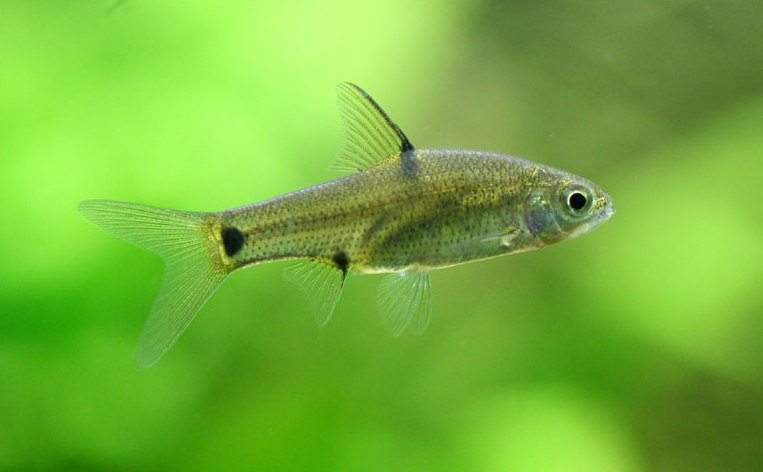
Puntius sharmai
Menon & Rema Devi, 1993
Max length40mm SL1.6in SLTank60 × 30cm24 × 12inTemp20–26°C68–79°FpH5.5–7.5This species is almost unheard of in the aquarium hobby outside of India but is maintained by some private collectors. It's distinguished from similar species by possessing a single pair of maxillary barbels, a relatively elongate body, and distinctive black spot above the anterior anal-fin base. The genus Puntius was for a number of years viewed as a polyphyletic catc...
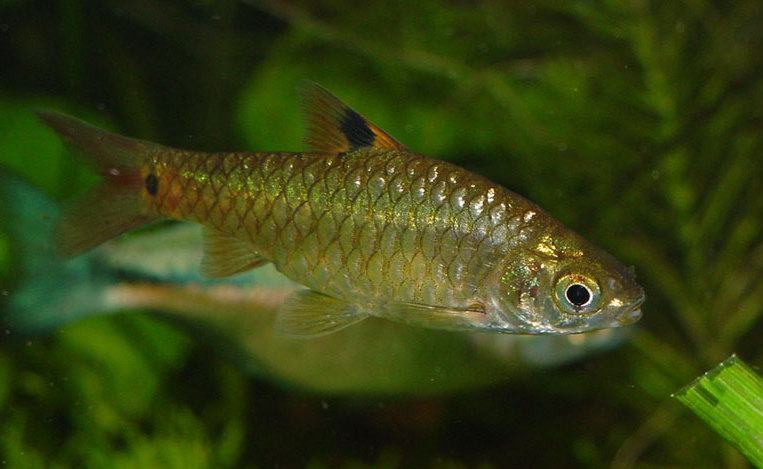
Puntius vittatusGreenstripe Barb
Day, 1865
Max length45mm SL1.8in SLTank75 × 30cm30 × 12inTemp18–26°C64–79°FpH6.0–7.5It can be told apart from similar-looking congeners such as P. crescentus and P. muzaffarpurensis by the following combination of characters: barbels absent; lateral line incomplete with up to 5 pored scales; 20-22 lateral line scales; 8 predorsal scales; dorsal-fin with a vertically-orientated black streak and a black tip with orange markings; a dark spot at the base of the caudal peduncle.
Rasbora cephalotaeniaPorthole Rasbora
authority not recorded
Max length130mm SL5in SLTank120 × 45cm48 × 18inTemp22–25°C72–77°FpHnot recordedThis species is not often exported which is a shame as it makes an elegant, peaceful resident of the larger community tank. It can be easily distinguished from similar-looking congeners such as R. einthovenii and R. jacobsoni by examining the dark lateral stripe that extends lengthways along the body of the fish as in R. cephalotaenia it is composed of a series of dark spots whereas in the other species it forms a continous solid line. Rainboth's 'Fishes of the Cambodian Mekong'...
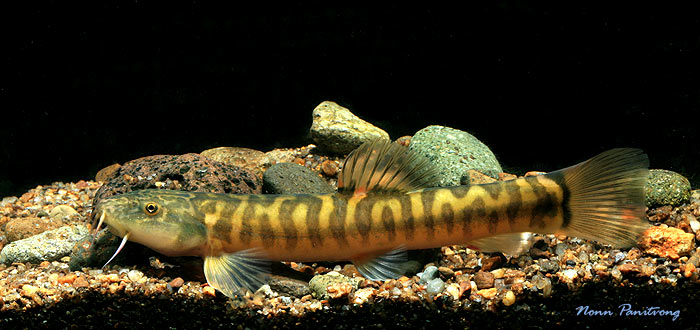
Schistura schultzi
Smith, 1945
Max length93mm SL3.7in SLTank120 × 30cm48 × 12inTemp16–24°C61–75°FpH6.0–8.0There appears to be some discrepancy between Smith's original description and Kottelat (1990) in that Smith states the fish is a member of a group of species lacking an ocellus at the upper caudal-fin base, whereas Kottelat mentions the presence of 'a black spot at upper extremity of caudal-fin base, surrounded by a whitish area'.