Results for “benthophagous”
Type a name: scientific, common, or one a species used to go by. Or narrow the catalogue with the filters.
Filters
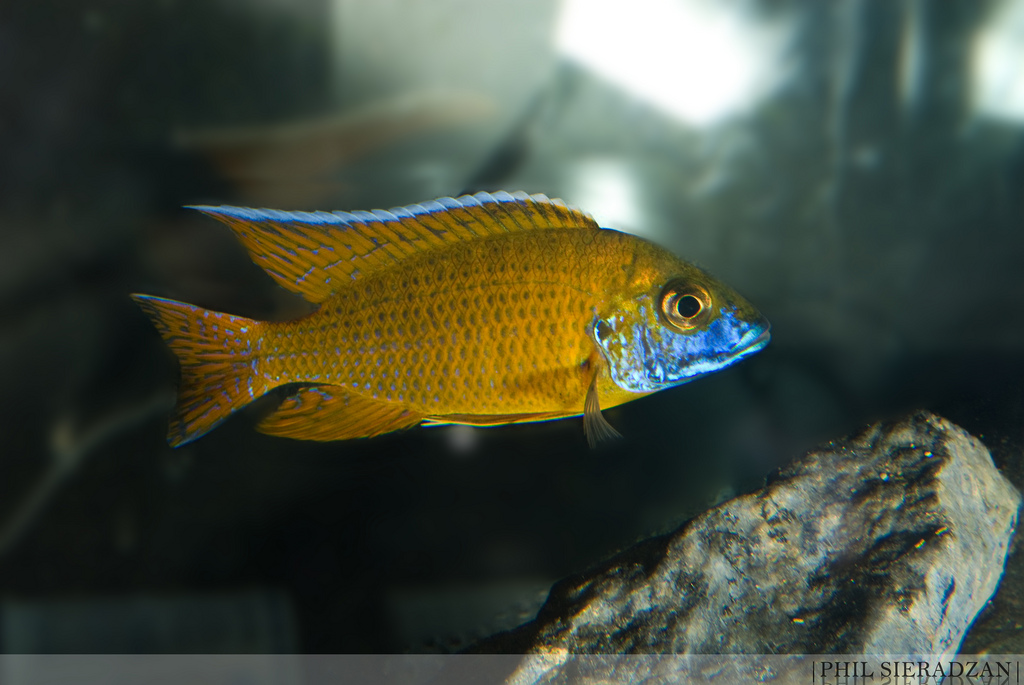
Aulonocara baenschiNew Yellow Regal Peacock
Meyer & Riehl, 1985
Max length♂ 120 · ♀ 90mm SL♂ 5 · ♀ 3.5in SLTank120 × 45cm48 × 18inTemp25–29°C77–84°FpH7.5–9.0This species may also be sold variously as 'yellow regal cichlid', 'Baensch's peacock', 'sunshine peacock' and 'Nkhomo-Benga peacock'. The easiest way to distinguish it from similar-looking congeners is to look at the profile of the snout, which is steeper and more curved than that of its congeners. Aulonocara spp. are benthophagous by nature employing a method of feeding whereby mouthfuls of substrate are taken and sifted for edible items with the remaining material expelled via the gills and mouth. They're equally-skilled at hunting as grazing, tending to hover above the substrate until tiny movements are detected, and possess enlarged sensory pores on the head which assist in this technique.
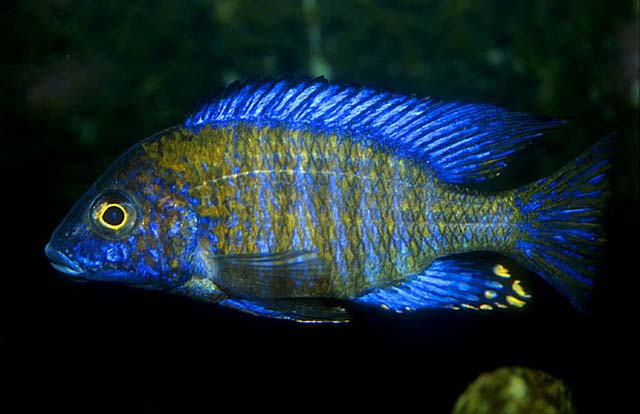
Aulonocara ethelwynnaeNorthern Aulonocara
Meyer, Riehl & Zetzsche, 1987
Max length110mm SL4in SLTank90 × 45cm36 × 18inTemp22–26°C72–79°FpH7.4–9.0Endemic to Lake Malawi where it was described from and only occurs around 'Chitendi Island', now normally referred to as Chitande island plus a short stretch of coastline between Ngara and Chilumba along the lake's northwestern shoreline. Aulonocara spp. are benthophagous by nature employing a method of feeding whereby mouthfuls of substrate are taken and sifted for edible items with the remaining material expelled via the gills and mouth. They're equally-skilled at hunting as grazing, tending to hover above the substrate until tiny movements are detected, and possess enlarged sensory pores on the head which assist in this technique.