Results for “natural selection”
Type a name: scientific, common, or one a species used to go by. Or narrow the catalogue with the filters.
Filters
Oreochromis mossambicusMozambique Mouthbrooder
authority not recorded
Max length390mm SL15in SLTank210 × 60cm84 × 24inTemp21–27°C70–81°FpH6.2–8.5One of the most invasive fish species in the world, O. mossambicus is one of the species farmed for supermarkets and restaurants across the globe. Several colour varieties have been selectively bred from the natural green fish to make the fish more appealing to consumers and unsurprisingly, it is these more brightly coloured forms which are usually seen in aquaria. Some of these variants are cross breeds with other species of Oreochromis. The destructive effect of O. mossambicus on non-nativ...
Trichogaster labiosaThick-lipped Gourami
authority not recorded
Max length100mm SL3.9in SLTank74 × 30cm29 × 12inTemp22–27°C72–81°FpH6.0–7.5Despite its ease of keeping and peaceable nature, this species is not particularly popular in the hobby, although it is imported quite regularly. A gold or 'sunset' strain exists, in which the barred patterning is replaced by an overall orange/gold colouration. This is not a natural variation, but has been selectively bred for the trade. The female of this form is almost as colourful as the male. Like others in the suborder Anabantoidei, the species possesses an accessory breathing...
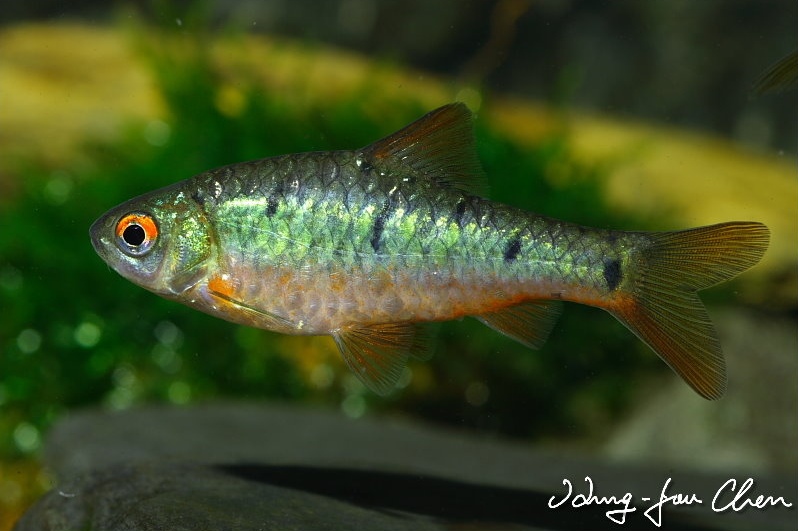
Barbodes semifasciolatusGolden Barb*
Günther, 1868
Max length75mm SL3.0in SLTank90 × 30cm36 × 12inTemp16–24°C61–75°FpH6.0–8.0This species is also known by the alternative names 'green' or 'Chinese' barb. The natural 'green' form is an infrequent find in the aquarium trade whereas the selectively-bred 'golden' variant is farmed in huge numbers and is among the most popular of freshwater aquarium fish. The latter was first produced in the 1960s and is now so ubiquitous that many hobbyists are initially unaware that it is not the natural form.
Catoprion mentoWimpel Piranha
authority not recorded
Max length150mm SL6in SLTank120 × 38cm48 × 15inTemp23–26°C73–79°FpH5.8–6.5This species is not actually a piranha in ichthyologic terms, being monotypic and therefore unique. It was so named due to its general resemblance to true piranha, and the fact that it is quite closely related to Pygocentrus species. Mento means "chin", referring to the protruding jaw of the fish. This jaw structure, along with the adapted teeth, is used in its natural feeding behaviour. It has been observed to swim at great speed into a selected target, biting hard as it collides w...
Trichopodus trichopterusThree-spot Gourami
authority not recorded
Max length150mm SL6in SLTank90 × 30cm36 × 12inTemp24–30°C75–86°FpH5.5–8.5This species is available in many different colour forms and varieties, all of which have been selectively bred for the aquarium trade. These are seen much more often than the natural form, which is the blue-grey three spotted fish. They include gold, opaline, cosby, marbled and silver forms. T. trichopterus is one of the hardiest fish commonly available in the trade and can adapt to many different water conditions. However it is recommended to the beginner with reservations regarding it's ...
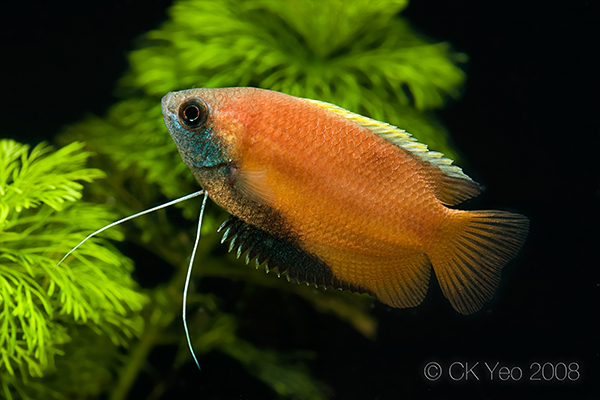
Trichogaster chunaHoney Gourami
Hamilton, 1822
Max length55mm SL2.2in SLTank60 × 30cm24 × 12inTemp22–27°C72–81°FpH6.0–7.5This species is readily available in the aquarium trade and is a good subject for those new to the hobby given its peaceable nature and relative adaptability in terms of water chemistry. It's sold under various names including A number of selectively-bred ornamental strains have also been produced including 'red', 'sunset', and 'golden', for which care is identical to the natural form.
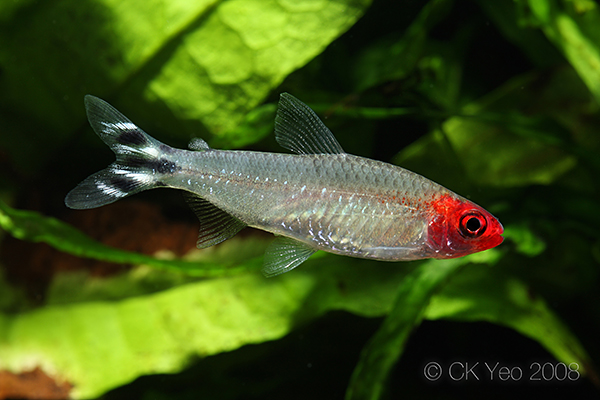
Hemigrammus bleheriFirehead Tetra
authority not recorded
Max length50mm SL2.0in SLTanknot recordedTemp23–26°C73–79°FpH5.5–7.0This is the species most commonly sold as 'rummy-nose tetra' in aquatic outlets. A selectively-bred "golden" variant has also been produced by commercial breeders and is available from time-to-time. The natural form is very similar to both the "true" rummy-nose, Hemigrammus rhodostomus and the 'false' rummy-nose, Petitella georgiae in appearance. The 3 species can distinguished by several factors. The first is by the extent to which the red colouration...