Results for “scale count”
Type a name: scientific, common, or one a species used to go by. Or narrow the catalogue with the filters.
Filters
Scleropages leichardtiSpotted Australian Arowana
authority not recorded
Max length900mm SL35in SLTank180 × 60cm72 × 24inTempnot recordedpH6.8–7.5Although S. leichardtii superficially resembles its Asian cousins, it is not considered as desirable an aquarium inhabitant, nor is it classed as being at risk in nature. It can be easily distinguished from the asian species by its much smaller scale size, greater lateral scale count (32-35 as opposed to 21-25 in the asian aros) and duller patterning. It differs from its Australian relative S. jardinii by its spotted scales, forward-pointing barbels, lack of sloping head and unpatterned gill cov...
Scleropages jardiniiAustralian Arowana
authority not recorded
Max length900mm SL35in SLTank180 × 60cm72 × 24inTemp24–29°C75–84°FpH6.8–7.5Although S. jardinii superficially resembles its Asian cousins, it is not considered as desirable an aquarium inhabitant, nor is it classed as being at risk in nature. It can be easily distinguished from the asian species by its much smaller scale size, greater lateral scale count (32-35 as opposed to 21-25 in the asian aros) and duller patterning. It differs from its Australian relative S. leichardtii by its more sloping head, downward-pointing barbels and patterned gill covers. The base colour...
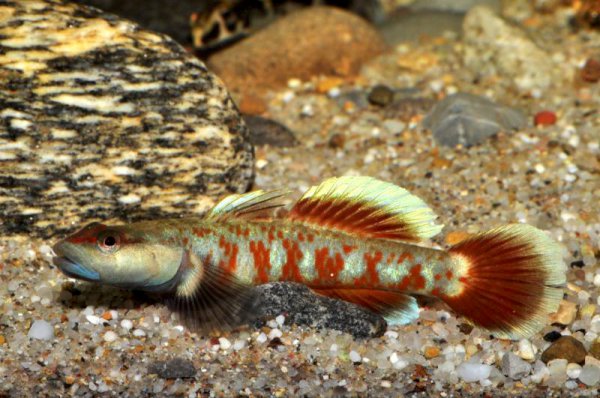
Rhinogobius zhoui
Li & Zhong, 2009
Max length36mm SL1.4in SLTank60 × 30cm24 × 12inTemp19–24°C66–75°FpH7.0–7.8This species has been in the aquarium trade since 2010 and is sold under several names including 'Chinese vermilion goby', 'Zhou's scarlet goby', 'scarlet goby', and 'flame goby'. It can be told apart from congeners by the following combination of characters: second dorsal-fin rays I, 8-9; anal-fin rays I, 7-8; pectoral-fin rays 16-18; longitudinal scale series 29-31; predorsal scales 10-12; vertebral count 10+16=26.
Osphronemus goramyGiant Gourami
authority not recorded
Max length700mm SL28in SLTank183 × 61cm72 × 24inTemp20–30°C68–86°FpH6.5–8.0An incredibly hardy, long-lived fish which can survive for over 20 years in captivity. These fish develop real personality and can learn to recognise their owner. They are often sold as cute juveniles in aquatic shops with no information provided as to their adult size. The young have an attractive barred patterning which fades as the fish grow, which they do very quickly. A golden variety also exists in aquaria. O. goramy is cultured commercially for food on a large scale in several countrie...
Colossoma macropomumBlack Pacu
authority not recorded
Max length600mm SL24in SLTank300 × 90cm118 × 36inTemp22–28°C72–82°FpH5.5–7.5Known as the tambaqui in its native countries, this is the second largest species of scaled fish found in the Amazon basin. This alone should tell you much of what you need to know about its suitability as an aquarium inhabitant. In reality, it's debatable as to whether the species should be considered an aquarium subject at all. While pacu rarely reach their maximum size in captivity, they're still easily capable of growing to a couple of feet in length. The myth that fish will only g...
Piaractus brachypomusRed-bellied Pacu
authority not recorded
Max length880mm SL35in SLTank300 × 90cm118 × 36inTemp23–28°C73–82°FpH4.8–7.5Know as the pirapitinga in its native countries, this is the one of the largest species of scaled fish found in the Amazon basin. This alone should tell you much of what you need to know about its suitability as an aquarium inhabitant. In reality it's debatable as to whether the species should be considered an aquarium subject at all. While pacu rarely reach their maximum size in captivity, they're still easily capable of growing to a couple of feet in length. The myth that fish will o...
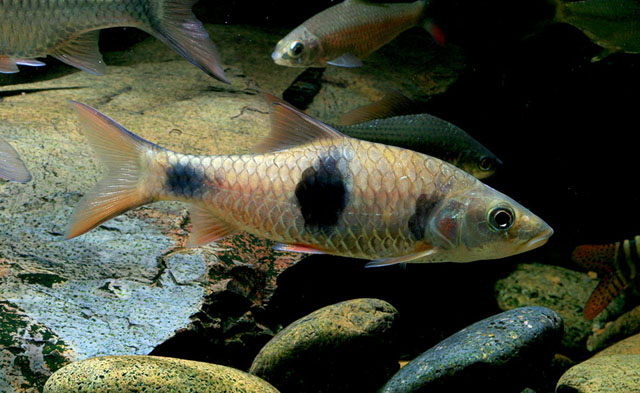
Hampala salweenensis
Doi & Taki, 1994
Max length201mm SL8in SLTank240 × 60cm96 × 24inTemp20–26°C68–79°FpH6.0–8.0This species is poorly-known in the aquarium hobby and may have never been maintained outside its native countries. It can be distinguished from congeners by the following combination of characters: 26-27 lateral line scales; two roundish, dark blotches on each flank, one beneath dorsal-fin origin and above the lateral line, the other on the caudal peduncle and passing thro...
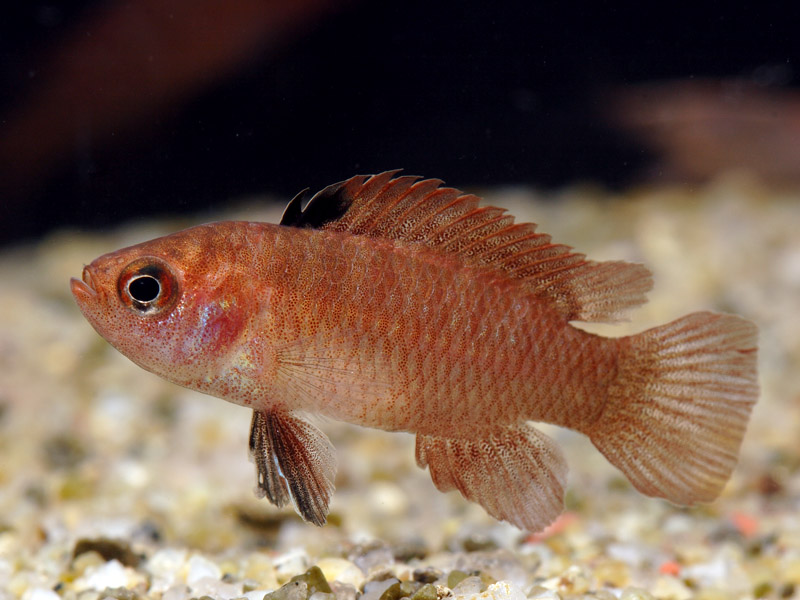
Dario hysginon
Kullander & Britz, 2002
Max length20mm SL0.8in SLTank45 × 30cm18 × 12inTemp20–24°C68–75°FpH6.5–7.5This species is traded under various names such as 'red melon Dario' or 'flame red Dario'. Among congeners D. dayingensis is most similar since it differs only in a few meristic counts and by its slightly larger adult size. D. hysginon can be told apart by possessing 22-24, usually 23, lateral scales (vs. 24-25 in D. dayingensis), 8½ (vs. 9½) scales in the transverse scale row, a...