Results for “scientific name”
Type a name: scientific, common, or one a species used to go by. Or narrow the catalogue with the filters.
Filters
Melanotaenia trifasciataBanded Rainbowfish
authority not recorded
Max length150mm SL6in SLTank120 × 30cm48 × 12inTemp24–33°C75–91°FpH6.5–8.0M. trifasciata exhibits a wide variation in colour and patterning depending on locality, and it's very important that the different morphs are not mixed in the aquarium, as they will hybridise freely. These different forms are often distinguished by the addition of the name of collection locality being added to the scientific name of the fish. It's thought that several species may in fact be in evidence here, and a reclassification will probably occur at some point As with many othe...
Megalodoras uranoscopusGiant Raphael Catfish
authority not recorded
Max length700mm SL28in SLTank240 × 120cm96 × 48inTemp21.1–25°C70–77°FpHnot recordedThis species is also known by the vernacular name "ripsaw catfish" (U.S.) and was often referred to by the scientific name M. irwini, now considered a junior synonym of M. uranoscopus, in older literature. Within the family Doradidae the genus Megalodoras is considered most closely-related to Lithodoras, Centrodoras and Platydoras, respectively. Members of the family Doradidae can be distinguished from all other Siluriformes by possession of a unique infranuchal scute, a dermal bon...
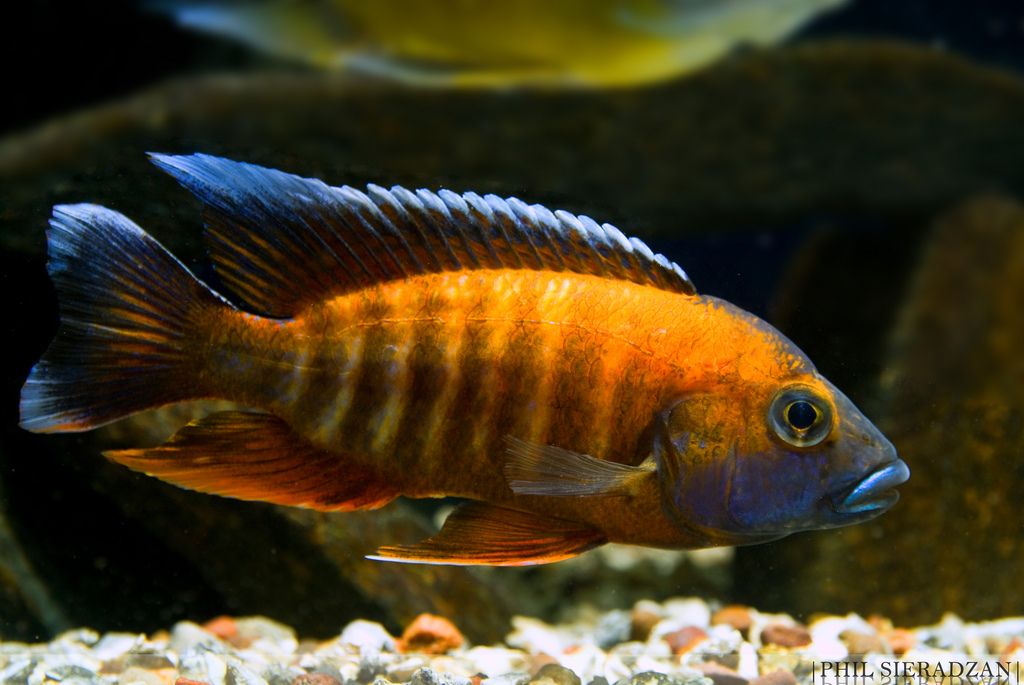
Aulonocara jacobfreibergiMalawi Butterfly
Johnson, 1974
Max length170mm SL7in SLTank120 × 60cm48 × 24inTemp25–29°C77–84°FpH7.5–9.0This was one of the first Aulonocara spp. to enter the hobby and its popularity has endured. It's known by several other vernacular names including 'Freiberg's peacock', 'fairy cichlid' and 'African butterfly' as well as the erroneous 'scientific' names Trematocranus trevori, T. jacobfreigbergi and T. regina. A naturally-occurring, yellowish form from Undu reef, Tanzania is often referred to as 'lemon jake'. It can be told apart from most other members of the genus by the broad, pale distal margins in the dorsal, anal and caudal fins, more deeply-forked caudal fin and larger adult size.
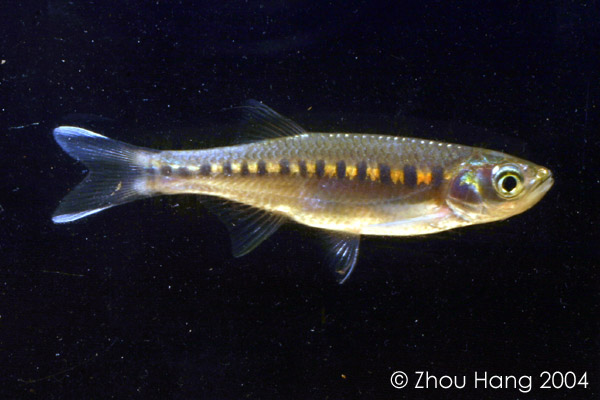
Luciosoma spilopleura
Bleeker, 1855
Max length82mm SL3.2in SLTanknot recordedTempnot recordedpHnot recordedThis species is poorly known in general and is not present in the ornamental trade, although its name is widely misapplied to other Luciosoma species. Its congeners are mostly marketed as 'apollo shark', 'shark minnow', or similar, and often labelled with incorrect scientific names. Identification of the fish pictured here is based on Bleeker (1855, 1860) and Roberts (1989), plus drawings by Bleeker, thus...
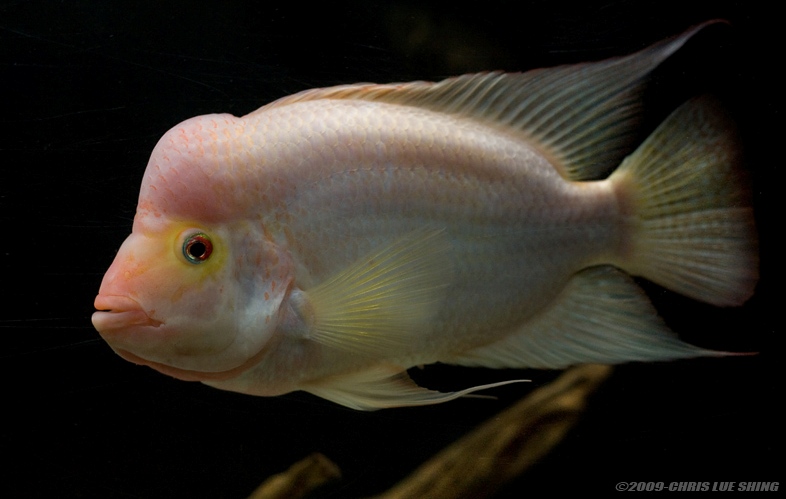
Amphilophus citrinellusMidas Cichlid
Günther, 1864
Max length350mm SL14in SLTanknot recordedTemp21–26°C70–79°FpH6.0–8.0Previously included as a member of the genus Cichlasoma, the midas cichlid is often confused with the red devil, A. labiatus. The two can be distinguished through differences in morphology. As suggested by its scientific name, A. labiatus often possesses characteristically large lips, although this is variable and should not be used as a defining indicator of species. More reliable differences include the bigger nuchal hump and more thick-set appearance in A. citrinellus. The midas exists in many n...
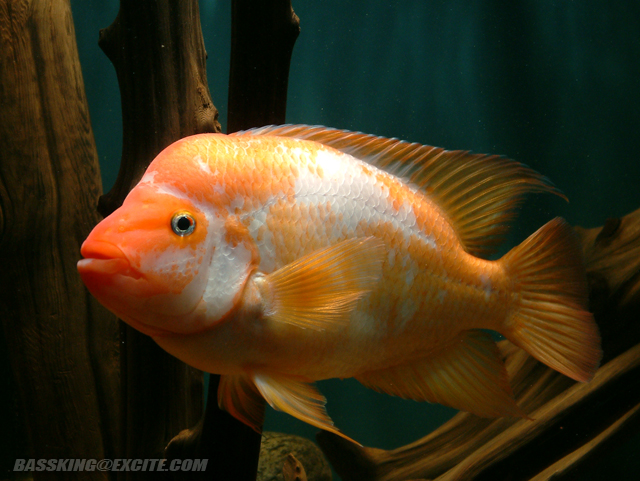
Amphilophus labiatusRed Devil Cichlid
Günther, 1864
Max length350mm SL14in SLTanknot recordedTemp21–26°C70–79°FpH6.0–8.0Previously included as a member of the genus Cichlasoma, the red devil is often confused with the midas cichlid, A. citrinellus. The two can be distinguished through differences in morphology. As suggested by its scientific name, A. labiatus possesses characteristically large lips, although in reality this is variable and should not be used as a defining indicator of species. Certainly, tank bred fish tend not to have these large lips. More reliable differences include the bigger nuchal hump and mo...
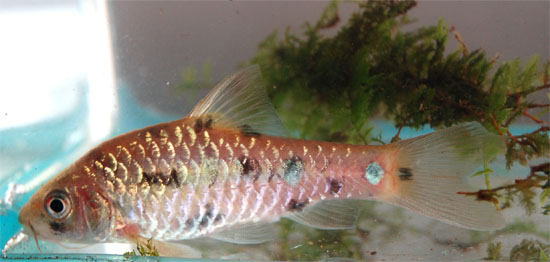
Barbodes everetti
Boulenger, 1894
Max length120mm SL5in SLTank120 × 45cm48 × 18inTemp18–28°C64–82°FpH6.0–7.0This species is uncommon in the aquarium hobby, although the scientific name is widely misapplied to Barbodes dunckeri, a similar-looking species native to Peninsular Malaysia and Singapore commonly referred to as 'clown barb' and labelled as B. everetti in the majority of available literature. The two are quite easy to tell apart, with B. everetti an overall less...
Haplochromis latifasciatus
authority not recorded
Max length125mm SL5in SLTank120 × 30cm48 × 12inTemp23–28°C73–82°FpH7.2–8.2This beautiful species is critically endangered in nature but is not that rare in the hobby being quite easily bred. Many sources refer to it by the invalid scientific name Astatotilapia latifasciata and may also be seen for sale as Haplochromis sp. "zebra obliquidens" or H. obliquidens. Sadly it's thought that the latter fish has never even been exported and is extinct in nature. Furthermore, H. obliquidens is a Victorian species and does not even inhabit the same lake as H. l...
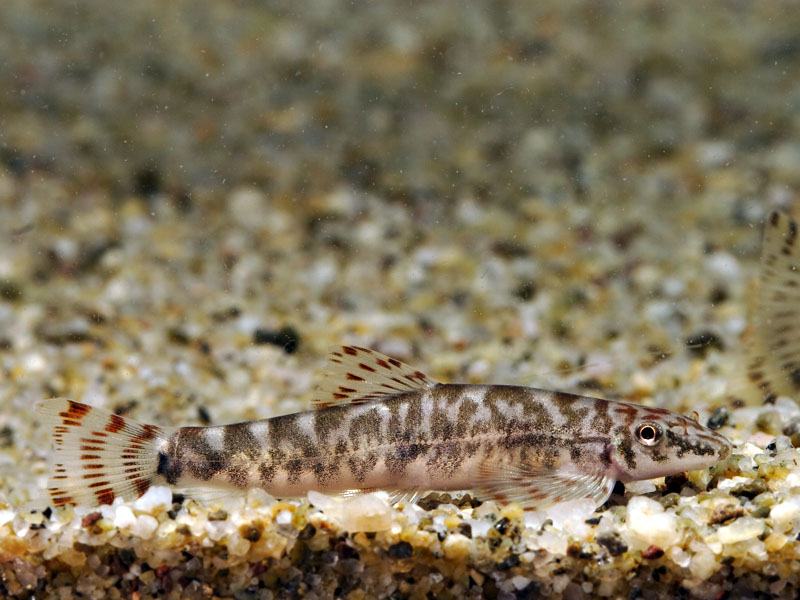
Liniparhomaloptera disparisBroken-band Hillstream Loach
Lin, 1934
Max length80mm SL3.1in SLTank80 × 30cm31 × 12inTemp20–24°C68–75°FpH6.5–8.0L. disparis is sometimes available as bycatch among shipments of other species such as Rhinogobius duospilus but also appears on trade lists under the fictitious scientific name 'Homaloptera hoffmani'. It can be told apart from similar-looking members of the genus Formosania by its noticeably shorter barbels and from Vanmanenia spp. by the fact that the rostral fold is not lobed and the mouth is relatively small (25% head width. In addition the lower lip in Liniparhomaloptera is not divided and has a flat, papillated edge.
Nanochromis transvestitus
authority not recorded
Max length70mm SL2.8in SLTanknot recordedTemp24–27°C75–81°FpH4.0–7.0One of our favourite dwarf cichlids, N. transvestitus is a truly stunning fish when in good condition. However, it is not recommended to the beginner due to its very specific water requirements. The scientific name is derived from the fact that the female is the more colourful fish, making it something of an oddity....
Otopharynx lithobatesSulphur-headed Hap
authority not recorded
Max length160mm SL6in SLTank90 × 45cm36 × 18inTemp24–28°C75–82°FpH7.6–8.8O. lithobates is a true rock dweller and is hardly ever seen in open water, even in aquaria. In fact, the scientific name lithobates literally translates as "rock dweller". Breeding males of this species rank among the most stunning of Lake Malawi Haplochromine cichlids. The three characteristic spots on the flanks disappear and are masked by a stunning neon blue patterning. Almost the entireand top of the head turn a deep yellow-orange colour. The most colourful variant is the "...
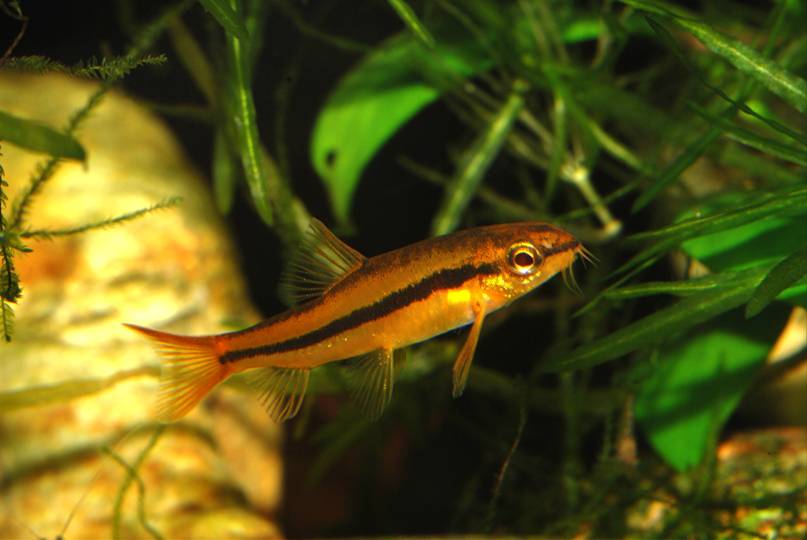
Petruichthys sp. 'rosy'Rosy Loach
authority not recorded
Max length30mm SL1.2in SLTank60 × 30cm24 × 12inTemp20–26°C68–79°FpH6.5–8.0This species continues to be referred to by the fictitious scientific name 'Tuberoschistura arakensis' but actually appears to be an undescribed Yunnanilus sp. and is also sometimes traded as Y. sp. 'orange' or 'Burmese pink loach' but appears to be a member of the genus Petruichthys as per Kottelat (2012). There exist more than 30 described Yunnanilus spp., the...
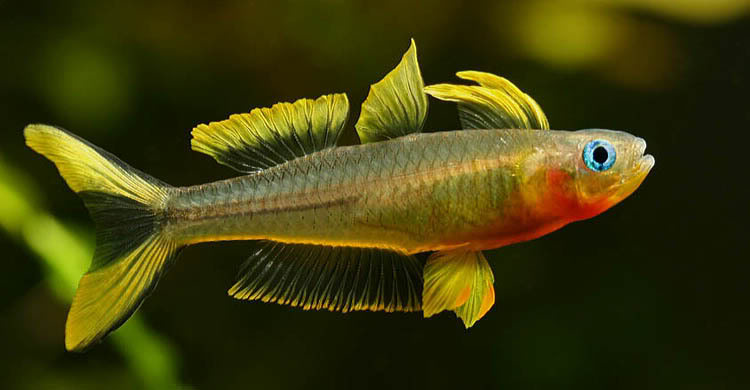
Pseudomugil furcatusForktail Blue-eye
Nichols, 1955
Max length60mm SL2.4in SLTank60 × 30cm24 × 12inTemp24–28°C75–82°FpH7.0–8.0This species is also traded as 'forktail rainbowfish' or 'yellow forktail', and it's also undergone several changes in scientific name since description. Pseudomugil furcatus is the original designation, but Allen (1980) created the genus Popondetta for it on the basis of morphological characters including number of anal-fin rays (16-20 in P. furcatus, 8-12 in other Pseudomugil spp.), absence of anterior...
Synodontis nigriventrisUpside-down Catfish
authority not recorded
Max length100mm SL3.9in SLTanknot recordedTemp24–28°C75–82°FpH6.0–7.5One of the commonest Synos seen for sale, S. nigriventris is occasionally confused with S. contractus. However, on close inspection the species are easy to tell apart as S. nigriventris lacks the large head and mouth and larger eye of S. contractus. The scientific name nigriventris refers to the fact that the belly of this fish is darker than the dorsal area. This is a form of camouflage, making the fish harder to spot by predators above, such as predatory fish, birds etc. It is a basic re...
Hemiancistrus guahiborumL106
authority not recorded
Max length150mm SL6in SLTank120 × 30cm48 × 12inTemp22–26°C72–79°FpH6.0–7.5This species was only described to science in 2005, the species name being taken from the name of a local tribe. It's also known as the spotted orange seam plec, due to its patterning. It's found living alongside other Loricariid species in nature, including Peckoltia and other Hemiancistrus species. There's ongoing discussion as to whether this species and the currently undescribed L122 are one and the same, as these two were apparently both included in the scientific description...