Results for “streaked”
Type a name: scientific, common, or one a species used to go by. Or narrow the catalogue with the filters.
Filters
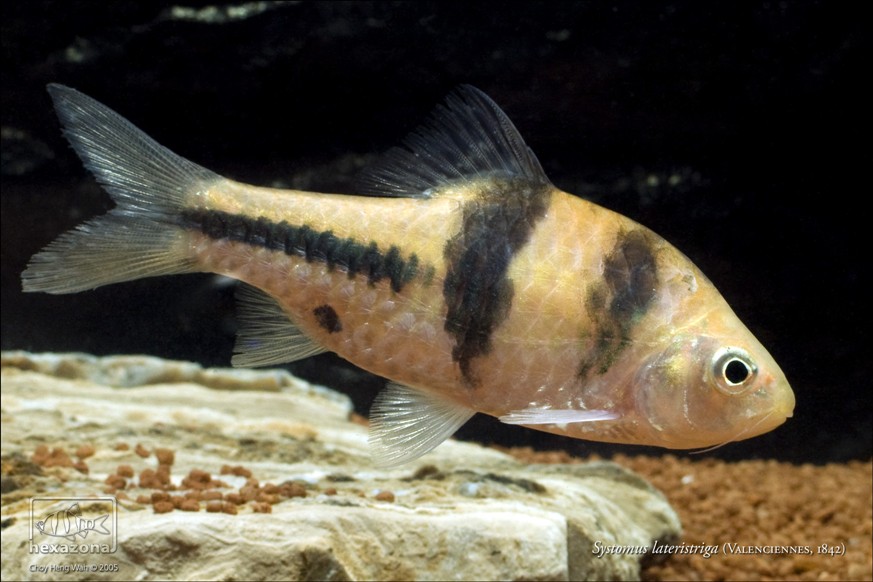
Barbodes lateristrigaSpanner Barb
Valenciennes, 1842
Max length150mm SL6in SLTank150 × 45cm60 × 18inTemp20–28°C68–82°FpH6.0–8.0This species is commonly-referred to as 'T-barb' in some countries. It's closely-affiliated with and sometimes traded as the congener B. kuchingensis but that species can be told apart by colour pattern comprising a prominent row of dark spots along the lateral line, plus a short, horizontally-orientated streak extending from the upper part of the operculum. In B. lateristriga the lateral markings usually form a solid stripe and there is no streak extending from the operculum.
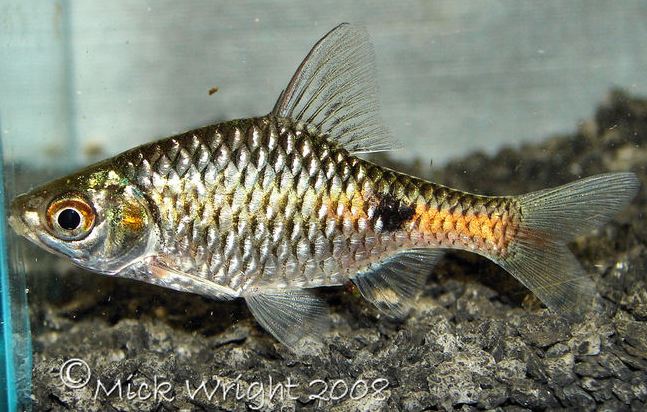
Puntius terioOnespot Barb
Hamilton, 1822
Max length90mm SL3.5in SLTank80 × 30cm31 × 12inTemp18–26°C64–79°FpH6.5–7.5This species is uncommon in the aquarium trade which is a little surprising given its huge natural range. Different populations can vary in colour pattern to an extent though all share the defining aspects given by Hamilton, comprising a diffuse yellow-golden marking on the operculum plus a dark spot on the caudal peduncle. The latter is usually surrounded by a variably-sized golden-yellow margin, and the dorsal-fin often contains irregular dark spots and streaks, these sometimes forming a longitudinal band.
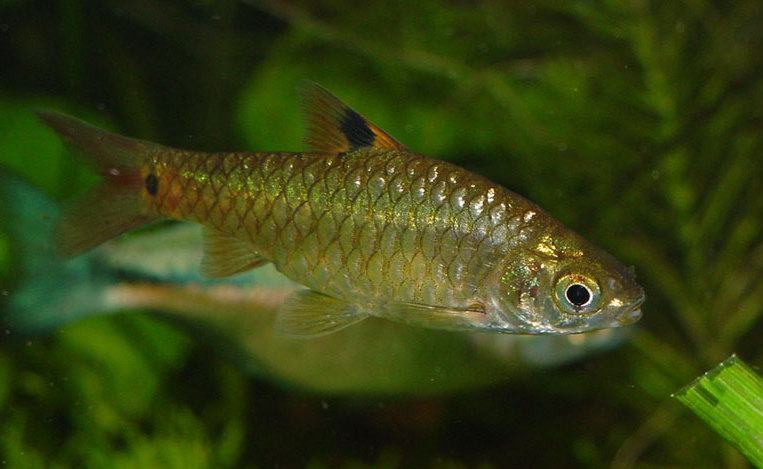
Puntius vittatusGreenstripe Barb
Day, 1865
Max length45mm SL1.8in SLTank75 × 30cm30 × 12inTemp18–26°C64–79°FpH6.0–7.5It can be told apart from similar-looking congeners such as P. crescentus and P. muzaffarpurensis by the following combination of characters: barbels absent; lateral line incomplete with up to 5 pored scales; 20-22 lateral line scales; 8 predorsal scales; dorsal-fin with a vertically-orientated black streak and a black tip with orange markings; a dark spot at the base of the caudal peduncle.