Andinoacara pulcher
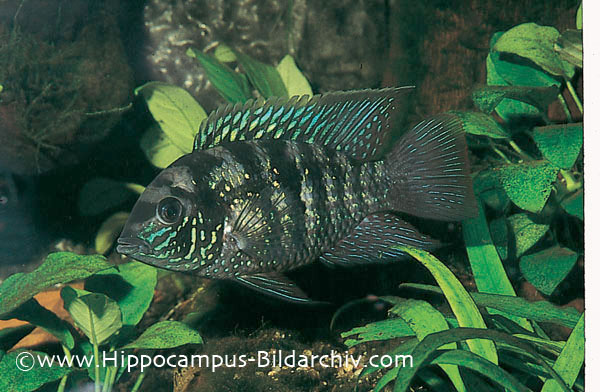
Blue Acara · Blaupunktbuntbarsch
Formerly Cychlasoma pulchrum Gill, 1858
On this page12 sections
Quick facts
Difficulty3 of 6 measures
More bars, more demanding.
- Space
- large tank
- Water
- tap water
- Temp
- unfussy
- Temperament
- unknown
- Social
- unknown
- Compatibility
- unknown
This species was previously known as 'Aequidens' pulcher but has been considered s member of the genus Andinoacara since 2009.
Etymology
Andinoacara: named for the Andes mountain chain in South America, around which members of this genus are distributed, in combination with acará, the Tupí-Guaraní word for cichlids.
pulcher: Latin adjective meaning 'beautiful, pretty', presumably in reference to this species' attractive colour pattern.
Distribution
Native to Trinidad and Tobago plus parts of Venezuela, and has been introduced in various other countries.
Habitat
An adaptable species that occupies a variety of habitats in nature, from murky still waters through to flowing clearwater streams and rivers.
Aquarium size
An aquarium with base measurements of 120 cm x 30 cm or equivalent is just about sufficient to house a pair.
Maintenance
The tank should ideally be furnished with a soft, sandy substrate and driftwood branches. Floating plants to provide shade are also a good idea, but rooted plants are less so, as this fish is an avid digger. Species that can be attached to decor, such as Anubias or java fern stand a much better chance of survival. The blue acara can be quite sensitive to deteriorating water quality so employ an efficient biological filter, along with a stringent maintenance regime.
Water conditions
Diet
Mainly carnivorous, so offer meaty fare such as bloodoworm, brine shrimp, chopped mussel or prawn and earthworms. Most dried foods are also accepted.
These boxes carry affiliate links and we may earn a commission. What they recommend comes from each profile’s own figures, never chosen by hand or paid for.
Behaviour and compatibility
Peaceful for a cichlid of this size, and can be combined with other species that are too large to swallow. Good tankmates include medium-sized characins, catfishes such as Corydoras spp., Loricariids and, in a big enough tank, other relatively peaceful cichlids.
Sexual dimorphism
Reproduction
One of the easiest substrate spawning cichlids to breed in the hobby. The best way to obtain a pair is to buy 6 young fish and allow them to grow and pair off naturally. Once a pair forms it is wise to remove the other fish unless the tank is very large. The aquarium should be set up as suggested above with slightly soft and acidic water of pH 6.5-7.0 and a temperature of 25 – 28 °C77 – 82 °F. It is best to use air-powered filtration as fry may be sucked up by power filters. Lots of flat stones and broad-leaved plants, such as Echinodorus sp. will provide potential spawning sites.
Feed the fish lots of live and frozen foods to bring them into condition. The pair will choose and then thoroughly clean a spawning site within their territory. This may be a flat rock, broad plant leaf or a pit excavated from the substrate. Spawning occurs in a similar fashion to many other cichlids, with the female laying a line of eggs before moving away, allowing the male to take her place and fertilise them. Up to 200 eggs may be fertilised in this manner.
The eggs hatch in around 48-72 hours, and during this period the male will defend the spawning site while the female tends to the eggs. Some role swapping may occur here. The fry become free swimming after another 72 hours or so and at this point they can be fed microworm and/or brine shrimp nauplii. Brood care by the parents usually continues for about 2 weeks, after which they may spawn again.
Notes
A wonderful beginner's cichlid, the Blue Acara has been a mainstay of the aquarium hobby for many years. Unfortunately most of the fish we see in the hobby today are pale imitations of the wild caught fish, as captive breeding has narrowed the gene pool. Some of the fish available are also known to be hybrids with other related species.
This species was previously known as 'Aequidens' pulcher but has been considered s member of the genus Andinoacara since 2009.
Species images · 3
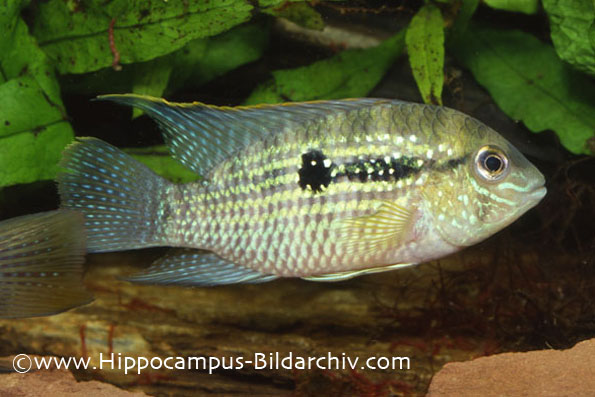
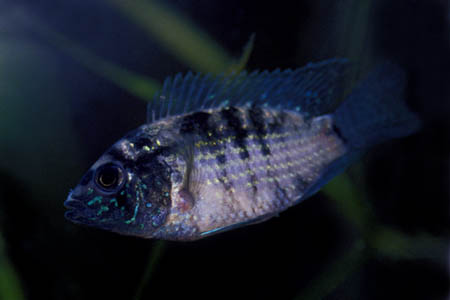
Used with the photographer’s permission. Not licensed for reuse.
Distribution
Profile completeness18 of 24
75% complete
Missing: aquarium size, references, temperament, social needs, community suitability, water condition notes.