Aulonocara maylandi
Sulphurhead Peacock
Last revised 2026Edit this page
On this page12 sections
Quick factsEdit
Difficulty6 of 8 measures
- Space
- large tank
- Water
- flexible
- Temp
- needs a steady temperature
- Diet
- unknown
- Temperament
- unknown
- Social
- needs to be in a group
- Compatibility
- fine with others
Other demands
Each of these can raise the rating on its own, whatever the measures above say.
- Hardiness
- needs a well-established tank
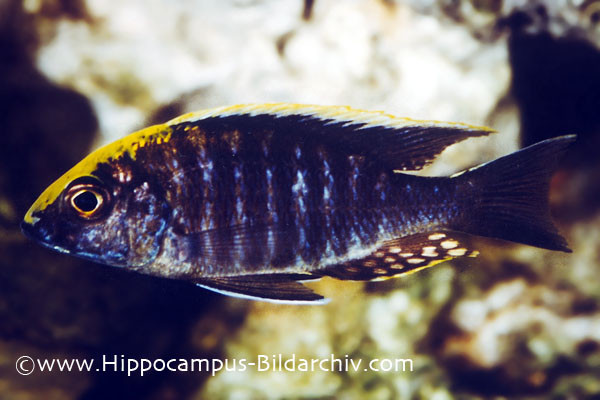
The sulphurhead peacock, Aulonocara maylandi, is a cichlid endemic to Lake Malawi, where it occurs in two principal colour forms. Males from West Reef and Eccles Reef, in the southeast of the lake, carry a bright yellow band from the snout along the back and dorsal-fin margin. At Kande Island, off the central-western shore, the stripe is whitish and both sexes have an enlarged lower pharyngeal bone. That population was described as A. maylandi kandeensis, a name still widely used in the hobby.
Distribution
EditEndemic to Lake Malawi where there exist two principal colour forms. The 'sulphur head' variant inhabits West Reef and Eccles Reef, close to Makanjila Point in the southeastern part of the lake, while the form often referred to by the subspecific name A. m. kandeensis is known only from Kande Island, just off the central-western shoreline. See the 'notes' section for more information on the differences between these populations and why we include them together here.
Habitat
Write a noteEditInhabits the so-called intermediate zones of the lake, where rocky shores give way to sandy bottoms with scattered rocks. The population at Kande Island occurs in water around 10 metres deep with nuptial males forming their territories at the point where rocks and sand meet, and females swimming in foraging groups over sand.
Aquarium size
Write a noteEditMinimum base dimensions of 120 ∗ 30 cm48 ∗ 12 in or equivalent are recommended unless keeping the fish in smaller aquaria for breeding purposes.
Maintenance
Write a noteEditArrange some piles of rockwork around the tank but leave some open spaces between them and use fine sand as substrate so that it's able to feed naturally (see 'diet'). Coarser options such as gravel or small pebbles can inhibit feeding, damage gill filaments and even be ingested with the potential of internal damage/blockages. It will not harm plants so hard water-tolerant species such as Vallisneria, Anubias or Sagittaria species can be added if you wish. Water quality is of the utmost importance since these cichlids are extremely susceptible to deteriorating water quality/swings in chemical parameters and should never be introduced to a biologically immature aquarium. The best way to achieve the desired stability is to over-filter the tank using a combination of canister filters and/or a sump system, and perform minimum weekly water changes of 30-50%.
Water conditions
EditThese recommendations come from this profile’s own figures. They contain affiliate links, so we may earn a commission.
Diet
Write a noteEditAulonocara spp. are benthophagous by nature, employing a method of feeding whereby mouthfuls of substrate are taken and sifted for edible items with the remaining material expelled via the gills and mouth. They're equally-skilled at hunting as grazing, tending to hover above the substrate until tiny movements are detected, and possess enlarged sensory pores on the head which assist in this technique.
The captive diet should contain a variety of high quality, fine-grade prepared foods plus small live and/or frozen chironomid larvae, Tubifex, Artemia, mosquito larvae, etc.. At least some of the dried products should contain a high proportion of vegetable matter such as Spirulina or similar.
Home-made, gelatine-bound recipes containing a mixture of dried fish food, puréed shellfish, fresh fruit and vegetables, for example, can also work well and can be cut into bite-sized discs using the end of a sharp pipette or small knife. Rather than a single large meal offer 3-4 smaller portions daily to allow natural browsing behaviour as this seems to result in the best growth rate and condition.
Behaviour and compatibility
Write a noteEditAmong the most peaceful and timid members of the genus and a species-specific set-up is recommended, although in larger aquaria it can be kept with other non-aggressive spaecies provided these are chosen with care. Possibilities could include smaller Copadichromis, Placidochromis, and peaceful Mbuna such as Labidochromis caeruleus. Other Aulonocara species are best avoided as most are able to hybridise, however, and the majority of Mbuna are excessively boisterous and thus unsuitable. It's possible to maintain a colony with multiple males if you wish and it's not uncommon to see more than a single individual displaying full nuptial colour pattern in such cases.
Sexual dimorphism
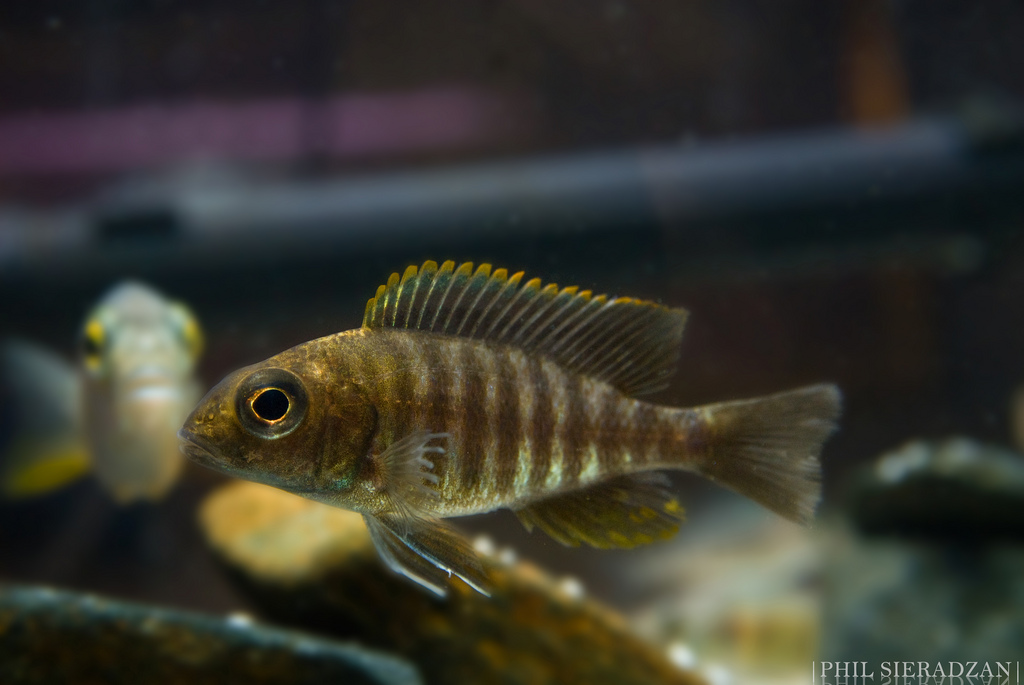
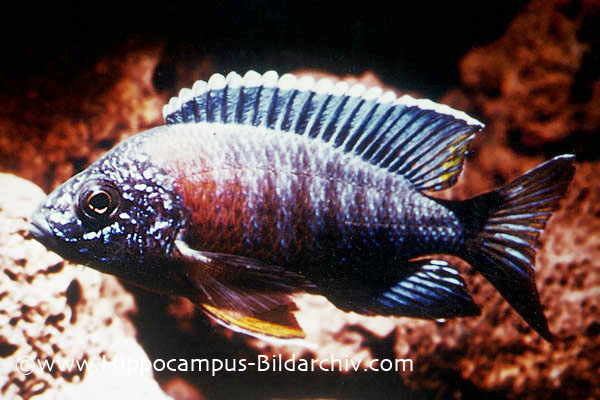
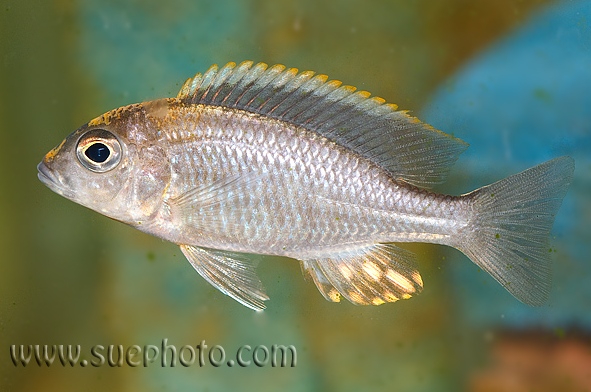
Write a noteEditMales are larger and more colourful than females.
Reproduction
Write a noteEditMaternal mouthbrooder which will often spawn in a community set-up, but should be moved or maintained in a specific tank if the intention is to maximise yield. Males can be aggressive in pursuit of females so a ratio of a single male to 4 or more females is normally recommended in order to reduce the attention on any particular individual. Some flattish rocks and open areas of sand should be included to act as potential spawning sites. The male will select one such site and begin his courtship display and when a female is willing she will approach and lay a batch of eggs, after which she immediately picks them up in her mouth. The male possesses a number of 'egg spots' on the anal fin and the female is also attracted to these, but when she tries to add them to her mouth she actually recieves milt from the male, thus fertilising the eggs. The female will carry brood for up to 4 weeks before releasing fully free swimming fry. She will not normally eat during this period and can be easily spotted by her distended mouthparts combined with a distinctive 'chewing' motion. If overly stressed the eggs may be eaten or ejected prematurely meaning care must be taken if you decide to isolate a brooding female. It's also worth noting that if a female is away from the colony for too long she may lose her position in the pecking order of the group so try to wait as long as possible before moving a female unless she is being actively harassed. Some breeders artificially strip the fry from the mother's mouth at the 2 week stage and raise them separately from that point. The fry may still have some yolk sac remaining when released and do not require additional food until this has disappeared. If released with yolk sacs fully-absorbed, Artemia nauplii or similar can be offered immediately. They usually start to become sexable at around the 4 month stage.
Notes
EditThis species exists in two distinctive phenotypes, with male individuals from West reef and Eccles reef possessing a bright yellow band of colour running from the tip of the snout over the anterior portion of the dorsal surface and along the distal margin of the dorsal fin. This form is commonly referred to as 'sulphurhead' or 'sulfurhead' in the aquarium hobby. At Kande Island males exhibit a similar overall colour patterm but the dorsal stripe is whitish in colour and both males and females possess an enlarged lower pharyngeal bone. This population was described as a subspecies, Aulonocara maylandi kandeensis Talwil and Allgayer, 1987 but that name was moved into synonymy with A. maylandi by Eccles and Trewavas just two years later. It's often referred to incorrectly as 'A. kandeensis' in the hobby and use of the subspecific name remains widespread, but is included here alongside A. maylandi because we prefer to avoid listing subspecies separately.
References
- Meyer, Riehl & Zetzsche (1987). A revision of the cichlid fishes of the genus Aulonocara Regan, 1922 from Lake Malawi, with descriptions of six new species (Pisces, Perciformes, Cichlidae). Courier ForschungsInstitut Senckenberg 94, 7-53
- Grant, S. M., H. W. Dieckhoff, H. J. Mayland and M. K. Meyer (1987). Ecology of Aulonocara REGAN, 1922 in Lake Malawi. Courier ForschungsInstitut Senckenberg 94, 131-139
Species images · 4
These photographs are used with each photographer’s permission.
Send a photograph