'Barbus' guirali
African Blackfin Barb
On this page11 sections
Quick facts
Difficulty5 of 6 measures
More bars, more demanding.
- Space
- very large tank
- Water
- soft or acidic
- Temp
- steady heat
- Temperament
- unknown
- Social
- shoal
- Compatibility
- community tank
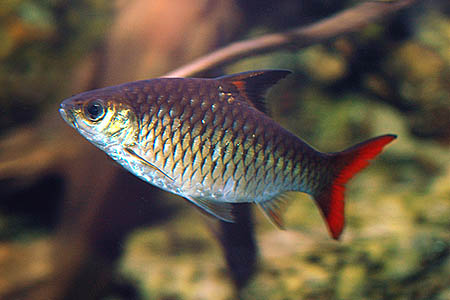
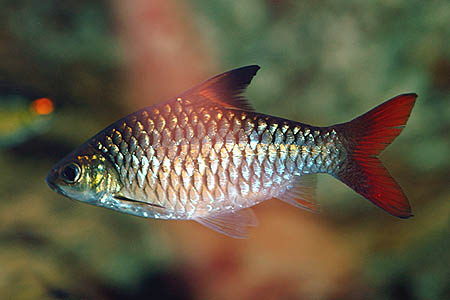
A stylish-looking but rare barb in the hobby and unfortunately little information is available regarding its captive care. Forum member Andy Rushworth has kept a lone individal and told us it was a perfect aquarium inhabitant in terms of behaviour and maintenance. He also mentioned that the fish he had looked exactly like the specimen in our images but that he has seen at least one batch of what appeared to be a different species imported under the same na...
Distribution
To date this species has been recorded only from Cameroon and Gabon. In Cameroon it appears to be restricted mostly to the south and west of the country although some collections have occured more centrally. It has been recorded from most of the major south and westerly river basins including the Ntem, Nyong, Dja and Sanaga.
In Gabon it occurs in the great Ogooué River basin which drains virtually the entire country as well as the Ngouné and Ivindo, two of its main tributaries.
Habitat
Primarily inhabits rivers but is also known to enter affluent streams and tributaries.
Aquarium size
Base dimensions of at least 150 ∗ 45 cm60 ∗ 18 in are recommended.
Maintenance
Fairly undemanding provided its tank is well-maintained. It can appear a little washed out in very sparsely decorated set-ups though. A combination of good lighting and a darkish substrate will encourage it to show its best colours. It does best in very clean, well-oxygenated water with a degree of flow and can look quite superb in a set-up decorated with smooth rocks, twisted roots and live plants.
Water conditions
Temperature: 22 – 26 °C72 – 79 °F
pH: The water across its natural range is invariably soft and slightly acidic so aim for a value within the range 5.5 – 6.5, particularly if you want the fish to breed.
Hardness: 1 – 10 dGH
These boxes carry affiliate links and we may earn a commission. What they recommend comes from each profile’s own figures, never chosen by hand or paid for.
Diet
An unfussy eater that will greedily accept just about anything offered. For the best condition and colours offer regular meals of small live and frozen foods such as bloodworm, Daphnia, and Artemia along with good quality dried flakes and granules.
Behaviour and compatibility
This species makes an ideal addition to a peaceful community of slightly bigger African species such as other similarly sized 'Barbus', Alestiid tetras, Mochokid catfish and even members of the genus Ctenopoma in the correct surroundings. If geography is not an issue it can actually be combined with most peaceful fish of a size too large to be considered food and that have a bold enough disposition to not be intimidated by its size and active nature.
It's a schooling species by nature and really should be kept in a group of at least 8-10 specimens. Maintaining it in decent numbers will not only make the fish less skittish but will result in a more effective, natural-looking display. Any aggressive behaviour will normally also be contained as the fish concentrate on maintaining their hierarchical position within the group. Whether you will be available to find the fish on sale in such numbers is another matter as it is usually only available as a contaminant amongst shipments of other species.
Sexual dimorphism
Males should be more intensely coloured, slimmer and slightly smaller than females.
Reproduction
Unreported in the hobby as far as we know and if you are lucky enough to find it on sale in numbers it would make an excellent project. Adopting a strategy as for other similarly-sized cyprinids should be a good starting point.
Notes
A stylish-looking but rare barb in the hobby and unfortunately little information is available regarding its captive care. Forum member Andy Rushworth has kept a lone individal and told us it was a perfect aquarium inhabitant in terms of behaviour and maintenance. He also mentioned that the fish he had looked exactly like the specimen in our images but that he has seen at least one batch of what appeared to be a different species imported under the same name.
The genus Barbus is in something of a confused state classification-wise. While there exist almost 340 putative species the vast majority of them do not appear to be closely-related to the genus Barbus sensu stricto.
Berrebi et al. (1996) proposed that only the European, Southwest Asian and North African representatives should be included in Barbus (around 20 species) and that 'all species of Barbus sensu lato which cannot be placed in a proper genus or allocated to an already existing genus be referred to as 'Barbus'' pending further study. This includes all sub-Saharan species and is the system we follow here at SF.
Species images · 2
Used with the photographer’s permission. Not licensed for reuse.