Chalceus macrolepidotus
Pink-tailed Chalceus
Last revised 2026Edit this page
On this page11 sections
Quick factsEdit
Difficulty4 of 8 measures
- Space
- large tank
- Water
- flexible
- Temp
- flexible
- Diet
- unknown
- Temperament
- territorial
- Social
- unknown
- Compatibility
- unknown
Other demands
Each of these can raise the rating on its own, whatever the measures above say.
- Hardiness
- unknown
Before you buy
Needs a tight-fitting lid as this species is known to jump
Make sure the tank cover is very well-fitting, as it is a renowned jumper.
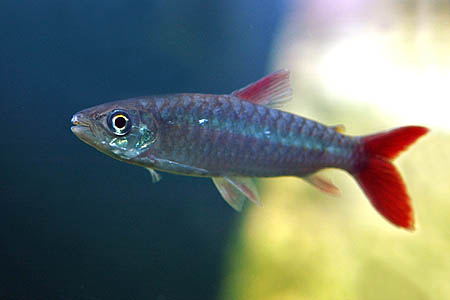
The pink-tailed chalceus, Chalceus macrolepidotus, is a large characin found throughout northern South America, from Colombia to French Guiana. It inhabits the surface layers of highly oxygenated rivers. Its very large scales tend to fall off during transport, so new imports can be delicate, though once acclimatised it usually proves fairly hardy. It does best singly or in a group of more than six, since smaller groups tend to scrap.
Distribution
EditFound throughout northern South America in Colombia, Venezuela, Guyana, Suriname, French Guiana and Peru.
Habitat
Write a noteEditMost often seen inhabiting the surface layers of highly oxygenated rivers.
Aquarium size
Write a noteEdit120 ∗ 45 ∗ 45 cm48 ∗ 18 ∗ 18 in - ~243 litres~64 US gal should be the smallest tank considered. It's capable of a real turn of speed and can injure itself quite easily in small tanks.
Maintenance
Write a noteEditIt requires a lot of swimming space, so decor is not really critical, although a sandy substrate with some beech branches and floating plants looks very effective, and mimics many of its natural biotopes. The floating cover will also help to reduce bouts of skittishness, to which it is prone. Some water movement is also appreciated. Make sure the tank cover is very well-fitting, as it is a renowned jumper.
Water conditions
EditTemperature: 23 – 28 °C73 – 82 °F
pH: 6.0-7.5
Hardness: 5-18°H
These recommendations come from this profile’s own figures. They contain affiliate links, so we may earn a commission.
Diet
Write a noteEditFeeds primarily on insects and aquatic crustaceans in nature. While dried foods are usually accepted, a good proportion of the diet should contain meaty foods such as prawns, mussel, bloodworm, chopped earthworms etc.
Behaviour and compatibility
Write a noteEditIt does best when kept either as a single specimen, or in a group with more than 6 fish. In smaller groups, the fish tends to scrap with one another. Other than this, it is a good addition to many larger communities. Tankmates can include similarly-sized characins such as Leporinus, Metynnis, Mylossoma and Brycon sp., large Loricariids, Pimelodiids, and cichlids such as Geophagus or Satanoperca sp. Try to avoid other surface-dwelling species unless the tank is huge, as when mature it can be somewhat territorial. Much smaller fish will be eaten.
Sexual dimorphism
Write a noteEditUnknown.
Reproduction
Write a noteEditHas been achieved. Details are very scarce and all that is known is that a very large aquarium is required and up to 2000 eggs are scattered among vegetation. The young are apparently quite large and can be fed on brine shrimp nauplii as soon as the yolk sac has been absorbed.
Notes
EditThis species can look quite stunning when cared for properly. It can sometimes be a little delicate when initially imported, as it has very large scales which tend to fall off during transport. Once acclimatised, it usually proves fairly hardy. There are reports of aquarium specimens surviving for over fifteen years in well-maintained conditions.
Species images · 1
These photographs are used with each photographer’s permission.
Send a photographDistribution
Profile completeness19 of 24
79% complete
Also missing: taxonomic authority, etymology.
Community
Questions about Chalceus macrolepidotus?
Ask on Discord