Limia nigrofasciata
Hump-backed Limia · Black-barred Limia
Last revised 2012Edit this page
On this page11 sections
Quick factsEdit
Difficulty3 of 8 measures
- Space
- medium tank
- Water
- needs a steady pH
- Temp
- needs a steady temperature
- Diet
- unknown
- Temperament
- unknown
- Social
- unknown
- Compatibility
- unknown
Other demands
Each of these can raise the rating on its own, whatever the measures above say.
- Hardiness
- unknown
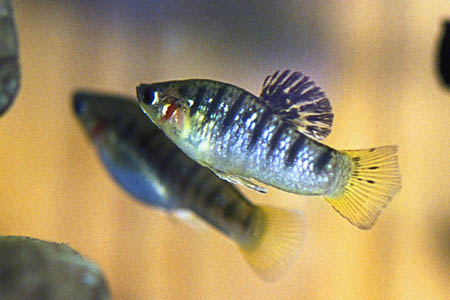
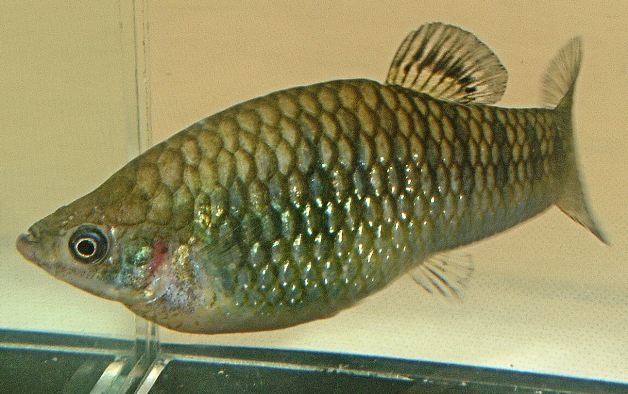
The hump-backed limia, Limia nigrofasciata, is a livebearer from Haiti and the Dominican Republic, found in shallow, heavily vegetated water. It usually swims in large shoals and also occurs in brackish conditions at several locations. Adult males develop a characteristic hump along the spine, caused by deposition of fatty tissue, and the species breeds very easily provided soft, acidic water is avoided.
Distribution
EditHaiti and the Dominican Republic.
Habitat
Write a noteEditAquarium size
Write a noteEdit45 ∗ 30 ∗ 30 cm18 ∗ 12 ∗ 12 in - ~41 litres~11 US gal.
Maintenance
Write a noteEditRelatively unfussy but prefers a planted tank with some open spaces for swimming.
Water conditions
EditTemperature: 22 – 26 °C72 – 79 °F
pH: 7.0-8.0
Hardness: 10-25°H
These recommendations come from this profile’s own figures. They contain affiliate links, so we may earn a commission.
Diet
Write a noteEditOmnivorous and will accept most foods offered but the diet should contain some vegetable matter. This can either be fresh form or some kind of vegetable flake.
Behaviour and compatibility
Write a noteEditCan be kept in a community tank provided the water is not too soft and acidic. It combines well with other genera of livebearers, hardy tetras, Loricariids and Corydoras.
Sexual dimorphism
Write a noteEditMales possess a gonopodium and are slightly smaller and more colourful than females. Males also develop the characteristic 'hump'.
Reproduction
Write a noteEditVery easy if soft, acidic water conditions are avoided. It reproduces in standard livebearer fashion. As with related species, the males can be somewhat incessant in their pursuit of females. Several females should be kept to every male in order to dissipate this. Areas of dense planting for the females to seek refuge in will also help.
Gestation takes around 6-8 weeks and broods of up to 50 fry are not uncommon. The adult fish will predate on the young, so the best method of raising them is to remove the gravid female to a separate tank and allow her to give birth there before returning her to the main aquarium. The use of breeding nets or traps is not recommended, as their small size is not suitable for raising fry. The fry are quite large and will accept brine shrimp nauplii or powdered flake from birth. It is thought that temperature may play a part in sex determination of this species, with more young fish developing into females the higher the water temperature. The young grow quickly if well fed and can attain adult size in under 6 months.
Notes
EditThe hump that develops along the spine of adult males is caused by deposition of fatty tissue.
Species images · 2
These photographs are used with each photographer's permission.
Send a photographProfile completeness17 of 24
Community
Questions about Limia nigrofasciata?
Ask on Discord