Synodontis eupterus
Featherfin Synodontis
Formerly Synodontis euptera
Last revised 2026Edit this page
On this page11 sections
Quick factsEdit
Difficulty4 of 8 measures
- Space
- large tank
- Water
- flexible
- Temp
- flexible
- Diet
- unknown
- Temperament
- needs a tank of its own
- Social
- unknown
- Compatibility
- unknown
Other demands
Each of these can raise the rating on its own, whatever the measures above say.
- Hardiness
- unknown
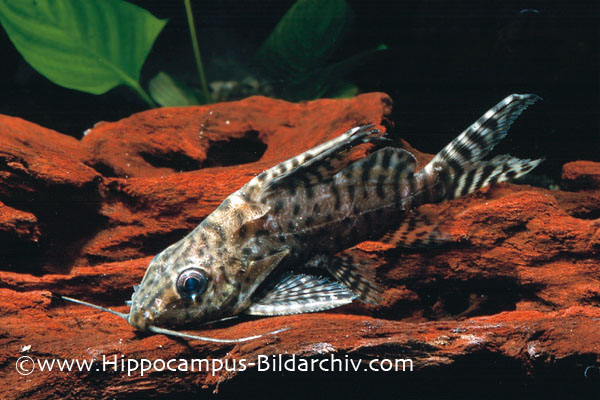
The featherfin Synodontis, Synodontis euptera, is a catfish from Nigeria, Cameroon, Mali, Ghana, Sudan, Chad and Niger. Juveniles are often sold as Synodontis 'Network' for their reticulated pattern, with no hint of an adult size of up to 300 mm SL. The pattern breaks up into simple spots with age as the long extensions of the 'feathered' dorsal fin develop. It can live for over 15 years in the aquarium.
Distribution
EditHabitat
Write a noteEditNigeria, Cameroon, Mali, Ghana, Sudan, Chad, Niger. It occurs in varying biotopes.
Aquarium size
Write a noteEdit120 ∗ 30 ∗ 30 cm48 ∗ 12 ∗ 12 in - ~108 litres~29 US gal.
Maintenance
Write a noteEditAn aquarium with a soft substrate and rocks, pieces of driftwood and twisted roots arranged to form hiding places suits this species. Floating vegetation is also recommended in order to diffuse the light entering the tank. Other planting is beneficial but not essential.
Water conditions
EditTemperature: 22 – 27 °C72 – 81 °F
pH: 6.0-7.5
Hardness: 8-20 dH
These recommendations come from this profile’s own figures. They contain affiliate links, so we may earn a commission.
Diet
Write a noteEditSynodontis are omnivorous and are most unfussy in terms of feeding. Frozen, live and dried foods are all accepted. It also relishes vegetable matter in the form of shelled peas, cucumber etc., which it will rasp at with the teeth in its lower jaw.
Behaviour and compatibility
Write a noteEditShould not be kept with any fish so small as to be considered food. Ideal tankmates include Alestiid tetras, robust cichlids (particularly West African species), Mormyrids, Knifefish, Gouramis and larger rasboras and barbs. It tends to become slightly territorial as it matures, especially towards other Synos. However any aggression is usually far less pronounced than in some other members of the genus and it can be maintained in a small group in a suitably sized aquarium, provided each fish is given a refuge to call home. Not recommended for the general community due to its adult size.
Sexual dimorphism
Write a noteEditAdult females are much plumper than males. It can also be sexed by examining the genital papillae. This is not for the amateur however. The fish should be held ventral side up in the palm of your hand. The dorsal fin should be taken between your middle and ring fingers in order to avoid being pierced by the sharp dorsal fin rays. The genital area you are looking for is concealed beneath the pelvic fins. This can be exposed by pulling (gently) on the caudal fin. A male fish will exhibit an extended papillae which should be pointed and ridged. The spermatoduct can be seen on the caudal side. Females also have a clearly visible papillae but this is more rounded and the oviduct is on the opposite side to the male's spermatoduct. Most species of medium/large Synodontis can be sexed using this method but it should be noted that most species take 2 years or more to reach sexual maturity.
Reproduction
Write a noteEditNot achieved under natural conditions in aquaria, although captive breeding has occured on commercial fish farms via the use of hormone injections. Many of the young fish that come onto the market have been produced in this way. In nature, S. eupterus breeds in areas of seasonal flooding that are rich in micro-organisms. They are egg scatterers and exhibit no parental care.
Notes
EditOne of the most popular and commonly seen Synos in the hobby, S. eupterus is usually offered for sale as a small (1-3") juvenile with no information regarding its potential size. These young fish are often sold as Synodontis "Network" due to their attractive reticulated patterning. This patterning breaks up as the fish mature and adult specimens have a simple spotted colouration. The characteristic 'feathered' dorsal also develops with age, with the first few rays developing long extensions.
This species is relatively secretive in the aquarium, and can often be found in the classic Synodontis inverted position underneath overhanging rocks or driftwood. However, it will learn to emerge for food, even when the tank lights are on with time. It can survive for over 15 years in the aquarium if maintained properly.
Also known as the Featherfin Squeaker.
Species images · 4
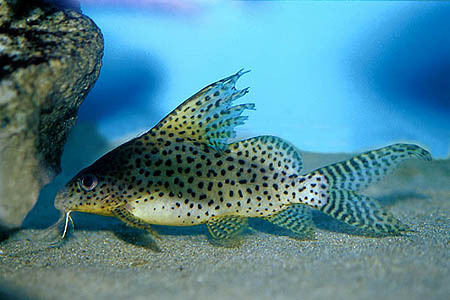
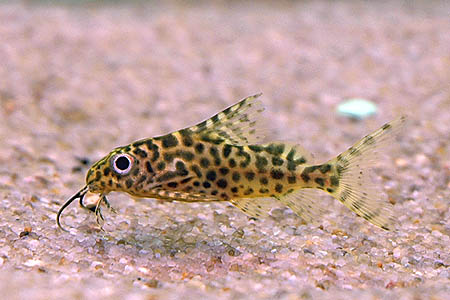
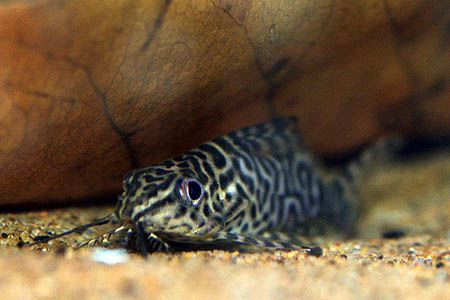
These photographs are used with each photographer's permission.
Send a photographHow the name has changed
Renamed from Synodontis euptera to Synodontis eupterus.
2026Eschmeyer's Catalog of Fishes: genera, species, references
Profile completeness19 of 24
79% complete
Also missing: a recorded distribution, etymology.
Community
Questions about Synodontis eupterus?
Ask on Discord