Tropheus moorii
Last revised 2026Edit this page
On this page13 sections
Quick factsEdit
Difficulty7 of 8 measures
- Space
- large tank
- Water
- needs alkaline water
- Temp
- needs a steady temperature
- Diet
- no meaty foods
- Temperament
- peaceful
- Social
- needs to be in a group
- Compatibility
- choose tankmates carefully
Other demands
Each of these can raise the rating on its own, whatever the measures above say.
- Hardiness
- unknown
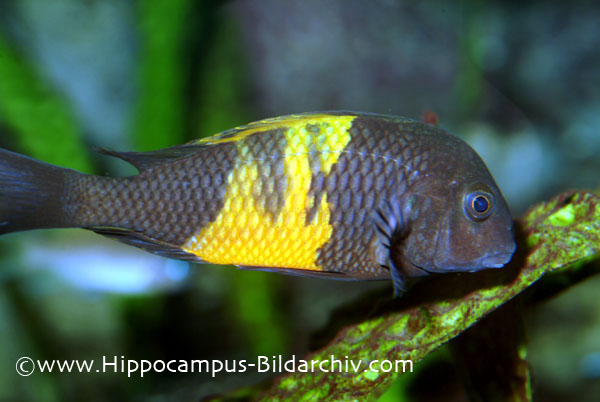
Tropheus moorii is a cichlid endemic to Lake Tanganyika, found in shallow water around rocky shores and known in over 50 geographical morphs. Despite its popularity it is not a good species for the beginner. Water quality matters above all because it is very susceptible to 'bloat', vegetable matter should form the basis of its diet, and different morphs hybridise freely and should not be mixed.
Etymology
EditNamed in honour of John E.S. Moore, who first collected it during his 1895–96 expedition to Lake Tanganyika.
Distribution
EditEndemic to Lake Tanganyika.
Habitat
Write a noteEditIt inhabits shallow waters around rocky parts of the shoreline.
Aquarium size
Write a noteEdit48" x 12" x 12" (120cm x 30cm x 30cm) - 110 litres for a single specimen. A much larger tank is required for a group (see below).
Maintenance
Write a noteEditMany aquarists keep Tropheus in bare setups to reduce territorial behaviour but they can also be maintained in decorated aquaria. If you wish to decorate the tank, use piles of rockwork to form many cave-like structures and hiding places, interspersed with open areas for swimming. In either case use sand as substrate, and ensure the water is well-oxygenated.
Water conditions
EditTemperature: 23 – 27 °C73 – 81 °F
pH: 8.0-9.5
Hardness: 8-25°H
Diet
Write a noteEditIt will accept most foods offered but vegetable matter in the form of spirulina flakes, blanched spinach, nori etc. should form the basis of the diet. This can be supplemented with small feeds of live and frozen varieties. Never feed beefheart or any other animal meat as it interferes with the digestive system of these fish.
Behaviour and compatibility
Write a noteEditIt has a somewhat dubious reputation for aggressive behaviour but this is undeserved. In fact, it is relatively peaceful towards other species but will squabble with conspecifics. The fish are very active however and should not be kept with shy species. Possible tankmates include Julidochromis, Eretmodus and Tanganicodus species, as these require a similar diet to the Tropheus.
Obtaining a peaceful species group of T. duboisi is, unfortunately, rather difficult. The fish do not school in nature, and will usually fight amongst themselves in the aquarium, until a natural pecking order is established. However, in smaller groups (5-6 fish), the fish do not settle easily and may fight to the death. It is therefore generally recommended to purchase a group of 15-20 fish in order to reduce territorial behaviour. There are exceptions to this and we have seen small groups and even pairs of Tropheus living peacefully together, but these are exceptions to the rule. The main problems associated with successfully keeping a Tropheus colony are thus cost and tank size, with a 60" x 18" x 18" tank being the minimum size for a group. If it is maintained in a large group, the social interactions between the fish are truly fascinating. New individuals should never be introduced into an established community of Tropheus, as they will not be tolerated.
Sexual dimorphism
Write a noteEditThe sexes are hard to distinguish. There are some subtle differences in growth rate and body shape, but the only guaranteed method is to examine the genital papillae of the fish, but this is recommended to experts only. The genital papillae is pointed in the male and rounded in the female.
Reproduction
Write a noteEditPossible. Maternal mouthbrooder. The tank should be set up as decribed above. We recommend the purchase of 20-30 young fish and allowing them to grow on together, as adults are costly. If you can, try and obtain tank-bred fish, as wild specimens tend to be far more delicate, aggressive and expensive. It is difficult to obtain the perfect group, and some fish (particularly subdominant males) may be lost. The other method is to remove dominant males as they develop until you have the desired sex ratio. If you wish to keep more than one male, you should provide each with around 2 feet of territory, each containing a rock pile which the male will defend. 6-10 females should be kept per male. If there are multiple males in the tank, but only a single or continuous rock pile, only one male will become dominant and spawn with the females.
The fish spawn in open water, usually over rocks. During spawning itself the female may either take the eggs into her mouth before they reach the substrate, or allow them to drop into spaces between the rocks before picking them up. She then nuzzles the vent of the male, who releases his milt directly into the female's mouth, thus fertilising the eggs.
The female may carry the brood of 5-15 eggs for over 4 weeks before releasing the free swimming fry. She will usually continue to eat during this period and can be easily spotted by her distended mouth. If a female is overly stressed, she may spit out the brood prematurely or eat them, so care must be taken if you decide to move the fish. This is not recommended for Tropheus, as if a female is away from the colony for too long, she will lose her position in the pecking order of the group, and may be viciously attacked when she is returned.
Conversely, if she is left in the main aquarium she may lose most of the brood due to harassment from other fish. If you do move the female, turn off the tank lights and cover it with a blanket for a few hours when she is reintroduced. Most breeders who wish to raise large numbers of fry artificially strip them from the mother's mouth at the 2 week stage and raise them from that point. This approach is only for experts, however.
The fry are large enough to take brine shrimp nauplii, microworm and powdered dry foods once they become free swimming. If they are left with the mother brood care continues for a time, with the fry seeking refuge in her mouth when they feel threatened.
Notes
EditLike others in the genus, Tropheus moorii is something of an enigma in the aquarium hobby, and despite it's popularity is not a good species for the beginner. There has been much arguement and discussion about how best to maintain it in the aquarium, and some of these debates still rage on. We have provided the generally accepted method of keeping the fish, but in reality what works for one aquarist may not for another. One aspect which is always true, is that water quality is of the utmost importance in a Tropheus tank, as they are very susceptible to "bloat".
This species exists in over 50 geographical morphs, some of which have truly stunning colouration. Obviously, these should not be mixed in aquaria, as they will hybridise freely. It is likely that some of the morphs will eventually be described as distinct species.
References
- Ad Konings (2019). Tanganyika Cichlids in their natural habitat, 4th edition Cichlid Press, 144-150
Species images · 4
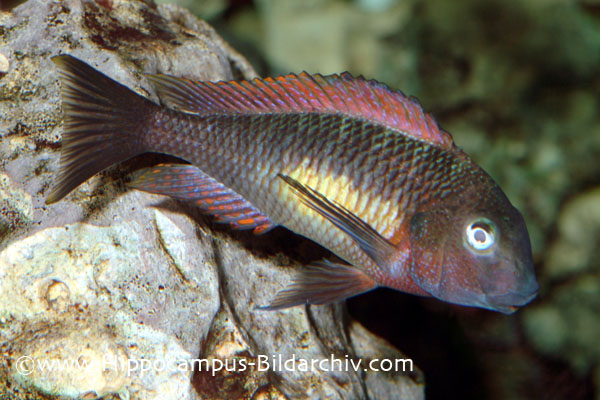
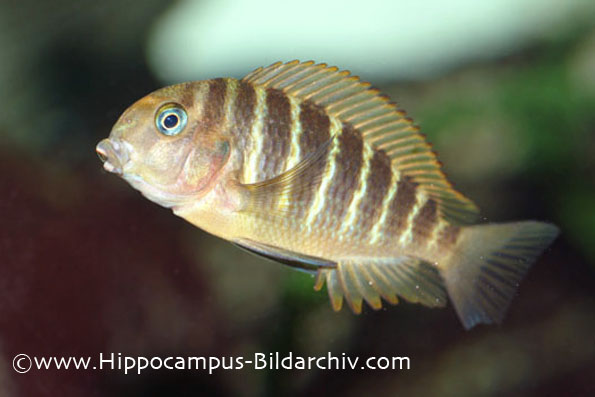
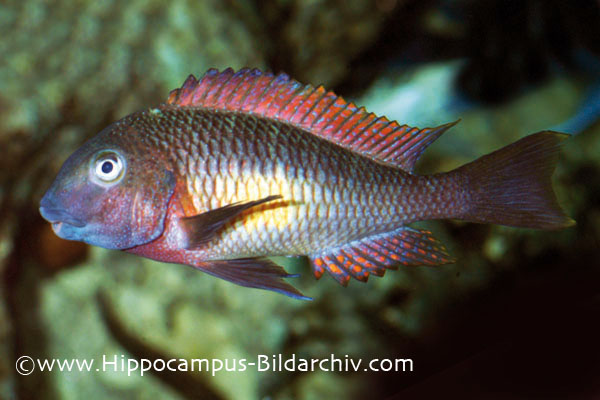
These photographs are used with each photographer’s permission.
Send a photographDistribution
Profile completeness22 of 24
Contributors
Improved by
- CowPuppet59
The number beside each name is how many contributions that person has had accepted on Seriously Fish.
Community
Questions about Tropheus moorii?
Ask on Discord