Every species
Every freshwater profile, A–Z.
Filters
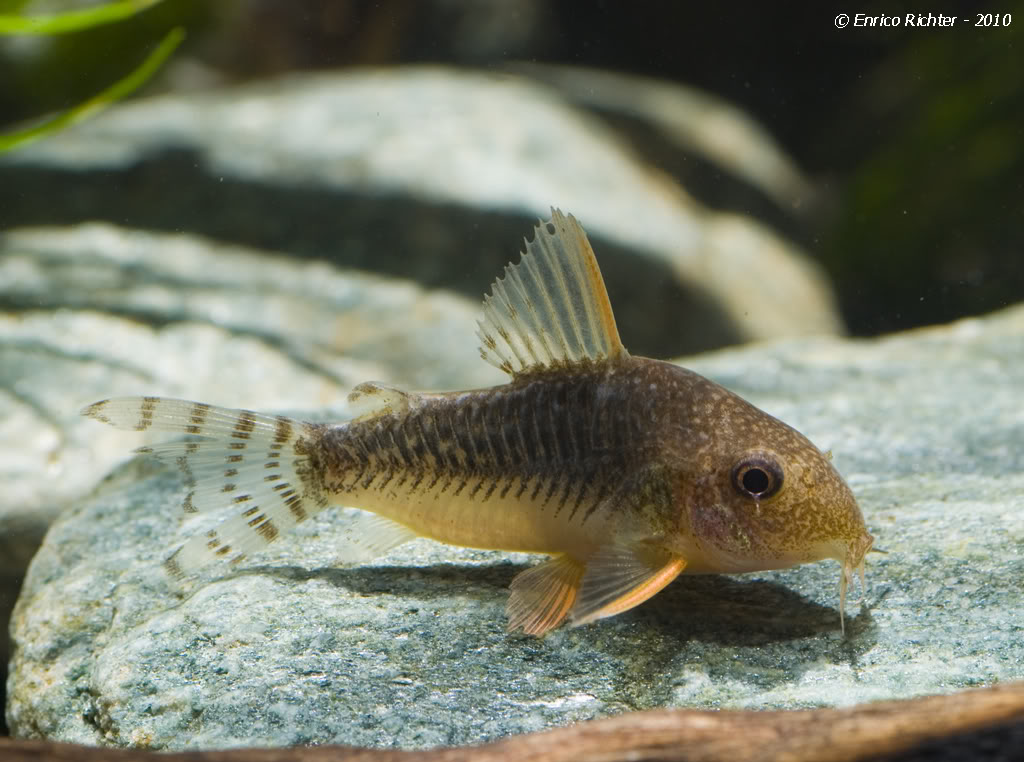
Corydoras gosseiPalespotted Cory
Nijssen, 1972
Max length55mm SL2.2in SLTank90 × 30cm36 × 12inTemp24–28°C75–82°FpH5.5–7.5The congener C. seussi, which is also native to the rio Mamoré, has a similar colour pattern but its snout is noticeably prolonged compared with that of C. gossei, plus there are some subtle differences in pigmentation. There is a third variant which has been referred to as 'CW069' in the aquarium hobby and appears to be somewhat intermediate, with a short, rounded snout as in C. gossei but a colour pattern more reminiscent of C. seussi.
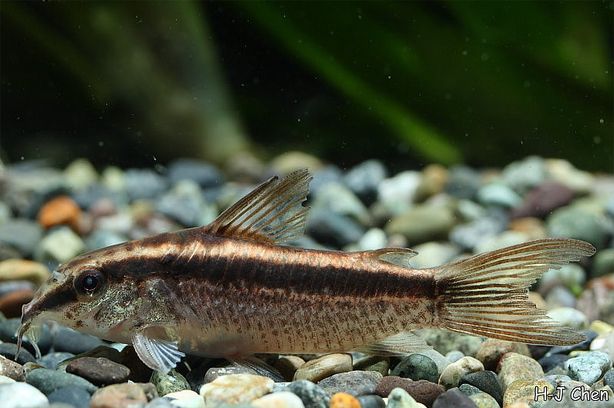
Corydoras gracilis
Nijssen & Isbrücker, 1976
Max length40mm SL1.6in SLTank60 × 30cm24 × 12inTemp20–26°C68–79°FpH5.0–7.5It can be distinguished from the majority of other Corydoras species by its distinctive colour pattern, comprising a uniform, lightish base pigmentation with a dark arched stripe extending over the upper portion of each flank, from the tip of the snout to the caudal-fin base. This is shared with a few congeners, however, including C. arcuatus, C. narcissus, and C. urucu.
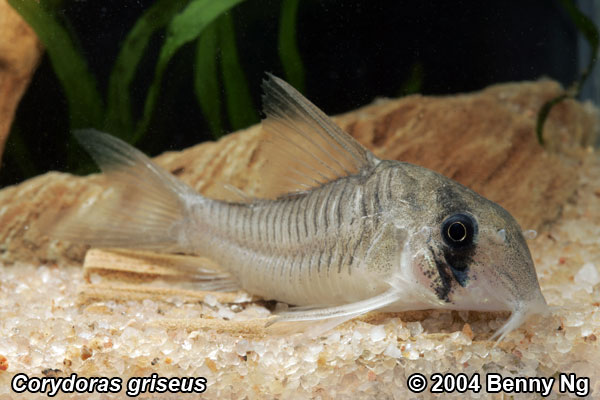
Corydoras griseus
Holly, 1940
Max length50mm SL2.0in SLTank90 × 30cm36 × 12inTemp20–26°C68–79°FpH6.0–7.5Native to Guyana, where it may be restricted to the Potaro River, a major tributary within the Essequibo watershed. It was described from aquarium specimens which were said to have been collected in 'very small water courses of the Amazon', but the type locality was corrected to 'Guyana-Essequibo, Potaro River, Kuribong trail' by Nijssen and Isbrücker (1980).
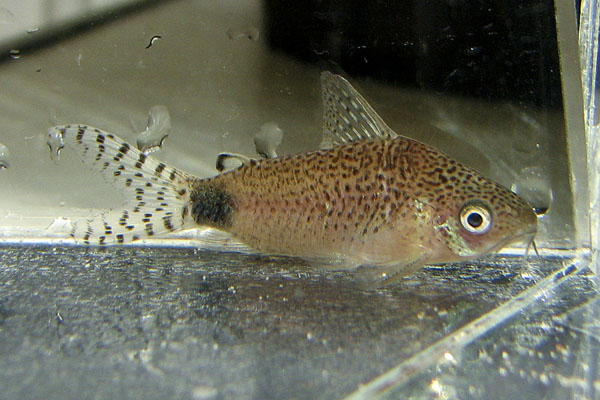
Corydoras guaporeGuaporé Cory
Knaack, 1961
Max length50mm SL2.0in SLTank90 × 30cm36 × 12inTemp22–28°C72–82°FpH5.0–7.0C. guapore is a sought after aquarium fish although it is not often traded. It exhibits slightly different behaviour to the majority of congeners in that it tends to form aggregations in midwater and spends a large proportion of its time away from the substrate. Its morphology exhibits corresponding adaptations towards a pelagic existence with a relatively large eye, a more terminal mouth position, more strongly-forked caudal-fin, and more symmetrical body shape than most other Corydoras species.
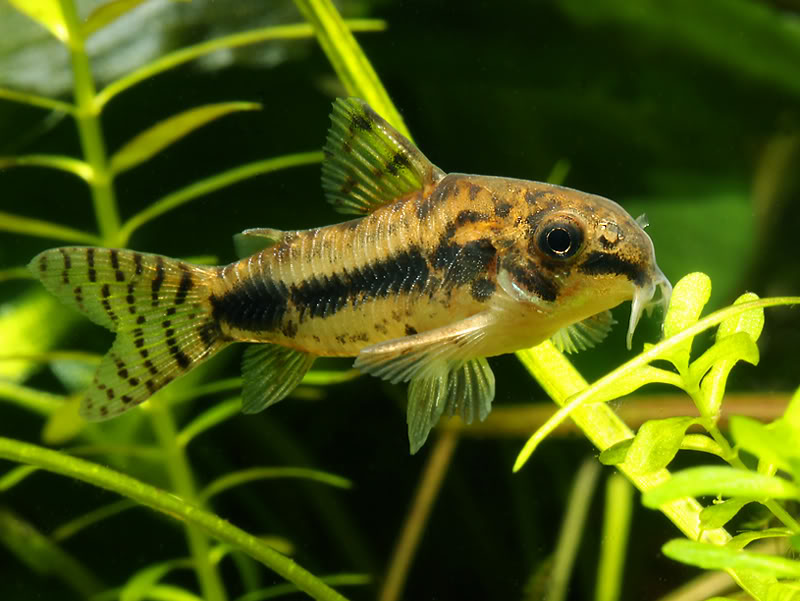
Corydoras habrosusSalt and Pepper Cory
Weitzman, 1960
Max length35mm SL1.4in SLTank60 × 30cm24 × 12inTemp20–26°C68–79°FpH5.5–7.5The majority of records derive from the Río Apure watershed in southwestern Venezuela, where C. habrosus has been collected in the states of Portuguesa, Cojedes, Barinas, Guárico, and Apure. Its distribution in Colombia is less clear but it is known with certainty from the Río Arauca and Río Casanare, the latter a tributary of the lower Río Meta, and it makes sense that it should also be found in other left bank Orinoco affluents between the Meta and Apure, which include the ríos Cinaruco and Capanaparo.
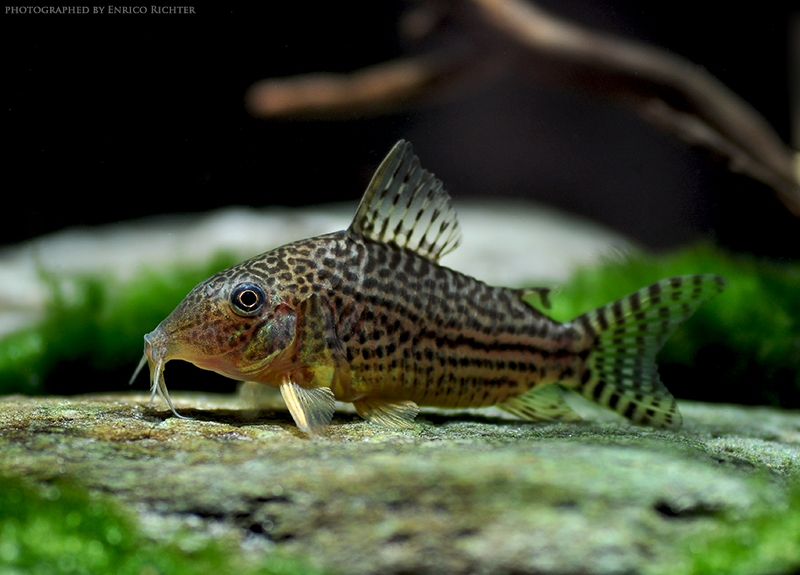
Corydoras haraldschultziMosaic Cory
Knaack, 1962
Max length85mm SL3.3in SLTank120 × 30cm48 × 12inTemp24–28°C75–82°FpH5.5–7.5The original type locality is 'Rio Guaporé, Brazil', supposedly in the vicinity of Pontes e Lacerda in Mato Grosso state. However, this was modified by Nijssen and Isbrücker (1980) to 'Brazil-Goias, Rio Tocantins, road between Pedro-Afonso (08°59'S 48°12'W) and Itacajá (08°18'S 47°45'W)'. This is confusing since the distance between these two localities is well over 1000 km, although it appears that the former is correct as per our image of specimens with locality details.
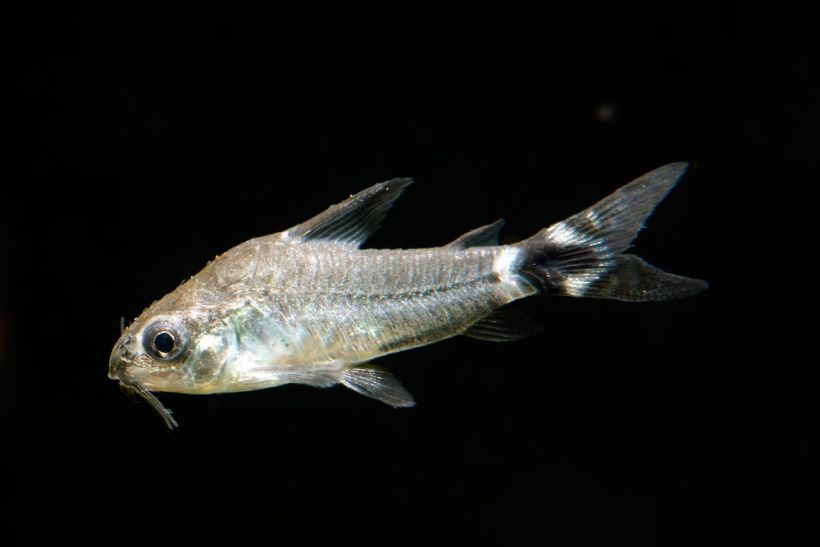
Corydoras hastatusTail-spot Pygmy Cory
Eigenmann & Eigenmann, 1888
Max length32mm SL1.3in SLTank60 × 30cm24 × 12inTemp20–26°C68–79°FpH6.0–7.5It exhibits slightly different behaviour to the majority of congeners in that it tends to swim in midwater and spends a large proportion of its time away from the substrate. Its morphology exhibits corresponding adaptations towards a pelagic existence with a relatively large eye, a more terminal mouth position, more strongly-forked caudal-fin, and more symmetrical body shape than most other Corydoras species.
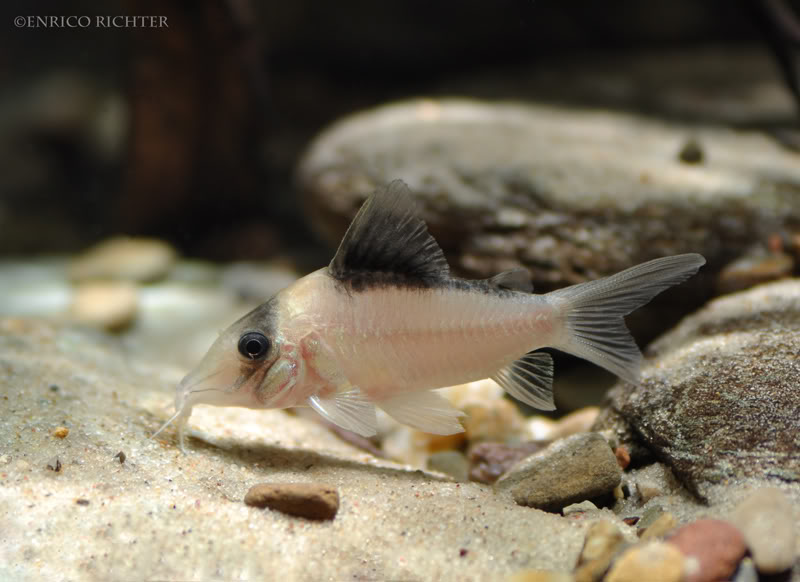
Corydoras imitatorImitator Cory
Nijssen & Isbrücker, 1983
Max length65mm SL2.6in SLTank90 × 30cm36 × 12inTemp20–26°C68–79°FpH4.0–7.0Endemic to the upper rio Negro basin in Amazonas state, northern Brazil, and Amazonas state, southern Venezuela. One specific locality is Igarapé Muiá (00°09'03"N 66°48'10"W). Type locality is 'Upper Rio Negro, eastern Amazonas, Brazil', which is thought to refer to forest brooks crossing the "new army road", north of São Gabriel da Cachoeira municipality.
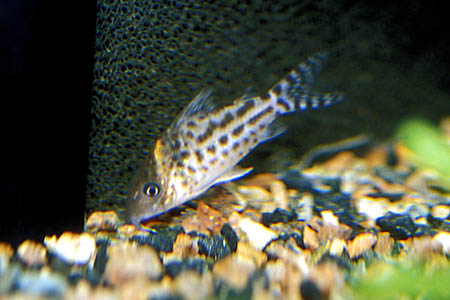
Corydoras incolicanaC001
Burgess, 1993
Max length80mm SL3.1in SLTank120 × 30cm48 × 12inTemp20–26°C68–79°FpH4.0–7.0C. incolicana was the first recipient of a 'C' number (see below) in 1993 and was described the same year. Unfortunately its description was published in an aquarium hobbyist magazine, and we have been unable to obtain a copy to date meaning its diagnosis is unavailable. It is therefore difficult to identify accurately, not least because its type locality is in a relatively remote area, and there exist a number of superficially similar Corydoras species or populations in the aquarium trade.
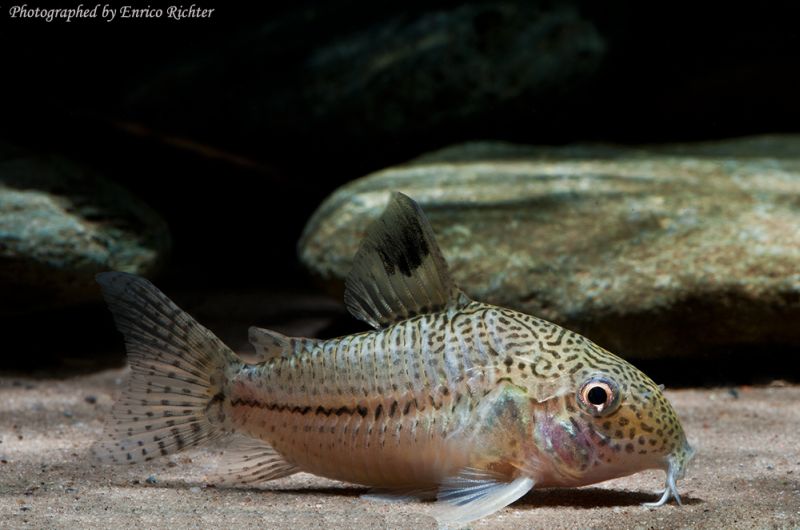
Corydoras juliiJulii Cory
Steindachner, 1906
Max length55mm SL2.2in SLTank90 × 30cm36 × 12inTemp20–26°C68–79°FpH5.5–7.5Native to coastal river systems south of the Amazon delta in the states of Piauí, Maranhão, Pará, and Amapá, northeastern Brazil. It has been recorded from the rios Guamá (including tributaries such as the rio Ararandeua), Maracanã (rio Peixe-Boi), Morcego, Parnaíba, Piriá, Caeté, Turiaçu (rio Jamari), and Mearim (rio Pindaré). Reports from French Guiana and western Brazil appear to represent cases of misidentification.
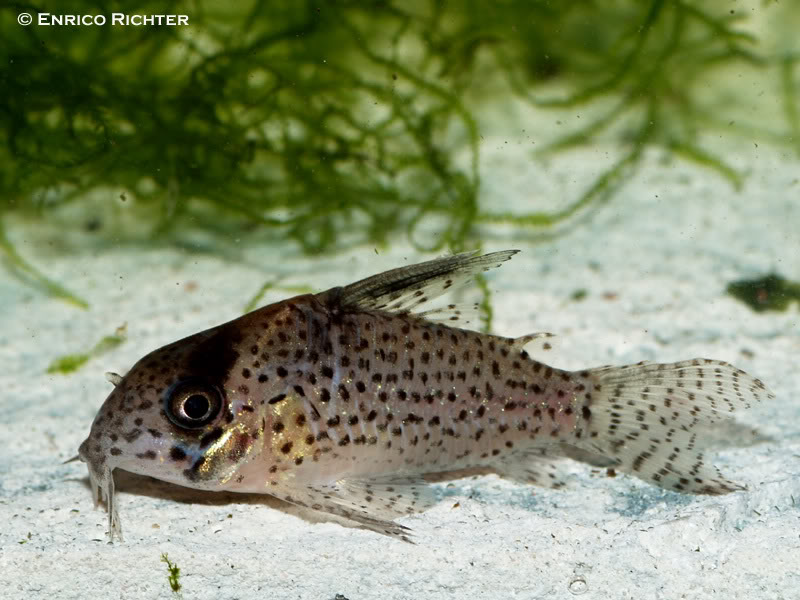
Corydoras kaneiC026
Grant, 1998
Max length50mm SL2.0in SLTank90 × 30cm36 × 12inTemp20–26°C68–79°FpH5.5–7.5Prior to description C. kanei was assigned the 'C' numbers C026 and C046. Among congeners it is most easily-confused with, and sometimes traded as, C. atropersonatus, but can be identified by presence (vs. absence in C. atropersonatus) of dark markings in the anal and caudal fins, presence of numerous, smaller (vs. fewer, larger) dark spots on the body, and an overall darker (vs. paler) base colouration.
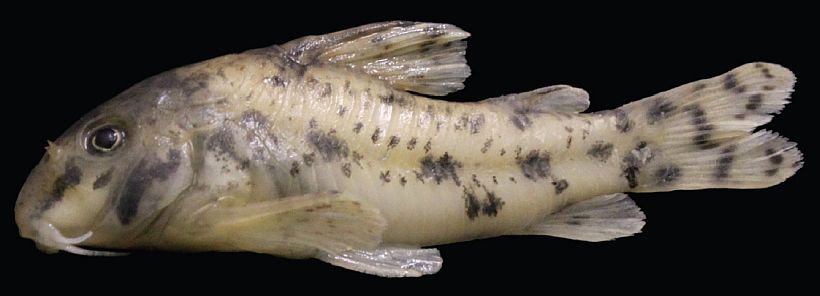
Corydoras lacrimostigmata
Tencatt, Britto & Pavanelli, 2014
Max length34mm SL1.3in SLTank60 × 30cm24 × 12inTemp20–25°C68–77°FpHnot recordedKnown only from the rio Ivaí basin, a tributary of the rio Paraná in Paraná state, southern Brazil. Type locality is 'Brazil, Paraná, Cândido de Abreu, rio Maria Flora, tributary to rio Ubazinho, rio Ivaí basin...
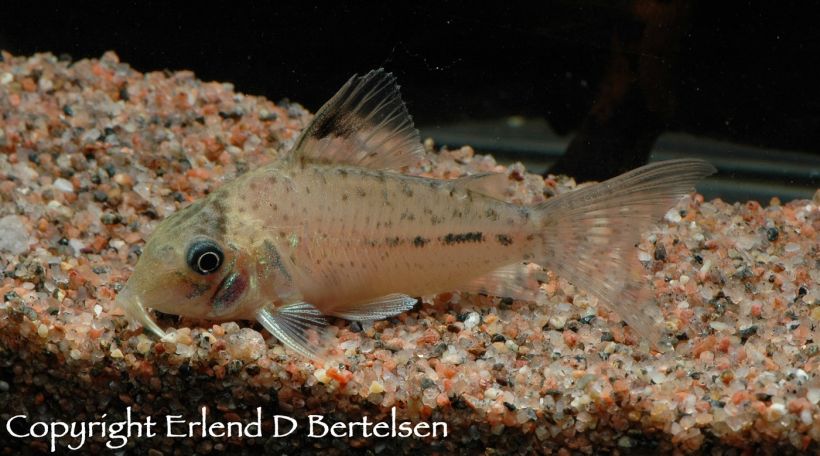
Corydoras lambertiC009
Nijssen & Isbrücker, 1986
Max length55mm SL2.2in SLTank80 × 30cm31 × 12inTemp20–26°C68–79°FpH6.0–8.0Unfortunately diagnostic characters cannot be provided since we have been unable to obtain the type description to date, and little else has been written about this species. There is also confusion regarding whether C. lamberti, the unidentified 'C009', and similar-looking fish collected close to Iquitos are conspecific or not. We include all together here until these issues are resolved.
Corydoras leucomelasBlackfin Cory
Eigenmann & Allen, 1942
Max length55mm SL2.2in SLTank90 × 30cm36 × 12inTemp22–26°C72–79°FpHnot recordedThere are currently over 180 described species of Corydoras (commonly shortened to "cory"), making it one of the most speciose of all South American fish genera. There are also loads of undescribed species, many of which have been assigned a "C number" for identification purposes. This is a very simple system of numbering and is similar to the L number scheme used to identify undescribed Loricariids. Both systems were implemented by the German aquarium magazine DATZ (Die Aqua...
Corydoras loretoensis
authority not recorded
Max length50mm SL2.0in SLTank45 × 38cm18 × 15inTemp22–25°C72–77°FpH6.0–7.2There are currently over 180 described species of Corydoras (commonly shortened to "cory"), making it one of the most speciose of all South American fish genera. There are also loads of undescribed species, many of which have been assigned a "C number" for identification purposes. This is a very simple system of numbering and is similar to the L number scheme used to identify undescribed Loricariids. Both systems were implemented by the German aquarium magazine DATZ (Die Aqua...
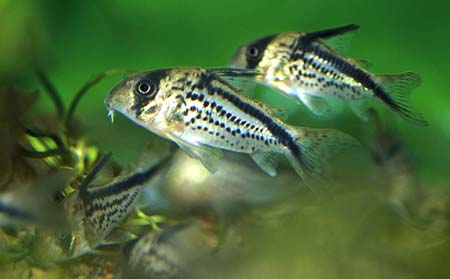
Corydoras loxozonus
authority not recorded
Max length55mm SL2.2in SLTank45 × 38cm18 × 15inTemp21–24°C70–75°FpH6.0–7.2There are currently over 180 described species of Corydoras (commonly shortened to "cory"), making it one of the most speciose of all South American fish genera. There are also loads of undescribed species, many of which have been assigned a "C number" for identification purposes. This is a very simple system of numbering and is similar to the L number scheme used to identify undescribed Loricariids. Both systems were implemented by the German aquarium magazine DATZ (Die Aqua...
Corydoras melanistiusSpotted Cory
authority not recorded
Max length55mm SL2.2in SLTank45 × 30cm18 × 12inTemp22–26°C72–79°FpH6.0–7.0There are currently over 180 described species of Corydoras (commonly shortened to "cory"), making it one of the most speciose of all South American fish genera. There are also loads of undescribed species, many of which have been assigned a "C number" for identification purposes. This is a very simple system of numbering and is similar to the L number scheme used to identify undescribed Loricariids. Both systems were implemented by the German aquarium magazine DATZ (Die Aqua...
Corydoras melanotaeniaGreen-gold Cory
authority not recorded
Max length60mm SL2.4in SLTank45 × 30cm18 × 12inTemp20–23°C68–73°FpH6.0–7.2There are currently over 180 described species of Corydoras (commonly shortened to "cory"), making it one of the most speciose of all South American fish genera. There are also loads of undescribed species, many of which have been assigned a "C number" for identification purposes. This is a very simple system of numbering and is similar to the L number scheme used to identify undescribed Loricariids. Both systems were implemented by the German aquarium magazine DATZ (Die Aqua...
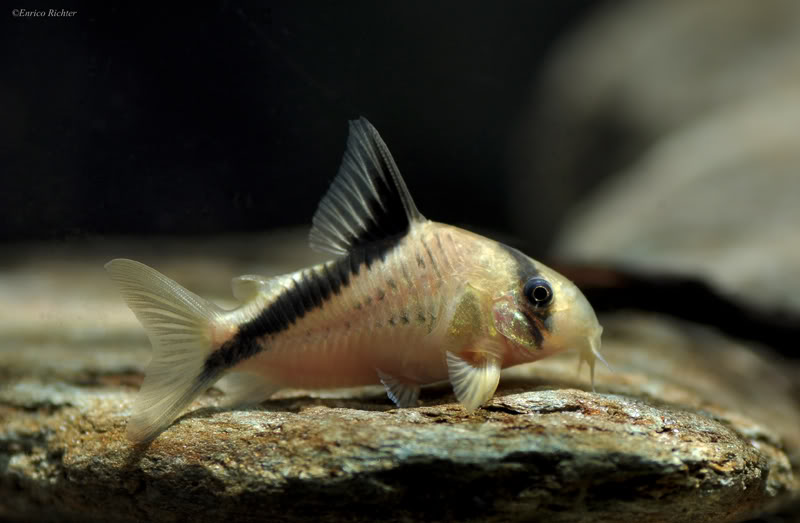
Corydoras meliniFalse Bandit Cory
Lönnberg & Rendahl, 1930
Max length50mm SL2.0in SLTank80 × 30cm31 × 12inTemp20–26°C68–79°FpH4.0–7.0In the aquarium hobby, the population from the rio Tiquié has been referred to as 'C084', while a similar, but larger, form from the Río Huallaga in Peru is known as 'C085'. Both forms have been marketed as C. sp. 'mega metae'. The existence of multiple, similarly-coloured species which coexist and sometimes form mixed schools is relatively common in the genus.
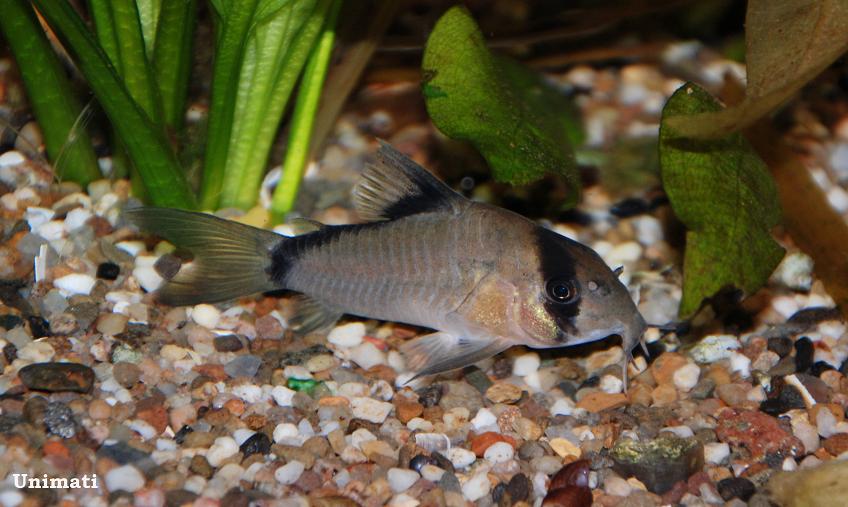
Corydoras metaeBandit Cory
Eigenmann, 1914
Max length50mm SL2.0in SLTank80 × 30cm31 × 12inTemp20–26°C68–79°FpH6.0–7.5Endemic to the Río Meta, a major tributary of the Río Orinoco in eastern Colombia and western Venezuela. It is known from several tributaries within the upper basin including the ríos Humea, Ocoa, Guatiquía (including its two branches the ríos Negrito and Guayuriba), Manacacias, and Metica (the name given to the upper Río Meta above its confluence with the Río Humea). It appears to be absent from the lower Meta and has not been recorded in Venezuela.