Every species
Every freshwater profile, A–Z.
Filters
Mogurnda adspersaSouthern Purple Spotted Gudgeon
authority not recorded
Max length140mm SL6in SLTank120 × 30cm48 × 12inTemp16–24°C61–75°FpH7.0–7.5This species is considered endangered across its native range, but has recently begun to appear in the hobby a little more often as a result of commercial farming. It's still by no means common though. Superficially it looks very similar to the much commoner Northern purple spotted gudgeon (Mogurnda mogurnda), but can be distinguished by the presence of only 30-36 scales along its lateral line, (as opposed to 37-48 in M. mogurnda), and a higher degree of red spotting in the second dorsal fi...
Mogurnda mogurndaNorthern Purple Spotted Gudgeon
authority not recorded
Max length170mm SL7in SLTank120 × 30cm48 × 12inTemp24–26°C75–79°FpH6.0–8.0A good species of gudgeon for the beginner, being tolerant of a wide range of water conditions, hardy and easily bred. We've even seen them spawning in dealer's tanks on more than one occasion. It's easily confused with the similar looking, but rarer Southern purple spotted gudgeon, Mogurnda adspersa, a fish which is now being farmed for the trade despite being endangered in nature....
Monocirrhus polyacanthusSouth American Leaf Fish
authority not recorded
Max length100mm SL3.9in SLTank75 × 30cm30 × 12inTemp23–29°C73–84°FpH5.0–6.8An incredibly-adapted species, this fish is camouflaged to mimic a dead leaf, both in body shape and pattern. It can change colour to match its surroundings and has a projection from its bottom lip that resembles a leaf stalk. When hunting, it stalks its prey in a head-down stance, appearing to drift towards it like a dead leaf drifting in a current. In reality, the fish is propelled by tiny movements of its transparent fins. When it strikes at an item of prey the entire mouth protrudes outwards...
Monopterus albusSwamp Eel
authority not recorded
Max length1000mm SL39in SLTank180 × 60cm72 × 24inTemp25–28°C77–82°FpH6.0–8.0An incredibly hardy species, M. albus has the ability to travel over land for short distances if kept moist and as mentioned above, often burrows into moist earth (sometimes up to a depth of 1.5 metres!) in order to survive dry conditions. It has only a single gill slit, located on the bottom of the throat, that allows it to trap air in its specially adapted gills. These contain an accessory breathing organ, which takes the form of a pair of lung-like sacs at the rear of the gill chamber. In thi...
Myleus schomburgkiiBlack-barred Myleus
authority not recorded
Max length120mm SL5in SLTank120 × 38cm48 × 15inTemp23–27°C73–81°FpH6.0–7.0Similar in care and appearance to its close relative, the Redhook (myloplus rubripinnis), myleus schomburgkii is easily distinguished by the black vertical bar on the flanks. It is also a smaller adult fish. Despite this, it is sometimes offered for sale marked as a Redhook. This fish is also variously referred to as the Black-ear Pacu, Disc Pacu and Disk Tetra....
Mylochromis melanonotusHaplochromis Yellow-black Line
authority not recorded
Max length260mm SL10in SLTank150 × 60cm60 × 24inTemp24–28°C75–82°FpH7.6–8.8M. melanonotus is rarely imported and little information is available regarding its captive care. The shovel-like lower jaw possessed by some individuals of this species has been the cause of some confusion regarding the fishes' true identity. It was originally placed in the genus Platygnathochromis, in which it was the only species. However, Ad Konings observed that amongst wild breeding populations there existed individuals both with and without the modified lower jaw. The specimens witho...
Myloplus rubripinnisRedhook
authority not recorded
Max length250mm SL10in SLTank180 × 38cm72 × 15inTemp23–27°C73–81°FpH6.0–7.0The Redhook is another species commonly sold as a Silver Dollar in the trade. It can be distinguished from those species as the black-trimmed, redis much more obvious than any of the metynnis species. The Redhook is also capable of growing much larger than its Silver Dollar relatives. This species was until recently referred to as myleus rubripinnis and is still widel y referred to as such. The Redhook is sometimes described as a difficult fish to care for but, given a large enough aquarium, ...
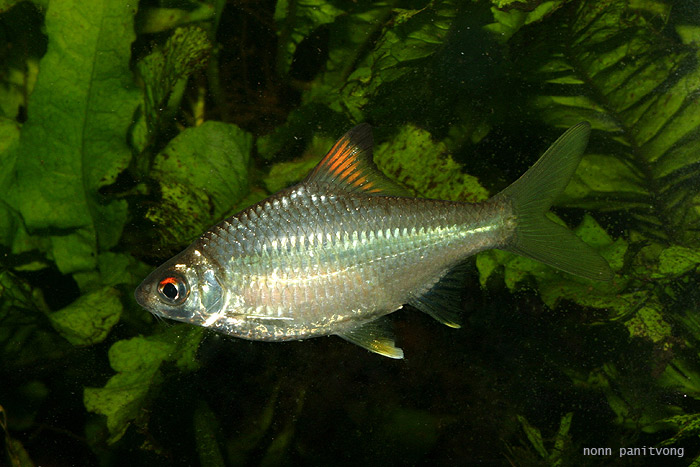
Mystacoleucus argenteus
Day, 1888
Max length140mm SL6in SLTank120 × 45cm48 × 18inTemp20–27°C68–81°FpH6.0–7.5All Mystacoleucus species possess a procumbent predorsal spine orientated towards the head, though it can be difficult to spot with the naked eye. This can become entangled in an aquarium net so care must be taken when handling the fish. The trait is shared by members of Tor, Spinibarbus and Paraspinibarbus although there exists no strong evidence to suggest that these genera form a monophyletic lineage and it is...
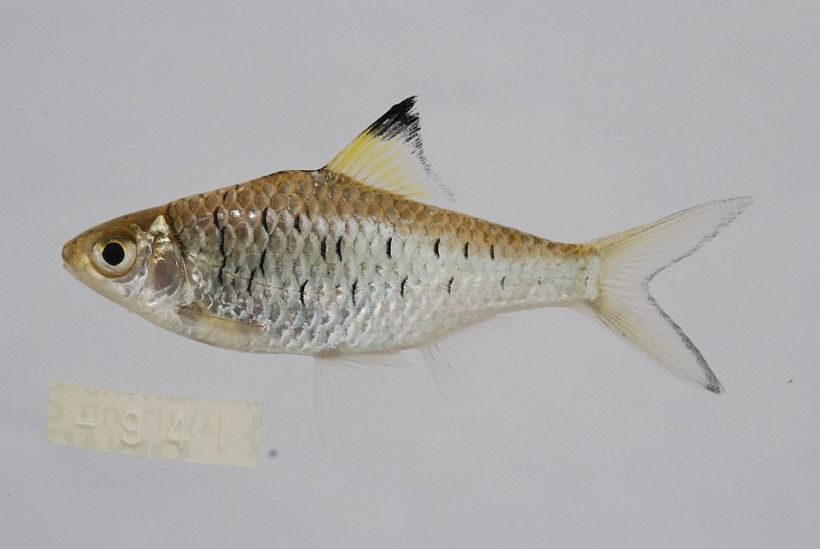
Mystacoleucus atridorsalis
Fowler, 1937
Max length80mm SL3.1in SLTanknot recordedTempnot recordedpHnot recordedThis species can be distinguished from congeners by the following combination of characters: body depth fits 2.5-2.7 times in SL; 28-31 +2-3 lateral line scales; 14-16 circumpeduncular scale rows; 5-5½ scale rows between the lateral line and dorsal-fin origin; a triangular distal blotch on the dorsal-fin; a few body scales with crescent-shaped black edges; a thin dark margin on the dorsal-fin, posterior to the distal blotch; a dark posterior margin on the caudal-fin; normally a single pair of rudimentary barbels present.
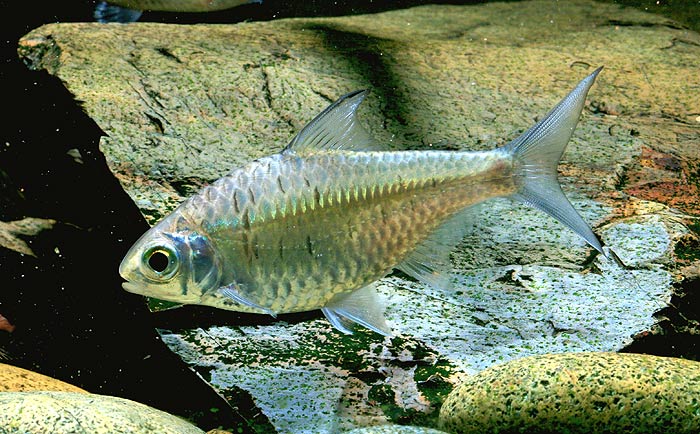
Mystacoleucus chilopterus
Fowler, 1935
Max length91mm SL3.6in SLTanknot recordedTempnot recordedpHnot recordedKnown from the middle Mekong basin in Laos and Thailand, including the Mun tributary drainage on the Khorat Plateau in northeastern Thailand, plus the Chao Phraya and Mae Klong watersheds in central and western Thailand, respectively. In the Mekong system it may also occur further upriver in Yunnan province, China, while the Khone Falls in Laos appear to represent its downstream limit.
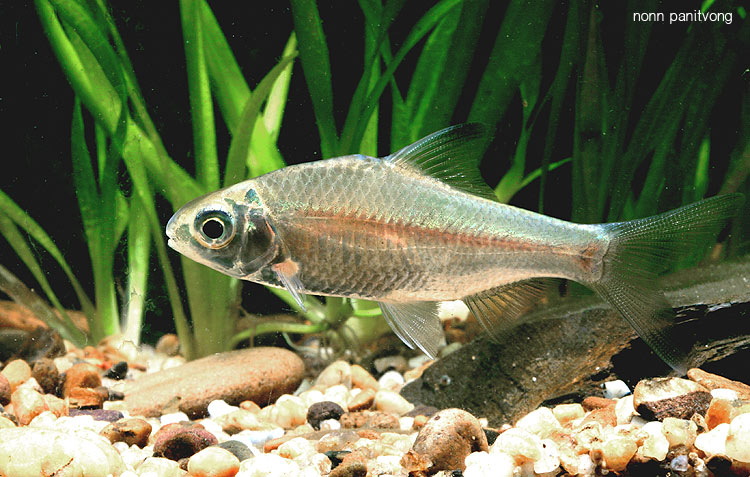
Mystacoleucus ectypus
Kottelat, 2000
Max length80mm SL3.1in SLTanknot recordedTempnot recordedpHnot recordedKnown from the middle Mekong basin in Laos and Thailand, and may be endemic to the Khorat Plateau. Records exist from the Mun and Songkhram watersheds in northeastern Thailand, and a number of Mekong tributaries in laos, including the Nam Mang and Nam Kou drainages. Type locality is 'Nam Mang downstream of Ban Thabok, between 18°22'25"N, 103°13'30"E, and about 1 kilometer upstream, Vientiane Province, Laos'.
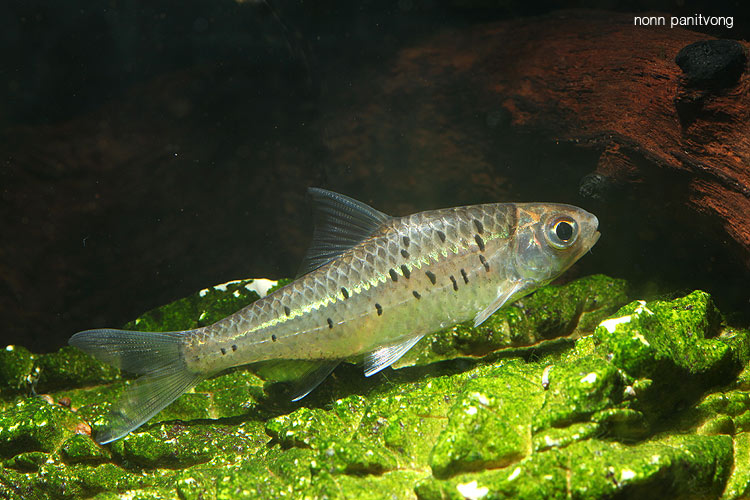
Mystacoleucus greenwayi
Pellegrin & Fang, 1940
Max length100mm SL3.9in SLTank120 × 45cm48 × 18inTemp20–27°C68–81°FpH6.0–7.5Predominantly a riverine fish favouring clear, well-oxygenated, running water with substrates of sand or gravel and often present in rock and boulder-filled headwater streams. In the Mun River, close to the Pak Mun dam, Thailand, sympatric species included Hampala dispar, Cyclocheilichthys apogon, Osteochilus hasseltii,...
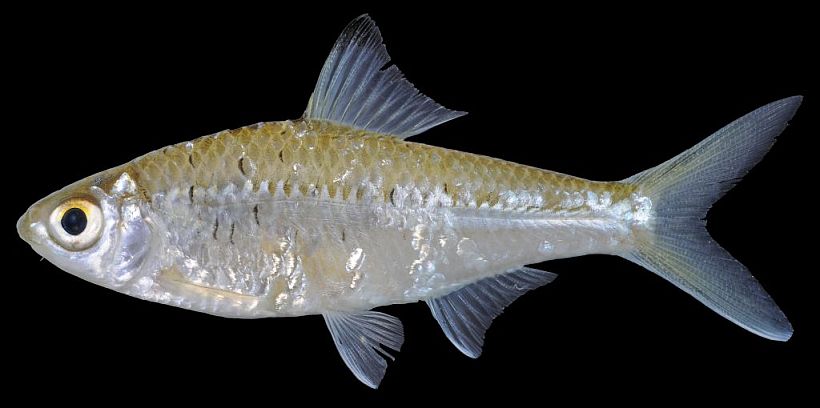
Mystacoleucus lepturus
Huang, 1979
Max length95mm SL3.7in SLTanknot recordedTempnot recordedpHnot recordedThis species can be distinguished from congeners by the following combination of characters: body relatively slender, depth fitting 3.4-3.8 times in SL; 32-33 + 2 lateral line scales; 14 circumpeduncular scale rows; presence of a single pair of barbels; black distal margin on dorsal-fin; numerous body scales with dark, crescent-shaped markings.
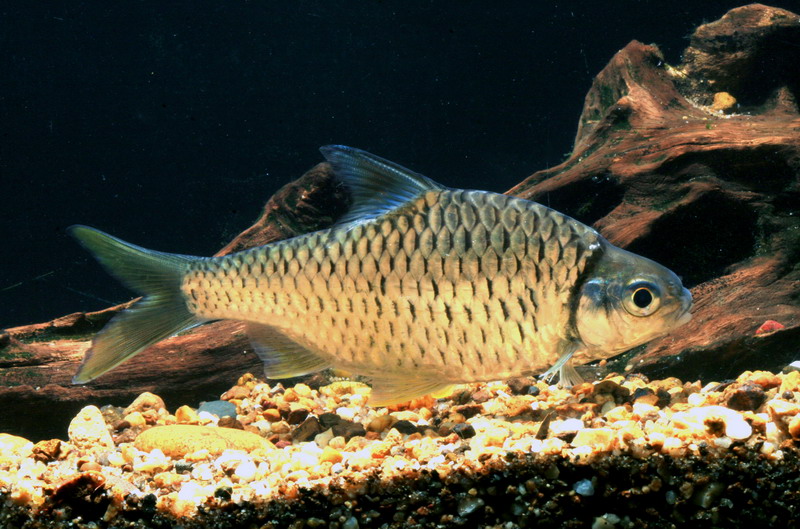
Mystacoleucus obtusirostris
Valenciennes, 1842
Max length140mm SL6in SLTank120 × 45cm48 × 18inTemp20–27°C68–81°FpH6.0–8.0This species is occasionally marketed as 'Burmese Rainbow Barb' in the ornamental trade. others may have been exported in small numbers or as bycatch among shipments of other species. It was referred to as Mystacoleucus marginatus for decades, but that name is a simultaneous subjective synonym of M. obtusirostris following Kottelat (2013).
Mystus bimaculatusTwo Spot Mystus
authority not recorded
Max length65mm SL2.6in SLTank45 × 30cm18 × 12inTemp23–30°C73–86°FpH4.0–6.5A delightful little species that deserves greater popularity in the hobby. All attempts at captive breeding should be encouraged, as its natural habitat is in danger of destruction by human activity.
Mystus bleekeriDay's Mystus
authority not recorded
Max length155mm SL6in SLTank120 × 30cm48 × 12inTemp18–26°C64–79°FpH5.8–8.0This species superficially resembles the more common (in the hobby) M. vittatus, but can be distinguished by its larger adult size and much longer adipose fin. It is an ideal peaceful catfish for larger communities and as with many other bagrids, is in our opinion somewhat underrated in the hobby....
Mystus leucophasisAsian Upside Down Catfish
authority not recorded
Max length300mm SL12in SLTank120 × 60cm48 × 24inTemp23–27°C73–81°FpH6.0–8.0Like some members of the African catfish genus Synodontis, this species spends the vast majority of it's time swimming in an inverted position. It is often seen for sale at only a couple of inches in length and may be confused with the popular (and much smaller) Synodontis nigriventris. It can easily be distinguished from this species by its patterning. It does not exhibit the or brown colours of the Synodontis and is a uniform black colour all over. Larger specimens may have some lighter c...
Mystus mysticetus
authority not recorded
Max length130mm SL5in SLTank120 × 30cm48 × 12inTemp22–27°C72–81°FpH6.0–7.0Apparently this species is often seen living and feeding with a congener, M. multiradiatus in large shoals. It is the only species of Mystus to possess laterally positioned eyes, all the others having their eyes in a dorsolateral position. It is an ideal peaceful catfish for larger communities and as with many other bagrids, is in our opinion somewhat underrated in the hobby....
Mystus rhegma
authority not recorded
Max length120mm SL5in SLTank90 × 30cm36 × 12inTemp22–26°C72–79°FpH6.5–7.5An irregular import and little is known about it's natural behaviour. It is however an ideal peaceful catfish for larger communities and as with many other bagrids, is somewhat underrated in the hobby.
Mystus singaringan
authority not recorded
Max length300mm SL12in SLTank120 × 45cm48 × 18inTemp22–27°C72–81°FpH5.6–7.0This large Mystus is not often seen in the hobby. It makes a fine bottom dweller for communities containing other robust species. It is used as a food fish in many of it's native countries....