Country · Africa
Republic of the Congo
Every profile recorded in Republic of the Congo, native or introduced.
- Species
- 9
- Families
- 5
- Genera
- 6
- Found only here
- 1
- Photographed
- 8 of 9
Where it isAfrica
Shares its fishes withspecies recorded in both
Found only here1
1 of these profiles carry Republic of the Congo and no other country. That is not the same as endemic. Most of these distributions are only half recorded.
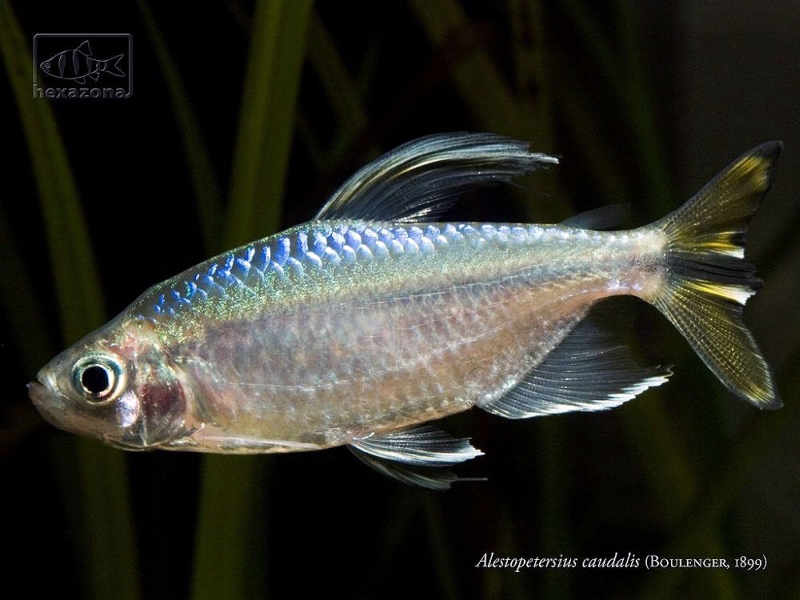
Alestopetersius caudalisYellow-Tailed Congo Tetra
Alestidae · Boulenger, 1899
This species is also traded as 'yellow-finned', 'yellowtail' or 'blue Congo' tetra and is occasionally bred on a commercial basis, although not on a scale comparable to its better-known relative Phenacogrammus interruptus. No recent key to the genus exists but based on Géry (1977) and images in Mbimbi Mayi Munene and Stiassny (2012) it can be told apart from congeners by a combination of: extended median caudal-fin rays in adult males; absence of prominent dar...
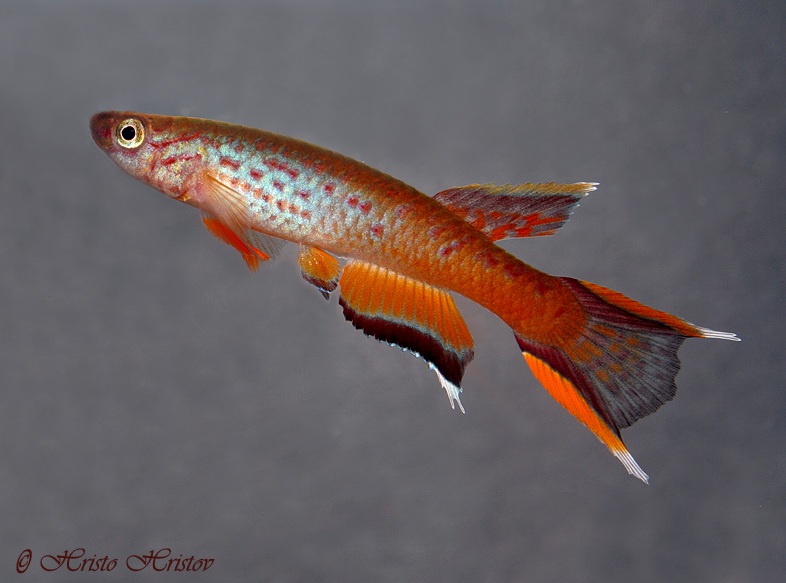
Aphyosemion australeGolden Lyretail
Nothobranchiidae · Rachow, 1921
Also known by the vernacular names You might also see it for sale as 'golden lyretail' or 'lyretail panchax, A. australe was among the first killifishes to become popular in the hobby and still a favourite today. There exist a number of wild forms which tend to be labelled with place and year of collection in order to preserve bloodlines and avoid hybridisation, as well as several ornamental strans including 'orange', 'gold', 'chocolate', and 'albino'.
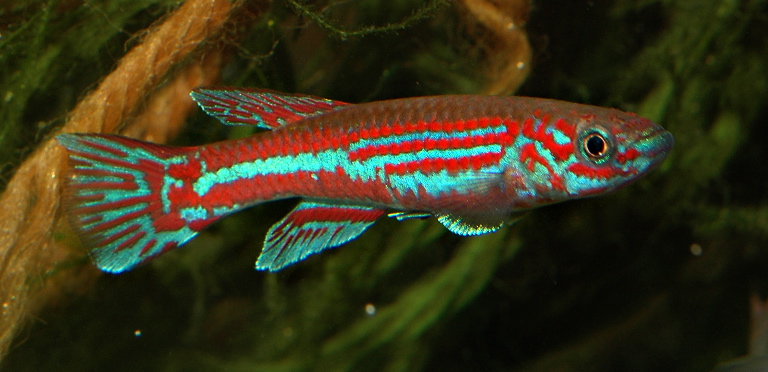
Aphyosemion ogoenseBroken-Line Lyretail
Nothobranchiidae · Pellegrin, 1930
This species is not an annual fish, being found in permanent bodies of water in nature. Over 20 different forms of it have been discovered at different localities and a handful have been given subspecific names. The most popular in the aquarium hobby include A. o. ottogartneri and A. o. pyrophore, both of which were initially described as separate species.
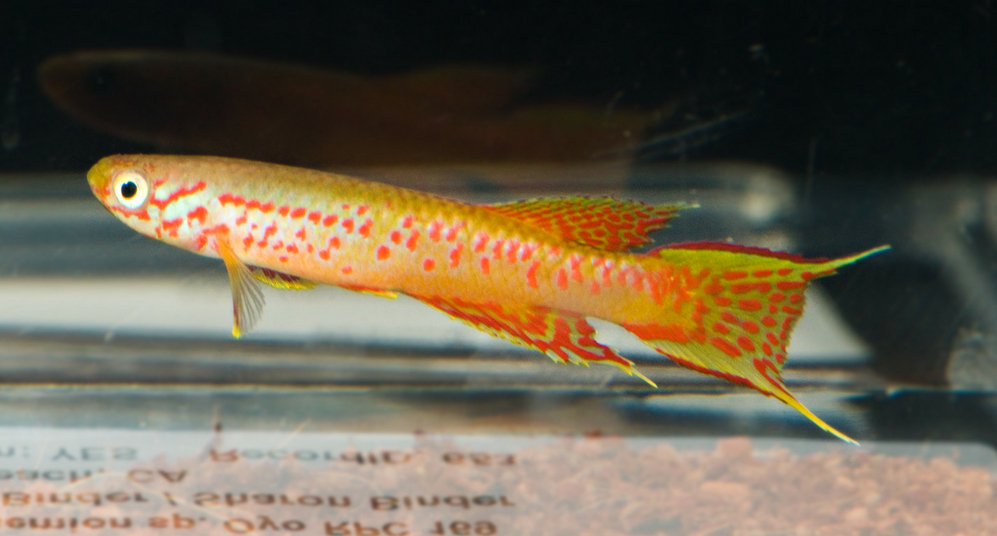
Aphyosemion sp. 'Oyo' RPC 91/8
Nothobranchiidae · authority not recorded
This fish may be synonymous with the congener A. castaneum. Collected for the aquarium hobby in 1991 from close to the town of Oyo, Cuvette department, Republic of the Congo. The town lies on the Alima River, a right bank tributary of the middle Congo system.
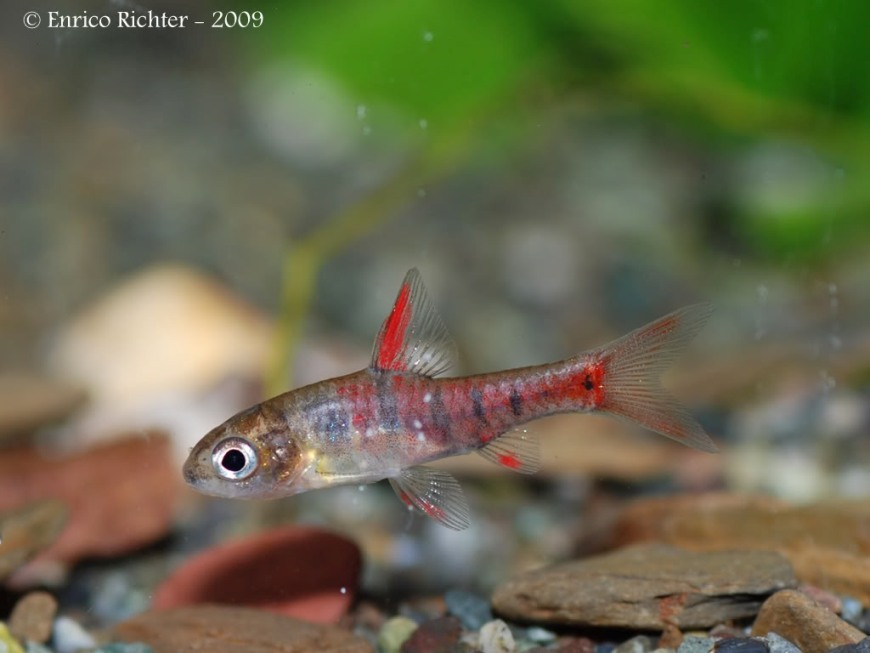
'Barbus' jae
Cyprinidae · Boulenger, 1903
Although gregarious by nature it is a shoaling rather than schooling species which develops a distinct pecking order between males. It should ideally be maintained in a group of 8 or more but the tank must be of a sufficient size which will allow weaker individuals some respite from dominant conspecifics and decorated in such a way that many broken lines of sight are provided. Conversely if kept singly, in a very small group or in cramped conditions it can become withdrawn and subdominant fish may be bullied incessantly.
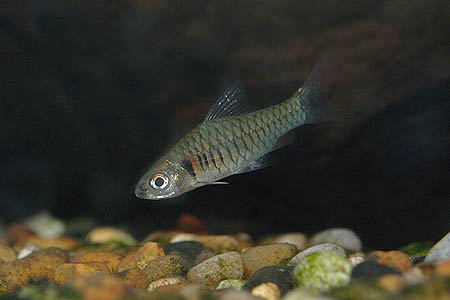
Clypeobarbus congicusCongo Barb
Cyprinidae · Boulenger, 1899
Clypeobarbus was originally put forward as a subgenus of Barbus by Fowler in 1936 on the basis that member species possessed a midlateral row of enlarged, shield-like scales but he only included the type species 'Barbus' kemoensis (now a junior synonym of Clypeobarbus pleuropholis) in the group. Subsequent work by Poll and Lambert (1961), Jubb (1965) and Skelton (1993) resulted in several additional species being placed into the grouping although it appears that little of this work was widely-recognised until the recent study was published.
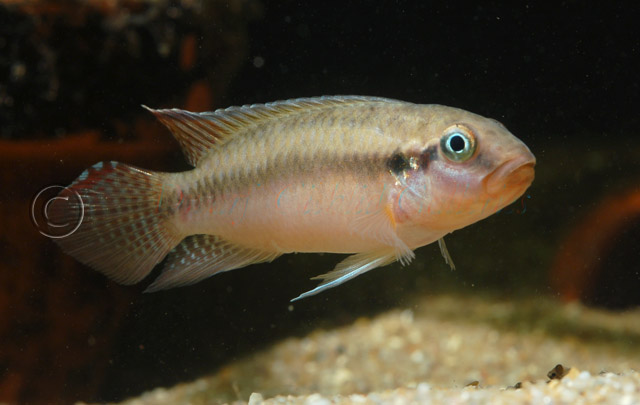
Congochromis sabinae
Cichlidae · Lamboj, 2005
This species was present in the hobby for some time prior to being officially described and the spectacular red fish first exported by Pierre Brichard in the 1960s appears to be a regional form of it. It was also known variously as Nanochromis sp. 'Bamanja', N. sp. 'Genema', N. sp. 'Makoua' and N. sp. Bloody Mary' prior to description, and continues to be mislabelled as N. squamiceps on trade lists. Diagnosis of C. sabinae is possible via a combination of c...
Ctenopoma acutirostreLeopard Bushfish
Anabantidae · Pellegrin, 1899
An ideal species for the newcomer to 'oddballs'. It is exceptionally hardy, long-lived (it can survive for over 15 years when cared for properly) and exhibits some interesting behaviour. It appears to have evolved convergently with leaf fish of the genera Polycentrus and Monocirrhus (they're not closely related). All these species mimic leaves and other aquatic debris to assist them in hunting their prey. If you add live food to its tank, you will see the typical stalking behaviou...
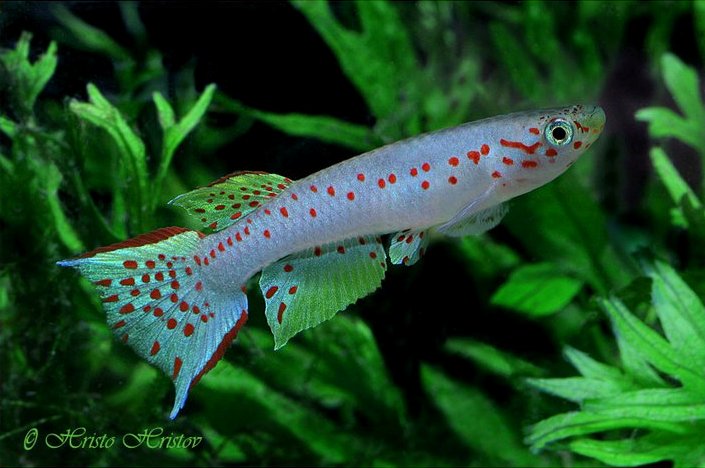
Aphyosemion decorseiDecorse's Lyretail
Nothobranchiidae · Pellegrin, 1904
Type locality is the settlement of Bessou, Lobaye prefecture, Central African Republic, which lies within the Ubangi (also spelled Oubangui) River basin. The Ubangi is a major tributary of the Congo River and this species appears restricted to its middle section and thus probably extends into northern Republic of Congo and Democratic Republic of Congo.