Results for “várzea”
Type a name: scientific, common, or one a species used to go by. Or narrow the catalogue with the filters.
Filters
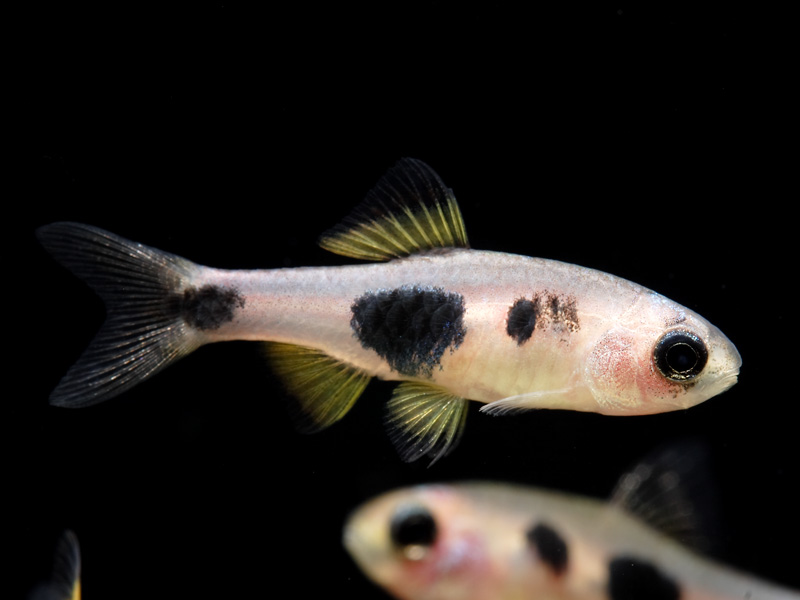
'Barbus' hulstaertiAfrican Butterfly Barb
Poll, 1945
Max length35mm SL1.4in SLTank45 × 30cm18 × 12inTemp17–24°C63–75°FpH5.0–6.5Two closely-related species are also found in the Congo basin and infrequently seen in the trade. 'B.' candens has been collected northeast of the range of 'B.' hulstaerti around the city of Kisangani (formerly Stanleyville) and nearby town of Yangambi. It can be distinguished from 'B.' hulstaerti by its paler body colouration, smaller dark markings on the body and red ventral and anal fins in males. 'B.' papillo is known only from its type locality close to the eastern town of Kindu between the Lualaba and Lomami rivers. It has an elongated central body marking and males possess black dorsal, ventral and anal fins.
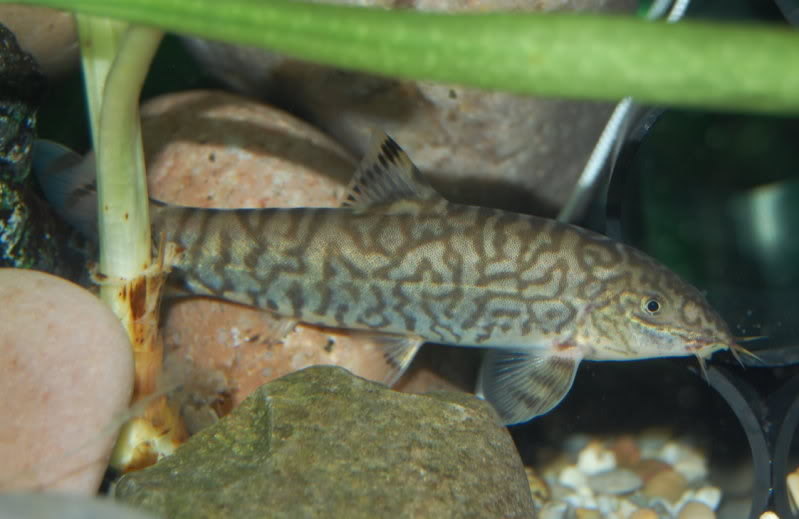
Botia almorhaeYo-Yo Loach
Gray, 1831
Max length160mm SL6in SLTank120 × 45cm48 × 18inTemp19–27.5°C66–82°FpH6.0–7.5The physical appearance of B. almorhae sensu stricto is something of a mystery. No pictures of live specimens appear in any scientific publications we've read and we've been unable to find a certified image of one anywhere meaning it's possibly never been seen in the aquarium trade. Instead the most commonly available members of the nominal species grouping seem to be B. lohachata, B. sp. 'Kosi' and B. sp. 'Teesta' (see individual notes below), plus the assorted hybrids that have appeared since the turn of the century (Grant, 2007).
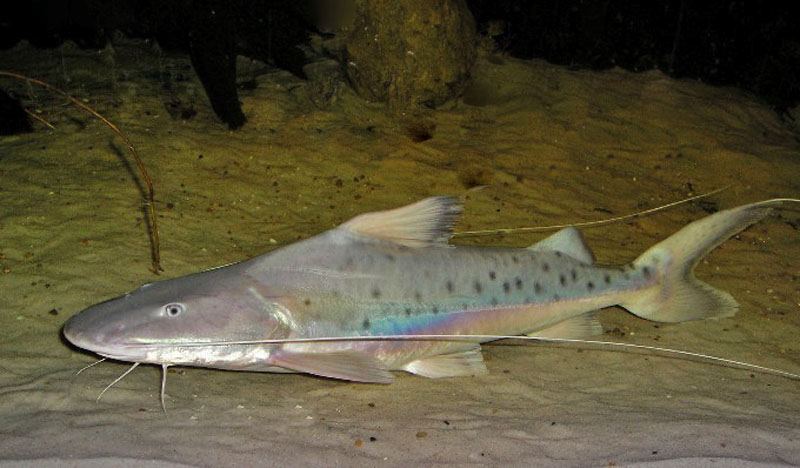
Brachyplatystoma capapretum
Lundberg & Akama, 2005
Max length880mm SL35in SLTanknot recordedTemp22–28°C72–82°FpH6.0–8.0This species can be told apart from the very similar-looking congener B. filamentosum by its smaller adult size (B. filamentosum can grow to almost 3 m in length), shorter maxillary barbels (never extending beyond base of adipose fin (vs. extending beyond base of adipose fin), moderately-forked with lobes of equal size (vs. deeply-forked caudal fin with upper lobe usually longer than the lower) and body col...
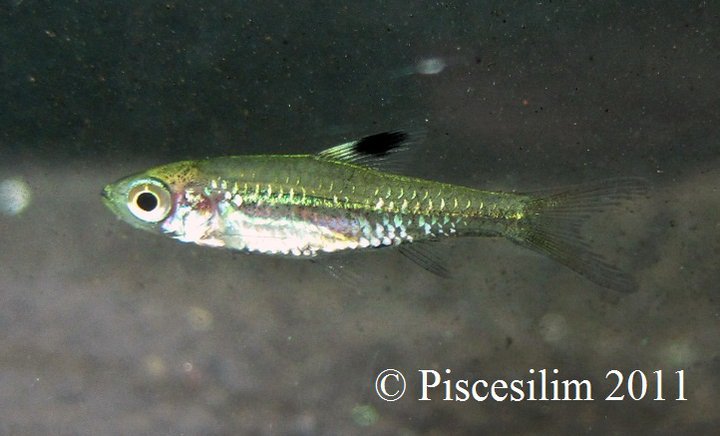
Brevibora cheeya
Liao & Tan, 2011
Max length55mm SL2.2in SLTank80 × 30cm31 × 12inTemp20–25°C68–77°FpH4.0–7.0This species is very rare in the trade and is normally imported only as bycatch among shipments of other fishes. It can be told apart from its well-known congener B. dorsiocellata by a combination of characters as follows: lateral line complete (25-30 pored scales vs. 4-9); more scales in the lateral row (29-32 vs. 25-27); larger adult siz...
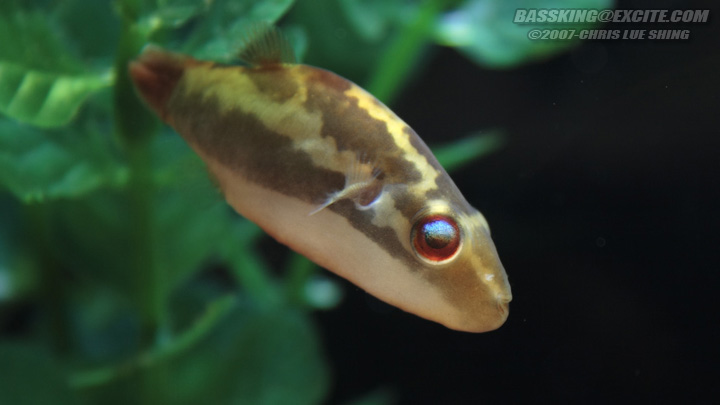
Carinotetraodon irrubescoRed-tailed Redeye Puffer
Tan, 1999
Max length45mm SL1.8in SLTank60 × 30cm24 × 12inTemp20–28°C68–82°FpH6.0–7.5This species is uncommon in the aquarium hobby. It is similar to the congeners C. borneensis and C. lorteti but can be told apart by males possessing a red (vs. bluish to greyish with black and white distal bands in C. lorteti) caudal-fin and lacking (vs. possessing) a black blotch at the base of the dorsal-fin.
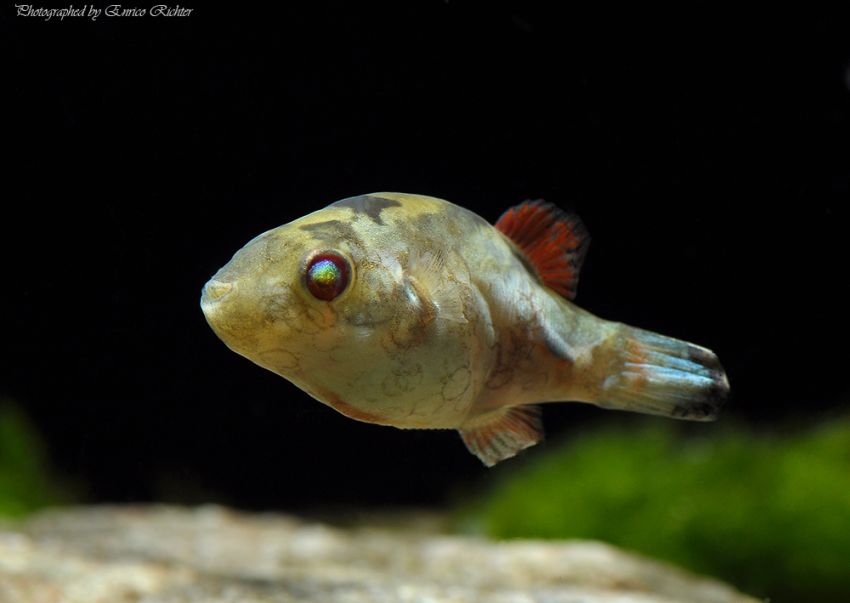
Carinotetraodon lortetiRedeye Puffer
Tirant, 1885
Max length60mm SL2.4in SLTank60 × 30cm24 × 12inTemp20–28°C68–82°FpH5.0–7.5Known from the lower Mekong basin in Thailand, Vietnam, and Cambodia, the Chao Phraya watershed in central Thailand, and may occur in smaller river systems between. Type locality is 'Thu-dâu-môt, Vietnam'.
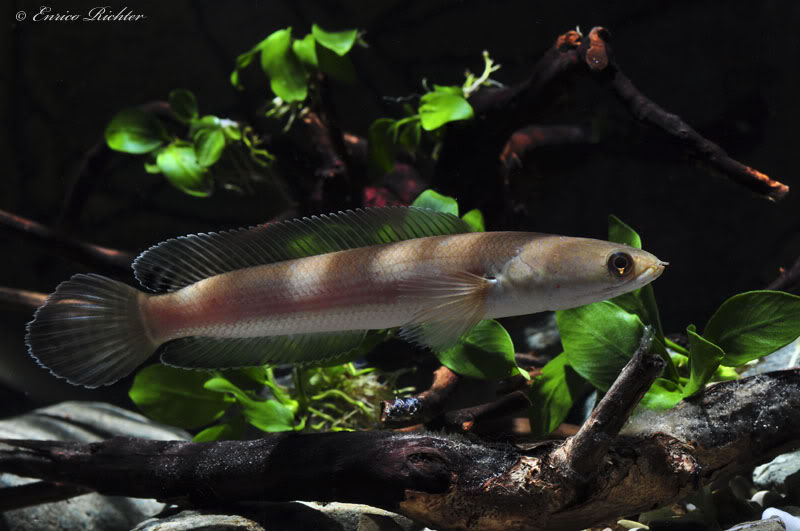
Channa melasomaBlack Snakehead
Bleeker, 1851
Max length300mm SL12in SLTank120 × 45cm48 × 18inTemp22–32°C72–90°FpH4.0–7.0This species can be told apart from the similar-looking congener C. baramensis (once considered synonymous with C. melasoma) by absence (vs. presence) of a black spot in the centre of numerous body scales and absence (vs. presence in specimens larger than 120 mm SL) of a barred caudal-fin pattern.
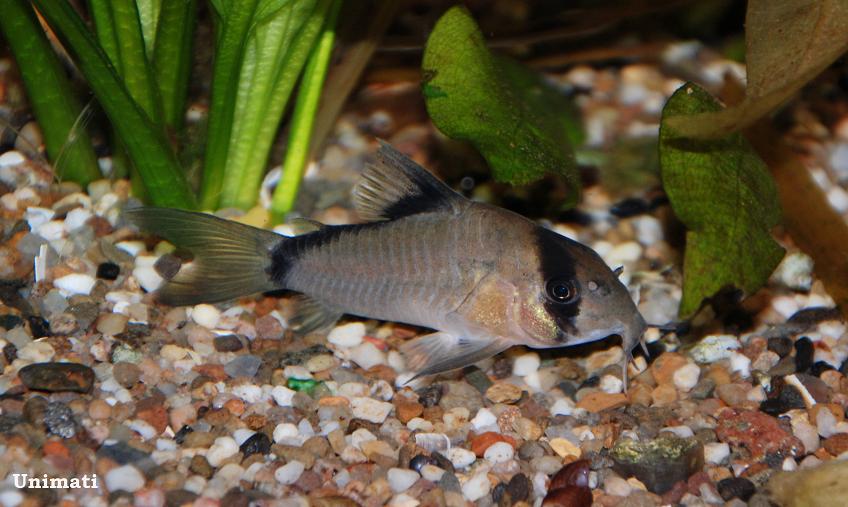
Corydoras metaeBandit Cory
Eigenmann, 1914
Max length50mm SL2.0in SLTank80 × 30cm31 × 12inTemp20–26°C68–79°FpH6.0–7.5Endemic to the Río Meta, a major tributary of the Río Orinoco in eastern Colombia and western Venezuela. It is known from several tributaries within the upper basin including the ríos Humea, Ocoa, Guatiquía (including its two branches the ríos Negrito and Guayuriba), Manacacias, and Metica (the name given to the upper Río Meta above its confluence with the Río Humea). It appears to be absent from the lower Meta and has not been recorded in Venezuela.
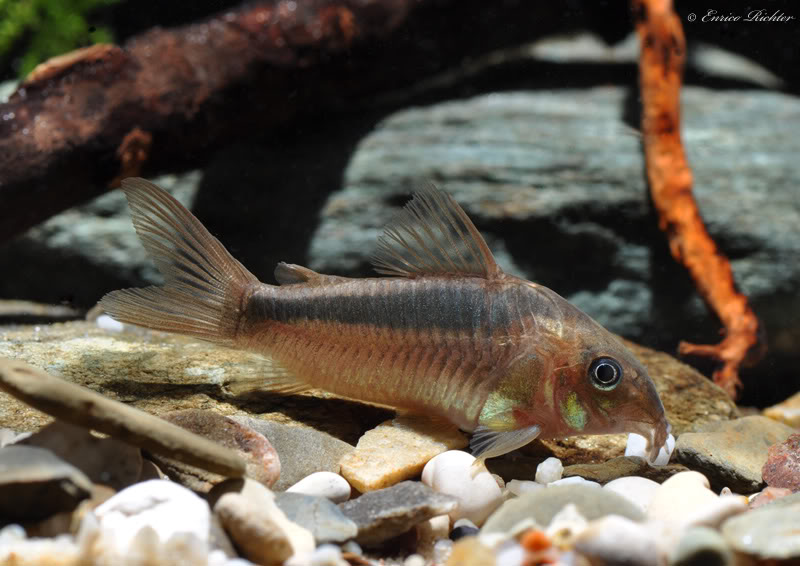
Corydoras rabautiRusty Cory
La Monte, 1941
Max length65mm SL2.6in SLTank90 × 30cm36 × 12inTemp20–27°C68–81°FpH5.5–7.2The broad dark stripe in the dorsal portion of the body extends into the ventral portion on the caudal peduncle, and this character can be used to distinguish it from the very similar-looking C. zygatus, with which it is often confused. In C. zygatus the dark stripe does not extend ventrally on the caudal peduncle and is present only on the dorsal part.
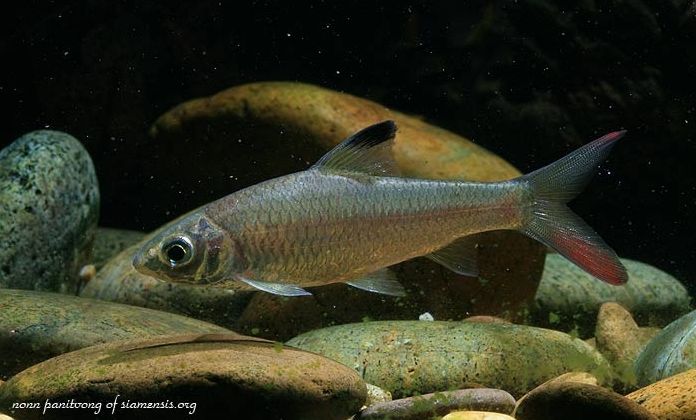
Discherodontus ashmeadi
Fowler, 1937
Max length135mm SL5in SLTank120 × 45cm48 × 18inTemp23–26°C73–79°FpH6.0–7.5D. ashmeadi is the type species and exhibits differences in dental morphology compared with other members of the genus. It can also be told apart from D. halei by the red/pink (vs. orange) colouration in the dorsal and anal fins and serrated (vs. smooth) dorsal spine. D. schroederi is also similar-looking but as it matures the prominent dark dorsal blotch fades to a thin dark distal band whereas in D. ashmeadi it is retained throughout life.
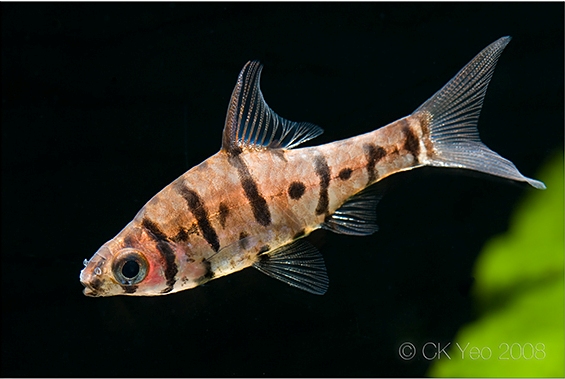
Eirmotus insignis
Tan & Kottelat, 2008
Max length36mm SL1.4in SLTank60 × 30cm24 × 12inTemp20–26°C68–79°FpH5.0–7.0Typically inhabits slow-moving, shallow, shady rainforest streams and swamps with dense submerged and marginal vegetation. The conditions are often rather turbid and the substrate composed of mud or fallen leaves, twigs and branches. Such environments characteristically contain soft, weakly acidic water and are often dimly-lit due to the rainforest canopy above. The fish are found sheltering among overhanging tree roots and aquatic vegetation.
Heteropneustes fossilisLiver Catfish
authority not recorded
Max length300mm SL12in SLTank120 × 45cm48 × 18inTemp21–25°C70–77°FpH6.0–8.0Also known as the stinging or fossil catfish, H. fossilis is not recommended to the inexperienced due to its venomous nature. The venom is contained in sacs at the base of the pectoral spines. A sting from one of these is very painful indeed, in some very rare cases fatal. It goes without saying that extreme care must be exercised when performing tank maintenance, or if you need to move the fish for any reason. If stung, the wound should be immersed in water as hot as you can stand, as this will...
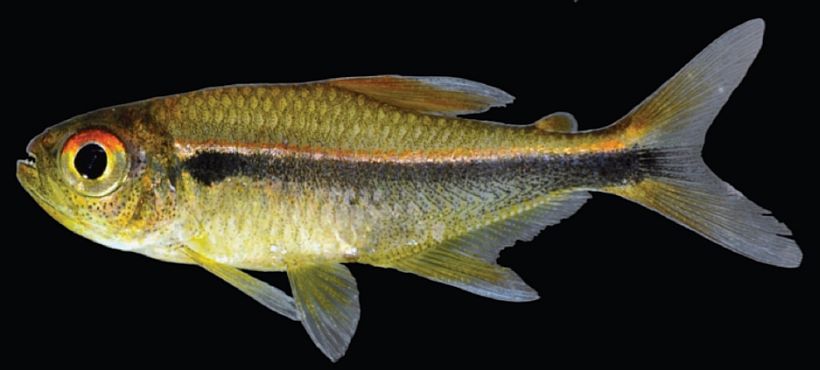
Hyphessobrycon eschwartzae
Román-Valencia & Ortega, 2013
Max lengthnot recordedTanknot recordedTempnot recordedpHnot recordedH. eschwartzae is told apart from other laterally-striped Hyphessobrycon species from the Madre de Dios watershed by the following characters: 4 simple anal-fin rays (vs. 3 in other species listed); 13-15 dentary teeth (vs. 5-11); 6 teeth in the internal premaxillary ro...
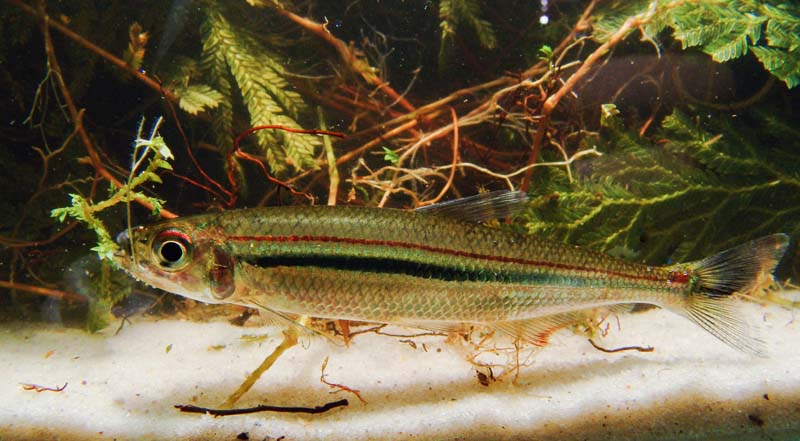
Iguanodectes geisleri
Géry, 1970
Max length55mm SL2.2in SLTank120 × 30cm48 × 12inTemp20–26°C68–79°FpH5.0–7.0I. geisleri is typically exported for the aquarium trade alongside the similar-looking congener I. adujai (Géry, 1970) but can be identified by presence (vs. absence in I. adujai) of a black lateral stripe on the body beneath the red stripe, and possession of 20-25 (vs. 28-34) anal-fin rays.
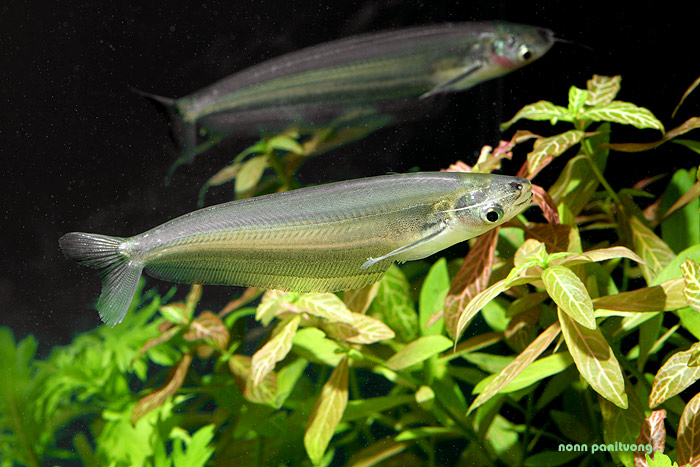
Kryptopterus geminus
Ng, 2003
Max length171mm SL7in SLTank150 × 45cm60 × 18inTemp20–28°C68–82°FpH6.0–7.5This species is likely to be traded for aquaria but probably misidentified as the very similar-looking K. cyrptopterus with which wild populations were formerly considered conspecific. These two are closely-related and can be distinguished from congeners by the dorsal profile lacking a nuchal concavity (vs. possessing a nuchal concavity) and possessing short maxillary barbels (extending to the pectoral-fin base vs. ext...
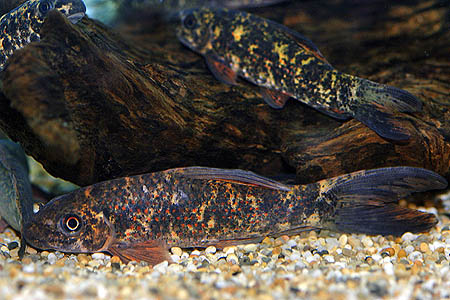
Labeo cyclorhynchusHarlequin Shark
authority not recorded
Max length160mm SL6in SLTanknot recordedTemp21–27°C70–81°FpH6.0–7.5L. cyclorhynchus was described twice in the space of two years, with Pellegrin erecting Labeo variegatus for it in 1901. Although the invalidity of the variegatus name is quite well-documented you may still see the species named as such in older literature, trade lists and by some websites. It's also worth noting that the attractive patterning seen in young fish does fade with age, the adults being much darker in colour. The genus Labeo currently contains over 100 species but is in dire ...
Leporacanthicus galaxiasGalaxy Plec
authority not recorded
Max length250mm SL10in SLTank120 × 45cm48 × 18inTemp22–26°C72–79°FpH5.6–7.0A very stylish looking plec, L. galaxias can also be seen for sale as the vampire or tusken plec. Both these names relate to features of morphology that are shared by all members of the genus. The latter arose from the presence of a characteristic growth on the head of the fish. The vampire moniker, meanwhile, is derived from the unique upper jaw dentition, consisting of, you guessed it, two large teeth or "fangs". The exact use for these is unknown, but they're probably utilised ...
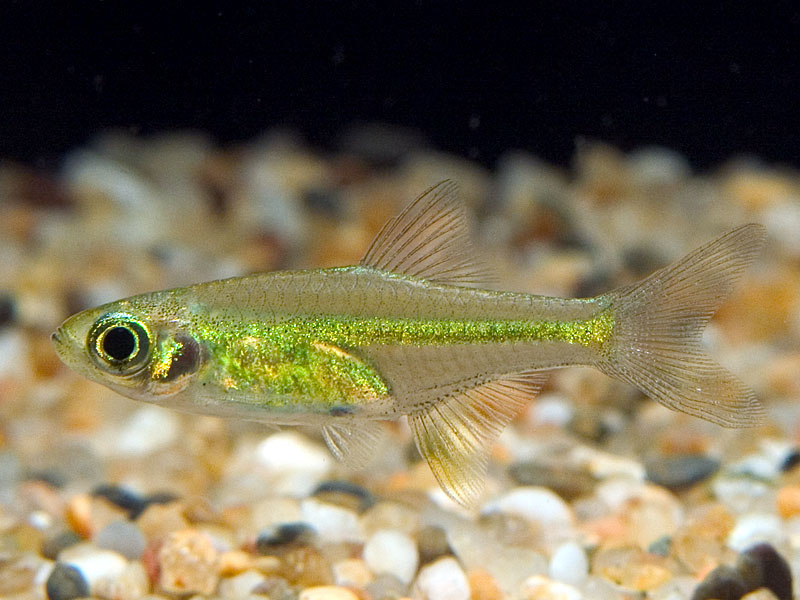
Microdevario kubotai
Kottelat & Witte, 1999
Max length20mm SL0.8in SLTank60 × 30cm24 × 12inTemp20–27°C68–81°FpH6.0–7.0Apparently inhabits calm to moderately-flowing stretches of well-oxygenated headwaters and minor tributaries. Such habitats tend to comprise transparent water, substrates of sand, gravel, rocks, boulders, and patches of leaf litter, with submerged driftwood, roots of riparian vegetation, and aquatic vegetation in places.
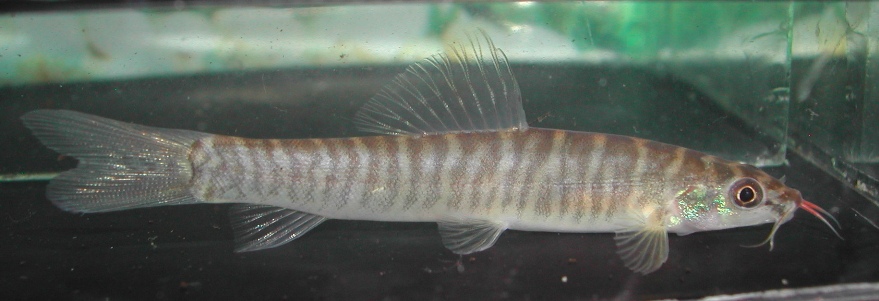
Nemacheilus platiceps
Kottelat, 1990
Max length61mm SL2.4in SLTank60 × 30cm24 × 12inTemp23–26°C73–79°FpH6.0–7.5This species is only traded occasionally. It's distinguished from congeners by a combination of characters including: 12-16 dark, irregular, vertical bars on body, usually split vertically; lips without furrows; inco...
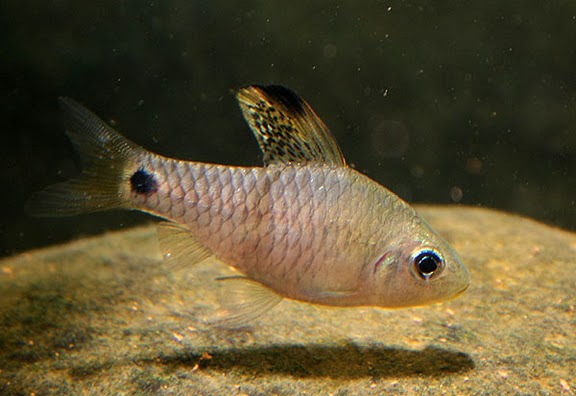
Oreichthys crenuchoidesDrape Fin Barb
Schäfer, 2009
Max length45mm SL1.8in SLTank60 × 30cm24 × 12inTemp23–28°C73–82°FpH6.0–7.5This fish is sometimes traded as Oreichthys cosuatis, O. sp. 'high fin', O. 'umangii' (a nomen nudum that has only ever been applied to an image of a fish in the book 'Ornamental Aquarium Fish of India'; K. L.Tekriwal and A. A. Rao 1999), Puntius 'arunavii' or 'neon highfin barb'. It can be distinguished from congeners by the following combination of characters: absence of a dark marking in the anal-fin (vs. presence in other species); ½7½ scales scales between pelvic-fin origin and dorsal midline (vs. ½6½ in O. cosuatis and...