Results for “species”
Type a name: scientific, common, or one a species used to go by. Or narrow the catalogue with the filters.
Filters
Potamotrygon orbignyiSmooth-back Stingray
authority not recorded
Max length375mm SL15in SLTanknot recordedTemp24–26°C75–79°FpH6.0–7.5P. orbignyi is one of the species often labelled as "teacup ray" in dealers' tanks. It can be tricky to identify when young, and we have seen it misidentified on numerous occasions. The species it resembles most closely is P. humerosa, although these can be distinguished by examining the skin of the fish. The texture of this is typically rough in P. humerosa and noticeably smooth in P. orbignyi. Provided you're sure what you're buying, it is one of the best species for t...
Potamotrygon scobinaMosaic Stingray
authority not recorded
Max length350mm SL14in SLTank180 × 75cm72 × 30inTemp24–26°C75–79°FpH6.0–7.5There are currently three genera in the family Potamotrygonidae, all of which hail from South America. Paratrygon and Plesiotrygon are both monotypic genera (contain only a single described species) and are rarely seen in the hobby. The vast majority of captive rays belong to the biggest genus, Potamotrygon. This contains 17 species at present, and its members are sometimes referred to as "big-eyed" stingrays for fairly obvious reasons. There are also a number of undescribed species th...
Protomelas fenestratusFenestratus
authority not recorded
Max length140mm SL6in SLTank120 × 45cm48 × 18inTemp24–28°C75–82°FpH7.6–8.8This species has an interesting method of feeding in nature. It will 'blow' sediment from the surface of rocks and feed on morsels that are uncovered. Protomelas sp. "steveni taiwan reef" is often sold as a subspecies of P. fenestratus but is actually thought not to be synonymous. P. taeniolatus is also very similar to fenestratus, and several colour forms of both these species exist. It is likely that some of these may be reclassified as distinct species in the future. None ...
Protomelas sp. steveni "Taiwan reef"
authority not recorded
Max length140mm SL6in SLTank120 × 45cm48 × 18inTemp24–28°C75–82°FpH7.6–8.8Protomelas sp. "steveni taiwan reef" is often sold as a subspecies of P. fenestratus, but is actually thought not to be synonymous and is currently undescribed. It can be distinguished from similar species such as P. fenestratus and P. taeniolatus by the bright redof adult males. None of these related species or morphs should be kept together in aquaria as they may hybridise. Some captive spawns of this species have resulted in albino fry. It is one of the more popular and readily a...
Pseudanos trimaculatusThree-spot Headstander
authority not recorded
Max length125mm SL5in SLTanknot recordedTemp23–27°C73–81°FpH6.0–7.5This species was formerly known as Anostomus trimaculatus and this name is still used in much of the available literature. It is now invalid, however. The genus Pseudanos contains 3 other known species, P. gracilis, P. irinae and the recently described P. winterbottomi. Care for these species is as for P. trimaculatus....
Rineloricaria fallaxWhiptail Catfish
authority not recorded
Max length155mm SL6in SLTank90 × 30cm36 × 12inTemp15–25°C59–77°FpH5.8–7.8One of the most common of the numerous species sold as 'whiptail catfish', R. fallax is an excellent species for the newcomer to Loricariids or catfish breeding. It's certainly not the most active species, but when settled and housed with the correct kind of tankmates is by no means shy either. In 2002 it was briefly placed in the resurrected genus Hemiloricaria, but this lasted less than twelve months, after which it was transferred back to Rineloricaria. Currently only Rinelo...
Rineloricaria lanceolataWhiptail Catfish
authority not recorded
Max length95mm SL3.7in SLTanknot recordedTemp25–28°C77–82°FpH6.0–8.0One of the most common of the numerous species sold as 'whiptail catfish', R. lanceolata is an excellent species for the newcomer to Loricariids or catfish breeding. It's certainly not the most active species, but when settled and housed with the correct kind of tankmates is by no means shy either....
Rineloricaria parvaWhiptail Catfish
authority not recorded
Max length110mm SL4in SLTank75 × 30cm30 × 12inTemp20–25°C68–77°FpH6.0–7.5One of the most common of the numerous species sold as 'whiptail catfish', R. parva is an excellent species for the newcomer to Loricariids or catfish breeding. It's certainly not the most active species, but when settled and housed with the correct kind of tankmates is by no means shy either. In 2002, it was briefly placed in the resurrected genus Hemiloricaria, but this lasted less than twelve months, at which point it was transferred back to Rineloricaria. Currently only Rin...
Salminus brasiliensisDorado
authority not recorded
Max length1000mm SL39in SLTanknot recordedTemp22–28°C72–82°FpH6.0–7.5The common name of this species is derived from the Portugese dourado and refers to the beautiful golden colour of the fish. We've included this species on the site purely because there have been an alarming number of juvenile fish showing up in some aquatic stores and, as a result, in hobbyists tanks. This species is simply not suited to captive life in any respect. If you see one for sale, and they are undeniably an attractive fish, please don't be tempted to buy it. As responsib...
Serrasalmus altuveiAltuvei
authority not recorded
Max length173mm SL7in SLTank120 × 45cm48 × 18inTempnot recordedpHnot recordedS. altuvei is very scarce in the hobby, most commonly being found among imports of juvenile S. rhombeus (the type species of the genus). It's also known as the "Caribe azul" or "blue caribe" in the trade. There are currently 24 described species of Serrasalmus, many of which look superficially similar. This one is considered a member of the "compressed group". This grouping of morphologically similar species currently comprises S. altuvei, S. geryi, S. compress...
Synodontis ocelliferOcellated Synodontis
authority not recorded
Max length200mm SL8in SLTank90 × 30cm36 × 12inTemp23–28°C73–82°FpH6.2–8.0S. ocellifer is often confused with other similar species of Synodontis but can be distinguished by the length of thewhich in this species is very long and runs from just past the base of the to just before the caudal fin. In recent years many alarming hybrids of this species have been appearing on the market and these should be avoided in our opinion. Besides being attractively marked this is one of the hardiest Synos available and is a good choice for the beginner....
Synodontis robbianus
authority not recorded
Max length130mm SL5in SLTank90 × 30cm36 × 12inTemp22–25°C72–77°FpH6.0–7.5S. robbianus is often confused with the similar but larger S. nigrita. They can be distinguished by the brownish base colour of this species as opposed to the greyer patterning exhibited by S. nigrita. It is also similar to several other Syno species, especially when juvenile. A hardy, adaptable species ideal for the newcomer to Synodontis but not often seen for sale....
Thayeria ifatiHalf-striped Penguin Tetra
authority not recorded
Max length50mm SL2.0in SLTank60 × 38cm24 × 15inTemp23–28°C73–82°FpHnot recordedThere are only three species in the genus Thayeria, of which T. ifati is the least often seen in the hobby. This is a shame as it's a very pretty little fish. The holotype was collected from the upper Rio Maroni, close to the settlement of Gaa Kabaon on the French Guiana/Suriname border by the famous ichthyologist Jacques Géry in 1957. Géry also described the species in 1959. Of its congeners, it was the type species T. obliqua that was originally given the common name of &quo...
Thayeria obliquaPenguin Tetra
authority not recorded
Max length80mm SL3.1in SLTank60 × 38cm24 × 15inTemp22–28°C72–82°FpHnot recordedThere are only three species in the genus Thayeria, of which Thayeria boehlkei is by far the most popular in the hobby. This is a shame, as T. obliqua is an equally attractive fish. It is the type species of the genus and was the original "penguin" fish or tetra, although Thayeria boehlkei is now usually sold under this name. T. sanctaemariae, described by Ladiges in 1951 is now classed as a synonym of T. obliqua. The species are easy to tell apart, as in Thayeria boehlkei the thic...
Trichogaster fasciataBanded Gourami
authority not recorded
Max length100mm SL3.9in SLTanknot recordedTemp21–28°C70–82°FpH6.0–7.5This species is a popular food fish in it's native countries. It is not often seen for sale these days, although it is both beautiful and peaceful. The alternative common name of 'Giant Gourami' is not particularly apt, although it is the largest species in the genus. Like others in the suborder Anabantoidei, the species possesses an accessory breathing organ known as the labyrinth organ. So-called due to its maze-like structure, this organ allows the fish to breathe atmospheri...
Xenotilapia simaBig-Eyed Xenotilapia
authority not recorded
Max length165mm SL6in SLTank120 × 38cm48 × 15inTemp23–27°C73–81°FpH8.0–9.5A rarely seen species in the hobby, X. sima is nevertheless a charming species for the peaceful Tanganyikan community. It feeds in a similar way to the well-known South American Geophagus species in that it will sift sand through its gills to extract invertebrates and morsels hidden in the substrate. It is quite a skittish fish and may react very nervously to rapid movements outside the tank or when lights are switched on and off....
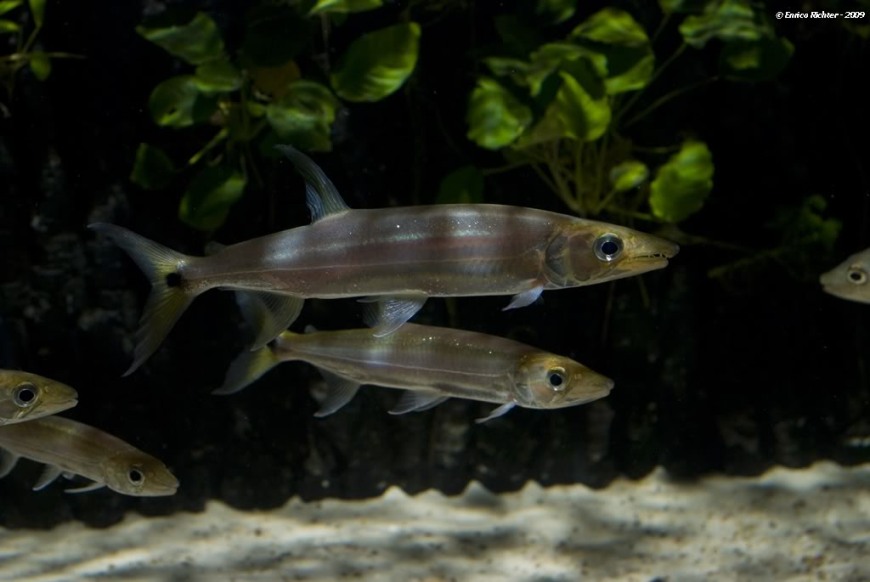
Acestrorhynchus falcirostrisBig-Eyed Cachorro
Cuvier, 1819
Max length350mm SL14in SLTank250 × 90cm98 × 36inTemp22–28°C72–82°FpH6.0–7.5This species is a member of the putative A. nasutus group of closely-related species within the genus alongside A. nasutus, A. maculipinna and A. isalineae. These are characterised by possession of two dark, longitudinal stripes, one running from the tip of the snout to the base and the other from the posterior edge of the lower maxilla to the underside of the caudal peduncle.
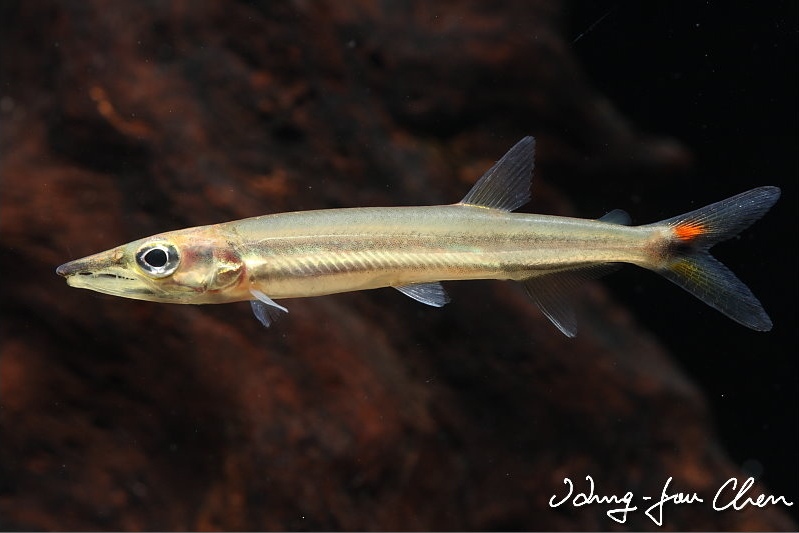
Acestrorhynchus isalineaeStriped Barracuda Tetra
Menezes & Géry, 1983
Max length105mm SL4in SLTank120 × 45cm48 × 18inTemp24–28°C75–82°FpH6.0–7.5This species is a member of the putative A. nasutus group of closely-related species within the genus alongside A. nasutus, A. maculipinna and A. isalineae. These are all characterised by possession of two dark, longitudinal stripes, one running from the tip of the snout to the base and the other from the posterior edge of the lower maxilla to the underside of the caudal peduncle.
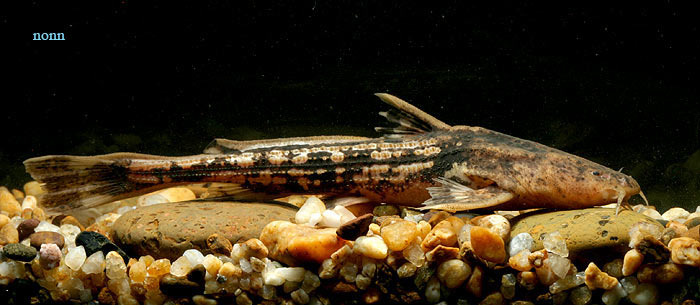
Acrochordonichthys gyrinusFalcate Chameleon Catfish
Vidthayanon & Ng, 2003
Max length80mm SL3.1in SLTank75 × 30cm30 × 12inTemp17.5–24°C64–75°FpH5.0–7.0As in other members of the genus body colouration in this species is variable, even among individuals collected from a single locality, although a few regularities have been observed which can be used to distinguish certain species from one another. This is thought related to the fact that Acrochordonichthys spp. periodically shed their skins and appear paler post-moulting.
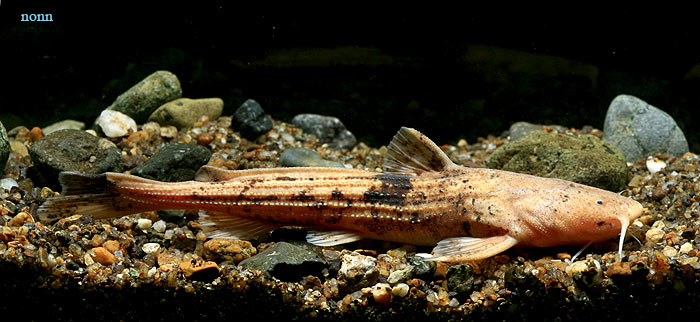
Acrochordonichthys septentrionalisMae Klong Chameleon Catfish
Ng & Ng, 2001
Max length100mm SL3.9in SLTank90 × 30cm36 × 12inTemp17.5–24°C64–75°FpH5.0–7.0As in other members of the genus body colouration in this species is variable, even among individuals collected from a single locality, although a few regularities have been observed which can be used to distinguish certain species from one another. This is thought related to the fact that Acrochordonichthys spp. periodically shed their skins and appear paler post-moulting.