Rineloricaria parva
Whiptail Catfish
Last revised 2012Edit this page
On this page11 sections
Quick factsEdit
Difficulty4 of 8 measures
- Space
- medium tank
- Water
- flexible
- Temp
- flexible
- Diet
- unknown
- Temperament
- peaceful
- Social
- unknown
- Compatibility
- unknown
Other demands
Each of these can raise the rating on its own, whatever the measures above say.
- Hardiness
- unknown
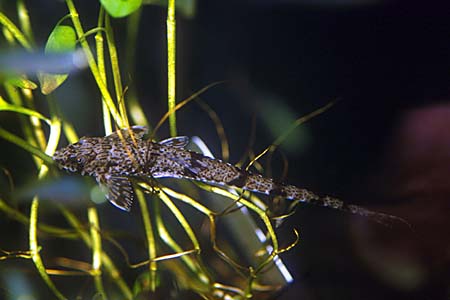
Rineloricaria parva is a whiptail catfish from Brazil, Paraguay and Argentina, found among leaf litter over sandy substrates. Commonly sold as a 'whiptail catfish', it is difficult to identify: the true R. parva has dark bands across the top of the body only and filaments on the top and bottom of the caudal fin. Some fish seen for sale may be hybrids with other species.
Distribution
EditHabitat
Write a noteEditIt's almost always found living amongst leaf litter over sandy substrates, in both clear and whitewater habitats (whitewater meaning water containing a lot of dissolved sediment, as opposed to rapids).
Aquarium size
Write a noteEditLargely inactive and a small group can can be kept in a tank of around 75 ∗ 30 ∗ 30 cm30 ∗ 12 ∗ 12 in - ~68 litres~18 US gal in size.
Maintenance
Write a noteEditA biotope setup can consist, very simply, of a layer of sand over which is scattered a layer of dried leaves (oak and beech are non-toxic and work particularly well). Some twisted branches (again, beech is good) and the occasional rounded stone can be used for effect. Provide some rock or wood caves, or lengths of pvc piping to act as potential spawning sites. It's equally at home in a well-planted tank, although in either situation it won't appreciate very bright lighting.
Water conditions
EditTemperature: 20 – 25 °C68 – 77 °F
pH: 6.0-7.5
Hardness: 2-15°H
These recommendations come from this profile’s own figures. They contain affiliate links, so we may earn a commission.
Diet
Write a noteEditFeeds on aufwuchs and small aquatic crustaceans in nature. In the aquarium it proves omnivorous and will accept both sinking dried foods, vegetable matter including blanched spinach, courgette, kale etc., and live and frozen fare, such as bloodworm or daphnia.
Behaviour and compatibility
Write a noteEditOne of the most peaceful catfish around, these can be combined with many other species. In a biotope setup good tankmates include small characins, Apistogramma, Corydoras and other quiet Loricariids, but it can be kept in most communities of peaceful fish. Don't keep it with anything too vigorous or aggressive as it will become very retiring, and will easily be out-competed for food. It's not territorial unless spawning, and is best kept in a small group. When selecting tankmates, bear in mind it does not do well at higher temperatures.
Sexual dimorphism
Write a noteEditMature males develop odontotes on the head and pectoral rays, which are lacking in females.
Reproduction
Write a noteEditIf kept in suitable conditions and fed well, the fish will breed quite easily, although the fry can be a little tricky to raise. Try starting with a group of 6 or more juvenile fish to give yourself the best chance of obtaining a pair. Set up the tank as suggested above, using lengths of pvc piping of less than 2" diameter to provide spawning caves. The water should be just on the acidic side of neutral and soft. Condition the fish on a diet of nutrient-rich greenstuffs, such as kale, spinach etc. and live and frozen bloodworm or similar.
When in spawning condition, a male will select a particular cave and clean it carefully. A receptive female will visit this cave and deposit her eggs, which the male then fertilises. The female then plays no further part in broodcare, with responsibility for the guarding and tending of the eggs falling solely to the male. This he does diligently, guarding the cave against intruders, whilst fanning the eggs with his fins. At this point, you may wish to remove the other fish, or indeed the tube itself to a separate tank, in order to avoid predation of the fry.
The eggs hatch in 4-5 days, and are free swimming 2 or 3 days later, at which point the male can now also be removed. They will browse on cucumber slices, spinach and other greens straight away. They will also take microworm and brine shrimp nauplii. The most important thing at this point is that the fry don't starve. They need constant access to a food source, and any vegetable matter must be of a consistency soft enough for them to digest. Try pre-softened leaves of kale and spinach (it's better to soften these by soaking them in water for a couple of days, as blanching in boiling water tends to strip many of the nutrients away), or algae grown on rocks in a sunlit tank. They are also sensitive to water quality, and small daily water changes are recommended.
If you're having trouble spawning these fish, try conducting a large (50-70%) water change with cool water, simulating the infux of colder water the rainy season brings in nature. Repeat every few days and the fish will often spawn.
Notes
EditOne of the most common of the numerous species sold as 'whiptail catfish', R. parva is an excellent species for the newcomer to Loricariids or catfish breeding. It's certainly not the most active species, but when settled and housed with the correct kind of tankmates is by no means shy either.
In 2002, it was briefly placed in the resurrected genus Hemiloricaria, but this lasted less than twelve months, at which point it was transferred back to Rineloricaria. Currently only Rineloricaria is valid, but you'll still see it being referred to as Hemiloricaria quite often.
Not only this, but it's a diificult fish to identify correctly. The true R. parva should show a combination of dark bands across the top of the body only and filaments on the top and bottom of the caudal fin. There are also differences in the arrangement of the ventral scutes between members of the genus. It's still not easy, though, and some of the fish seen for sale may even be hybrids with other species.
Species images · 1
These photographs are used with each photographer's permission.
Send a photographProfile completeness18 of 24
75% complete
Also missing: a recorded distribution, taxonomic authority, etymology.
Community
Questions about Rineloricaria parva?
Ask on Discord