Results for “aquarium”
Type a name: scientific, common, or one a species used to go by. Or narrow the catalogue with the filters.
Filters
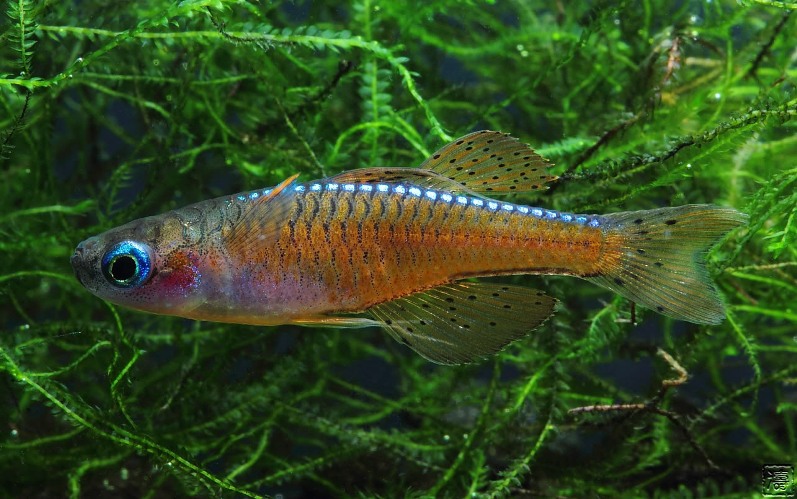
Pseudomugil sp. 'red neon'
authority not recorded
Max length35mm SL1.4in SLTank45 × 30cm18 × 12inTemp18–26°C64–79°FpH6.5–7.5This fish first appeared in the aquarium hobby in 2011 and has been traded under various names including P. sp. cf. paskai, P. sp. 'red orange neon', P. sp. 'neon orange', P. sp. 'Irian' and P. 'iriani'. The majority of fish available tend to be male, presumably due to their brighter colour pattern. It was initially suspected to be a hybrid or sele...
Pseudoplatystoma fasciatumBarred Shovelnose
authority not recorded
Max length1040mm SL41in SLTanknot recordedTemp22–26°C72–79°FpH6.0–7.6It's debatable as to whether this species should be considered an aquarium subject at all, given its eventual size. All too often juveniles are sold without adequate information regarding their long term care. These cats can and will attain something close to their maximum size in captivity, and will do so quite quickly. The myth that they will only grow to match the size of the tank they're kept in is just that - a myth. It's also worth noting that species such as this can live f...
Pseudoplatystoma tigrinumTiger Shovelnose
authority not recorded
Max length1050mm SL41in SLTanknot recordedTemp22–26°C72–79°FpH6.0–7.6It's debatable as to whether this species should be considered an aquarium subject at all, given its eventual size. All too often juveniles are sold without adequate information regarding their long term care. These cats can and will attain something close to their maximum size in captivity, and will do so quite quickly. The myth that they will only grow to match the size of the tank they're kept in is just that - a myth. It's also worth noting that species such as this can live f...
Pseudotropheus demasoni
authority not recorded
Max length75mm SL3.0in SLTank120 × 45cm48 × 18inTemp24–28°C75–82°FpH7.6–8.8This dwarf mbuna is one of the more recent introductions into the hobby, being described only in 1994. It is not recommended for the beginner due to its pugnacious nature, but does make a good aquarium subject for the advanced aquarist. It exhibits some very entertaining behavioural traits, preferring to hug the rock surfaces much more than most mbuna. It will often be seen swimming on its side or upside down as it explores caves and crevices. As with other members of the genus, it possesses fla...
Pseudotropheus elongatusElongate Mbuna
authority not recorded
Max length135mm SL5in SLTank120 × 38cm48 × 15inTemp24–28°C75–82°FpH7.6–8.8Over 30 different forms of this species occur in Lake Malawi. These should not be mixed in the aquarium as they will hybridise freely. P. elongatus differs morphologically from other mbuna, being relatively slender and elongate. In nature females protect territories which contain 'gardens' of algae which they leave to breed before returning once they are holding eggs. Juvenile fish from previous spawns also inhabit the territory, protecting it when the female is away. This species i...
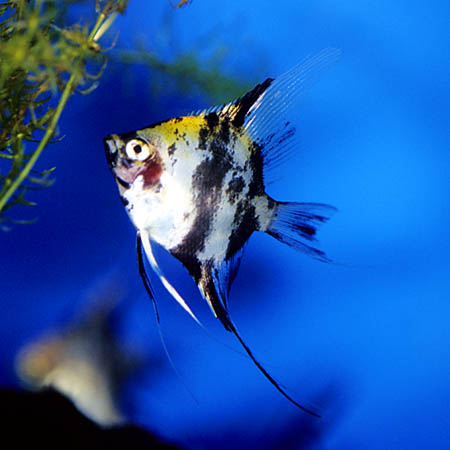
Pterophyllum "scalare"Angelfish
authority not recorded
Max length150mm SL6in SLTank100 × 40cm39 × 16inTemp24–30°C75–86°FpH6.0–7.4A well known and popular aquarium fish. Angels are available in a number of colour forms including black, gold and koi strains, in addition to the standard silver. It is worth remembering that although angels are generally peaceful, they are still cichilds so some aggression should be expected from time to time.
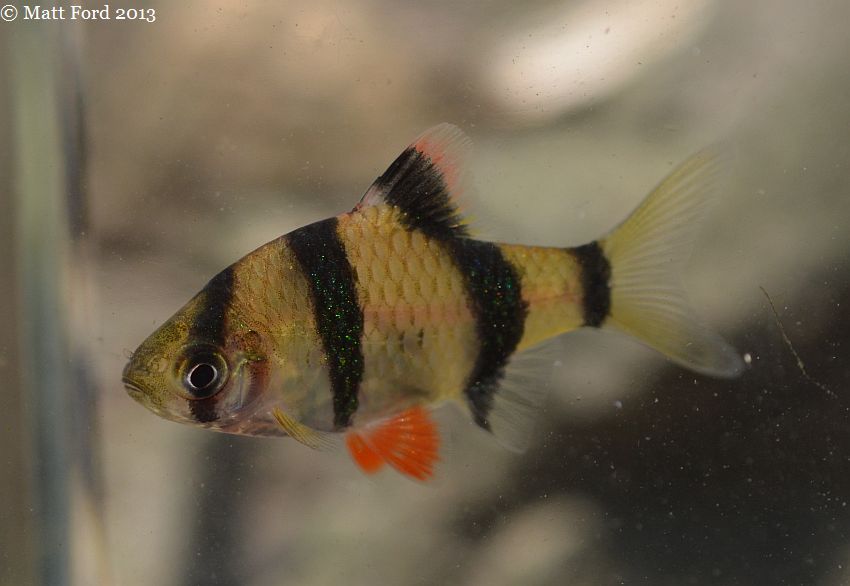
Puntigrus anchisporus
Vaillant, 1902
Max length60mm SL2.4in SLTank80 × 30cm31 × 12inTemp20–26°C68–79°FpH5.5–7.0This species occasionally appears in the aquarium hobby, but the trade is largely reliant on commercially-produced 'tiger barbs' of questionable origin. It is distinguished from congeners by the following combination of characters: lateral line complete; 14 circumpeduncular scales; 21-23+2 scales in the lateral row; dorsal-fin black with red outer band; pelvic fins red.
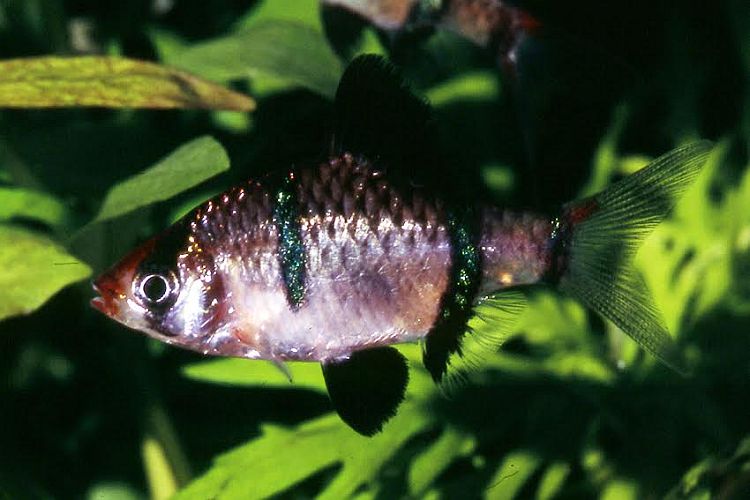
Puntigrus pulcher
Rendahl, 1922
Max length60mm SL2.4in SLTank80 × 30cm31 × 12inTemp20–26°C68–79°FpH5.0–7.5This species occasionally appears in the aquarium hobby, but the trade is largely reliant on commercially-produced 'tiger barbs' of questionable origin. It was considered a synonym of P. anchisporus for a number of decades following Alfred (1963), but revalidated by Kottelat and Tan (2011).
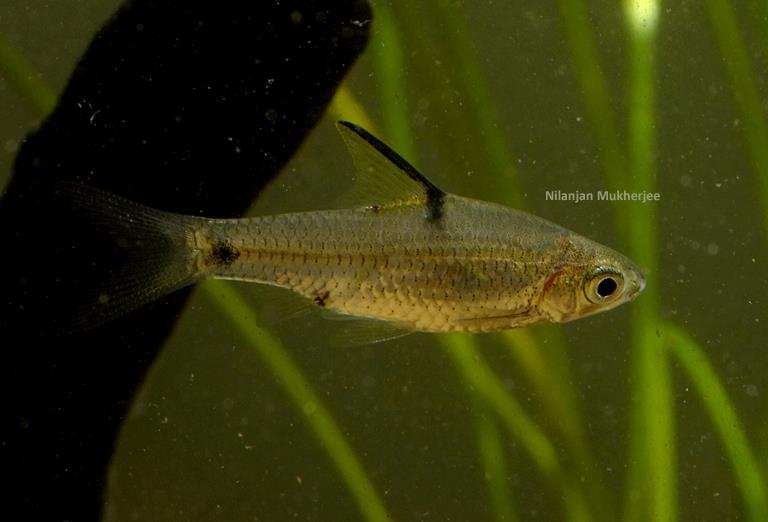
'Puntius' guganioGlass Barb
Hamilton, 1822
Max length65mm SL2.6in SLTank75 × 30cm30 × 12inTemp18–26°C64–79°FpH6.0–7.5Probably a micropredator feeding on small insects, worms, crustaceans and other zooplankton in nature. In the aquarium it should accept dried foods of a suitable size but should not be fed these exclusively. Daily meals of small live and frozen fare such as Daphnia, Artemia, Moina, etc., along with good quality flakes and granules will result in the best colouration and encourage the fish to come into breeding condition.
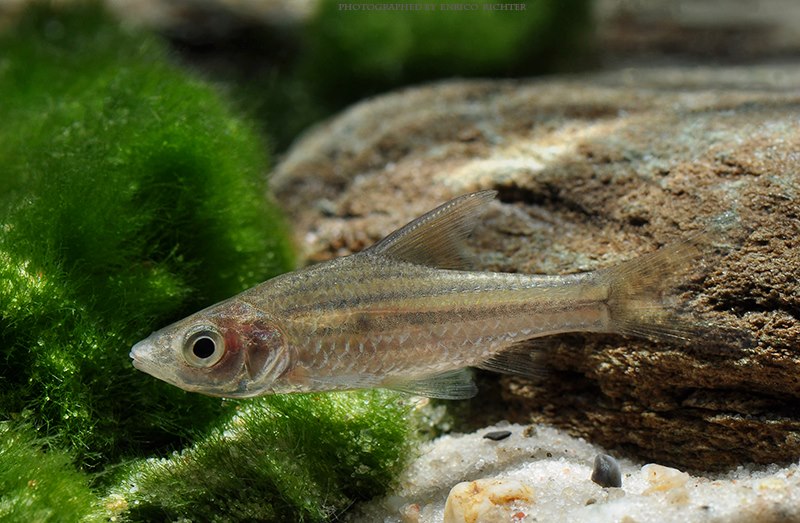
'Puntius' lineatusLined Barb
Duncker, 1904
Max length55mm SL2.2in SLTank80 × 30cm31 × 12inTemp20–26°C68–79°FpH4.0–7.0One of four similar-looking, laterally-striped 'Puntius' spp. native to Southeastern Asia alongside 'P.' gemellus, 'P.' johorensis, and 'P.' trifasciatus. Of these 'P.' lineatus is most often confused with 'P.' johorensis by virtue of the fact that these two seem most common in the aquarium trade. Telling them apart is relatively simple since 'P.' lineatus has 0 - 1 pairs of barbels (vs. 2 pairs in the other three species), juv...
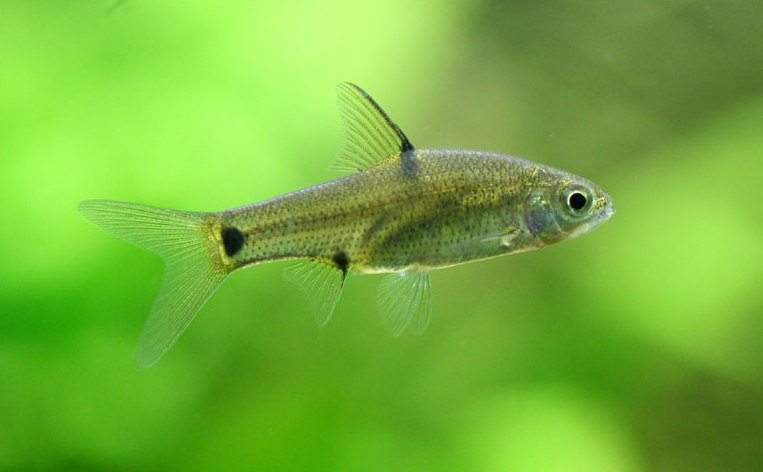
Puntius sharmai
Menon & Rema Devi, 1993
Max length40mm SL1.6in SLTank60 × 30cm24 × 12inTemp20–26°C68–79°FpH5.5–7.5This species is almost unheard of in the aquarium hobby outside of India but is maintained by some private collectors. It's distinguished from similar species by possessing a single pair of maxillary barbels, a relatively elongate body, and distinctive black spot above the anterior anal-fin base. The genus Puntius was for a number of years viewed as a polyphyletic catc...
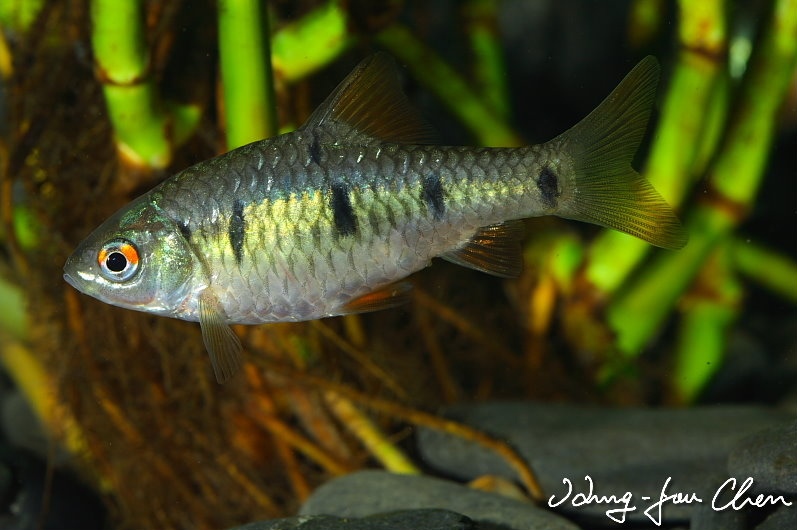
'Puntius' snyderi
Oshima, 1919
Max length75mm SL3.0in SLTank90 × 30cm36 × 12inTemp18–24°C64–75°FpH6.0–8.0This species is almost identical to the wild form of 'P.' semifasciolatus which is best known as the 'golden barb' in the aquarium hobby due to the popularity of a yellowish ornamental strain. The natural colour pattern is greenish in both species, however, and in terms of external characters they're only reliably distinguished by the fact that 'P.' semifasciolatus possesses a pair of prominent maxillary barbels wherea...
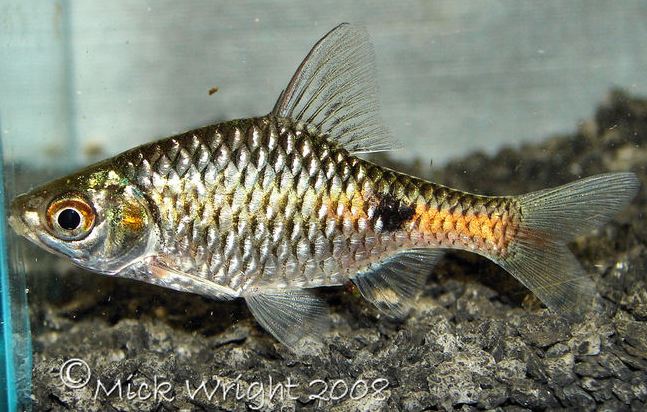
Puntius terioOnespot Barb
Hamilton, 1822
Max length90mm SL3.5in SLTank80 × 30cm31 × 12inTemp18–26°C64–79°FpH6.5–7.5This species is uncommon in the aquarium trade which is a little surprising given its huge natural range. Different populations can vary in colour pattern to an extent though all share the defining aspects given by Hamilton, comprising a diffuse yellow-golden marking on the operculum plus a dark spot on the caudal peduncle. The latter is usually surrounded by a variably-sized golden-yellow margin, and the dorsal-fin often contains irregular dark spots and streaks, these sometimes forming a longitudinal band.
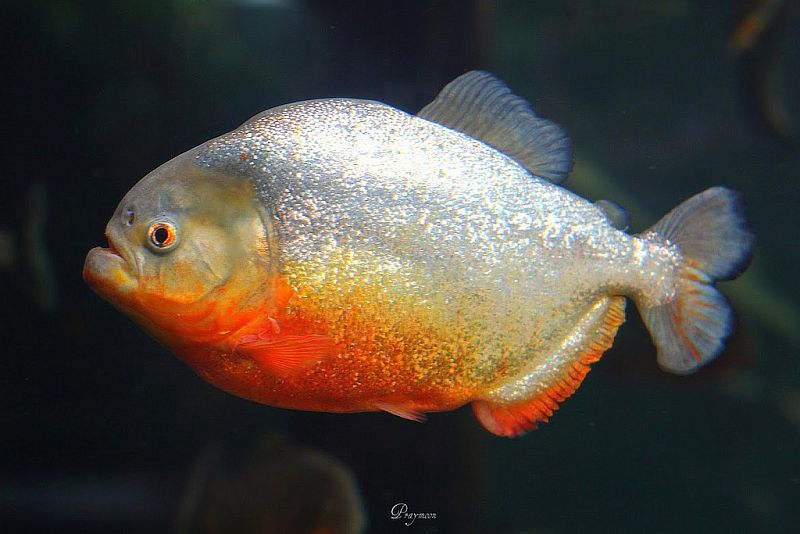
Pygocentrus nattereriRed Bellied Piranha
Kner, 1858
Max length350mm SL14in SLTank240 × 90cm96 × 36inTemp24–28°C75–82°FpH5.5–7.5Famed as a rapacious predator capable of rapidly stripping flesh from bone and a danger to any animal entering its native waters, P. nattereri is among the most notorious freshwater fishes in the world. As a result, displays featuring this “bloodthirsty” creature are found in most public aquaria, grisly Hollywood movies have been released, and the species has become popular in the aquarium trade. Little of this infamy is based on factual evidence, however.
Rasbora paviana
authority not recorded
Max length90mm SL3.5in SLTank120 × 30cm48 × 12inTemp22–26°C72–79°FpHnot recordedIn much of the literature this species is pictured with the invalid name R. paviei, due to an issue with spelling which was corrected by Kottelat (2005), and the common name 'sidestripe rasbora' although the latter has yet to find popularity in the aquarium hobby. There are a number of similar-looking species including R. sumatrana, R. hobelmani and R. laticlavia and it can be problematic to separate members of this 'group'. If the collection locality of the fish is known ide...
Rasbora rubrodorsalis
authority not recorded
Max length30mm SL1.2in SLTank45 × 30cm18 × 12inTemp24–28°C75–82°FpHnot recordedR. rubrodorsalis occurs sympatrically with the very similar-looking R. borapetensis over some of its natural range but is much the rarer of the two in the aquarium hobby. They are easily distinguishable from one another because R. rubrodorsalis has a bright red blotch in thewhilst in R. borapetensis the dorsal is colourless and only the base of the is coloured red. This species is sometimes sold under the erroneous name(s) R. beauforti or R. sp. cf. beauforti, probably because it was picture...
Rasbora sarawakensis
authority not recorded
Max length50mm SL2.0in SLTank60 × 38cm24 × 15inTemp22–26°C72–79°FpHnot recordedR. sarawakensis is poorly-documented in the aquarium literature and we're not even sure if it has been exported for the hobby although it may be worth looking out for among shipments of wild fish from southern/western Borneo. We find this a little odd as it is an attractive, very peaceful little fish that would suit many home aquaria and is apparently quite common across its natural range. Rainboth's 'Fishes of the Cambodian Mekong' characterised members of Rasbora by poss...
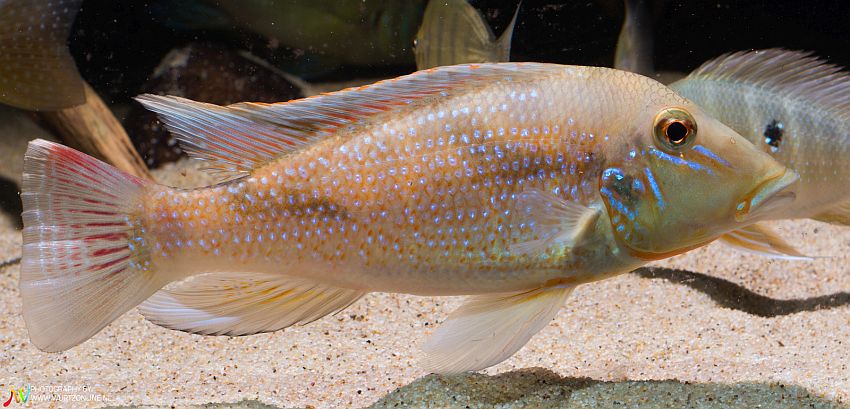
Retroculus lapidifer
Castelnau, 1855
Max length200mm SL8in SLTank210 × 60cm84 × 24inTemp26–32°C79–90°FpH6.0–8.0Retroculus spp. are unsuitable for the standard community aquarium, and should be maintained in a set-up designed to resemble a flowing river. The substrate should be composed of soft sand mixed with small pebbles if the aim is to breed the fish (see 'Reproduction'). Rocks, boulders, roots, branches, and aquatic plants can also be added, although the la...
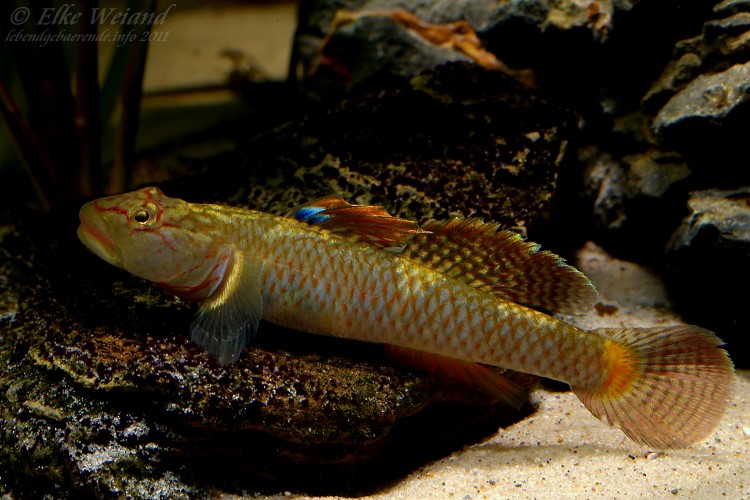
Rhinogobius leavelli
Herre, 1935
Max length60mm SL2.4in SLTank60 × 30cm24 × 12inTemp20–28°C68–82°FpH6.0–8.0This species appears to exist in a number of different forms which exhibit differences in colour pattern, morphology, or both, and it's currently unclear whether all of them are truly conspecific or not although those in the aquarium trade all appear similar to one another. We've been unable to obtain a copy of the original description so it's not currently possible to provide a detailed diagnosis either, with most recent studi...
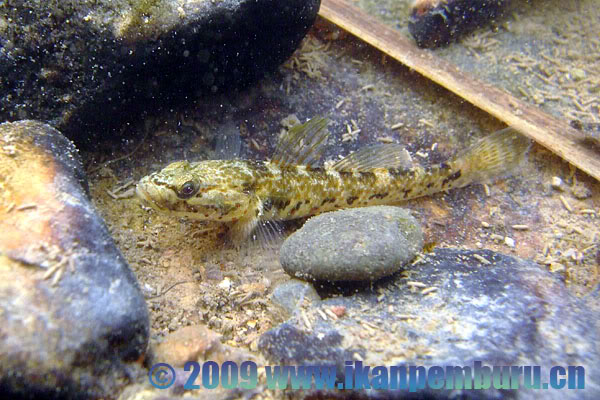
Rhinogobius lentiginis
Wu & Zheng, 1985
Max length32mm SL1.3in SLTank60 × 30cm24 × 12inTemp16–24°C61–75°FpH6.0–8.0It's unlikely that this species has been in the aquarium hobby given its natural range and the lack of commercial fishing for the ornamental trade in that area. Among congeners it's most similar to R. davidi but can be told apart by presence of 8 (vs. always 9 in R. davidi) soft dorsal-fin rays, 10 (vs. 11-12) transverse scale rows, and 6-7 (vs. 8-10) scales between the first dorsal-fin origin and upper pectoral-fin base.