'Puntius' guganio
Glass Barb
Formerly Cyprinus guganio Hamilton, 1822 · Barbus carletoni Fowler, 1924
On this page13 sections
Quick facts
Difficulty5 of 6 measures
More bars, more demanding.
- Space
- modest tank
- Water
- tap water
- Temp
- unfussy
- Temperament
- unknown
- Social
- shoal
- Compatibility
- community tank
Probably a micropredator feeding on small insects, worms, crustaceans and other zooplankton in nature. In the aquarium it should accept dried foods of a suitable size but should not be fed these exclusively. Daily meals of small live and frozen fare such as Daphnia, Artemia, Moina, etc., along with good quality flakes and granules will result in the best colouration and encourage the fish to come into breeding condition.
Etymology
guganio: appears to follow a local vernacular name for the fish.
Distribution
Widespread in Bangladesh, Nepal, and northern India where it occurs throughout the Ganges and Brahmaputra river systems plus most of their major tributaries.
In India records exist from numerous localities in the states of Uttar Pradesh, Bihar, West Bengal, and Assam.
Habitat
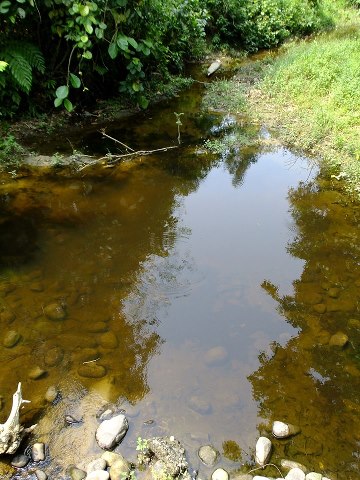
Inhabits slow-moving or standing bodies of water such as pools, ditches and minor rivers.
One record pertains to a ditch close to the Brahmaputra river with sandy substrate and no aquatic vegetation.
Aquarium size
An aquarium measuring 75 ∗ 30 cm30 ∗ 12 in or equivalent should prove of sufficient size to house a group.
Maintenance
Choice of décor is probably not critical though related species tend to show better colouration in a planted set-up with a dark substrate.
The addition of some floating plants and driftwood roots or branches to diffuse the light entering the tank also seems to be appreciated and adds a more natural feel, as does the addition of dried leaf litter.
Filtration does not need to be particularly strong though it may appreciate a degree of water movement given the natural habitat.
Water conditions
These boxes carry affiliate links and we may earn a commission. What they recommend comes from each profile’s own figures, never chosen by hand or paid for.
Diet
Probably a micropredator feeding on small insects, worms, crustaceans and other zooplankton in nature.
In the aquarium it should accept dried foods of a suitable size but should not be fed these exclusively.
Daily meals of small live and frozen fare such as Daphnia, Artemia, Moina, etc., along with good quality flakes and granules will result in the best colouration and encourage the fish to come into breeding condition.
Behaviour and compatibility
Likely to be peaceful and do best maintained in a group of 8-10 specimens.
Sexual dimorphism
Unknown.
Reproduction
Unrecorded.
Notes
This species is poorly known in the aquarium hobby and little information regarding its captive maintenance exists.
It's also of uncertain taxonomic placement and will probably be placed in a separate genus at some point in the future.
It differs from other species both currently and formerly included in the genus Puntius by possessing a stiff, serrated last unbranched dorsal-fin ray, an incomplete lateral line and 36-39 scales in the lateral series, a combination shared only with 'P.' nangalensis Jayaram, 1990. 'Puntius' ambassis (Day 1869) also appears related.
The genus Puntius was viewed as a polyphyletic catch-all containing over 100 species of small to mid-sized cyprinid for a number of years until Pethiyagoda et al. (2012) published a partial review covering South Asian members.
The majority of sub-Himalayan Puntius species were reclassified and new genera Dawkinsia, Dravidia, and Pethia erected to accomodate some of them, with the remainder either retained in Puntius or moved to the existing Systomus assemblage, though the definition of the latter was altered meaning some Southeast Asian species formerly placed there are no longer members.
It subsequently became clear that the name Dravidia was preoccupied by a genus of flesh fly, therefore the replacement name Haludaria was made available by Pethiyagoda (2013).
No species from Indochina, China, or Indonesia were included in the study meaning a significant number of former Puntius are currently classed as incertae sedis, i.e., of uncertain taxonomic placement, and this also applies to a number of South Asian species of unresolved status.
They’re perhaps best referred to as ‘Puntius‘ for the time being whereby the genus name is surrounded by quotation marks to denote its questionable usage, and that is the convention used here on SF at the moment.
References
- Hamilton, F. (1822). An account of the fishes found in the river Ganges and its branches. An account of the fishes found in the river Ganges and its branches., i-vii + 1-405
- Pethiyagoda, R., M. Meegaskumbura, and K. Maduwage (2012). A synopsis of the South Asian fishes referred to Puntius (Pisces: Cyprinidae). Ichthyological Exploration of Freshwaters 23(1), 69-95
- Kullander, S. O. and F. Fang (2005). Two new species of Puntius from northern Myanmar (Teleostei: Cyprinidae). Copeia 2005(2), 290-302
- Pethiyagoda, R. (2013). Haludaria, a replacement generic name for Dravidia (Teleostei: Cyprinidae). Zootaxa 3646(2), 199
Species images · 3
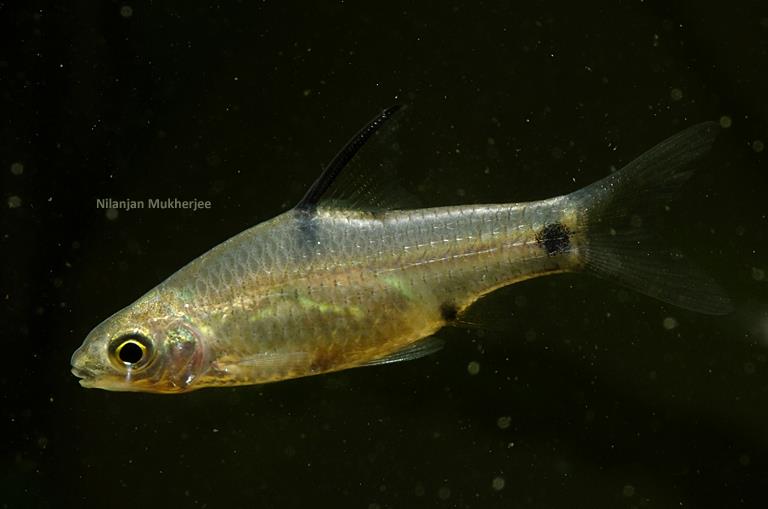
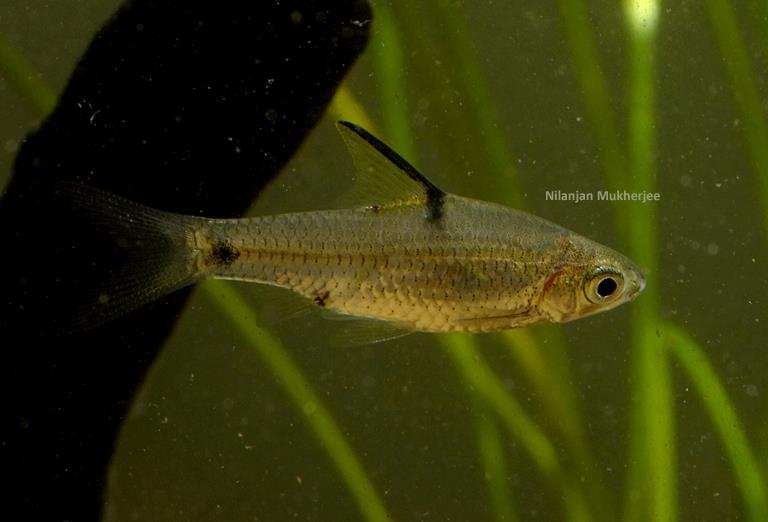
Used with the photographer’s permission. Not licensed for reuse.
Distribution
Profile completeness22 of 24
92% complete
Missing: temperament, water condition notes.