Results for “gill”
Type a name: scientific, common, or one a species used to go by. Or narrow the catalogue with the filters.
Filters
Hemisynodontis membranaceusMoustache Catfish
authority not recorded
Max length500mm SL20in SLTank120 × 60cm48 × 24inTemp22–26°C72–79°FpH6.5–7.5There is some confusion as to where this species should be placed taxonomically. It is currently the only species in the genus Hemisynodontis but it has been regularly moved between Synodontis, Hemisynodontis and Brachysynodontis. The main morphological differences that set it apart are the presence of additional gill rakers in this species and the fact it has relatively few mandibular teeth compared to Synodontis species. It also possesses the chracteristic "moustache", which is in fa...
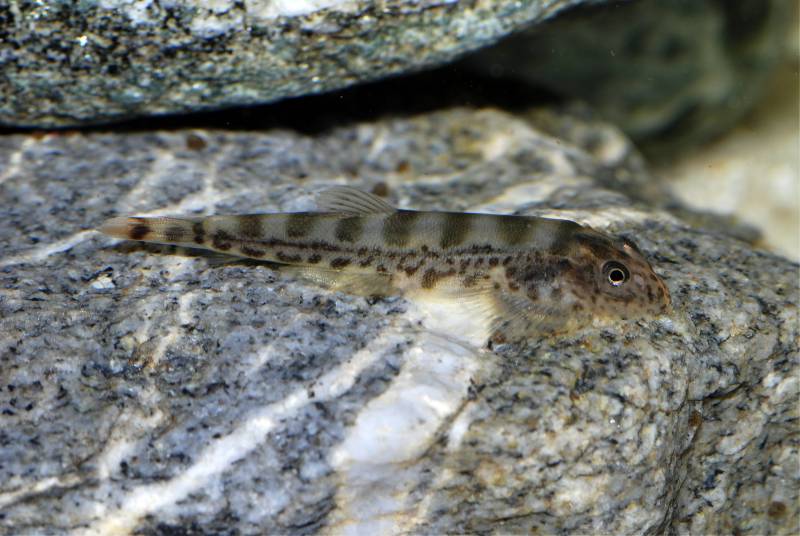
Hypergastromyzon humilis
Roberts, 1989
Max length35mm SL1.4in SLTank45 × 30cm18 × 12inTemp20–24°C68–75°FpH6.0–7.5The differences in pelvic-fin structure and gill openings led Roberts to redefine the genus when describing H. eubranchus, whereas Tan (2006) expressed doubts that the two are even congeneric but was unable to reach a definitive conclusion in the absence of fresh material. At any rate both species can be easily differentiated from Gastromyzon and Neogastromyzon spp. by observing the mo...
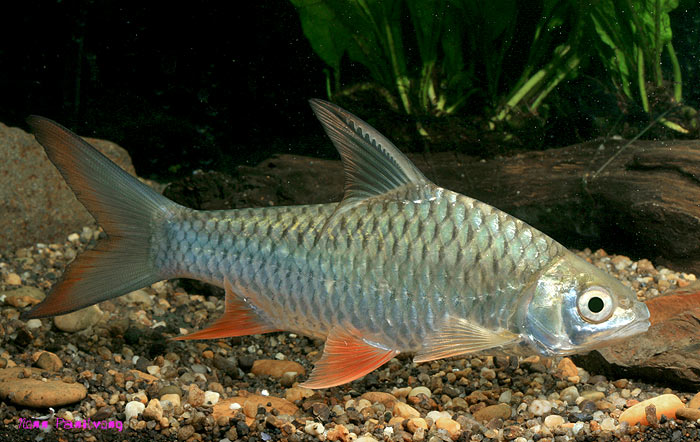
Hypsibarbus malcolmiGoldfin Tinfoil Barb
Smith, 1945
Max length500mm SL20in SLTanknot recordedTemp20–26°C68–79°FpH6.0–8.0H. malcolmi is distinguished from congeners by the following combination of characters: 12-17 (usually 14-15) rakers on first gill arch; usually 16 circumpeduncular scale rows; less than 30 lateral line scales; some branched lateral line canals, but branching not extensive, median portion of dorsal-fin dark.
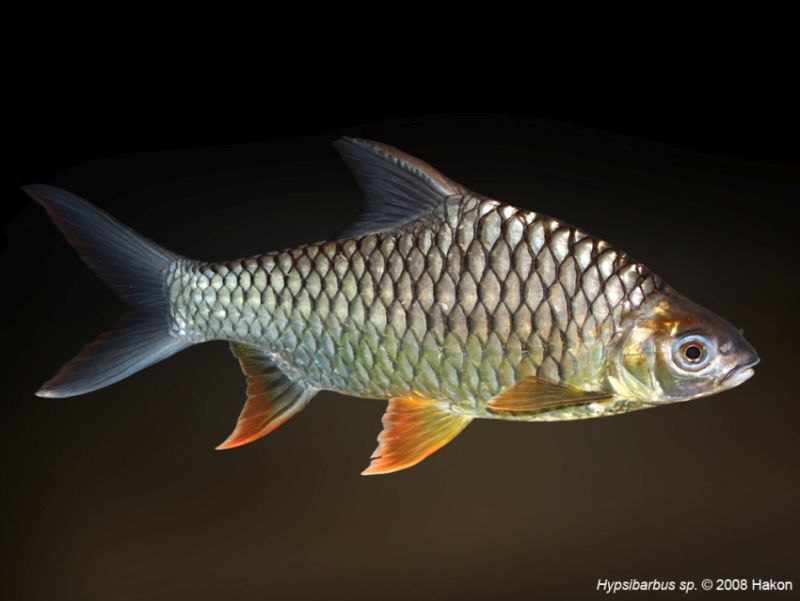
Hypsibarbus wetmorei
Smith, 1931
Max length250mm SL10in SLTank240 × 60cm96 × 24inTemp20–26°C68–79°FpH6.0–8.0H. wetmorei is distinguished from congeners by the following combination of characters: upper body reddish brown; robust body, not compressed; usually 4½ scale rows between lateral line and dorsal-fin origin; 8-12 rakers on first gill arch; 7-9 predorsal scales; 14 circumpeduncular scale rows; usually two scale rows separating vent and anal-fin; <29 lateral line scales; 9-14 serrations on the spinous dorsal-fin ray; distance between distal serrae on posterior margin of last unbranched dorsal-fin ray much greater than the width of their bases.
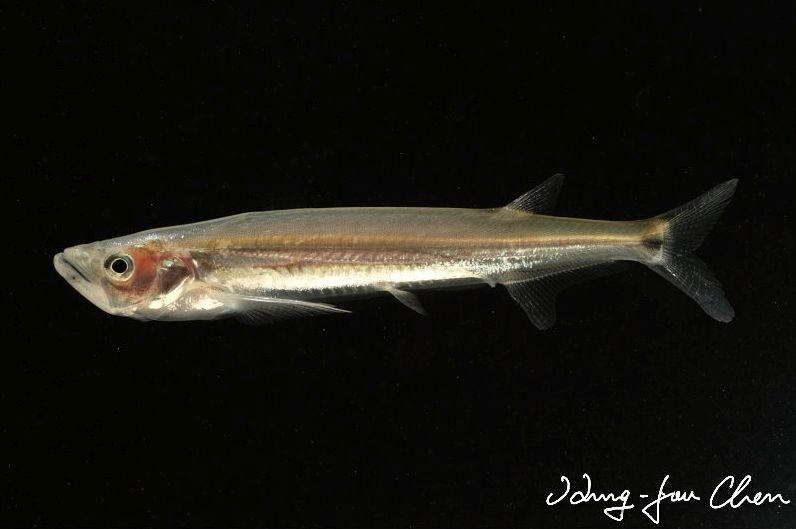
Macrochirichthys macrochirusGiant Sword Minnow
Valenciennes, 1844
Max length800mm SL31in SLTanknot recordedTemp20–26°C68–79°FpH6.0–8.0It is thought to have been extirpated from the Chao Phraya and Mae Klong rivers, Lake Songkhla, and the entire island of Java due to a variety of anthropogenic factors, and the Mekong populations have also been drastically reduced. In particular, it is sensitive to pollution and gillnetting, and is heavily overfished.
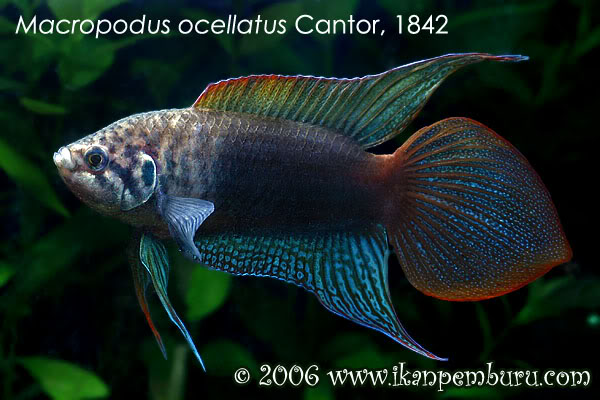
Macropodus ocellatusRoundtail Paradise Fish
Cantor, 1842
Max length80mm SL3.1in SLTank80 × 30cm31 × 12inTemp10–22°C50–72°FpH6.0–7.5M. ocellatus can be distinguished from congeners by the following combination of characters: caudal-fin rounded; eye stripe not connecting spot on posterior projection of opercle with eye; dorsal-fin rays filamentous posterior to a vertical through the posterior anal-fin rays in adults; 16-19 spinous dorsal-fin rays; 6-13 rakers on ceratobranchial of first gill arch; posterior tip or margin of body scales not darker than scales.
Neolamprologus olivaceous
authority not recorded
Max length80mm SL3.1in SLTanknot recordedTemp23–27°C73–81°FpH7.5–9.0This species is included in the so-called "Brichardi complex", which also includes N. brichardi, crassus, falcicula, gracilis, pulcher, savoryi and splendens. These should not be mixed in aquaria, as they will hybridise freely. N. olivaceouscan be distinguished from others in the complex by the two curved markings on the gill cover. It is possible that it is synonymous with N. pulcher, as proposed by Konings (1993)....
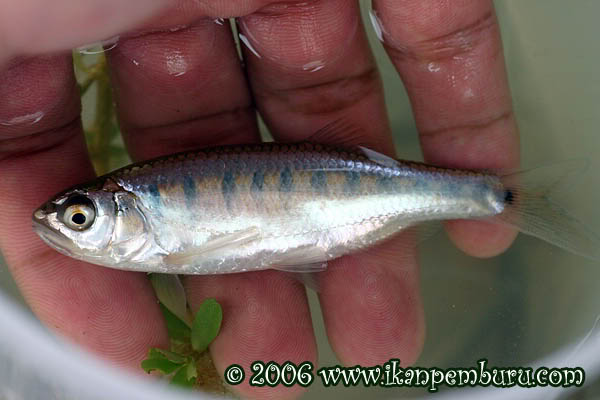
Opsarius caudiocellatus
Chu, 1984
Max length86mm SL3.4in SLTank150 × 45cm60 × 18inTemp18–24°C64–75°FpH6.5–8.0This species may have appeared in the aquarium trade though probably not under the correct name. It can be told apart from similar-looking congeners by the following combination of characters: presence of a black round spot at the caudal base; dorsal-fin rays black with connecting membranes transparent; posterior dorsal-fin origin located midway between upper angle of gill aperture and caudal-fin base, or slightly closer to the latter.
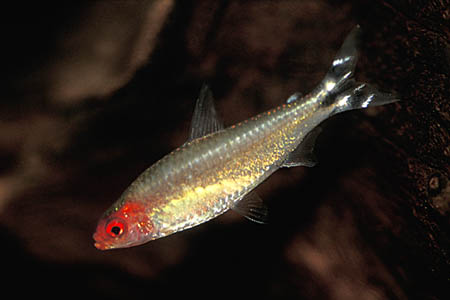
Petitella georgiaeFalse Rummy-nose
authority not recorded
Max length50mm SL2.0in SLTanknot recordedTemp22–26°C72–79°FpH5.5–7.0This is one of three species commonly sold under the name "rummy-nose tetra". The commonest of these is the firehead tetra, Hemigrammus bleheri, whilst the "true" rummy-nose is Hemigrammus rhodostomus. All three are very similar in appearance, but can be distinguished by several factors. The first is by the extent to which the red colouration on the head of the fish extends into the body. H. bleheri is the only one of the 3 in which the red extends beyond the gill covers. ...
Scleropages jardiniiAustralian Arowana
authority not recorded
Max length900mm SL35in SLTank180 × 60cm72 × 24inTemp24–29°C75–84°FpH6.8–7.5Although S. jardinii superficially resembles its Asian cousins, it is not considered as desirable an aquarium inhabitant, nor is it classed as being at risk in nature. It can be easily distinguished from the asian species by its much smaller scale size, greater lateral scale count (32-35 as opposed to 21-25 in the asian aros) and duller patterning. It differs from its Australian relative S. leichardtii by its more sloping head, downward-pointing barbels and patterned gill covers. The base colour...
Scleropages leichardtiSpotted Australian Arowana
authority not recorded
Max length900mm SL35in SLTank180 × 60cm72 × 24inTempnot recordedpH6.8–7.5Although S. leichardtii superficially resembles its Asian cousins, it is not considered as desirable an aquarium inhabitant, nor is it classed as being at risk in nature. It can be easily distinguished from the asian species by its much smaller scale size, greater lateral scale count (32-35 as opposed to 21-25 in the asian aros) and duller patterning. It differs from its Australian relative S. jardinii by its spotted scales, forward-pointing barbels, lack of sloping head and unpatterned gill cov...
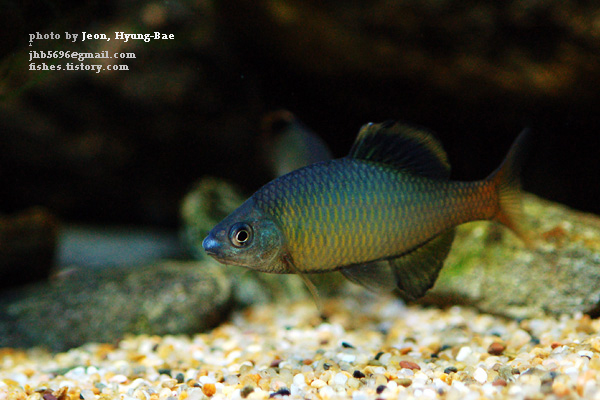
Tanakia signiferKorean Bitterling
Berg, 1907
Max length75mm SL3.0in SLTanknot recordedTempnot recordedpHnot recordedBitterlings (see 'Notes') exhibit an unusual spawning symbiosis in which the interlamellar spaces of the paired inner and outer gills of living unionid mussels are used as a spawning substrate. During the reproductive period females develop a long ovipositor which is used to deposit eggs through the mussel’s exhalant siphon. Males then move in to males release milt...
Trachelyichthys decaradiatus
authority not recorded
Max length80mm SL3.1in SLTank60 × 38cm24 × 15inTemp20–28°C68–82°FpH6.5–7.0Very similar to its congener T. exilis, it can be distinguished by looking at the position of the eye which is set much further forward in exilis. Also, the humeral process (long spine extending from the back of the gill plate), is broader and shorter in this species than exilis. Neither are seen very often in the hobby....
Trachelyichthys exilisPygmy Driftwood Catfish
authority not recorded
Max length80mm SL3.1in SLTank60 × 38cm24 × 15inTemp22–25°C72–77°FpH6.5–7.0Very similar to its congener T. decaradiatus, it can be distinguished by looking at the position of the eye, which is set much further back in decaradiatus. Also, the humeral process (long spine extending from the back of the gill plate), is longer and thinner in this species than decaradiatus. Neither are seen very often in the hobby, but are sometimes available at specialist outlets....
Xenotilapia melanogenysBlack-Chinned Xenotilapia
authority not recorded
Max length160mm SL6in SLTank120 × 38cm48 × 15inTemp24–27°C75–81°FpH7.5–9.0This fish feeds in a similar way to Geophagus species in that it will sift sand through its gills to extract invertebrates and morsels hidden in the substrate. It was until recently classified in the genus Enatiopus and is still named as such in much of the available literature. There are slight geographical variations in colour but these are not major. Interestingly, the shoals in which these fish live in nature appear to be fixed. That is, that an individual will remain in the same group for ...
Xenotilapia simaBig-Eyed Xenotilapia
authority not recorded
Max length165mm SL6in SLTank120 × 38cm48 × 15inTemp23–27°C73–81°FpH8.0–9.5A rarely seen species in the hobby, X. sima is nevertheless a charming species for the peaceful Tanganyikan community. It feeds in a similar way to the well-known South American Geophagus species in that it will sift sand through its gills to extract invertebrates and morsels hidden in the substrate. It is quite a skittish fish and may react very nervously to rapid movements outside the tank or when lights are switched on and off....